
Research Practitioner Series – Part 28e
The following represents the formal submission of my Higher Degree Research (HDR) Professional Doctorate Project 1 Document.
This 47,000 word (excluding references, bibliography and appendices) document is in many ways equivalent to a traditional PhD Doctoral Program Confirmation Document.
The document has been split across 6 blog posts due to its size.
Please see HDR Project 1 Submission: Introduction for Title page, the Abstract, the Statement of Originality, the Contents, and the Introduction of the Exegesis (Page, 2018i).
Please see HDR Project 1 Submission: Literature Review for Chapter 1 Literature Review (Page, 2018j).
Please see HDR Project 1 Submission: Methodology for Chapter 2 Methodology (Page, 2018k).
Please see HDR Project 1 Submission: Creative Practice in Critical Perspective for Chapter 3 Creative Practice in Critical Perspective (Page, 2018l).
This post, HDR Project 1 Submission: Conclusion includes the Conclusion of this exegesis, and the Reference List (Page, 2018m).

Conclusion
4.0 Project 1
At the outset of this Project 1, I had the responsibility to investigate existing knowledge in both literature and textural resources. I was hoping to discover existing knowledge that provides any degree of insight into the many unanswered issues I have had over the past several decades. Some of which were: defining the term music-making now encompass; discussing the concepts of hybridity and convergence; broadening of terms to include music & sound; consider the so-called connection that many of us humans feel while consuming music; exploring self, aesthetic experience, motives, and values in general, and specifically related to music & sound-making practice; and investigate how can one subjectively connect to one form of music, and not another form of music. My rigorous investigations of these issues have led me to the question:
How do the interdependent tenets of hybridity/convergence, agency and subjectivity afford – or inhibit – one’s authentic connection to contemporary DIY music & sound-making practice?
I engaged in academic peer-reviewed literary and textural resources across Project 1. However, the majority of my initial engagement in these resources was related to Chapter 2, research methodology. The dual role component of my research study was in many ways, the most troubling for me to understand. As such, I spent a large percentage on my research time, observing, researching and narrating my applied experiences. I was wrestling with how I was going to conduct myself in the dual primary roles of being both the practitioner as subject, and the researcher. I recognised the impact my historical failure to engage in conscious, deliberate and systematic reflective practice, was having on my creative practice. This motivated me to explore more. As my investigations deepened, engaging in peer-reviewed literature and textural resources, I discovered a particular lineage of musical style. This proved illuminating; highlighting aspects of practice – theoretical and practical – I hadn’t previously entertained. In many ways, this provided explanation why my creative –music-making – practice, and me as a creative practitioner, had not developed to my expectations. Engaging in this Project 1 pilot study has afforded me the opportunity to set parameters around the broader research study, defining what was to be in scope, and what was not. As I have progressed through the many twists and turns of my Project 1 Doctoral pilot study, I have gained deeper insight into my practice; and more importantly my self. This Project 1 pilot study has informed my Project 2 Research Study; confirming the parameters of such a study, highlighting aspects that may not have been obvious to me initially (in Year 1 of the doctoral study as I was developing my research study brief). Engaging in such a pilot study has enabled the production of a quantity of rich data for critical reflection and analysis; enabling me to demonstrate an expected level of rigour, in order to demonstrate the validity and worthiness of such a Project 2 Research Study. I look forward to continuing on my doctoral research study, further investigating my practice across the three (3) central aspects of a sustainable authentic creative practice: creative arts-making, meaning-making, and self-making, and reporting my interpreted findings and cultural production outputs at the end of part two (2) of this emergent journey.
4.1 Intention of Project 2
As outlined in Chapter 1, as a result of my pilot study, I started to illuminate what seems to have become a highly fragmented and yet complex field of contemporary creative practice. As I progress into Project 2, I suspect I will need to continue to investigate the revolution of those engaging in music & sound-making practice; the result of ongoing exponential technological change, social and cultural developments, and the changing structure of formal hierarchical industry structure. Practitioners with diverse backgrounds and influences have contributed to increasing levels of hybridisation of musical styles. Like their peers before them, contemporary practitioners continue to appropriate from any musical style. However, with ongoing exponential technological change, social and cultural developments, the speed and complexity of hybridisation have exponentially increased. Hybridity has now reached levels, where music and sound-making practice styles have converged, relative to what were once clearly delineated musical styles with segmented stages, roles, elements, workflows and technologies common within each approach. Highly hybridized – convergent forms of practice introduces levels of complexity to those practitioners and consumers who are not conscious of the legacy and lineage of the appropriated musical styles; and are not informed of the qualities and characteristics of each musical style.
However by this intermediary stage of my research study, I am starting to realise there are inconsistencies in my attempts to explain my connection to one form of music-making practice and not another form of music-making practice relying only on the elements of praxis. Rather than focussing on elements of praxis, I was revealing evidence in my investigative readings that these connections may be differently explained by considering approaches to music & sound-making practice. I had up until this point been primarily focussing on increasing hybridised mainstream pop forms of music, such as Moore uses as the basis of his analysis of contemporary music-making practice (Moore 2012). Immersed within my own bias of learning and development to an increasingly hybridised form of music-making practice that I was influenced by, and subsequently drawn to at a very young age, I had not considered other approaches that had been progressively appropriated by music-making practitioners over the proceeding decades. This moment is currently unfolding; proving to be a pivotal – a catalytic, an epiphanic moment – in my research study. As this discovery has occurred very late in Project 1, I have yet to complete a thorough literature and contextual review. I intend to continue to investigate this, and include this as a second Literature and Contextual resource review chapter in my Project 2 document. At this stage of my investigations there appears to be differences between three (3) broadly categorised approaches to music and sound-making practice: that of roots-based, High Arts-based and electroacoustic and sonic arts-based approaches to music and sound-making practice. My initial inquiries indicate there are differences within these approaches to music and sound-making practice, when comparing and contrasting the various stages of practice – that of learning, composition, production and consumption. I hope to continue to develop a more holistic approach to contemporary DIY music and sound-making practice, in order to understand the broadening subjective position of the practitioner and practitioner self. As an outcome of my research study, I hope to understand the developing agential positions required in hybridised/convergent forms of music and sound-making practice that are likely to include both homogenous and heterogeneous forms (Vella with Arthurs 2003, 143, 171). I begin to explore the perspective: spontaneous, pre-verbal imaginal play, in flow, affords a practitioner the opportunity to authentically connect to the practice activity (Lawrence 2012, 473; Nakamura & Csikszentmihalyi 2014a, 258, 206). I suspect contemporary practitioners in hybridised/convergent forms of music and sound-making practice require more developed forms of technical and extra-technical skills; and rational and extra-rational faculties agency, to authentically connect to practice than previously required. I suspect a synergistic outcome of a practitioner self with more developed functional and faculty agency is; they are afforded the opportunity to authentically connect to their desired creative practice in a sustainable consistent manner, irrespective of the approach to music and sound-making practice, the practice environment, the stages or the elements of praxis.
As outlined in Chapter 3, whilst I have gained considerable insight in my initially outlined problem, I need to continue my investigative research and engagement in creative practice. I plan to develop the data and insights generated in my DCI Project 1 pilot study. The title of Project 2 is to be: “Sounds that resonate… Developing sustainable authentic contemporary creative practice across three (3) tenets: creative art-making, meaning-making and self-making”. I intend to continue to generate four (4) forms of data: firstly, a range of documents including various computer-based applications and handwritten notes and charts; secondly; reflective narratives of my journey to date, informed by literature and textural resources; thirdly, exploratory music and sound practice sessions experimenting with a range of processing to create a psychedelic musical style aesthetic; and experimenting with creating music and sound objects and events as associated memory narratives of significant events in my life; and fourthly, the series of creative written memory narratives of selected significant events in the first twenty (20) years of my life. In addition to these forms of cultural production data, the exegesis will represent my critically reflections of the multiple forms of data gathered across the Project 1 pilot study, relative to what was experienced in Project 2. The intention is to continue to narrow my research study and critically reflect upon, and analyse my music-making journey across the three (3) tenets of: creative arts-making, meaning-making and self-making. It is intended that this process will generate new knowledge in understanding the process of sustainable authentic creative practice specifically, demonstrating utility across broader and varied forms of practice.
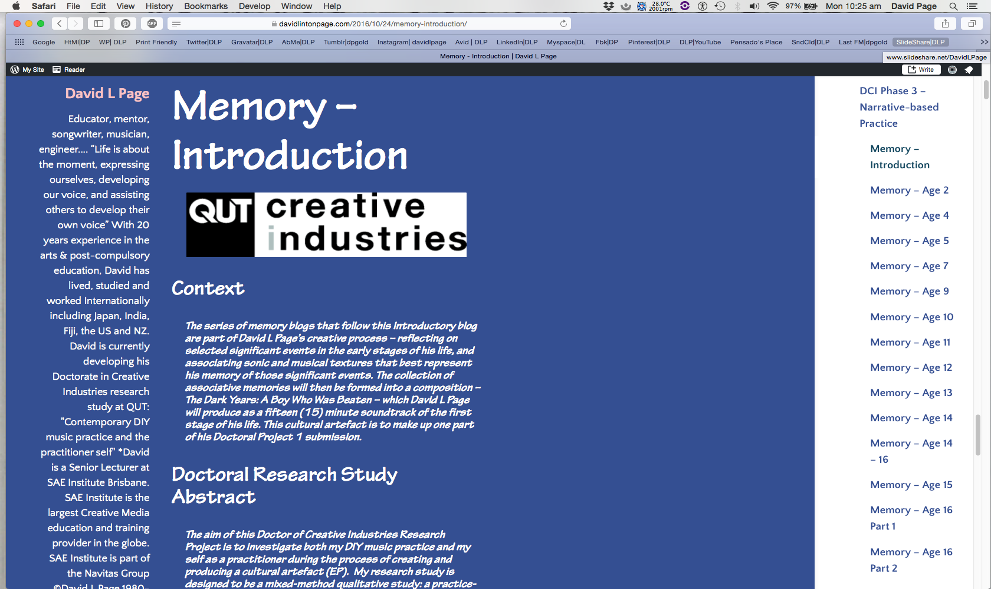
Page’s (2016n) 20 part series of re-experienced memory blogs of significant events, which will inform the 15 minute music and sound narrative.
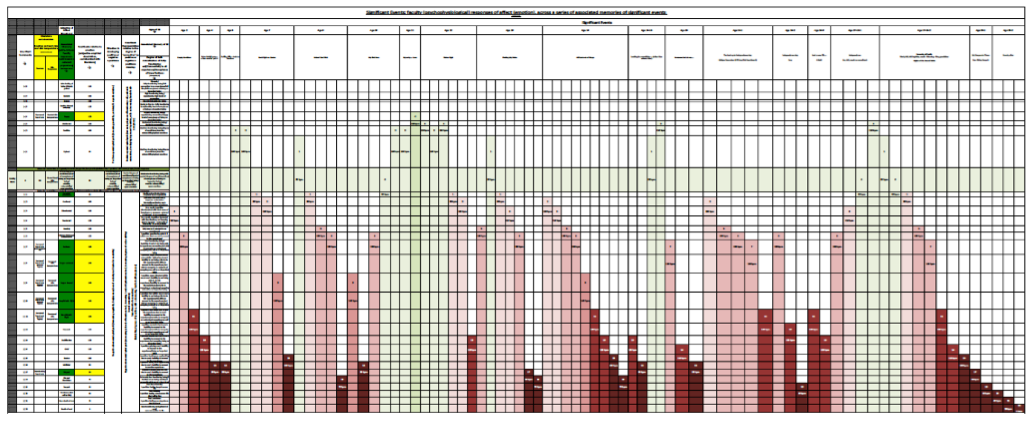
Page’s (2018a) A schematic draft of the 15 minute soundscape narrative of associated memories of significant events; with psychophysiological responses to re-experienced memories as the resonant pulse.
Please now refer to HDR Project 1 Submission: Appendices for the continuation of this document which includes the Appendices and a Bibliography (Page, 2018n).
References
Archer, Margaret S. 2010. Conversations about reflexivity, Ontological Explorations. New York: Routledge.
Archer, Margaret S. 2007. Making our way through the world: human reflexivity and social mobility. Cambridge: Cambridge University Press.
Atkins, Kim. 2008. Narrative identity and moral identity: a practical perspective. 1st ed. New York: Routledge.
Augoyard, Jean François and Henry Torgue. 2005. Sonic experience: a guide to everyday sounds. London: McGill-Queen’s Press-MQUP.
Barth, Fredrik. 1997. “How is the self conceptualised? variations among cultures.” In The Conceptual Self in Context: Culture, Experience, Self-understanding, edited by Ulric Neisser and David A Jopling, 75-91. Cambridge: Cambridge University Press.
Bartleet, Brydie-Leigh. 2009. “Behind the baton: Exploring autoethnographic writing in a musical context.” Journal of Contemporary Ethnography 38 (6): 713-733.
Bartlett, Brydie-Leigh and Carolyn Ellis. 2009. Music ethnographies: making auto-ethnography sing – making music personal. Bowen Hills: Australian Academic Press.
Batt-Rawden, Kari and Tia DeNora. 2005. “Music and informal learning in everyday life.” Music Education Research 7 (3): 289-304.
Beatles, The. 1968. White Album. Apple Records. Vinyl LP.
Beatles, The. 1967. Sgt. Peppers Lonely Hearts Club Band. Parlophone. Vinyl LP.
Beatles, The. 1966. Revolver. Parlophone. Vinyl LP.
Bennett, Andy. 2005. Culture and everyday life. New York, NY: Routledge.
Bennett, Andy. 2000. Popular music and youth culture: music, identity and place. New York: Palgrave.
Bennett, Samantha and Eliot Bates. 2018. Critical approaches to the production of music and sound. New York: Bloomsbury.
Biggs, Michael and Henrik Karlsson. 2011. The Routledge companion to research in the arts. Oxon: Routledge
Blom, Diana, Dawn Bennett and David Wright. 2011. “How artists working in academia view artistic practice as research: Implications for tertiary music education.” International Journal of Music Education.
Borgdorff, Henk. 2011. “The production of knowledge in artistic research.” In The Routledge companion to research in the arts, edited by M Biggs and H Karlsson, 44-63. London: Routledge.
Boud, David, Rosemary Keogh and David Walker. 2013. Reflection: turning experience into learning. New York: Routledge.
Boud, David. 2001. “Using journal writing to enhance reflective practice.” New Directions for Adult and Continuing Education 2001 (90): 9-18. doi: 10.1002/ace.16.
Boyle, Maree and Ken Parry. 2007. “Telling the whole story: the case for organizational autoethnography.” Culture and Organization 13 (3): 185-190.
Brackett, Marc A, Susan E Rivers, Michelle C Bertoli and Peter Salovey. 2016. “Emotional intelligence.” In Handbook of Emotions, edited by Michael Lewis, Jeannette M Haviland-Jones and Lisa Feldman Barrett, 19311-20079. New York: The Guilford Press.
Brattico, Elvira, Brigitte Bogert and Thomas Jacobsen. 2013. “Toward a neural chronometry for the aesthetic experience of music.” Frontiers in psychology 4: 206.
Brewer, Marilynn B. 1991. “The social self: on being the same and different at the same time.” Personality and social psychology bulletin 17 (5): 475-482.
Brookfield, Stephen D. 2006. The skillful teacher: on technique, trust, and responsiveness in the classroom. 2 ed. San Francisco: The Jossey Bass.
Brookfield, Stephen D. 2002. “Using the lenses of critically reflective teaching in the community college classroom.” New Directions for Community Colleges 2002 (118): 31-38.
Brookfield, Stephen D. 1995. Becoming a critically reflective teacher. San Francisco: Jossey Bass.
Brookfield, Stephen. 1986. Understanding and facilitating adult learning: A comprehensive analysis of principles and effective practices. Milton Keynes: Open University Press.
Brown, Brené. 2013. The power of vulnerability: teachings on authenticity, connection, and courage. Louisville: Sounds True.
Budd, Malcolm. 1992. Music and the emotions: the philosophical theories. London: Routledge.
Burgess, Richard James. 2013. The art of music production: the theory and practice. New York: Oxford University Press.
Burgess, Richard James. 1997. The art of record production. London: Omnibus Press.
Burns, Robert B. 2000. Introduction to research methods. 4th ed. Frenchs Forest: Pearson Education Australia.
Candy, P. C. 1991. Self-direction for lifelong learning: a comprehensive guide to theory and practice. San Francisco: Jossey-Bass.
Carter, TJ. 2013. “Nature of Experiential Learning and Reflective Practice 7 17-13”. https://www.slideshare.net/tjcarter/experiential-learning-and-reflective-practice-7-1713.
Chanda, Mona Lisa and Daniel J Levitin. 2013. “The neurochemistry of music.” Trends in cognitive sciences 17 (4): 179-193.
Changeux, Jean-Pierre. 2009. The physiology of truth: neuroscience and human knowledge. Cambridge: Harvard University Press.
Clayton, Martin. 2009. “The social and personal functions of music in cross-cultural perspective.” In The Oxford handbook of music psychology, edited by Susan Hallam, Ian Cross and Michael Thaut, 35-44. Oxford: Oxford University Press.
Clynes, Manfred. 1982. Music, mind, and brain: the neuropsychology of music. Vol. 94: Plenum Pub Corp.
Corey, Jason. 2010. Audio production and critical listening: technical ear training. Oxford: Focal Press.
Cotter, Jim. 2002. “Frank Zappa (1940-1993).” In Music of the twentieth-century Avant-Garde: a biocritical sourcebook, edited by Larry Sitsky, 593-598. London: ABC-CLIO.
Cranton, Patricia and Edward W Taylor. 2012. “Transformative learning theory: seeking a more unified theory.” In The Handbook of Transformative Learning: Theory, Research, and Practice, edited by Edward W Taylor, Patricia Cranton and Associates, 3-20. San Francisco: Jossey-Bass.
Cross, Ian. 2009. “The nature of music and its evolution.” In The Oxford handbook of music psychology, edited by Susan Hallam, Ian Cross and Michael Thaut, 3-13. Oxford: Oxford University Press.
Cross, Ian and Elizabeth Tolbert. 2009. “Music and meaning.” In The Oxford handbook of music psychology, edited by Susan Hallam, Ian Cross and Michael Thaut, 24-34. Oxford: Oxford University Press.
Csikszentmihalyi, Mihaly. 2014. Flow and the foundations of positive psychology: the collected works of Mihaly Csikszentmihalyi. 1st ed. New York: Springer.
Csikszentmihalyi, Mihaly. 2000. Beyond boredom and anxiety. 25th Anniversary ed. San Francisco: Jossey-Bass.
Csikszentmihalyi, Mihaly. 1996. Creativity: flow and the psychology of discovery and invention. New York: Harper Perennial.
Csikszentmihalyi, Mihaly and Rick Emery Robinson. 1990. The art of seeing: an interpretation of the aesthetic encounter. Santa Monica: Getty Publications.
Davidson, Jane W. 2015. “Practice-based music research: lessons from a researcher’s personal history.” In Artistic Practice as research in music: theory, criticism, practice, edited by Mine Dogantan-Dack, 93-106. Surrey: Ashgate Publishing, Ltd.
de Corte, Erik. 2010. “Historical developments in the understanding of learning.” In Educational Research and Innovation. The Nature of Learning: Using Research to Inspire Practice, edited by Dumont Hanna, Istance David and Benavides Francisco, 35-67: OECD publishing.
Demers, Joanna. 2010. Listening through the noise: the aesthetics of experimental electronic music. Oxford: Oxford University Press.
DeNora, Tia. 2004. Music in everyday life. Cambridge: Cambridge University Press.
Denzin, Norman K. 2016. “Interpretive autoethnography.” In Handbook of Autoethnography, edited by Stacy Holman Jones, Tony E Adams and Carolyn Ellis, 123-142. New York: Routledge.
Dewey, John. 1934. Art as experience. New York: Penguin Group.
Dogantan-Dack, Mine. 2015. Artistic Practice as research in music: theory, criticism, practice, edited by Graham Welch, Adam Ockelford and Ian Cross, SEMPRE Studies in The Psychology of Music. Surrey: Ashgate Publishing, Ltd.
Elliott, David James. 1995. Music matters: a new philosophy of music education. 1st ed. Oxford: Oxford University Press.
Ellis, Carolyn. 1997. “Evocative autoethnography: Writing emotionally about our lives.” Communication Faculty Publications Paper 304.
Emerick, Geoff and Howard Massey. 2007. Here, there and everywhere: my life recording the music of the beatles. New York, NY: Gotham Books.
Emerson, Caryl. 1983. “The outer word and inner speech: Bakhtin, Vygotsky, and the internalization of language.”Critical Inquiry 10 (2): 245-264.
Everest, F Alton. 2007. Critical listening skills for audio professionals. Boston: Thomson Course Technology.
Everett, Walter. 1999. The Beatles as musicians: Revolver through the Anthology: Oxford University Press, USA.
Ewen, Robert. 2003. An introduction to theories of personality. 6th ed. New Jersey: Psychology Press.
Feldenkrais, Moshe. 1977. Awareness through movement: health exercises for personal growth. Ringwood: Arkana.
Finlay, Linda. 2008. “Reflecting on ‘reflective practice’.” Practice-based Professional Learning Centre paper 52 29 (August 12th, 2015). www.open.ac.uk/pbpl.
Fivush, Robyn and Janine Buckner. 1997. “The self as socially constructed:a commentary.” In The Conceptual Self in Context: Culture, Experience, Self-understanding, edited by Ulric Neisser and David A Jopling, 176-181. Cambridge: Cambridge University Press.
Floyd, Pink. 1973. Dark side of the moon. Harvest. Vinyl LP.
Fogel, Alan, Ilse de Koeyer, Francesca Bellagamba and Holly Bell. 2002. “The dialogical self in the first two years of life: embarking on a journey of discovery.” Theory & Psychology 12 (2): 191-205.
Foucault, Michel. 1988. “Technologies of the self.” In Technologies of the Self: a Seminar with Michel Foucault, edited by Luther H Martin, H Gutman and Patrick H Hutton, 16-49. London: Univ of Massachusetts Press.
Franz, Jill M. 2010. “Arts-based research.” Researching Practice: A Discourse on Qualitative Methodologies 2: 217-226.
Fredrickson, Barbara L. 2000. “Extracting meaning from past affective experiences: The importance of peaks, ends, and specific emotions.” Cognition & Emotion 14 (4): 577-606.
Fredrickson, Barbara L and Michael A Cohn. 2010. “Positive Emotions.” In Handbook of Emotions, edited by Michael Lewis, Jeannette M Haviland-Jones and Barrett Lisa Feldman, 777-796. New York: The Guildford Press.
Frith, Simon. 2002. “Music and everyday life.” Critical Quarterly 44 (1): 35-48.
Frith, Simon. 1996. “Music and identity.” In Questions of Cultural Identity, edited by Stuart Hall and Paul du Gay, 108-198. London: SAGE Publications.
Gallagher, Mitch. 2012. “Studio legends: Alan Parsons on “Dark Side of the Moon”. Accessed Feb 4 2016. http://www.premierguitar.com/articles/Studio_Legends_Alan_Parsons_on_Dark_Side_of_the_Moon.
Gentile, Jill. 2008. “Agency and its clinical phenomenology.” In Psychological Agency: Theory, Practice, and Culture, edited by Roger Frie, 1568-1833. Cambridge, Massachusetts: Massachusetts Institute of Technology.
Ghaye, Tony and Sue Lillyman. 2014. Reflection: principles and practices for healthcare professionals 2nd edition: Andrews UK Limited.
Ghaye, Tony and Sue Lillyman. 2006. Learning journals and critical incidents: reflective practice for health care professionals. 2nd ed. London: Mark Allen Publishing.
Gibbs, Graham. 2013. Learning by doing. 1st ed, Oxford Centre for Staff and Learning Development. Oxford: Oxford Brookes University.
Gibbs, Graham. 1988. Learning by doing: a guide to teaching and learning methods. New York: FEU.
Gilbert, Les. 1996. Kakadu Billabong. Natural Symphonies. Compact Disc.
Gillespie, Alex. 2007. “The social basis of self-reflection.” In The Cambridge Handbook of Sociocultural Psychology, edited by Jaan Valsiner and Alberto Rosa, 678-691. Cambridge: Cambridge University Press.
Goncalves, Miguel M and Antonio P Ribeiro. 2012. “Narrative processes of innovation and stability within the dialogical self.” In Handbook of Dialogical Self Theory, edited by Hubert JM Hermans and Thorsten Gieser, 301-318. Cambridge: Cambridge University Press.
Grace, S and R Ajjawi. 2010. “Phenomenological research: Understanding human phenomena.” Researcing practice: A discussion on qualitative methodologies. Rotterdam: Sense.
Graham, Gordon. 1995. “The value of music.” The Journal of Aesthetics and Art Criticisms Vol 53 (2 Spring 1995): 139-153.
Gray, Carole and Julian Malins. 2004. Visualising research: a guide for postgraduate students in art and design. Burlington: Ashgate Publishing.
Green, Lucy. 1988. Music on deaf ears: musical meaning, ideology and education, edited by Wilfrid Mellers and Peter Martin. 1st ed, Music and Society. Manchester: Manchester University Press.
Goudena, Paul P. 2014. “The problem of abbreviation and internalisation of private speech.” In Private Speech: From Social Interaction to Self-Regulation, edited by Rafael M Diaz and Laura E Berk, 199-214. East Sussex: Psychology Press.
Graham, Gordon. 1995. “The value of music.” The Journal of Aesthetics and Art Criticisms Vol 53 (2 Spring 1995): 139-153.
Griffiths, Morweena. 2010. “Research and the self.” In The Routledge companion to research in the arts, edited by M Biggs and H Karlsson, 167-185. London: Routledge.
Hallam, Susan. 2017. “Musical identity, learning and teaching.” In Handbook of musical identities, edited by Raymond A. R. MacDonald, David J. Hargreaves and Dorothy Miell, 475-491. Oxford: Oxford University Press.
Hannaford, Carla. 1995. Smart moves: why learning is not all in your head. Arlington: Great Ocean Publishers.
Hargreaves, DJ, D Miell and RAR MacDonald. 2002. “What are musical identities, and why are they important?” In Musical Identities, edited by RAR MacDonald, DJ Hargreaves and D Miell, 1-20. Oxford Oxford University Press.
Harmon-Jones, Eddie and Cindy Harmon-Jones. 2016. “Anger.” In Handbook of Emotions, edited by Michael Lewis, Jeannette M Haviland-Jones and Lisa Feldman Barrett, 29453-30133. New York: The Guilford Press.
Harris, John. 2005. The dark side of the moon: the making of the pink floyd masterpiece. Cambridge, USA: Da Capo Press.
Hartley, John. 2005. “Creative Identities.” In Creative Industries, edited by John Hartley, pp106-116. Carlton: Blackwell Publishing.
Haseman, Brad. 2015. “Forensic reflective practice: effecting personal and systemic change.” Accessed July 1, 2015. https://blackboard.qut.edu.au/webapps/blackboard/content/listContent.jsp?course_id=_118711_1&content_id=_5744651_1.
Haseman, Brad. 2005. “Creative Practice.” In Creative Industries, edited by John Hartley, 158-176. Carlton: Blackwell Publishing.
Haseman, Brad and Daniel Mafe. 2009. “Acquiring know-how: Research training for practice-led researchers.”Practice-led research, research-led practice in the creative arts: 211-228.
Hermans, Hubert JM. 2001a. “Mixing and moving cultures require a dialogical self.” Human development 44 (1): 24-28.
Hermans, Hubert JM and Thorsten Gieser. 2012. Handbook of dialogical self theory. Cambridge: Cambridge University Press.
Hermans, Hubert JM and Harry JG Kempen. 1993. The dialogical self: meaning as movement. New York: Academic Press, Inc.
Heron, John. 2009. “Life cycles and learning cycles.” In Contemporary Theories of Learning: Learning Theorists… in their own words, edited by Knud Illeris, 129-146. Oxon: Routledge.
Hesmondhalgh, David. 2013. Why music matters. Vol. 1. West Sussex, UK: Wiley Blackwell.
Hofstede, Geert. 1984. Culture’s consequences: International differences in work-related values. Vol. 5. Newbury Park: Sage Publications.
Homer, Matthew. 2009. “Beyond the studio: the impact of home recording technologies on music creation and consumption.” Nebula 6 (3): 85-99.
Hracs, Brian J. 2012. “A creative industry in transition: the rise of digitally driven independent music production.” Growth and Change 43 (3): 442-461.
Hracs, Brian J, Doreen Jakob and Atle Hauge. 2013. “Standing out in the crowd: the rise of exclusivity-based strategies to compete in the contemporary marketplace for music and fashion.” Creative location and Planning A 45 (5): 1144-1161.
Hughes, Anton. 1997. Babbling Brook. K-Tel. Compact Disc.
Isen, Alice M. 2010. “Some ways in which positive affect influences decision-making and problem solving.” In Handbook of Emotions, edited by Michael Lewis, Jeannette M Haviland-Jones and Barrett Lisa Feldman, 548-573. New York: The Guildford Press.
Izhaki, Roey. 2013. Mixing audio: concepts, practices and tools. 3rd ed. Oxford: Focal.
Janata, Petr and Scott T Grafton. 2003. “Swinging in the brain: shared neural substrates for behaviors related to sequencing and music.” Nature neuroscience 6 (7): 682-687.
Jarvis, Peter. 2012. Towards a comprehensive theory of human learning, edited by Peter Jarvis, Lifelong Learning and the Learning Society. New York: Routledge.
Jopling, David A. 1997. “A “self of selves”.” In The Conceptual Self in Context: Culture, Experience, Self-Understanding, edited by Ulric Neisser and David A Jopling, 249-268. Cambridge: Cambridge University Press.
Juslin, Patrik N and John A Sloboda. 2001. Music and emotion: theory and research. 1st ed, Series in Affective Science. New York: Oxford University Press.
Kegan, Robert. 1982. The evolving self: problem and process in human development. Cambridge: Harvard University Press.
Kemp, Anthony E. 1996. The musical temperament. New York: Oxford University Press.
Kensinger, Elizabeth A and Daniel L Schacter. 2010. “Memory and emotion.” In Handbook of Emotions, edited by Michael Lewis, Jeannette M Haviland-Jones and Barrett Lisa Feldman, 601-617. New York: The Guldford Press.
King, Nicola. 2000. Memory, narrative, identity: remembering the self. Edinburgh: Edinburgh University Press.
Koenig, Linda J. 1997. “Depression and the cultural context of the self-serving bias.” In The conceptual self in context: Culture, experience, self-understanding, edited by Ulric Neisser and David A Jopling, 62-74. Cambridge: Cambridge University Press.
Koelsch, Stefan and Walter A Siebel. 2005. “Towards a neural basis of music perception.” Trends in cognitive sciences9 (12): 578-584.
Kolb, David A. 1984a. “Experiential learning as the science of learning and development.” Englewood Cliffs NPH, editor1984.
Kolb, David A. 1984b. Experiential learning: experience as the source of learning and development. New Jersey: Prentice-Hall
Kramer, Jonathan D. 2016. Postmodern music, postmodern listening, edited by Robert Carl. New York: Bloomsbury Academic.
Kuznetsov, Stacey and Eric Paulos. 2010. “Rise of the Expert Amateur: DIY Projects, Communities, and Cultures.” In Proceedings of the 6th Nordic Conference on Human-Computer Interaction: Extending Boundaries, Reykjavik, Iceland, October 16-20, 2010, edited, 295-304. http://dl.acm.org/citation.cfm?id=1868914&picked=prox: ACM.
Lakoff, George. 1997. “The internal structure of the self.” In The Conceptual Self in Context: Culture, Experience, Self-understanding, edited by Ulric Neisser and David A Jopling, 92-113. Cambridge: Cambridge University Press.
Lange, Elizabeth A. 2012. “Transforming transformative learning through sustainability and the new science.” In The Handbook of Transformative Learning: Theory, Research, and Practice, edited by Edward W Taylor, Patricia Cranton and Associates, 195-211. San Francisco: Jossey-Bass.
Lawrence, Randee Lipson. 2012. “Transformative learning through artistic expression: getting out of our heads.” In The Handbook of Transformative Learning: Theory, Research, and Practice, edited by Edward W Taylor, Patricia Cranton and Associates, 471-485. San Francisco: Jossey-
Lawrence-Wilkes, Linda and A Chapman. 2015. “Reflective Practice.” Accessed June 2, 2015. http://www.businessballs.com/reflective-practice.htm.
Lawrence-Wilkes, Linda and Lyn Ashmore. 2014. The reflective practitioner in professional education. Hampshire: Springer.
Leavy, Patricia. 2018. “Introduction to arts-based research.” In Handbook of Arts-Based Research, edited by Patricia Leavy, 3-21. New York: The Guilford Press.
Leavy, Patricia. 2015. Method meets art: arts-based research practice. New York: The Guildford Press.
Lennon, John and Paul McCartney. 1966. Tomorrow Never Knows. Parlophone. Vinyl 45rpm.
Levitin, Daniel J. 2006. This is your brain on music: the science of human obsession. New York: Penguin Books.
Lewis, Byron and Frank Pucelik. 1990. Magic of NLP demystified: a pragmatic guide to communication and change. Portland: Metamorphous Press.
Lewis, Michael. 2010. “The emergence of human emotions.” In Handbook of Emotions, edited by Michael Lewis, Jeannette M Haviland-Jones and Lisa Feldman Barrett, 304-319. New York: The Guilford Press.
Lewis, Michael, Jeannette M Haviland-Jones and Lisa Feldman Barrett. 2010. Handbook of emotions. 3rd ed. New York: The Guilford Press.
Lewisohn, Mark. 2010. The complete Beatles chronicle: the definitive day-by-day guide to the Beatles’ entire career. Chicago: Chicago Review Press.
Lewisohn, Mark and Paul McCartney. 2005. The complete Beatles recording sessions: the official story of the abbey road years 1962-1970. New York: Bounty books.
Liamputtong, Pranee and Jean Rumbold. 2008. Knowing differently: arts-based and collaborative research methods. New York: Nova Science Publishers.
Lindegger, Graham and Charl Alberts. 2012. “The dialogical self in the new South Africa.” In Handbook of Dialogical Self Theory, edited by Hubert JM Hermans and Thorsten Gieser, 215-235. Cambridge: Cambridge University Press.
Logic Pro. 2016. https://www.apple.com/au/logic-pro Accessed 21st January, 2016
Long, Douglas G. 1990. Learner managed learning: the key to lifelong learning and development. New York: Kogan Page.
Lyons, N. 2010. Handbook of reflection and reflective inquiry: mapping a way of knowing for professional reflective inquiry. Vol. 1 New York: Springer.
Madsen, Virginia. 1995. “Notes towards sound ecology in the garden of listening.” unknown unknown: 11-16.
Massey, Howard. 2000. Behind the glass I: top record producers tell how they craft the hits. Vol. 1. Berkeley: Hal Leonard Corporation.
McGregor, Sue LT. 2008. “Transformative education: grief and growth.” In Narrating Transformative Learning in Education, edited by Morgan Gardner and Ursula Kelly, 51-73. New York: Palgrave McMillan.
McLaughlin, Noel and Martin McLoone. 2000. “Hybridity and national musics: the case of Irish rock music.” Popular Music 19 (2): 181-199.
McRobbie, Angela. 1998. British fashion design: Rag trade or image industry? New York: Routledge.
Menon, Vinod and Daniel J Levitin. 2005. “The rewards of music listening: response and physiological connectivity of the mesolimbic system.” Neuroimage 28 (1): 175-184.
Merriam, Sharan B and Laura L Bierema. 2014. Adult learning: linking theory and practice. San Francisco: Jossey-Bass.
Merriam, Sharan B, Rosemary S Caffarella and Lia M Baumgartner. 2007. Learning in adulthood: a comprehensive guide. 3rd ed. San Francisco: Jossey-Bass.
Mezirow, Jack. 2012. “Learning to think like an adult: core concepts of transformation theory.” In The Handbook of Transformative Learning: Theory, Research, and Practice, edited by Edward W Taylor, Patricia Cranton and Associates, 73-97. San Francisco: Jossey-Bass.
Mezirow, Jack. 1991. Transformative dimensions of adult learning. San Francisco: Jossey-Bass.
Moffat, Amanda. 2013. “Stepping Outside the Circle: A Reflective Practice Framework for Creative facilitators.” Stepping Outside of the Circle, 10 April 2016. http://www.steppingoutsidethecircle.com.
Moon, Jenny. 2001. “PDP working paper 4: reflection in higher education learning.” Higher Education Academy: 25. researchgate.net.
Moore, Allan F. 2012. Song means: analysing and Interpreting recorded popular song, Ashgate Popular and Folk Music Series. Surrey: Ashgate Publishing Ltd.
Moorefield, Virgil. 2005. The producer as composer: shaping the sounds of popular music. London: MIT Press.
Moran, Ian P. 2011. “Punk: the do-it-yourself subculture.” Social Sciences Journal 10 (1): 13.
Morin, Alain. 2005. “Possible links between self-awareness and inner speech theoretical background, underlying mechanisms, and empirical evidence.” Journal of Consciousness Studies 12 (4-5): 115-134.
Moylan, William. 2007. Understanding and crafting the mix: the art of recording. 2nd ed. Boston: Focal Press.
Moylan, William. 1992. The art of recording: the creative resources of music production and audio. Boston: Focal Press.
Nakamura, Jeanne and Mihaly Csikszentmihalyi. 2014a. “Emerging goals and the self-regulation of behaviour.” In Flow and the Foundations of Positive Psychology: The Collected Works of Mihaly Csikszentmihalyi, edited by Mihaly Csikszentmihalyi, 199-208. New York: Springer.
Nakamura, Jeanne and Mihaly Csikszentmihalyi. 2014b. “The concept of flow.” In Flow and the Foundations of Positive Psychology: The Collected Works of Mihaly Csikszentmihalyi, edited by Mihaly Csikszentmihalyi, 239-263. New York: Springer.
Nash, Johnny. 1972. I can see clearly now. Epic. Vinyl LP.
Neisser, Ulric. 1994. “Self-narratives: true and false.” In The remembering self: Construction and accuracy in the self-narrative, edited by Ulric Neisser and Robyn Fivush, 1-18. Cambridge: Cambridge University Press.
Neisser, Ulric. 1988. “Five kinds of self‐knowledge.” Philosophical psychology 1 (1): 386-403.
Newman, Barbara M and Philip R Newman. 2012. Development through life: a psychosocial approach. Belmont: Cengage Learning.
O’Connor, Joseph and John Seymour. 1990. Introducing NLP: neuro linguistic programming: psychological skills for understanding and influencing people. San Francisco: The Aquarian Press.
O’Connor, Tony. 1999. Awakenings. Studio Horizon. Compact Disc.
Öhman, Arne. 2010. “Fear and anxiety: overlaps and dissociations.” In Handbook of Emotions, edited by Michael Lewis, Jeannette M Haviland-Jones and Barrett Lisa Feldman, 709-729. New York: The Guildford Press.
Oliva, Daniela, Authentic Human Experience: The Implications of Technology on Creative Capabilities (April 1, 2010). Available at SSRN: https://ssrn.com/abstract=1582811 or http://dx.doi.org/10.2139/ssrn.1582811
Owen, David. 2006. “The soundtrack of your life.” New Yorker 10: 66-71.
Pace, Steven. 2012. “Writing the self into research using grounded theory analytic strategies in autoethnography.” TEXT Special Issue Website Series 13.
Page, David L. 2018n. HDR Project 1 Submission: Appendices. Accessed 30th August, 2018
Page, David L. 2018m. HDR Project 1 Submission: Conclusion. Accessed 30th August, 2018
Page, David L. 2018l. HDR Project 1 Submission: Creative Practice in Critical Perspective. Accessed 30th August, 2018
Page, David L. 2018k. HDR Project 1 Submission: Methodology Accessed 30th August, 2018
Page, David L. 2018j. HDR Project 1 Submission: Literature Review. Accessed 30th August, 2018
Page, David L. 2018i. HDR Project 1 Submission: Introduction. Accessed 30th August, 2018
Page, David L. 2018h. Blog category topics summary document. Created 12th January, 2016. Accessed 1st August, 2018
Page, David L. 2018g. “3D Model”. Courtesy of http://www.origaminut.com/10/origami-star-five-intersecting-tetrahedra Accessed 1st August, 2018
Page, David L. 2018f. “Practice-making Tetrahedron” chart. Created 10th August, 2018
Page, David L. 2018e. “Meaning-making Tetrahedron” chart. Created 10th August, 2018
Page, David L. 2018d. “Self-making Tetrahedron” chart. Created 10th August, 2018
Page, David L. 2018c. “3D Holistic Model of Sustainable Authentic Practice” chart. Created 1st August, 2018
Page, David L. 2018b. “3 Approaches to Music & Sound-making practice” chart. Created 1st July 2018
Page, David L. 2018a. “Significant Events: Faculty (psychophysiological) responses of affect (emotion), across the predetermined associated memories of each of the significant events” chart Created 18th June 2018
Page, David L. 2017d. Doctoral Research Study – Part 24a https://davidlintonpage.com/2017/12/27/doctoral-pilot-study-part-24a. Accessed 1st August 2018
Page, David L. 2017c. https://davidlintonpage.com/2017/03/20/doctoral-pilot-study-part-15a. Accessed 1st August 2018
Page, David L. 2017b. https://davidlintonpage.com/2017/01/10/doctoral-pilot-study-part-13a. Accessed 1st August 2018
Page, David L. 2017a. David L Page WordPress.com site https://davidlintonpagedotcom.wordpress.com. Accessed 1st August 2018
Page, David L. 2016v. History of Music Production Part 4b https://davidlintonpage.com/2016/03/05/history-music-production-part-4b-experimental-practice-changes-the-approach-to-mainstream-music-production. Accessed 15th August 2018
Page, David L. 2016u. History of Music Production Part 4a https://davidlintonpage.com/2016/02/20/history-music-production-part-4a-diy-experimental-practice-influences-large-format-console-studios. Accessed 15th August 2018
Page, David L. 2016t. Doctoral Pilot Study Part 2b. https://davidlintonpage.com/2016/02/17/doctoral-pilot-study-part-2b. Accessed 15th August 2018
Page, David L. 2016s. Memory – Age 20 Pt2 https://davidlintonpage.com/2016/12/09/memory-age-20-pt-2. Accessed 1st August 2018
Page, David L. 2016r. Memory – Introduction https://davidlintonpage.com/2016/10/24/memory-introduction. Accessed 1st August 2018
Page, David L. 2016q. “Investigations – Significant Events” chart. Accessed 1st August, 2018
Page, David L. 2016p. Memory – Age 4 https://davidlintonpage.com/2016/06/27/memory-age-4. Accessed 1st August 2018
Page, David L. 2016o. Aesthetic Processing https://davidlintonpage.com/2016/03/16/aesthetic-processing. Accessed 1st August 2018
Page, David L. 2016n. iNotes. Accessed 1st October 2017
Page, David L. 2016m. iNotes. Accessed 1st October 2017
Page, David L. 2016l. iNotes. Accessed 1st October 2017
Page, David L. 2016k. iNotes. Accessed 1st October 2017
Page, David L. 2016j. iNotes. Accessed 1st October 2017
Page, David L. 2016i. iNotes. Accessed 1st October 2017
Page, David L. 2016h. iNotes. Accessed 1st October 2017
Page, David L. 2016g. iNotes. Accessed 1st October 2017
Page, David L. 2016f. iNotes. Accessed 1st October 2017
Page, David L. 2016e. iNotes. Accessed 1st October 2017
Page, David L. 2016d. iNotes. Accessed 1st October 2017
Page, David L. 2016c. “Investigations – Critical Listening” chart. Accessed 1st August, 2018
Page, David L. 2016b. iNotes. Accessed 1st October 2017
Page, David L. 2016a. Doctoral Pilot Study Part 1a https://davidlintonpage.com/2016/01/05/doctoral-pilot-study-part-1a. Accessed 1st October 2017
Page, David L. 2015c. Doctoral Research Study – Part 2f https://davidlintonpage.com/2015/05/30/doctoral-research-study-part-2f. Accessed 1st August 2018
Page, David L. 2015b. https://davidlintonpage.com/2015/04/10/critical-listening-part-3. Accessed 1st August 2016
Page, David L. 2015a. https://davidlintonpage.com/2015/03/12/critical-listening-part-2b. Accessed 1st August 2016
Page, David L. 2014b.https://davidlintonpage.com/2014/12/16/pre-doctoral-research-study-part-1. Accessed 1st August 2016
Page, David L. 2014a.https://davidlintonpage.com/2014/10/05/music-practitioner-pt-2-what-brought-me-here. Accessed 1st August 2016
Page, David L. 1993c. Memory – Age 2 https://davidlintonpage.com/1993/09/08/memory-age-2. Accessed 1st August 2018
Page, David L. 1993b. Memory – Age 13 https://davidlintonpage.com/1993/08/23/memory-age-13. Accessed 1st August 2018
Page, David L. 1993a. Memory – Age 9 https://davidlintonpage.com/1993/04/14/memory-age-9. Accessed 1st August 2018
Page, David L. 1992. Memory – Age 7 https://davidlintonpage.com/1992/09/13/memory-age-7. Accessed 1st August 2018
Page, David L. 1991h. Memory – Age 14 – 16 https://davidlintonpage.com/1991/09/17/memory-age-14-16. Accessed 1st August 2018
Page, David L. 1991g. Memory – Age 15 https://davidlintonpage.com/1991/07/13/memory-age-15. Accessed 1st August 2018
Page, David L. 1991f. Memory – Age 20 Part 1 https://davidlintonpage.com/1991/06/19/memory-age-20-part-1. Accessed 1st August 2018
Page, David L. 1991e. Memory – Age 17-19 Part 2 https://davidlintonpage.com/1991/05/10/memory-age-17-19-part-2. Accessed 1st August 2018
Page, David L. 1991d. Memory – Age 17-19 Part 1 https://davidlintonpage.com/1991/05/10/memory-age-17-19-part-1. Accessed 1st August 2018
Page, David L. 1991c. Memory – Age 16 Part 3 https://davidlintonpage.com/1991/04/20/memory-age-16-part-3. Accessed 1st August 2018
Page, David L. 1991b. Memory – Age 16 Part 2 https://davidlintonpage.com/1991/03/15/memory-age-16-part-2. Accessed 1st August 2018
Page, David L. 1991a. Memory – Age 16 Part 1 https://davidlintonpage.com/1991/02/28/memory-age-16-pt-1. Accessed 1st August 2018
Page, David L. 1990f. Memory – Age 14 https://davidlintonpage.com/1993/11/15/memory-age-14. Accessed 1st August 2018
Page, David L. 1990e. Memory – Age 13 https://davidlintonpage.com/1993/08/23/memory-age-13. Accessed 1st August 2018
Page, David L. 1990d. Memory – Age 11 https://davidlintonpage.com/1990/09/06/memory-age-11. Accessed 1st August 2018
Page, David L. 1990c. Memory – Age 10 https://davidlintonpage.com/1990/05/17/memory-age-10. Accessed 1st August 2018
Page, David L. 1990b. Memory – Age 12 https://davidlintonpage.com/1990/02/03/memory-age-12. Accessed 1st August 2018
Page, David L. 1990a. Memory – Age 5 https://davidlintonpage.com/1990/03/23/memory-age-5. Accessed 1st August 2018
Parker, Allan and Margaret Stuart. 1986. Switch on your brain: a guide to better reading , concentration and coordination. Marrickville: Hale & Iremonger.
Parsons, Alan. 1975. “Four sides of the moon”. In Studio Sound. Croydon: Link House Publications.
Pascal, J and N Thompson. 2012. “Developing critically reflective practice.” Reflective Practice: International and Multidisciplinary Perspectives 13(2) 311-325. Accessed June 12, 2015. doi: 10.1080/14623943.2012.657795.
Pen, Ronald. 1992. Introduction to music. New York: McGraw-Hill.
Peraino, Judith Ann. 2006. Listening to the sirens: musical technologies of queer identity from Homer to Hedwig. Berkeley: University of California Press.
Price, Andy. 2015. “The Making of Pink Floyd’s Dark Side of the Moon.” Article. Accessed Feb 4 2016. http://www.musictech.net/2015/06/landmark-productions-pink-floyd-the-dark-side-of-the-moon.
Prior, Nick. 2010. “The rise of the new amateurs: Popular music, digital technology and the fate of cultural production.” Handbook of cultural sociology. London: Routledge: 398-407.
Pro Tools. 2016. https://www.avid.com Accessed 21st January, 2016
Purdue, Derrick, Jörg Dürrschmidt, Peter Jowers and Richard O’Doherty. 1997. “DIY culture and extended milieux: LETS, veggie boxes and festivals.” The Sociological Review 45 (4).
Rescher, Nicholas. 2003. Epistemology: an introduction to the theory of knowledge, edited by George R Lucas Jr, SUNY series in Philosophy. New York: SUNY Press.
Reimer, Bennett, Anthony J Palmer, Thomas A Regelski and Wayne D Bowman. 2002. “Why do humans value music?” Philosophy of Music Education Review 10 (1): 41-57.
Reising, Russell. 2005. Speak to me: the legacy of Pink Floyds The dark side of the moon, Ashgate popular and folk music series. Hampshire: Ashgate Publishing Company.
Revival, Creedence Clearwater. 1970. Cosmo’s Factory. Fantasy Records. Vinyl LP.
Rickard, Nikki S. and Tanchyuan Chin. 2017. “Defining the musical identity of non-musicians.” In Musical identities, edited by Raymond A. R. MacDonald, David J. Hargreaves and Dorothy Miell, 288-303. Oxford: Oxford University Press.
Ritzer, George and Nathan Jurgenson. 2010. “Production, consumption, prosumption: the nature of capitalism in the age of the digital prosumer.” Journal of Consumer Culture 10 (1).
Roads, Curtis. 2015. Composing electronic music: a new aesthetic. Oxford: Oxford University Press.
Robbins, Stephen, Rolf Bergman, ID Stagg and Mary Coulter. 2009. Management 5. Sydney: Pearson Education Australia.
Robbins, Tony. 1991. Awaken the giant within: how to take immediate control of your mental, emotional, physical and financial. New York: Simon and Schuster.
Robson, C. 1993. Real world research. Oxford: Blackwell.
Rogers, I. 2013. “The hobbyist majority and the mainstream fringe: the pathways of independent music-making in Brisbane, Australia.” In Redefining mainstream popular music, edited by Sarah Baker, Andy Bennett and Jodie Taylor, 162-173. New York: Routledge.
Rokeach, Milton. 1979. Understanding human values: individual and societal. New York: The Free Press.
Rolfe, Gary. 2002. “Reflective practice: where now?” Nurse Education in Practice 2 (1): 21-29.
Rowan, John. 2012. “The use of I-positions in psychotherapy.” In Handbook of Dialogical Self Theory, edited by Hubert JM Hermans and Thorsten Gieser, 341-355. Cambridge: Cambridge University Press.
Ryan, Mary Elizabeth. 2014. “Reflective practice in the arts.” In Literacy in the Arts, edited by G Barton, 77-90. London: Springer.
Ryan, Kevin and Brian Kehew. 2006. Recording the Beatles: the studio equipment and techniques used to create their classic albums. London: Curvebender.
Sagan, Olivia. 2015. Narratives of art practice and mental wellbeing: reparation and connection. 1st ed. New York: Routledge
Schafer, R Murray. 1993. The soundscape: our sonic environment and the tuning of the world. Rochester: Destiny Books.
Schön, Donald A. 1983. The reflective practitioner: how professionals think in action. Aldershot, England: Arena.
Schwartz, Elliott, Barney Childs and Jim Fox. 1998. Contemporary composers on contemporary music. New York: Da Capo Press.
Sloboda, J. 2005. Exploring the musical mind: cognition, emotion, ability, function. Oxford: Oxford University Press.
Small, Christopher. 1998. Musicking: the meanings of performing and listening. Hanover: University Press of New England.
Smith, Hazel and Roger Dean. 2009. Practice-led research, research-led practice in the creative arts. Edinburgh: Edinburgh University Press.
Spencer, Amy. 2005. DIY: The rise of lo-fi culture: Marion Boyars London.
Sokolov, Aleksandr. 1972. Inner speech and thought. New York: Springer Science & Business Media.
Stevens, Cat. 1970. Tea for the tillerman. Island Records. Vinyl LP.
Sullivan, Graeme. 2010. Art practice as research: inquiry in visual arts. New York: Sage.
Tagg, Philip. 1994. “Subjectivity and soundscape, motorbikes and music.” Soundscapes. Essays on vroom and moo: 48-66.
Taylor, Jodie. 2012. Playing it queer: popular music, identity and queer world-making. Bern: Peter Lang.
Taylor, Jodie. 2008. “Pink Noise: Queer identity and musical performance in a local context.” Paper presented at the Music on the Edge: selected refereed papers from the 2007 IASPM-ANZ Conference, Dunedin, New Zealand. jaspm.org..au.
Taylor, Stephanie and Karen Littleton. 2012. Contemporary identities of creativity and creative work. Surrey: Ashgate Publishing Limited.
Théberge, Paul. 2012. “The end of the world as we know It: the changing role of the studio in the age of the internet.” In The art of record production: an introductory reader for a new academic field, edited by Simon Frith and Simon Zagorski-Thomas, 77-90. Farnham, Surrey: Ashgate.
Théberge, Paul. 1997. Any sound you can make: making music/consuming technology. Hanover: University Press of New England.
Tingen, Paul. 2014. “Inside track: Happy – secrets of the mix engineers: Leslie Braithwaite.”
Accessed May 1, 2015. http://www.soundonsound.com/sos/may14/articles/inside-track- 0514.htm.
Tolkien, John Ronald Reuel. 2012a. The hobbit. London: Houghton Mifflin Harcourt.
Tolkien, John Ronald Reuel. 2012b. The lord of the rings. London: Houghton Mifflin Harcourt.
Toman, Ivo. 2012. The power of inner speech: how to gain control of your life and attain success. Prague: Taxus International.
Tumblr.com Accessed January 2nd, 2016 www.tumblr.com
Valsiner, Jaan and Kenneth R Cabell. 2012. “Self-making through synthesis: extending dialogical self theory.” InHandbook of Dialogical Self Theory, edited by Hubert JM Hermans and Thorsten Gieser, 82-97. Cambridge: Cambridge University Press.
van Lier, Leo. 2008. “Agency in the classroom.” Sociocultural theory and the teaching of second languages 163: 186.
Vella, Richard (with Andy Arthurs). 2003. Sounds in space, sounds in time: projects in listening, improvising and composing. 2nd ed. London: Boosey & Hawkes.
Veloso, Ana Luísa and Sara Carvalho. 2013. “Music composition as a way of learning: emotions and the situated self.” Musical Creativity: Insights from Music Education Research: Insights from Music Education Research: 73.
Wallis, R Dr. 2001. “Best practice cases in the music industry and their relevance for government policies in developing countries.” Paper presented at the United Conference on Trade and Development, Brussels, Belgium, May 14-20, 2001.
Waters, Simon. 2000. “Beyond the acousmatic: hybrid tendencies in electroacoustic music.” In Music, Electronic Media and Culture, edited by Simon Emmerson, 56-83. Aldershot: Ashgate Publishing Ltd.
Watson, Allan. 2014. Cultural Production in and Beyond the Recording Studio. New York, NY: Routledge
Watson, Allan. 2013. “‘Running a studio’s a silly business’: work and employment in the contemporary recording studio sector.” Area 45 (3): 330-336.
Watson, Matthew and Elizabeth Shove. 2008. “Product, Competence, Project and Practice DIY and the dynamics of craft consumption.” Journal of Consumer Culture 8 (1): 69,74.
Webber, Colin. 2009. “In music and in life: confronting the self through auto-ethnography.” In Music ethnographies: making auto-ethnography sing – making music personal, edited by Brydie-Leigh Bartlett and Carolyn Ellis, 261-273. Bowen Hills: Australian Academic Press.
Wertsch, James V. 2007. “Collective memory.” In The Cambridge Handbook of Sociocultural Psychology, edited by Jaan Valsiner and Alberto Rosa, 645-660. New York: Cambridge University Press.
Who, The. 2007. Amazing journey: the story of the who. Universal Pictures. DVD.
Who, The. 1971. Who’s Next. Decca. Vinyl LP
Wiley, Norbert. 2016. Inner speech and the dialogical self. Philadelphia: Temple University Press.
Williamon, Aaron and Sam Thompson. 2004. “Psychology and the music practitioner.” In The Music Practitioner: Research for the Music Performer, Teacher, and Listener. Ashgate Publishing, edited by Jane W Davidson, 9-26. Aldershot: Ashgate.
Willis, Peter. 2012. “An existential approach to transformative learning.” In The Handbook of Transformative Learning: Theory, Research, and Practice, edited by Edward W Taylor, Patricia Cranton and Associates, 212-229. San Francisco: Jossey-Bass.
WordPress.com Accessed January 7th, 2016 www.wordpress.com
Wright, David George, Dawn Bennett and Diana Blom. 2010. “The interface between arts practice and research: attitudes and perceptions of Australian artist‐academics.” Higher Education Research & Development 29 (4): 461-473.
Young, John. 2015. “Imaginary workscapes: creative practice and research through electroacoustic composition.” In Artistic Practice as research in music: theory, criticism, practice, edited by Mine Dogantan-Dack, 149-166. Surrey: Ashgate Publishing, Ltd.
Young, Neil. 1979. Live Rust. Reprise. Vinyl LP.
Young, Neil. 1971. Harvest. Reprise Records. Vinyl LP.
Zatorre, Robert J and Valorie N Salimpoor. 2013. “From perception to pleasure: music and its neural substrates.” Proceedings of the National Academy of Sciences 110 (Supplement 2): 10430-10437.
Zwozdiak-Myers, Paula. 2012. The teacher’s reflective practice handbook: becoming an extended professional through capturing evidence-informed practice. London: Routledge.
Please now refer to HDR Project 1 Submission: Appendices for the continuation of this document which includes the Appendices and a Bibliography (Page, 2018n).
