

Research Practitioner Series – Part 28f
The following represents the formal submission of my Higher Degree Research (HDR) Professional Doctorate Project 1 Document.
This 47,000 word (excluding references, bibliography and appendices) document is in many ways equivalent to a traditional PhD Doctoral Program Confirmation Document.
The document has been split across 6 blog posts due to its size.
Please see HDR Project 1 Submission: Introduction for Title page, the Abstract, the Statement of Originality, the Contents, and the Introduction of the Exegesis (Page, 2018i).
Please see HDR Project 1 Submission: Literature Review for Chapter 1 Literature Review (Page, 2018j).
Please see HDR Project 1 Submission: Methodology for Chapter 2 Methodology (Page, 2018k).
Please see HDR Project 1 Submission: Creative Practice in Critical Perspective for Chapter 3 Creative Practice in Critical Perspective (Page, 2018l).
Please see for HDR Project 1 Submission: Conclusion for Chapter 4 Conclusion, and the Reference List (Page, 2018m).
This post, HDR Project 1 Submission: Appendices includes the Appendices and a Bibliography to conclude this HDR Project 1 submission (Page, 2018n).

Appendices
Appendix 1
Page’s (2015c) DLP’s Musical Influences: from family, friends and media influences, ordered into lay musical style categories

Page 2015c https://davidlintonpage.com/2015/05/30/doctoral-research-study-part-2f
Appendix 2
Praxis v5a: When I reflected on practice, self was a starting point of my practice. Then I realized listening was always present in some form. What I highlighted was an inextricable link between self and music practice, with listening at the core. V5a is represented in a linear, sequential, systematic form.

Page, 2017d. https://davidlintonpage.com/2017/12/27/doctoral-pilot-study-part-24a
Appendix 3
Investigating: exploring approaches to music and sound – Vella (with Arthurs) 2003


Page, 2016c.
Appendix 4
By mid-2016, Praxis v5b moved to a circular, non-sequential representation. By mid-2017, the number of elements & stages of Praxis v9k had expanded from the original 5 stages and 6 elements to 8 stages of practice, and 22 elements of Praxis.

Page, 2017d. https://davidlintonpage.com/2017/12/27/doctoral-pilot-study-part-24
Appendix 5
In my quest for a theme for the cultural production that I could connect to, I started noticed the significance of 3 of the elements of Praxis: music style; compositional approach and music production approach. There was something there, but I wasn’t sure what…

Appendix 6
The development of my Significant Events


Page, 2016q.
Music & Sound soundtrack theme:
Significant events of my life, between 0 and 20 years of age
Highlighted significant event periods:
-
-
-
-
-
- Age 2: Exeter Rd
- Age 4: Peter Rabbit Kindergarten
- Age 5: Puffing Billy, Victoria
- Age 7: Exeter Rd
- Age 9: Cricket season pick
- Age 10: My first guitar
- Age 11: Trixie
- Age 12: Water fight at Lindfield East
- Age 13: Exploring guitar
- Age 14: All bent out of shape
- Age 14-16: Looking for something
- Age 15: Friend departs
- Age 16 Part 1,2,3: Independence Day
- Age 17-19 Part 1,2: Independence; bouncing off walls
- Age 20 Part 1,2: Desperate times; the crash
-
-
-
-
Appendix 7
The theme for the cultural production led me to consider a soundtrack, rather than a roots-based style song I had a degree of routine expertise in. This raised the following questions, and led me to literature:
What is associative memory?
-
-
-
-
-
- Vella with Arthurs (2003)
-
-
-
-
When I reflect on a specific past event, what music & sound do I hear?
-
-
-
-
-
- value of music: Budd (1992)
- imitation vs representation: Graham (1995)
- emotional sounds & the brain: Panksepp & Bernatzky (2002)
- neural responses: Janata & Grafton (2003)
- emotional responses: Juslin & Västfjäll (2008)
- meaning of music: Cross (2009); Cross & Tolbert (2009)
- neural responses/aesthetic experience: Brattico et al (2013)
- electroacoustic approach/imaginal expression: Young (2015)
-
-
-
-
How am I going to best represent this specific past event in music & sound ?
-
-
-
-
-
- subjectively?
- others to interpret?
-
-
-
-
What is the value of music?
-
-
-
-
-
- interpretive?
-
-
-
-
How do we make meaning?
-
-
-
-
-
- experiences?
- multiple experiences?
- agency?
-
-
-
-
How does this relate to self-making?
-
-
-
-
-
- subjectivity?
-
-
-
-
Appendix 8
Music & Sound soundtrack theme:
Significant events of my life, between 0 and 20 years of age
A Blog series of highlighted significant event periods:
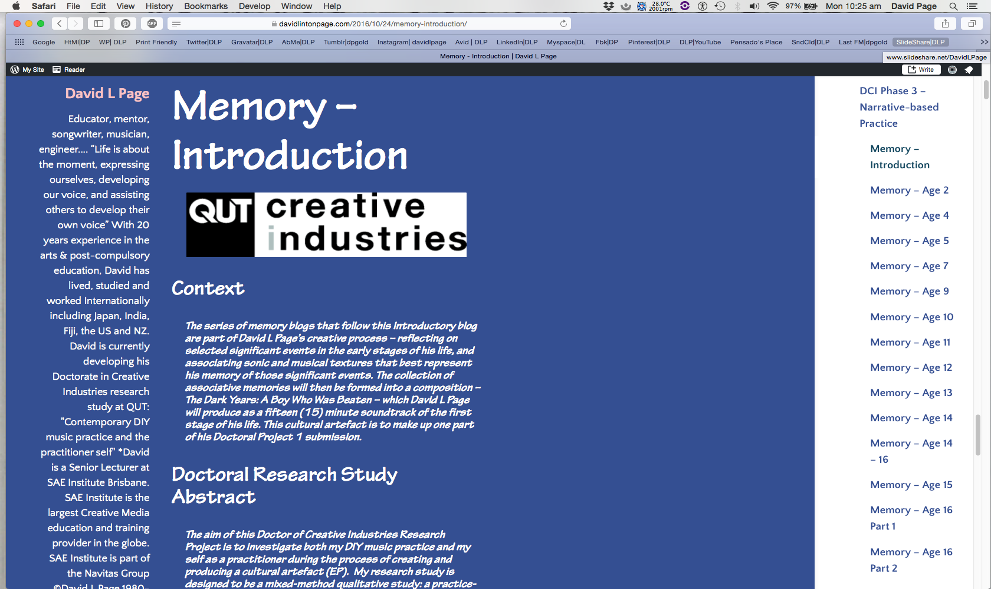
Page, 2016r https://davidlintonpage.com/2016/10/24/memory-introduction
Appendix 9
Music & Sound soundtrack theme:
Significant events between 0 and 20 years of age
Hyper linked blogs of developed narratives for each of the highlighted significant event periods:
-
-
-
-
- Memory – Age 2: My earliest recollection
- Memory – Age 4: A few months past four (4)
- Memory – Age 5: Train to freedom
- Memory – Age 7: Rock fight on Exeter
- Memory – Age 9: School yard pick
- Memory – Age 10: My first love affair
- Memory – Age 11: My first, my only…
- Memory – Age 12: Water fight
- Memory – Age 13: Finding my voice….
- Memory – Age 14: The boy who was…(all bent out of shape)
- Memory – Age 14-16: Looking for something
- Memory – Age 15: Someone lost at sea
- Memory – Age 16 Part 1,2,3: Independence Day
- Memory – Age 17-19 Part 1,2: Independence; bouncing off walls
- Memory – Age 20 Part 1,2: Desperate times; herein after
-
-
-
Appendix 10
As I progressed through Project 1, I interpreted I was working through specific developmental phases of self-making and meaning-making. I noted these phases were distinct, though not necessarily occurring in sequential order. I noticed I returned to each phase on multiple occasions during my practice:
- Identity (Kegan 1982; Brewer 1991; Frith 1996; Hargreaves et al 2002; Hallam 2017; Denzin 2016)
- Values (Rokeach 1979; Hofstede 1984; Green 1988; Mezirow 1991; Lakoff 1997; Reimer et al 2002; Hesmondhalgh 2013)
- Narrative (Neisser 1994; Ellis & Bochner 2000; Hermans 2001a; Cobley 2001; Elliot 2005; Atkins 2008; Taylor & Littleton 2012; Gongalves & Ribeiro 2012; Sagan 2015)
- Embodiment (Budd 1992; Tagg 1994; Hermans 2001a; Reimer et al 2002; Hermans & Gieser 2012; Fogel et al 2012; Lawrence 2012; Denzin 2016;Pace 2012; Ellis 1997)
- Narrative (Neisser 1994; Ellis & Bochner 2000; Hermans 2001a; Cobley 2001; Elliot 2005; Atkins 2008; Taylor & Littleton 2012; Gongalves & Ribeiro 2012; Sagan 2015)
- Values (Rokeach 1979; Hofstede 1984; Green 1988; Mezirow 1991; Lakoff 1997; Reimer et al 2002; Hesmondhalgh 2013)

Page, 2017d. https://davidlintonpage.com/2017/12/27/doctoral-pilot-study-part-24a
Appendix 11
My developing composition of Significant Events: integrated into this composition are faculty (psychophysiological) responses of affect (emotion), across the predetermined associated memories of each of the significant events.
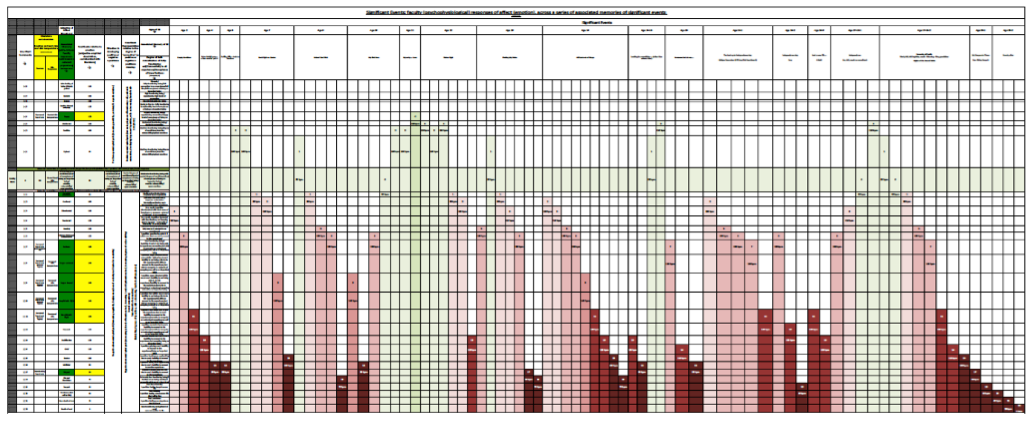
Page, 2018a.
Appendix 12
I continued to engage in both practice and literature, and delve into my previous observation and unrest with the three (3) elements of Praxis: music style; compositional approach and music production approach. I was starting to consider that perhaps a better way to explain my connection to music and sound-making was not to be via developing Praxis; but rather in investigating and analyzing approaches to music and sound-making practice.
[Editorial comment: This image is titled ‘Mid-Project 2 approach’, but in retrospect, this proved to be incorrect. The title ‘End-Project 1 approach’ would have be more accurate given the time-line of the emergent HDR Journey as it turned out] 
Appendix 13
Sullivan, 2010. Sullivan’s Visual Framework

Appendix 14
A potential outcome of Project 2? A holistic model, integrating all 3 tenets of self-making, meaning-making and practice-making, (subjectivity, agency, hybridity); overarching the phases of identity, values, narrative and embodiment to arrive at a 3 dimensional model of sustainable authentic practice?

Appendix 15
The three interdependent (3) tenets of contemporary practice: creative practice-making, meaning-making, and self-making.

Page, 2018d.

Page, 2018e.

Page, 2018f.

Page, 2018g.
Appendix 16
Blog category topics summary document: a section of Page’s blog summary and scheduling document, with each line summarising key information for each publically hosted blog. As at 01/09/2018, I have approximately seventy (70) blogs publically hosted, totalling 150,000 words. I have another fifty (50) blogs currently scheduled for release.

Page, 2018h.
This now concludes my HDR Project 1 Submission series. Please watch out for further HDR Project 1+ and Project 2-related blog posts for the continuation of this emergent journey.
Bibliography
Abramson, Christopher D. 1999. “Digital Sampling and the Recording Musician: A Proposal for Legislative Protection.” NYUL Rev. 74: 1660.
Anderson, Nate. 2008. “Reznor makes $750,000 even when the music is free.” Accessed May 20, 2015. http://arstechnica.com/uncategorized/2008/03/reznor-makes-750000-even-whenthe-music-is-free.
Antares. 2015. “Auto-tune.” Accessed May 7, 2015. http://www.antarestech.com.
Apple. 2010. “Final cut pro 7 manual. Accessed 10th May, 2015.
Bahn, Curtis, Tomie Hahn and Dan Trueman. 2001. “Physicality and feedback: a focus on the body in the performance of electronic music.” In Proceedings of the International Computer Music Conference, edited, 44-51.
Bandura, Albert. 2001. “Social cognitive theory: An agentic perspective.” Annual review of psychology 52 (1): 1-26.
Barney, Jay B and Ricky W Griffin. 1992. The management of organizations: Strategy, structure, behavior: Houghton Mifflin College Div.
Barstow, Clive Professor. 2017. “Writing on writing: approaching the creative exegesis as an embodied and co-dependent element of praxis (unpublished)”.
Bates, Eliot and Samantha Bennett. 2018. “The production of music and sound: a multidisciplinary critique.” In Critical Approaches to the Production of Music and Sound, edited by Samantha Bennett and Eliot Bates, 1-20. New York: Bloomsbury.
Beck, Don Edward and Christopher Cowan. 2014. Spiral dynamics: Mastering values, leadership and change: John Wiley & Sons.
Bell, Adam Patrick. 2015. “Can we afford these affordances? GarageBand and the double-edged sword of the digital audio workstation.” Action, Criticism, and Theory for Music Education 14 (1): 44.
Bell, Adam Patrick. 2014. “Trial-by-fire: A case study of the musician–engineer hybrid role in the home studio.” Journal of Music, Technology & Education 7 (3): 295-312.
Blanchard, Kenneth and P Hersey. 1997. “Situational leadership.” A new paradigm of leadership: Visions of excellence for 21st century organizations: 149-153.
Boeree, C George. 2006. “Abraham Maslow.” Accessed June 17, 2015. http://www.maslow.org.
Bockstedt, Jesse, Robert J Kauffman and Frederick J Riggins. 2005. “The move to artist-led online music distribution: Explaining structural changes in the digital music market.” In System Sciences, 2005. HICSS’05. Proceedings of the 38th Annual Hawaii International Conference on, Hawaii, USA, edited, 1-10: IEEE.
Burgess, Richard James. 2014. The history of music production. New York: Oxford University Press.
Burke, David. 2011. “Heart of Darkness : Bruce Springsteen’s Nebraska”. London: Cherry Red Books.
Burns, Tom R and Thomas Dietz. 1992. “Cultural evolution: social rule systems, selection and human agency.” International Sociology 7 (3): 259-283.
Burrell, Gibson and Gareth Morgan. 1992. Sociological paradigms and organisational analysis: elements of the sociology of corporate life. Aldershot, Hants: Ashgate.
Carter T.J. 2013. “Nature of Experiential Learning and Reflective Practice 7 17-13”. https://www.slideshare.net/tjcarter/experiential-learning-and-reflective-practice-7-1713.
Chen, Jason Chi Wai. 2012. “A pilot study mapping students’ composing strategies: Implications for teaching computer-assisted composition.” Research Studies in Music Education 34 (2): 157-171.
Cobley, Paul. 2001. Narrative. New York: Routledge.
Cole, S. J. 2011. “The Prosumer and the Project Studio: The Battle for Distinction in the Field of Music Recording.” Sociology 45 (3): 447–463. Watson, Allan. Cultural Production in and Beyond the Recording Studio (Routledge Studies in Human Geography) (p. 199). Taylor and Francis. Kindle Edition.
Cottrell, Stephen J. 2010. “The rise and rise of phonomusicology.” In Recorded Music: Performance, Culture and Technology, edited by Amanda Bayley, 15-36. Cambridge: Cambridge University Press.
Covey, Stephen R. 1991. Principle centered leadership. New York: Simon and Schuster.
Craig, Cheryl. J. 2010. “Reflective practice in the professions: teaching.” In Handbook of reflection and reflective inquiry: mapping a way of knowing for professional reflective inquiry, edited by Nona Lyons, 189-214. London: Springer Science + Business Media.
Dandy Warhols, The. 2010. The Dandy Warhols: best of the capitol years 1995-2007. Capitol Records. Compact Disc.
Davidson, Robert. 2014. “Music Literacies: Teaching Diversity.” In Literacy in the Arts, edited by G Barton, 161-173. London: Springer.
Davie, Mark. 2015. “DIY: don’t be a tool.” Audio Technology 2015 (106): 98.
Davie, Mark. 2014. “Danger Mouse: producer of the decade.” Audio Technology (100): 98.Davie, Mark. 2012. “The diy revolution.” Audio Technology (91): 98.
Dean, R. T., ed. 2009. The Oxford handbook of computer music. Oxford: Oxford University Press.
Daykin, Norma. 2008. “Knowing Through Music: Implications for Research.” In “Knowing Differently: Arts-Based and Collaborative Research Methods”, edited by Pranee Liamputtong and Rumbold. Jean, 229-243. New York: Nova Science Publishers Inc
De Carvalho, Alice Tomaz. 2012. “The discourse of home recording: authority of pros and the sovereignty of big studios.” Journal of the Art of Record Production 7.
DeNora, Tia. 2005. “The pebble in the pond: Musicing, therapy, community.” Nordic Journal of Music Therapy 14 (1): 57-66.
DeNora, Tia. 2001. “Aesthetic agency and musical practice: new directions in the sociology of music and emotion.” In Music and emotion: theory and research, edited by Patrik N Juslin and John A Sloboda, 161-180. Oxford: 2001.
DeNora, Tia. 1999. “Music as a technology of the self.” Poetics 27 (1): 31-56.
Diekelmann, Nancy. 2001. “Narrative pedagogy: Heideggerian hermeneutical analyses of lived experiences of students, teachers, and clinicians.” Advances in Nursing Science 23 (3): 53-71.
Dodge, Charles and Thomas A Jerse. 1997. Computer music: synthesis, composition and performance. 2nd ed. Melbourne: Macmillan Library Reference.
Doyle, Tom. 2008. “Stuart Price: producing Seal & Madonna.” Accessed May 2, 2015. https://www.soundonsound.com/sos/feb08/articles/stuart_price.htm.
Duckworth, William. 2005. Virtual music: How the web got wired for sound. New York, NY: Routledge.
Edstrom, Brent. 2006. Musicianship in the digital age. Boston: Thompson Course Technology.
Ellis, Carolyn S and Arthur Bochner. 2000. “Autoethnography, personal narrative, reflexivity: researcher as subject.” In The Handbook of Qualitative Rsearch, edited by Norman Denzin and Yvonna Lincoln, 733-768. New York: Sage.
Elliott, Jane. 2005. Using narrative in social research: qualitative and quantitative approaches. London: Sage Publications Ltd.
Emmerson, Simon. 2007. Living electronic music. Hampshire, UK: Ashgate Publishing, Ltd.
Eno, Brian. 2004. “The studio as compositional tool.” In Audio culture: readings in modern music, edited by Christoph Cox and Daniel Warner, 127-130. New York: Continuum.
Eno, Brian. 1982. Ambient 4: on land. Editions EG. Compact Disc.
Flam, Helena. 2010. “Emotion, and the silenced and short-circuited self.” In Conversations about reflexivity, 187. New York: Routledge.
Folkestad, Göran, David J Hargreaves and Berner Lindström. 1998. “Compositional strategies in computer-based music-making.” British Journal of Music Education 15 (01): 83-97.
Frith, Simon. 1992. “The industrialization of popular music.” Popular Music and Communication 2: 49-74.
Frith, Simon and Simon Zagorski-Thomas. 2012. The art of record production: an introductory reader for a new academic field: Ashgate Publishing, Ltd.
Fromm, Erich. 1997. To have or to be? New York: Continuum.
Gabrielsson, Alf and Erik Lindström. 2001. “The influence of musical structure on emotional expression.” In Series in Affective Science, edited by Patrik N Juslin and John A Sloboda, 223-248. New York: Oxford University Press.
George-Warren, Holly and Patricia Romanowski. 2001. The Rolling Stone encyclopedia of rock & roll, edited by Jon Pareles: Touchstone.
Gerber, Michael E. 2005. E-myth mastery: the seven essential disciplines for building a world class company. New York: Harper Business.
Gerber, Michael E. 1999. The e-myth manager: why management doesn’t work – and what to do about it. New York: Harper Business.
Gerber, Michael E. 1986. The E-myth: why most small businesses don’t work and what to do about it. New York: Harper Business.
Ghaye, Tony and Sue Lillyman. 2014. Reflection: principles and practices for healthcare professionals 2nd edition: Andrews UK Limited.
Ghaye, Tony and Sue Lillyman. 2006. Learning journals and critical incidents: reflective practice for health care professionals. 2nd ed. London: Mark Allwn Publishing.
Gibson, Bill. 2006. The s.m.a.r.t. guide to becoming a successful producer/engineer Boston: Thompson Course Technology.
Gibson, James J. 2014. The ecological approach to visual perception: classic edition. 2nd ed. New York: Psychology Press.
Gibson, JJ. 1979. “The theory of affordances ” In The Ecological Approach to Visual Perception edited by JJ Gibson, 127-143. Boston: Houghton Miffin.
Gilreath, Paul. 2010. The guide to midi orchestration. 4th ed. Oxford: Focal.
Gotye. 2011a. “Making, making mirrors – a short documentary.” Accessed May 5, 2015. https://www.youtube.com/watch?v=2ZXLyeatI0s&list=PL2qcTIIqLo7WEHIeJ0s2Y21jgIKoQahkD&index=64.
Goyte. 2011b. Making Mirrors. Eleven May 5, 2015. Compact Disc.
Grammy Awards. 2015. “The 2015 Grammy Awards.” Accessed May 20, 2015. https://www.grammy.com/nominees.
Green, Lucy. 2016a. How popular musicians learn: a way ahead for music education. 2nd ed, Ashgate Popular and Folk Music Series. New York: Routledge.
Green, Lucy. 2016b. Music, informal learning and the school: a new classroom pedagogy. 2nd ed, Ashgate Popular and Folk Music Series. New York: Routledge.
Griffiths, Morweena. 2010. “Research and the self.” In The Routledge companion to research in the arts, edited by M Biggs and H Karlsson, 167-185. London: Routledge.
Gunderson, Philip A. 2004. “Danger Mouse’s “grey album”, mash-ups, and the age of composition.” Postmodern Culture 15 (1): 7.
Grace, S and R Ajjawi. 2010. “Phenomenological research: Understanding human phenomena.” In Researching Practice: a discourse on qualitative methodologies. Rotterdam: Sense Publishers, edited by J Higgs, N Cherry, R Macklin and R Ajjawi, 197-208. Rotterdam: Sense Publisher.
Gray, Carole and Julian Malins. 2004. Visualising research: a guide for postgraduate students in art and design. Burlington: Ashgate Publishing.
Griffin, RW. 1996. Management. 5th ed. Boston: Houghton Mifflin Company.
Hannaford, Carla. 1995. Smart moves: why learning is not all in your head. Arlington: Great Ocean Publishers.
Hargreaves, David J, Raymond MacDonald and Dorothy Miell. 2012. “Explaining musical imaginations: creativity, performance, and perception.” In Musical Imaginations: Multidisciplinary Perspectives on Creativity, Performance and Perception, edited by David J Hargreaves, Dorothy Miell and Raymond MacDonald, 1-14. Oxford: Oxford University Press.
Harrison, George and Derek Taylor. 2017. I Me Mine: The Extended Edition. 2nd ed. Guildford: Genesis Publications.
Haseman, Brad, Daniel Mafe, Hazel Smith and Roger T Dean. 2009. “Practice-led research, research-led practice in the creative arts.” Acquiring know-how: Research training for practice-led researchers: 211-228.
Hemphill, David and Shari Leskowitz. 2012. “DIY activists: communities of practice, cultural dialogism, and radical knowledge sharing.” Adult Education Quarterly 63 (1): 57-77. doi: 10.11.77/0741113612442803.
Hermans, Hubert JM. 2001b. “The dialogical self: toward a theory of personal and cultural positioning.” Culture & psychology 7 (3): 243-281.
Hewitt, Michael. 2008. Music theory for computer musicians. Boston: Cengage Learning Course Technology.
Holland, Dorothy, William Jr. Lachicotte, Debra Skinner and Carole Cain. 1998. Identity and agency in cultural worlds. Cambidge, Masschusetts: Harvard University Press.
Huber, David Miles and Robert E Runstein. 2013. Modern recording techniques. 8th ed. Burlington: Focal Press.
Huber, David Miles and Robert E Runstein. 2010. Modern recording techniques. 7th ed. Boston: Focal Press.
Holder, Christopher. 2011. “Goyte.” Audio Technology (84): 98.
Hornby, Albert Sydney. 2005. Oxford advanced learner’s dictionary. 7 ed. New York: Oxford University Press.
Johnsen, Andreas , Ralf Christensen and Henrik Moltke. 2007. “Good Copy, Bad Copy.” Copyright and Culture Documentary. Accessed June 7, 2015. https://www.youtube.com/watch?v=WEKl5I_Q044&list=PL2qcTIIqLo7WEHIeJ0s2Y21jgIKoQahkD&index=72.
Johnson, Mark. 2010. “Embodied knowing through art.” In The Routledge companion to research in the arts, edited by M Biggs and H Karlsson, 141-151. London: Routledge.
Jones, B. (2012). The cambridge companion to recorded Music/Recorded music: Performance, culture and technology.ARSC Journal, 43(1), 97-101. Retrieved from https://gateway.library.qut.edu.au/login?url=https://search-proquest-com.ezp01.library.qut.edu.au/docview/1041299144?accountid=13380
Jopling, David A. 2002. Self-knowledge and the self. 2nd ed. New York: Routledge.
Jupp, Victor. 2006. The Sage dictionary of social research methods. London: Sage.
Juslin, Patrik N and John A Sloboda. 2010. Handbook of music and emotion: theory, research, applications. 2nd ed. Oxford: Oxford University Press.
Juslin, Patrik N and Daniel Västfjäll. 2008. “Emotional responses to music: the need to consider underlying mechanisms.” Behavioral and brain sciences 31 (05): 559-575.
Kealy, Edward R. 1982. “Conventions and the production of the popular music aesthetic.” The Journal of Popular Culture 16 (2): 100-115.
Klein, Stanley B and Cynthia E Gangi. 2010. “The multiplicity of self: neuropsychological evidence and its implications for the self as a construct in psychological research.” Annals of the New York Academy of Sciences 1191 (1): 1-15.
Kögler, Hans-Herbert. 2006. “Music and identity: Adorno and the promise of popular culture.” Philosophy of Culture.
Langford, Simon. 2010. Remix manual. Burlington: Focal Press.
Leach, Joel. 2011. A concise guide to music industry terms. Missouri: Mel Bay Publications.
Lewis, Byron and Frank Pucelik. 1990. Magic of NLP demystified: a pragmatic guide to communication and change. Portland: Metamorphous Press.
Leyshon, Andrew. 2009. “The Software slump?: digital music, the democratisation of technology, and the decline of the recording studio sector within the musical economy.” Creative location and Planning 41 (6): 1309.
Loftus, Stephen and Joy Higgs. 2010. “Researching the individual in workplace research.” Journal of Education and Work 23 (4): 377-388. doi: 10.1080/13639080.2010.495712.
Long, Douglas G. 2012. Third generation leadership and the locus of control: knowledge, change and neuroscience. London: Routledge.
MacDonald, Raymond A. R., David J. Hargreaves and Dorothy Miell. 2002. Musical identities. Oxford: Oxford University Press.
MacGregor, Douglas. 1960a. The human side of enterprise. Vol. 21: New York.
MacGregor, Douglas. 1960b. “Theory X and theory Y.” Organization theory: 358-374.
Marrington, Mark. 2011. “Experiencing musical composition in the DAW: the software interface as mediator of the musical idea.” Journal on the Art of Record Production 1.
Maslow, Abraham Harold. 1950. “Self-actualizing people: a study of psychological health.” Personality.
Maslow, Abraham Harold, Deborah Collins Stephens, Gary Heil and Warren Bennis. 1998. Maslow on management: John Wiley New York.
McWilliam, Erica. 2008. The creative workforce: how to launch young people into high-flying futures. Sydney: UNSW press.
Melcher, Michael F. 2014. The Creative Lawyer: a practical guide to authentic professional satisfaction. 2nd ed. Chicago: American Bar Association Publishing.
Merleau-Ponty, Maurice and Colin Smith (translator). 2005. Maurice Merleau-Ponty: phenomenology of perception. 4th Edition ed. London: Routledge. doi: 10.4324/9780203720714.
Miller, Eric R. 2013. “The influence of recording technology on music performance and production.” Bachelor of Science in Media Arts and Studies, Media Arts and Studies, Ohio University.
Montana, Patrick J and Bruce H Charnov. 2000. Management. 3rd ed. Vol. 333, Business Review Books. New York: Barron’s Educational Series.
Morawetz, David. 1974. “Employment implications of industrialisation in developing countries: a survey.” The Economic Journal: 491-542.
Music Group. 2015. “Behringer : our story.” Accessed May 2, 2015. http://www.behringer.com/EN/Our-Story/index.aspx
Mykhalovsky, Eric. 1996. “Reconsidering Table Talk.” Qualitative Sociology 19 (1)..
Nevels, Daniel L. 2013. “Using music software in the compositional process: a case study of electronic music composition.” Journal of Music, Technology and Education 5 (3): 257-271. doi: 10.1386/jmte.5.3.257_1.
Neyfakh, Leon. 2014. “The Sadness of T-Pain.” Accessed June 7, 2015. http://www.newyorker.com/culture/culture-desk/the-sadness-of-t-pain.
Nilsson, Bo. 2003. ““I can always make another one!”–Young musicians creating music with digital tools.” Musicianship in the 21st century: issues, trends and possibilities (Sydney, Australian Music Centre).
Nine Inch Nails. 2008. Ghosts I-IV. Shock Records. Compact Disc.
O’Connor, Joseph and John Seymour. 1990. Introducing NLP: neuro linguistic programming: psychological skills for understanding and influencing people. San Francisco: The Aquarian Press.
Onion image courtesy of: Onion Layers Accessed 28th March, 2015
Owsinski, Bobby. 2013. The mixing engineer’s handbook. Boston: Cengage learning.
Oxford. 2015. “Oxford dictionary.com.” Accessed 01/06/2015.
Page, David L. 2004. Ericsson’s 10,000 hours (Ericsson in Page 2004)
Paine, Garth. 2009. “Gesture and morphology in laptop music performance.” In The Oxford handbook of computer music, edited by Roger T Dean, 214-232. New York: Oxford University Press.
Panksepp, Jaak and Günther Bernatzky. 2002. “Emotional sounds and the brain: the neuro-affective foundations of musical appreciation.” Behavioural processes 60 (2): 133-155.
Parker, Allan and Margaret Stuart. 1986. Switch on your brain: a guide to better reading , concentration and coordination. Marrickville: Hale & Iremonger.
Parsons, Alan and Julian Colbeck. 2014. Art & Science of Sound Recording – The Book. Milwaukee: Hal Leonard.
Parsons, Alan. 1982. “Alan Parson’s Project.” On Eye in the sky, Alan Parsons. Arista. Vinyl LP.
Parsons, Alan. 1980. “Alan Parson’s Project.” On The turn of a friendly card, Alan Parsons. Arista.
Vinyl LP.
Parsons, Alan. 1979. “Alan Parson’s Project.” On Eve, Alan Parsons. Arista. Vinyl LP.
Parsons, Alan. 1978. “Alan Parson’s Project.” On Pyramid, Alan Parsons. Arista. Vinyl LP.
Parsons, Alan. 1977. “Alan Parson’s Project.” On I Robot, Alan Parsons. Arista. Vinyl LP.
Parsons, Alan. 1976. “Alan Parson’s Project.” On Tales of mystery and imagination, Alan Parsons. Mercury. Vinyl LP.
Peters, Thomas J and Nancy Austin. 1985. “A passion for excellence. The leadership difference.
Porpora, Douglas V and Wesley Shumar. 2010. “Self talk and self reflection: a view from the US.” In Conversations about reflexivity, 206. New York: Routledge.
Raimond, Yves, Samer A Abdallah, Mark B Sandler and Frederick Giasson. 2007. “The music ontology.” In ISMIR, edited, 417-422: Citeseer.
Ralston, Shane Jesse. 2001. “Self-knowledge and the Self.” In Symposium, edited, 134-136.
Recording Producers and Engineers Wing, The. 2008. “Digital Audio Workstation Guidelines for Music Production.” Accessed May 27, 2015. https://www.grammy.org/files/pages/DAWGuidelineLong.
Ricoeur, Paul. 1985. Time and narrative. Vol. 2. Chicago: University of Chicago Press
Saee, John. 2010. “Foreign Direct Investment as a Catalyst for Economic Development.” In The 6th International Scientific Conference “Business and Management’2010, edited, 1080-1085.
Schaal, Karl. 2015. “The Symphony of Light.” Accessed May 29, 2015. https://www.facebook.com/pages/The-Symphony-of-Light/144765125549958?fref=ts.
Schaal, Karl. 2015. “The Symphony of Light.” Accessed May 29, 2015. https://soundcloud.com/thesymphonyoflight.
Schönpflug, Ute and Ludwig Bilz. 2009. “The transmission process: mechanisms and contexts.” In Cultural transmission: psychological, developmental, social, and methodological aspects, edited by Ute Schönpflug, 490. New York: Cambridge University Press.
Schwartz, Elliott, Barney Childs and Jim Fox. 1998. Contemporary composers on contemporary music. New York: Da Capo Press.
Senge, Peter M. 2006. The fifth discipline: the art and practice of the learning organisation. 2nd ed, Business Books. London: Random House.
Senge, Peter M, Charlotte Roberts, Richard B Ross, Bryan J Smith and A Kleiner. 1994. The fifth discipline fieldbook: strategies and tools for building a learning organization. London: Nicholas Brealey Publishing.
Senge, Peter M, A Kleiner, Charlotte Roberts, Richard Ross, George Roth and Bryan Smith. 1999. The dance of change: the challenges to sustaining momentum in a learning organization. London: Nicholas Brealey Publishing.
Senge, Peter M, Nelda Cambron-McCabe, Timothy Lucas, Bryan Smith and Janis Dutton. 2012. Schools that learn: a fifth discipline fieldbook for educators, parents, and everyone who cares about education. 2nd ed. London: Crown Business.
Sillitoe, Sue. 1999. “Recording Cher’s “Believe”.” Accessed June 7, 2015. http://www.soundonsound.com/sos/feb99/articles/tracks661.htm.
Singer, Peter. 2001. Hegel: A very short introduction. Oxford: Oxford University Press.
Smythe, Thomas W. 2001. “Self-Knowledge and the Self.” Journal of Philosophical Research 26: 287-294.
Stengers, Isabelle. 2013. “Introductory notes on an praxis of practices.” Cultural Studies Review 11 (1): 183-196.
Stone, Brad. 2009. “Artists find backers as labels wane.” Accessed June 7, 2015. http://www.nytimes.com/2009/07/22/technology/internet/22music.html?_r=0.
Tame Impala. 2012. Lonerism. Modular. Compact Disc.
Tamm, Eric. 1995. Brian Eno: his music and the vertical color of sound. New York, NY: Da Capo Press.
Tanaka, Atau. 2009. “Sensor-based musical instruments and interactive music.” In The Oxford handbook of computer music, edited by Roger T Dean, 233-257. New York: Oxford University Press.
Tankel, J.D., 1990. The practice of recording music: Remixing as recoding. Journal of Communication, 40(3), pp.34-46.
TEAC. 2015. “TEAC TASCAM history.” Accessed June 7,2015. www.tascam.com.
Tepper, Steven J. and Eszter Hargittai. 2009. “Pathways to music exploration in a digital age.” Poetics 37 (3): 227-249.
Théberge, P., 2004. The network studio: Historical and technological paths to a new ideal in music making. Social Studies of Science, 34(5), pp.759-781.
Thompson, Linda K and Mark Robin Campbell. 2008. Diverse methodologies in the study of music teaching and learning: IAP.
Thompson, Paul and Brett Lashua. 2014. “Getting it on record issues and strategies for ethnographic practice in recording studios.” Journal of Contemporary Ethnography: 1-24.
Väkevä, Lauri. 2010. “Garage band or GarageBand®? Remixing musical futures.” British Journal of Music Education27 (01): 59-70.
Valsiner, Jaan and Alberto Rosa. 2007. “Contemporary socio-cultural research: uniting culture, society, and psychology.” In The Cambridge Handbook of Sociocultural Psychology, edited by Jaan Valsiner and Alberto Rosa, 729. New York: Cambridge University Press.
Walton, Mary. 1988. Deming management method. London: Penguin.
Watson, Allan. 2012. “The world according to iTunes: mapping urban networks of music production.” Global Networks12 (4): 446-466.
Webb, A. 2007. “Is GarageBand top of the pops?” The Guardian Available at: http://www.guardian.co.uk/technology/2007/oct/18/news.apple.
Wenner, J, John Lennon and Yoko Ono. 1971. Lennon remembers: the Rolling Stone’ interviews [with John Lennon and Yoko Ono]. New York: Penguin.
Wikström, Patrik. 2013. The music industry: music in the cloud, Digital media and society series. Cambridge: Polity.
Wiley, Norbert. 2010. “Inner speech and agency.” In Conversations about reflexivity, edited by Margaret S. Archer, 17-38. New York: Routledge.
Wilson, Colin. 1980. The new existentialism. Middlesex: Wildwood House.
Young, Sherman and Steve Collins. 2010. “A View from the Trenches of Music 2.0.” Popular Music and Society 33 (3): 339-355.
Zagorski-Thomas, Simon. 2005. “The US vs the UK sound: meaning in music production in the 1970s.” In The art of record production: an introductory reader for a new academic field, edited by Simon Frith and Simon Zagorski-Thomas, 57-90. Farnham, Surrey: Ashgate.
This now concludes my HDR Project 1 Submission series.
This blog series continues in several months with the Research Practioner Series – Part 29, the HDR Project 1+ series, commencing with “Gaining clarity with Intention” (Page, 2018j).
Note: That series will then segue into Research Practioner Series – Part 31, the HDR Project 2 series, continuing this emergent journey.
– @David L Page 30/08/2018
Copyright: No aspect of the content of this blog or blog site is to be reprinted or used within any practice without strict permission directly from David L Page.
