Category Archives: Soft Skills
All things communication related: all that is associated to the act of communicating, engaging, discussion, expressing, projecting, reflecting, learning, developing self image and ‘voice’, changing & developing views and perceptions, goal setting, time management, negotiation, conflict resolution, educing, teaching, training, guiding, or scaffolding: either of yourself or others, into something more than who you were, to become who you really are …….


Media Identity & Curation Part 2

As revealed in my blog last month, Media Identity & Curation Part 1, I hold a very broad view of creative practice. My interests, activities and roles are diverse. I love life and the aesthetic of life. Whether it is a visual, auditory, kinaesthetic, gustatory or olfactory-based creations, I embrace them all. As my personal motto describes, my life is full: “Life is about the moment……. experiencing the moment…” (Page 2014). Whilst most days I prioritise my primary interest of music practice, I take every opportunity to immerse myself proactively in as many sensory-based practices as I can on a daily basis. I seek out people to engage and learn from – practitioners who know more of a discipline area than I do – to develop my knowledge, understanding and appreciation of that particular practice.
My Media Strategy
As described last month, I use social media to support my diverse interests and practice. The sites I choose and the practice I engage through each site such as blogging and curating of text, video and audio resources relate to my broad creative practice. My media strategy is very deliberate. The media sites must connect the diversity of my interests and practice. The media sites must facilitate the expression of my self, revealing more understanding of my self in the process, and making connections with others of similar interests or practice to share experience, knowledge, understanding and appreciation of a particular practice.
In this aspect of my creative practice, new facets of myself and in turn, new distinctions regarding my practice are revealed – to my self, and to others. Through my media strategy the dynamic relationship between my self, my practice and my audience is demonstrated – my self informing my practice, my practice informing my self and my audience, which in turn reinforces and consolidates my identity at any point in time.
Representative of my diverse interests and practice, the social media sites I use include: about.me, gravatar.com, wordpress.com, tumblr.com, twitter.com, linked-in.com, myspace.com, facebook.com, pinterest.com, you-tube.com, soundcloud.com, instagram.com, lastfm.com, slideshare.com, googlescholar.com, academia.com and google.com.
[Note: I also write, perform and produce under pseudonyms. I consider each pseudonym an alternative identity. I am conscious these specific practice identities also inform my creative practice as defined in this blog, and will no doubt reveal themselves for interrogation, analysis and reflection during my higher degree research study. But for the purpose of this blog, I will disregard the media I use to represent those identities.
In this blog I choose one site that I proactively use to support my creative practice, and show how I have structured the curation of the content. The site is: Pinterest.com.
Pinterest [Pinterest.com/David L Page]
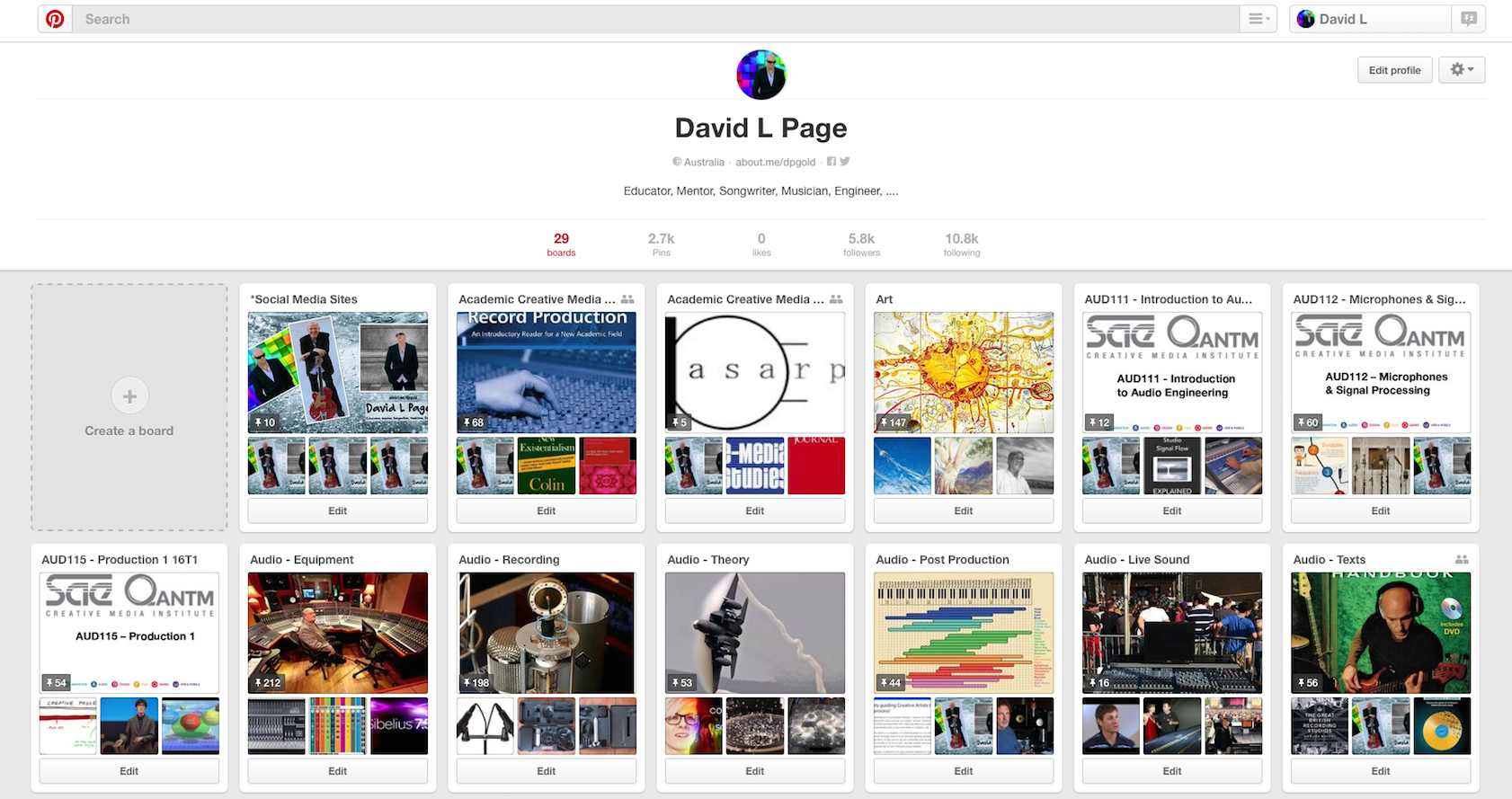
Pinterest uses a board system for the user to categorise their interests. The boards I have created are intended to reflect the diversity of my interests, activities and roles. The following boards in some form represent my interests in visual, auditory, kinaesthetic, gustatory and olfactory-based phenomena or creations – natural or constructed. Please note that each the Boards within my Pinterest site, and each pin is linked to a relevant playlist within my You-Tube Channel [You-Tube/David L Page] .
-
*Social Media Sites: connections to David L Page’s Social Media Sites, all linked for ease of access.
-
Academic Creative Media – Texts: All ‘academic creative media texts’ related: Research Methodology, Creativity Theory, Music Theory, Genre Studies, Cultural Theory, Compositional Theory, Arrangement Theory, Songwriting Studies, Audio Theory – Digital versus Analogue, Production Theory – Recording, Mixing, Mastering, Post-Production, Anecdotal, etc. Intended audience are undergraduate and post-graduate Creative Media students
-
Academic Creative Media – Journals: All ‘academic creative media journals’ related: Research Methodology, Creativity Theory, Music Theory, Genre Studies, Cultural Theory, Compositional Theory, Arrangement Theory, Songwriting Studies, Audio Theory – Digital versus Analogue, Production Theory – Recording, Mixing, Mastering, Post-Production, Anecdotal, etc. Intended audience are undergraduate and post-graduate Creative Media students
-
Art: All things ‘visual art’ related: paintings, posters, drawings, lithographs, sculpture, pottery; and the people that do it……
-
Audio – Equipment: All things ‘audio equipment’ related: any audio equipment including hardware, software, and peripheral equipment and devices……
-
Audio – Recording: All things ‘audio recording’ related in a studio: microphones, microphone placement, microphone technique and any recording related technique or matter ……
-
Audio – Theory: All things ‘Audio Theory’ related: sound waves, frequencies, amplitude, decibels, harmonics, acoustics, electronics……
-
Audio – Post Production: All things ‘Audio Post-Production’ related: ADR, Foley, Mixing, Mastering
-
Audio – Live Sound: All things ‘audio recording’ related in live sound: sound reinforcement, stage setup, front of house, monitoring side of stage, microphones, microphone placement, microphone technique and any live sound related technique or matter ……
-
Audio – Texts: All ‘audio texts’ related: Theory, Recording, Mixing, Mastering, Post-Production, Anecdotal or Process, etc. Intended audience are Audio Production practitioners & students
-
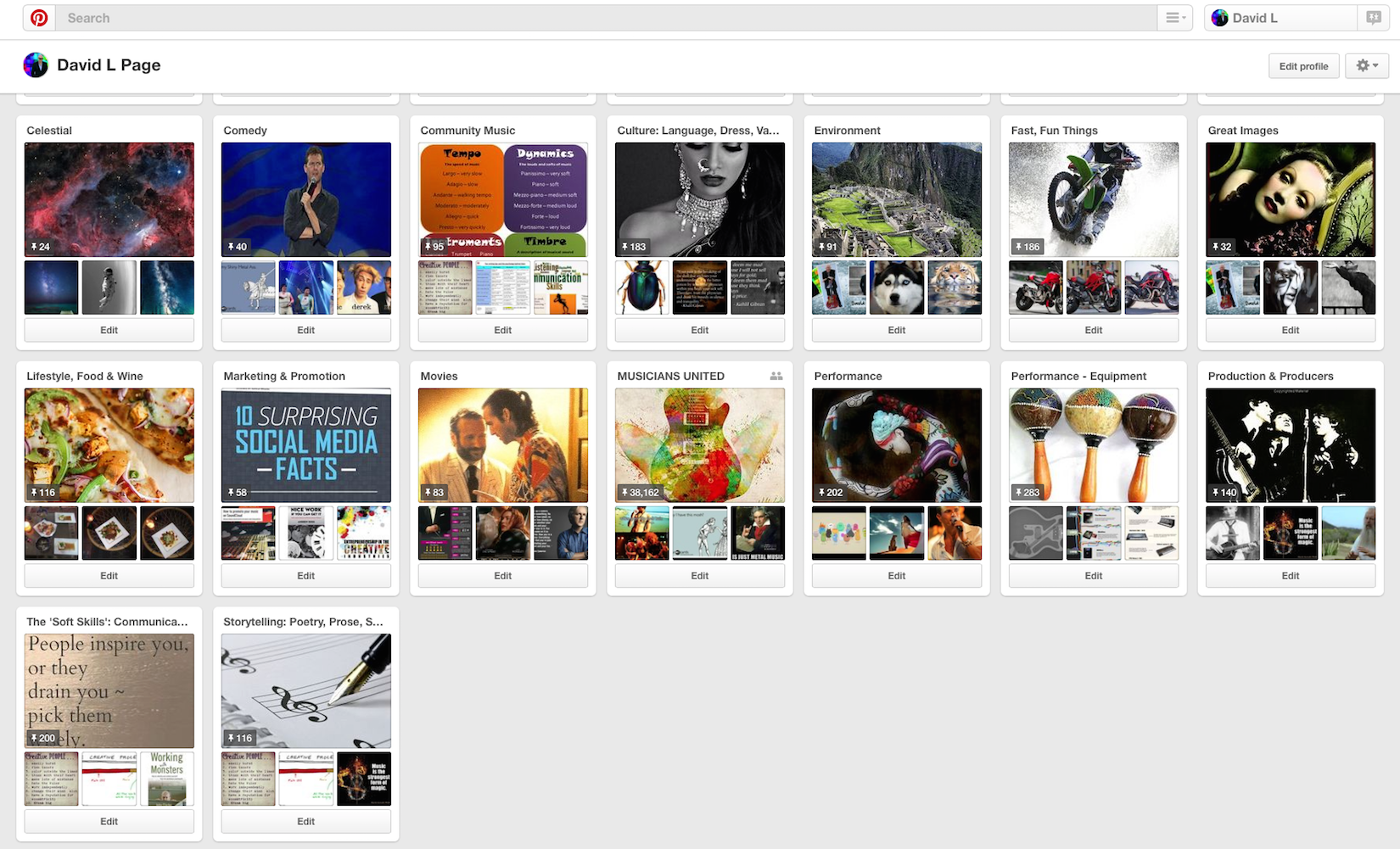
Celestial: All things celestial – space and movement in places other than on Planet Earth………
-
Comedy: All things ‘comedy’ related: people or events…
-
Community MusicCommunity Music: All things ‘community music’ related: making music accessible to all … for all to enjoy, to learn, to develop, to become, to overcome, ‘holistic therapy’ …..To guide, to mentor, to inspire, to educe……
-
Culture: Language, Dress, Values, Beliefs, Spirituality, Rituals, Traditions, Music, Food, Lifestyle: All things ‘culture’ related: Language, Dress, Values, Beliefs, Spiritual Beliefs, Rituals, Traditions … (I have chosen to exclude Music and Food & Lifestyle here, making other ‘Pinterest boards’ dedicated to those..)…
-
Environment: All things ‘environment’ related: continents, nature – flora, fauna, environmental or historical monuments….
-
Fast, Fun Things: All things related to going fast, being physically active, using exhilarating modes of transport……
-
Great Images: All things ‘photography and imagery’ related …….. [ In addition to my other Pinterest boards, for more great photos/images, see http://about.me/dpgold/collections/greatpic]
-
Lifestyle, Food & Wine: All things ‘living’ related: enjoying, relaxing, breathing, exercising, eating and drinking…..
-
Marketing & Promotion: All things ‘marketing’ related: branding, strategic planning, product analysis, market analysis, proactive plan development, advertising via a range of mediums, print versus social media, promotion ………
-
Movies: All things ‘film’ related: movies, documentaries, short film, sit-com, or animation; and the people that act or direct these …….
-
Performance: All things ‘performance’ related: any creative expression, irrespective of the art form…. performance or performer….
-
Performance – Equipment: All things ‘performance equipment’ related: any performance-related equipment including hardware, software, and peripheral equipment and devices. ‘Instruments’, no mater their country or nationality origin, or whether their medium is ‘organic’, ‘electronic’ or ‘virtual’…
-
Production & Producers: All things ‘Producers’ and the ‘Production’ of recorded mediums related: including the Recording and Mixing process and the Producers & Engineers dedicated to this….
-
The ‘Soft Skills’: Communication, Education, Learning, Development & Change: All things ‘communication’ related: all that is associated to the act of communicating, engaging, discussion, expressing, projecting, reflecting, learning, developing self image and ‘voice’, changing & developing views and perceptions, goal setting, time management, negotiation, conflict resolution, educing, teaching, training, guiding, or scaffolding: either of yourself or others, into something more than who you were, to become who you really are …….
-
Storytelling: Poetry, Prose, Songwriting & Composition: All things ‘contemporary storytelling’ related: poetry, prose, & poets, songwriting & songwriters, raps & rappers, composition & composers, arrangements & arrangers….. examples, methods & people who practice the many and varied mediums of ‘contemporary storytelling’…
I have also created three Boards very specific to one particular audience, that of my Trimester One and Trimester Two students within the Bachelor of Audio degree I Lecture in at SAE Institute. I have used these specific Boards to engage in , and take a proactive interest in researching within the particular unit and subject content. These are:
-
AUD111 – Introduction to Audio Engineering 16T1: SAE Institute, Brisbane 1st Trimester Bachelor of Audio unit
-
AUD112 – Microphones & Signal Processing 16T1: SAE Institute, Brisbane 1st Trimester Bachelor of Audio unit
-
AUD115 – Production 1 16T1: SAE Institute, Brisbane 2nd Trimester Bachelor of Audio unit
I also joined one Pinterest Group Board which I thought was aligned to my media strategy:
-
MUSICIANS UNITED: ALL THINGS MUSIC: Beautiful Instruments, Recording Studios, Concerts, Musical Heroes, Quotes, Tips and Tricks, and anything that makes musicians SMILE. :
I am proactive in curating resources (pinning) and sharing these within my immediate music practice audience, predominantly my Higher Education undergraduate creative media students.I have yet to proactively engage in the wider global market place within Pinterest due to my other commitments and priorities. I currently have 1,569 Pinterest followers, and I am following 2, 389 Pinterest users.
As a creative practitioner I use social media to support my diverse interests and practice, and Pinterest is an example of this strategy. Within Pinterest, I curate text, video and audio resources that relate to my broad creative practice. I have very deliberately used this media site to connect the diversity of my interests and practice, in concept and functionally via direct links to my other media sites. As a result, this media site facilitates an expression of my self, revealing more understanding of my self in the process, and making connections with others of similar interests or practice to share experience, knowledge, understanding and appreciation of a particular practice.
In this aspect of my creative practice, new facets of myself and in turn, new distinctions regarding my practice are revealed – to my self, and to others. Through this particular media strategy the dynamic relationship between my self, my practice and my audience is demonstrated – my self informing my practice, my practice informing my self and my audience, which in turn reinforces and consolidates my identity at any point in time.
References
Page, David L. 2014. Life is About the Moment 20/09/2014 Tumblr and WordPress.com blog. Accessed 13th November, 2014
Page, David L. 2014. Media Identity & Curation Part 1 18/10/2014 WordPress.com blog. Accessed 13th November, 2014
Page, David L. 2014. David L Page’s Pinterest.com site Accessed 13th November, 2014
Page, David L. 2014. David L Page’s You-Tube Channel Accessed 13th November, 2014
– ©David L Page 14/11/2014
– updated ©David L Page 01/03/2015
– updated ©David L Page 15/15/2016
Copyright: No aspect of the content of this blog or blog site is to be reprinted or used within any practice without strict permission directly from David L Page.
Media Identity & Curation Part 1
This blog is a continuation of a series. See here for the previous blog.
A creative practitioner
As a creative practitioner I am conscious of the dynamic nature of creative endeavours. I am aware of the relationship between my self and my practice: my self informs my practice, and in turn, my practice informs my self and my identity. This process enables the constant revealing of new facets of myself, and in turn, new distinctions regarding my practice.
In this blog I reflect on my use of social media in support of my practice: the sites I choose, the images I select to represent my identity in those particular forums, and the practice I engage through each site such as blogging and curating of text, video and audio resources related to my broad practice. I embrace and proactively engage in the dynamic process of being a creative practitioner.
My Practice
As a contemporary music practitioner, my roles and activities are diverse. I practice music and creative writing on a daily basis for my creative projects, undertaking a higher degree research study, lecturing in a higher education undergraduate degree, mentoring a number of aspiring musicians, and actively engaging in a number of forms of research practice across multi-disciplines.
Note: I also write, perform and produce under pseudonyms. I consider each pseudonym an alternative identity. I am conscious these specific practice identities also inform my music practice as defined in this blog, and will no doubt reveal themselves for interrogation, analysis and reflection during my higher degree research study. But for the purpose of this blog, I will disregard the media I use to represent those identities.
My Media Needs
What I require from my media is: to have multiple mediums that allow me to curate my interests and artefacts generated by my diverse practice, have a coherent image and brand that connects these multiple mediums, with means to engage and communicate with my potential audience. Representative of my diverse practice, I use a wide range of social media sites including: about.me, gravatar.com, wordpress.com, tumblr.com, twitter.com, linked-in.com, myspace.com, facebook.com, pinterest.com, you-tube.com, soundcloud.com, lastfm.com, slideshare.com, googlescholar.com, academia.com and google.com to name a few. Each of these social media sites facilitate a specific aspect of my contemporary music practice.

My Media Identity
I use the above image as my contemporary music practice signature image, and as my profile image on my about.me site [about.me/David L Page]. As you may immediately notice in this image, I use the backdrop image of water. Water represents three things to me: firstly, the functional side of water-related activities such as swimming for health, fitness and feeling good; secondly, my life partner and I share a love for water-based activities, and since our initial meeting this love has always governed our lifestyle. [The original photo image was taken by my life partner in our swimming pool] ; and thirdly, as expressed in my blog last month “Life is About the Moment”, water represents to me the fluidity of life:
“Life is about the moment ….. all things fluid……. experiencing the moment… listening, observing, interacting, laughing, loving, enJOYing, soaking the moment in, digesting it, considering it, reflecting …. expressing ones’ being, streaming ones’ consciousness. While in the moment, everything appears suspended – almost in slow motion – and yet is still very much part of life and moving somewhere…” (Page 2014).

I use this image as my banner image on my WordPress account [wordPress.com/David L Page] and my You-Tube Channel [You-tube.com/David L Page]. Blogging and curating resources such as text, video and audio resources related to my broad practice enables me to engage proactively and express the diversity of my music practice. As an educator and mentor I have the opportunity to model practice – functional, conceptual and philosophical – across a diverse range of practice that collectively makes up my creative practice, and in particular, my music practice. I believe that such an opportunity encapsulates the idea of fluidity as I described above, and therefore it is fitting for me to have the image of water as the central theme of my branding, and present on my sites. My likely audience is aspiring creative practitioners, novice reflective practitioners and researchers. Perhaps I trust that the extensive use of media will also allow the ocean of knowledge to flow to a far greater audience, far broader than to those who I currently interact with on a physical basis in my current world.
The other images within the above signature image include what I consider key different perspectives of my self. Whilst all taken at the same photo shoot, each one reveals a different dimension of my self as creative music practitioner.
The first image reveals me in a quiet reflective state. At the time of the photo, I was within my own thoughts, and not aware I was about to be photographed. To offset the melancholy of the moment, a state that is quite often interpreted by non-creative practitioners as my serious side, I chose to use a very colourful backdrop in my attempt to directly connect such melancholic moment to my creative practitioner self. I am hoping this image reinforces my acceptance of the necessity and value of such introspection and reflection as a music practitioner engaging in original and authentic creative practice. I use this image as my profile image on my Google Scholar account [Google scholar/David L Page] and my You-Tube Channel [You-tube.com/David L Page].

The image in the centre reveals me in what I would hope is my everyday public face: happy, smiling, and approachable; relaxed, but professional. I chose this image as it places me with a guitar. Guitars in general are an integral part of how I see my self. Playing guitar represents a tool to express my self, a tool to lose my self in the moment, a tool that I learnt to reveal my creative being to my self, and then in and to the public. Guitar also represents a form of therapy to me, as I believe the action of my guitar-based music practice has allowed me to achieve and maintain a healthy balance in life – physically land spiritually. For this I am most grateful for the opportunity of my guitar-based music practice.

More specifically, this particular guitar is one of my favourite guitars, my Gretsch 6120. This particular instrument represents several things in my life. I am left-handed, and given the scarcity of left-handed guitars relative to right-handed guitars, I have had to travel the world to find a selection of guitars that resonated with my self. I found this Gretsch 6120 in Houston Texas, at one of the few exclusive left-handed guitar shops, and after playing approximately sixty different left-handed guitar over three days, this guitar spoke to me.
I chose to include this particular guitar for two reasons: a) this particular Gretsch is a hollow body guitar, originally used by country-based artists such as Chet Atkins. In my mind, this image pays homage to those country artists who were respectful and gentlemanly, going about their business of music practice without unnecessary fanfare or the need for glamour. Chet Atkins and Les Paul directly influenced the art of session playing, recording and production techniques that remain to this day as significant. Their music practice and dedication to their craft and art of music practice directly influenced my love for music in general, and continues to influence my music practice;
and b) playing rock n’ soul style music live through guitar amplifiers is an experience that I have not yet found in any other form of practice or activity in life. Playing this type of guitar, a wide body hollow body guitar with large amounts of air inside the guitar, electrified through a guitar amplifier at loud volumes requires specific skill and control to avoid the guitar, amplifier, and the PA system from creating levels of extreme feedback that are unusable in terms of the the musical and sonic integrity of the music and the composition, or dangerous for the venues PA system or listener’s health (damage to their ears). To realise the warmth of tone with high volume, achieving acceptable levels of signal distortion and degeneration, without going over the edge of total sonic destruction is a well practiced skill. It requires balanced amounts of reckless abandon and greatly intentioned control in order to achieve signal that is both musically and sonically complementary to the composition and the performance. Such practice represents to me: fun; creativity; rebellion; a heightened sense of energy, life and positivity; skill and expertise; and mostly joy when I am in that state of music practice. I use this image as my profile image on my Twitter account [Twitter/David L Page].

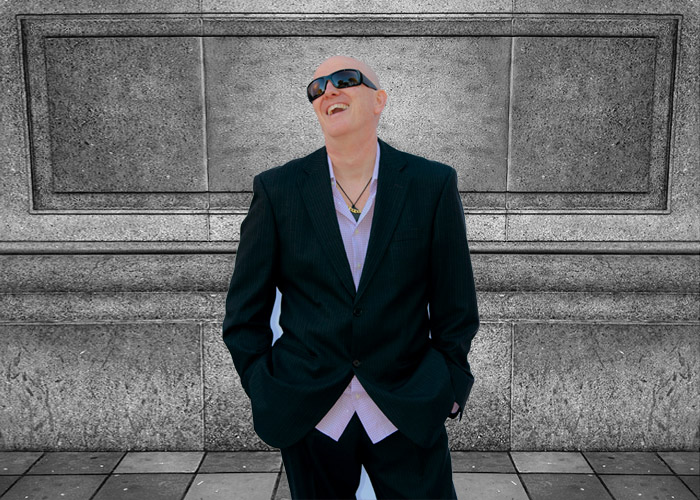
The third image is my professional image. This image represents to me my professional image. Having spent a large part of my career in business development, management and Corporate Governance , I chose the more formal backdrop that could be found on a building found in the financial district of a city. However to contrast this backdrop given my current field of practice is within the Creative Industries, a profile shot that was professional but relaxed, and expressing gratitude and happiness was selected. At the time of this particular photo being taken I was actually thinking about how grateful I was for the abundance of opportunities and successes I have had in my life. I use this image as my profile image on my Linked-In account [Linked-In/David L Page]
As a creative practitioner I immerse myself proactively in all practice-related endeavours. I use social media in support of my practice.The sites I choose, the images I select to represent my identity in those particular forums, and the practice I engage through each site such as blogging and curating of text, video and audio resources related to my broad practice are all very deliberate actions, and must work together to reinforce the coherent image and brand that connects these multiple mediums. In this aspect of my music practice, new facets of myself and in turn, new distinctions regarding my practice are revealed. In this way the dynamic relationship between my self and my practice is demonstrated – my self informing my practice, and in turn, my practice informing my self and my identity.
This blog series is planned to continue with Media Identity & Curation Part 2 (Page 2014b). It is intended for this blog series to continue on a regular basis as I progress through my doctoral research project.
References
Chet Atkins Official Website. 2014 http://www.misterguitar.us Accessed 16th October, 2014
Les Paul Biography. 2009. http://www.biography.com/people/les-paul-9435046 Accessed 16th October, 2014
Page, David L. 2014 David L Page’s About.me site Accessed 16th October, 2014
Page, David L. 2014. David L Page’s Google Scholar site Accessed 16th October, 2014
Page, David L. 2014. Life is About the Moment 20/09/2014 Tumblr and WordPress.com blog. Accessed 16th October, 2014
David L Page’s Linked-In site: David L Page’s Linked-In site Accessed 16th October, 2014
Page, David L. 2014. Media Identity & Curation Part 2 18/10/2014 WordPress.com blog. Accessed 13th November, 2014
Page, David L. 2014. David L Page’s Pinterest.com site Accessed 16th October, 2014
Page, David L. 2014. David L Page’s Twitter site Accessed 16th October, 2014
Page, David L. 2014. Music Practitioner Part 2 Accessed 16th October, 2014
Page, David L. 2014 David L Page’s WordPress site Accessed 16th October, 2014
Page, David L. 2014. David L Page’s You-Tube Channel Accessed 16th October, 2014
– ©David L Page 18/10/2014
– updated ©David L Page 15/11/2014
– updated ©David L Page 15/05/2016
Copyright: No aspect of the content of this blog or blog site is to be reprinted or used within any practice without strict permission directly from David L Page.
Life is about the moment…..

This blog is a continuation of a series. See here for the previous blog.
at any point in time…..
Life is about the moment ….. all things fluid……. experiencing the moment… listening, observing, interacting, laughing, loving, enJOYing, soaking the moment in, digesting it, considering it, reflecting …. expressing ones’ being, streaming ones’ consciousness. While in the moment, everything appears suspended – almost in slow motion – and yet is still very much part of life and moving somewhere… Education is about learning to learn, developing and expressing … often introspectively, learning about oneself, our boundaries, beliefs, values, languaging, thoughts, & feelings ….. discovering & then developing our voice ……. who we are and how we fit into the universe… Music and audio for me is the sum of both life and education. Songwriting, composing, recording, arranging, mixing, and performing is about being in the moment ….. being fluid ……. and yet also, learning, developing and expressing myself…… discovering & then developing MY voice ……(Page 2014b).
This blog series is planned to continue next month with Music Practitioner Part 2.
References
Page, David L 2014a Music Practitioner Part 1 Accessed 20th September, 2014
Page, David L. 2014b. Life is About the Moment 20/09/2014 Tumblr and WordPress.com blog. Accessed 20th September, 2014
Page, David L 2014c Music Practitioner Part 2 Accessed 20th September, 2014
Water image courtesy of: David L Page’s About.me Accessed 20th September, 2014
– ©David L Page 20/09/2014
– updated ©David L Page 05/10/2014
– updated ©David L Page 15/05/2016
Copyright: No aspect of the content of this blog or blog site is to be reprinted or used within any practice without strict permission directly from David L Page.
Mixing Part 7 – Following a process….
Mixing
This blog continues a series of blogs on Mixing (Page 2014).
Developing a skillset by following a process
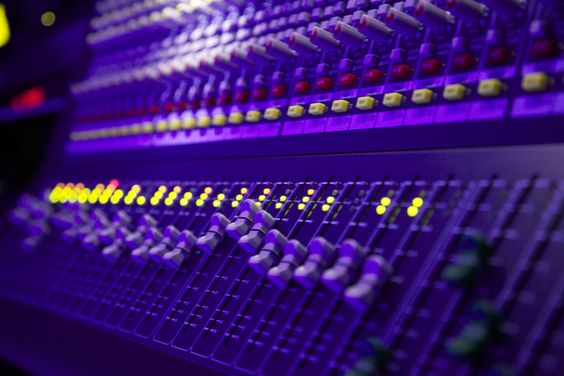
(MIDAS 2014)
I was presenting to a group of Bachelor of Audio Trimester 2 students, preparing for the mixing stage of their final creative productions. In reflection, I felt a similar sentiment as my blog last year, ”Effectively guiding creative artists through a task: process” [May 2014]. In summary, the key elements are:
Mixing is a process…..
1) Yes mixing is individual, but it is an individual process based on developed workflows accumulated over many hours of experience…
2) The ONLY thing that separates different mixing engineers is their perspective …. what they are aiming to achieve. What are you aiming to achieve in your mix? Can you articulate that aim clearly? Have you nominated a reference track as your guide through this process?
3) Genre dictates in large part what workflow you choose. The mix process (workflow) you choose should be congruent to the genre.
4) For every workflow choice, there is a positive and a downside to that process. What provides you the most benefit, with the least amount of negatives in your desired aim, for your desired outcome?
5) There are no rules, BUT like all things technical and creative, there are fundamentals that you need to develop – learn, and practice – BEFORE you commence to attempt to discard them. In the previous blog (Page 2014), I proposed Owsinski’s Mixing elements as a very worthy guide.
6) There are a diverse range of mixing approaches put in front of you, with diverse perspectives, views, and workflows. There is NO correct workflow. You are shown options, for you to decide for yourself what workflow will work for you. If in doubt though, through your lack of time to develop this skill thoroughly yet, then please consult Owsinski’s Mixing elements as a very worthy guide (see point 5)
It is intended for this blog to continue in a series of Mixing blogs here.
References
MIDAS 2014 console image courtesy of AE Project Studio. Accessed 29th June, 2014
Owsinski, B 2013 Modern Mixing Techniques, Cengage Learning, Inc USA
Page, David L. 2015. Post-Production Instrumental Editing + Processing Options Accessed 22nd January, 2015
Page, David L. 2014. Mixing part 6 – effectively guiding creative artists through a process Accessed 29th June, 2014
– ©David L Page 19/07/2014
– updated ©David L Page 22/01/2015
Copyright: No aspect of the content of this blog or blog site is to be reprinted or used within any practice without strict permission directly from David L Page.
Mixing Part 6 – Effectively guiding Creative Artists through a process
Mixing
This blog continues a series of blogs on Mixing (Page 2014a).
Guiding Creative Artists: steps along a path
To walk down any path, it is usual to be sequential in that process. If you want to get to z, it is usual (but not always) appropriate to progress through each of the letters to get there. a , b ,c ,d, e, f, g, h, etc… To follow the suggested steps – a series of steps to follow, observing what is around you – you can generally arrive at your destination in a timely manner. As you develop, it is of course important to sometimes stop or even perhaps deviate on the set path, and to experience what occurs when you attempt a, b, c, d, etc in a natural logical sequence; and when you do not follow such a logical sequence. What is the result of following a before b, b before c, etc – or not?
As we get to the business end of yet another Trimester, I observe our Creative Media students again getting quite angst with their attempts to mix their final productions. I observe that most are yearning for what is actually a very straightforward process. Following suggested the steps – a series of steps that has been provided across several Modules to follow and experiment with, observing what occurs when they attempt a, b, c, d, etc, and understanding that in many instances, a must come before b, b before c, etc.

Whether myself, my peers or my students – in a studying phase or in our professional lives – it seems to be common amongst most of us to want some guiding process or sequence that we can initially follow, at least until we can get comfortable with the task, and then feel confident enough to be able to fly on our own, and then possibly self-empowered enough to customise the process into our own individual unique workflow. Not necessarily process in specifics or for what could be classified as micro-management, but process in terms of the introduction of a concept for global understanding, with a series of logical process steps to be able to realize the task at least all the way through.
Over recent weeks, as I have again introduced a group of novice audio production students to the art and technique of mixing in a Tri 1 Bachelor’s unit, I was reminded of how overwhelming such a task is. Initial questions most common continue to be: “how do I EQ?”, “what do I compress?”, to “what EQ works on a kick drum?”, to “does EQ come before compression?”, to name a few.
(MIDAS 2014)
Leading audio production author Owsinski outlines in his book “Modern Mixing Techniques” the steps and elements of mixing that he sees as common to all mixes are:
-
session set up,
-
gain structure,
-
stereo balance,
-
spectral,
-
dynamics,
-
time-domain, and
-
interest (Owsinski, 2013).
In my observation of those far more experienced in the audio industry, it is usually the fundamentals of: deciding upon a reference track, setting up your session, and setting your gain structure and balance first, that get the most immediate attention. The completion of these fundamentals, allowing the mix engineer to progress through a workflow, seems to be consistent to successful mixing sessions. In fact, it is quite often the case with a well played and recorded session, that once the fundamentals have been completed, the experienced mix engineer may only need to use minimal audio processing at best, because the mix is already sitting nicely where it is, with all of the instruments placed within their own space, at good levels, negating the need for further attention and processing.
In contrast, in general the novice will overlook these fundamentals, eager to dive into what they perceive as mixing, applying audio processing, inserting as many plug-ins as they can, and start turning the EQ and Dynamic pots to extremes until they achieve obvious changes in sonic qualities. However, quite often as a result of their actions, the overall gain structure and stereo image is now adversely affected, presenting a range of other issues within the mix such as clipping, distortion, raised noise floor, lack of clarity, masking and possibly also unacceptable degradation of the audio quality: quite possibly, the exact opposite of what they were trying to achieve from the outset.
At this point, it is then not uncommon for the novice to exhibit a range of responses with their first mix task attempt: confusion, overwhelm, becoming debilitated with the task at hand, to panic, immediately re-entering the deep end and start randomly pushing more buttons, ‘knob twirling’, and adding even more audio processing devices trying to fix what they have created.
And yet, when they next have the opportunity of observing an experienced mix engineer approaching a mix task, what they are likely to witness is someone proceeding through a flurry of steps, moving swiftly, effectively and efficiently through a series of sub-conscious moves, as they progress through their customised workflow, developed over many hours, and countless mix session tasks. Essentially, the experienced mix engineer will have a clear goal of what they are trying to achieve and a clear roadmap of how they are going to achieve it.
I can guarantee such experienced activity necessitates commencing with the fundamentals.
In my observation, a novice creative artist may not understand the need or function of having a clear goal of what they are trying to achieve, before they commence the task. If you do not know what you are trying to achieve, most will probably end up somewhere other than where they wanted to. And whilst this may not be problematic in a creative streaming situation, it will not assist the creative artist if they need to be working to a brief for an external client (quite possibly, merely their Lecturer for the achievement of an assessment task).
Additionally, a novice creative artist may not have a clear roadmap of how to get to their goal. The fundamentals, a series of steps that allows the artist to progress sequentially through the task at hand, increasing the possibility of an outcome in the vicinity of what they were attempting to achieve. I have found that positive questions that assist in this stage need to be process-based questions such as: “now, what do I need to do first?” “then?” “then?”
I have also found a secondary benefit that this fundamental stage facilitates. It seems to assist the novice creative artist to catch their breath, ground themselves and focus before they immerse themselves into the technical and creative task at hand. Once they commence the task, the goal should be to move effectively and efficiently through a series of steps to a desired outcome (‘goal’).
The fundamentals are an ideal place for the novice creative artist to commence a technical and creative task, at least until they can get comfortable with the task, then feel confident enough to be able to fly on their own, and then self-empowered enough possibly to customise the process into their own individual unique workflow.
It is intended for this blog to continue in a series of Mixing blogs here (Page 2014b).
References
MIDAS 2014 console image courtesy of AE Project Studio. Accessed 29th June, 2014
Owsinski, B (2013) Modern Mixing Techniques, Cengage Learning, Inc USA
Page, David L. 2014b. Mixing Part 7 Accessed 19th July, 2014
Page, David L. 2014a. Mixing Part 1 Accessed 13th April, 2014
Stone path in creek image courtesy of: aisf.or.jp accessed 5th May 2014
– ©David L Page 14/05/2014
– updated ©David L Page 19/07/2014
Copyright: No aspect of the content of this blog or blog site is to be reprinted or used within any practice without strict permission directly from David L Page.
Introduction to Audio Engineering
Welcome to Audio Engineering and the world of studios. A studio represents different things to different people. Some see it as a technical place to track and mix artists’ expression (Burgess 2014; Burgess 2013; Burgess 1997). Others see a studio as an instrument, in which to develop an artist’s ideas into something more, possibly fusing several musical styles into a new genre (Eno 2004; Eno 1982). Irrespective of your perspective and motivation, one needs to start at the beginning – the fundamentals.

(Hans Zimmer home studio)
Knowledge and Skill base required
The practical knowledge and skillset required of an Audio Engineer/ Producer is both vast and very complex. In addition to the knowledge and skillset of mixing and recording, both in themselves very involved and potentially taking years to master, there are a range of other knowledge and skills required. There is a range of equipment to know about, and theories required to know the studio environment, and to be able to succeed in this position on a professional basis.
Whilst there is a common industry view that perhaps there is less onus on being an engineer in the original sense of the word in terms of analogue gear and being able to fix that gear in this era, I would argue that the extent of knowledge and skills required is no less vast and complex. In fact, I would argue that with the development of audio gear in this digital era, there is a broader knowledge and skillset base required than was previously required. Some of the aspects a budding Audio Engineer/Producer must become quite conversant with are:
Step 1
-
Firstly, one must understand a generic Studio Setup
-
Then one must learn the specifics of the particular Studio Setup. For example: the console, patchbay, interface, computer system, and assorted outboard peripherals
Step 2
-
Secondly, one must understand a generic Signal Flow of a console
-
Then one must learn the specifics of the particular console in the studio you are going to use. For example: MIDAS Heritage 1000 , Neve VXS, SSL AWS 948, API Legacy, Amek Media 51, Euphonix System 5, Audio ASP8024, Behringer Eurodesk SX4882 or Behringer X32
Step 3
-
Thirdly, one must understand a generic audio interface, and what role it plays in the signal path of a modern studio (AD/DA)
-
Then one must learn the specifics of the particular audio interface (AD/DA). For example: Avid HD 16×16, Apogee Symphony, Antelope Audio Orian 32+, Universal Audio Apollo, Apogee Ensemble, Focusrite Saffire, Focusrite Scarlett, Fireface 800 or PreSonus Studio 192
Step 4
-
Fourthly, one must understand a generic Tape Device
-
Then one must learn the specifics of the particular tape device, whether magnetic or virtual tape. For example: Avid Pro Tools, Logic Pro, Reason, Ableton Live, FL Studio, or Reaper.
Step 5
-
Fifthly, one must understand generic principles behind peripherals for audio processing (outboard gear, etc), why we should use them, when we should use them, and how we should use them
-
Then one must learn the specifics of the particular peripherals for audio processing in the particular studio. For example: Teletronix LA-2A, Urei 1176, Fairchild 670, Tube-tech CL1B, Manley ELOP+, Neve 2254, DBX 160, Empirical Labs Distressor, SSL-G Series Bus Compressor, Manley Variable MU limiter, Chandler EMI TG1, Alesis 3630, API 3124+, Eventide Reverb 2016, Focusrite Octopre MkII Dynamic, or Behringer MDX2600 Composer
In addition to this studio environment knowledge base and skillset required as outline above, more than likely one will have to contend with the various one-off technical issues that will happen from day to day with either electrical or mechanical equipment limitations and/or malfunctions. As we each experience on a daily basis, these can be very prevalent and disrupt even the best laid plans for a mixing or recording session. There are a range of issues that can happen at any point in time in a studio, and therefore the modern day Audio Engineer/Producer must have a broad knowledge and skillset base in order to problem solve through these issues in order to move on with the object of the session; either to record, or to mix.
I have deliberately overlooked mentioning the additional soft skills knowledge and skillset required of an Audio Engineer/Producer in terms of daily interacting with people related to the studio environment. These soft skills include communication, negotiation, patience and social skills. Whilst extremely important knowledge and skillset to have, they could be considered to be beyond the realms of an industry-based subject matter expert (SME) in this discussion.
Additionally, if you are recording and mixing, then most assume that the modern Audio Engineer/Producer/producer must have a degree of understanding and skills in the creative arts processes of: songwriting, music, arrangement, and/or instrumentation to draw on as may be required for the client.
Therefore, in conclusion in this brief discussion, the practical knowledge and skillset required of a modern day Audio Engineer/Producer is still to this day very vast and complex.
A budding Audio Engineer/Producer must develop a very broad knowledge and skillset base across the disciplines of the industry subject matter, the broader relevant Creative Arts and the soft skills; in order to operate within and around the studio environment, and to be able to maximise their chance of developing a successful professional career as a Audio Engineer/Producer.
References
Burgess, Richard James. 2014. The history of music production. New York: Oxford University Press.
Burgess, Richard James. 2013. The art of music production: the theory and practice. New York: Oxford University Press.
Burgess, Richard James. 1997. The art of record production. London: Omnibus Press.
Eno, Brian. 2004. “The studio as compositional tool.” In Audio culture: readings in modern music, edited by Christoph Cox and Daniel Warner, 127-130. New York: Continuum.
Eno, Brian. 1982. Ambient 4: on land. Editions EG. Compact Disc.
Hans Zimmer’s home studio image courtesy of: http://www.scpr.org/programs/the-frame/2015/01/20/41178/interstellar-composer-hans-zimmer-says-hollywood-i/?slide=2 Accessed 12th December 2015
– ©David L Page 09/05/2013
– updated ©David L Page 27/01/2016
Copyright: No aspect of the content of this blog or blog site is to be reprinted or used within any practice without strict permission directly from David L Page.
Mixing Part 1
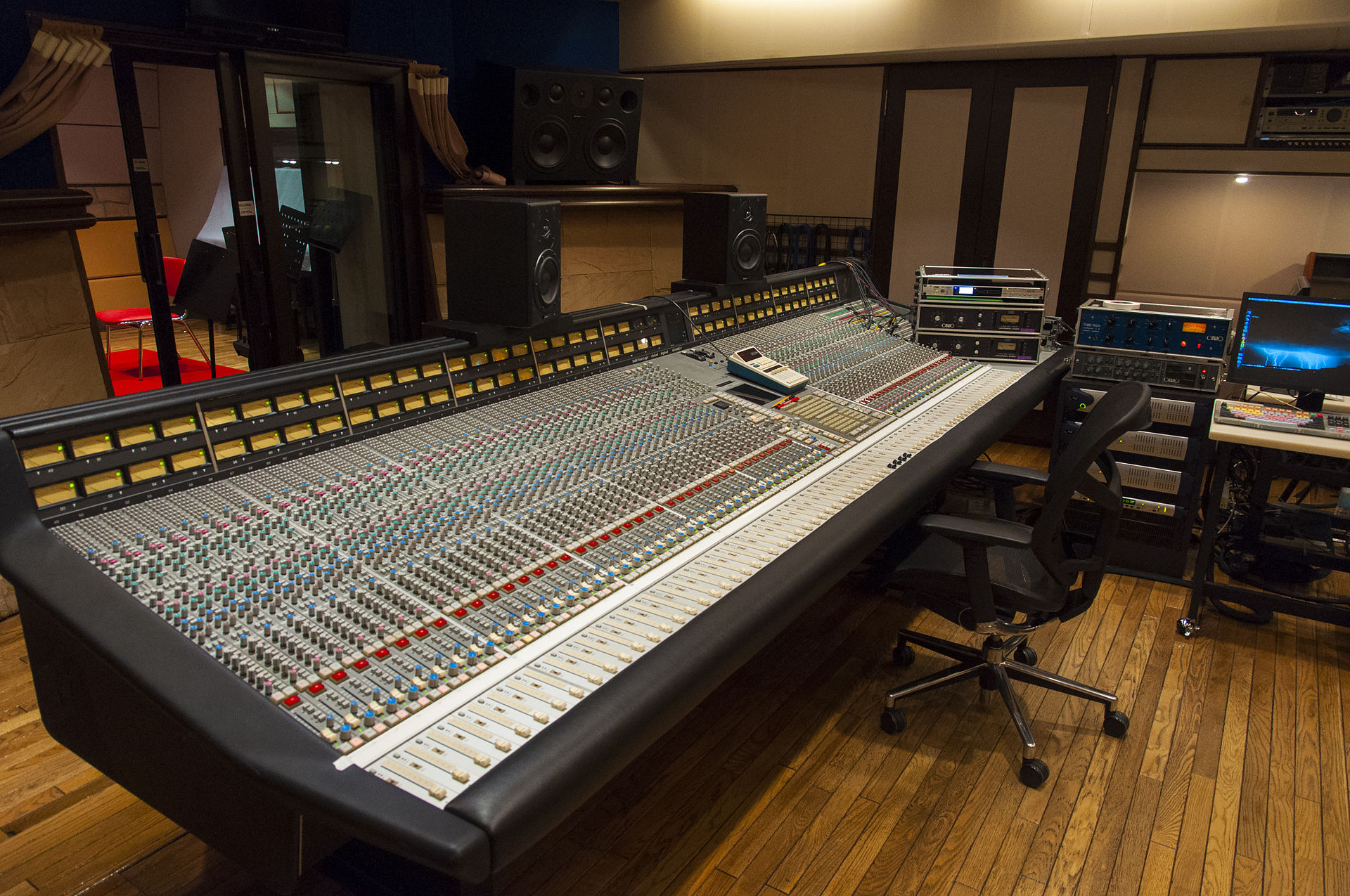
(Solid State Logic SL4064G+ 2010)
The Mixing Process
Background
As outlined in my Pre-Production Plan (Page 2010) blog several months ago, lets return to the basics. It is the goal of the audio industry to facilitate to the realisation of recorded artefacts – recorded and then distributed in the mediums of shellac or vinyl records, magnetic tapes, compact discs and now more commonly as wav or MP3s. Within the process of producing these artefacts, there are considered to be three stages of the production process:
-
The pre-production stage;
-
The production stage;
-
The post-production stage.
Whilst there are blurred lines between several of these stages depending upon what musical style (genre) one is working within, the acoustic style recording process essentially adheres to the following three stages:
-
The pre-production stage is about planning for the production of the artefact
-
The production stage is the actual recording process of the artefact. This process is commonly referred to as the tracking
-
The post-production stage follows the tracking stage, preparing each track so that it is well balanced in terms of instrumentation, levels, frequency and dynamics – in preparation for the final step of this stage – the mastering process – prior to the artefact being released to the public
At the heart of the production lies the actual reason for the artefact – the song or composition. This focus – the main reason for the production process – needs to be maintained throughout the creation of the artefact process. It must not become secondary to the process. It is often said that that to make a great song, you need to have:
-
a great song;
-
great instrumentation;
-
a great performance;
-
a great recording;
-
a great mix;
-
and great mastering.
Step 1: the artist creates a song in terms of melody, harmony, rhythm, counterpoint melodies, counter-point rhythms and instrumentation – creativity following both technical and musical theory guidelines. This is then practiced and adjusted or moulded as required.
Step 2: the song then needs to be arranged, with appropriate instrumentation relative to the musical style (genre) of the song.
Step 3: once the song is considered to be finished, it needs to be recorded. An essential aspect of the production process is the performance of the musicians used in the tracking process. If the musicians are both technically proficient and aesthetically sensitive, then there is hope that the song could be captured as the songwriter or composer had intended the song to be. A great song needs to be performed in the best possible way in order for that song to stand and be considered as it was intended.
Step 4: Whilst there are a number of approaches to the recording process, one usual approach is to capture the instruments as they were intended to sound. In this recording approach, the recording process is fundamentally a technical process; with the recording objective being to capture the song as close to as possible the pure or natural sound or tone of the instrumentation being recorded. In this recording approach, whilst some creativity can be used to get pre-desired effects, recording is fundamentally a technical process to capture the pure or natural sound or tone as being played. Note: if your offer to an artist is ‘to record them’, then this is the step at which you provide them whatever assets you have as a result of the recording, or production process. To go to the next step is to provide them ‘a mixed song = a produced song’, an entirely more complex and time consuming process…
Step 5: Once this recording, or production process is complete – ie not further recording is required – the song needs to be mixed.

The Mixing Process
It is the role of the mixing engineer to take all of the recorded tracks and commit each of them to a final mixdown, in order to realise the pre-agreed qualities of the required end goal – the sum total of these tracks as being part of the cultural production artefact – in a balanced manner. This is the goal – the target – of mixing.
Mixing involves working on each track independently. Mixing is a constructive, engineering process, considering each of the recorded sound source elements – usually, but not necessarily, the instruments – that have been captured to tape as part of the tracking process. As outlined by Ownsinski (2013), the mixing process includes adjusting the amplitude levels and panning each instrument within each of these tracks, allowing each instrument to be heard within the balance of the mix – to sit within its own space – spectrally and dynamically. The mixing engineer usually also adds processing – sonic and automation –to the recorded process to embellish the tracks sonically and musically.
The mixing process therefore is both a technical and a creative process.

The mixing process is considered to be a technical process in terms of any auditory or sonic corrections required from the recording (tracking) process. This is usually required if for any reason there are deficiencies in either the recording or performance equipment; or the tracking or performance process. A mix engineer may assess the recorded assets as being deficient in either amplitude, their stereo position, or the actual recorded frequency range of the particular instruments.
The mixing process is considered to be a creative process as the mix engineer can influence the final tracks, by determining the relationship between multiple musical and sonic captured sound sources within the one track. Moylan (1992) agrees mixing is both a technical and an aesthetic process. Mixing requires the creation of a sound stage – width, depth and height – that is both congruent to the genre, but also allows the mix engineer to transport the listener to a land that they imagine, an environment that is congruent for the artist and the cultural production to exist. A good mixing engineer arranges the sound sources in a way that creates moments of interest for the listener, that engages them without them necessarily being conscious of the manipulation. Sometimes the mixing engineer may decide it is necessary to take what could have been a pure or natural sound or tone, and dress it up for the desired outcome – usually, for an audience’s entertainment. The degree of dress up used by a mixing engineer should be guided by the pre-agreed qualities of the required end goal; but often an experienced mix engineer is recruited for their experience and creativity. In this case, they will use techniques to create a soundscape – breadth, height, depth and dynamics -, along with a range of processing and automation techniques to add colour, interest, texture, space to highlight the existing or original song hooks, and also to add a range of extra hooks. There are after all, many options in the creative process.
However, as mixing involves working towards an end-goal of a cultural production where all of the sounds and tracks work as a homogenous whole, it is important that the mix engineer progressively builds a mix to a pre-agreed aesthetic. In order to facilitate this process, it is necessary to use a reference track to guide all of the participants in the production process at every step of the process. This reference track will suggest what type of song they are producing, the musical style (genre), the balance of what the finished tracks should become, and the degree of production creativity that it appropriate to include in the particular track. The pre-agreed reference track is especially important within the mixing stage. The mixing engineer will use a reference track – a track that they can make reference to regarding the overall balance of the desired artefact – as an agreement with the person directing the production process (known as key stakeholder – possibly the song-writer, artist, manager or record label owner) – of what this end-goal, the cultural production will sound similar to, musical style-wise, musically and sonically.
It is intended for this blog to continue in a series of Mixing Part 2 blog (Page 2025).
References
Izhaki, Roey. 2013. Mixing audio: concepts, practices and tools. 3rd ed. Oxford: Focal.
Moylan, William. 1992. The art of recording: the creative resources of music production and audio. NY: Kluwer Academic Pub.
Owsinski, B 2013 Modern Mixing Techniques, Cengage Learning, Inc USA
Page, David L. 2014. Mixing Part 6 Accessed 19th May, 2014
Page, David L. 2010. Pre-Production Plan – Part 1 Accessed 10th December 2010
Roback, Steven. 2004. Pro-tools 6 for macs. NY: Peachpit Press
Senior, Mike. 2011. Mixing secrets for the small studio. Oxford: Focal Press.
Target image courtesy of: http://www.clipartpanda.com/clipart_images/target-skills-53658831 Accessed 12th May 2014
Solid State Logic SL4064G+ image courtesy of: SSL 4064 Accessed 10th December 2010
– ©David L Page 15/12/2010
– updated ©David L Page 10/04/2013
– updated ©David L Page 14/05/2014
Copyright: No aspect of the content of this blog or blog site is to be reprinted or used within any practice without strict permission directly from David L Page.
Educational Philosophy Part 1
Educational Philosophy
Education, training and learning is about achieving a specific intended end goal for a group of learners; and having the learners attain the learning outcomes of a particular discipline (Bowe et al 1992).

At the core of education, training and learning lays the education philosophy of the institution, which is then embedded within the curriculum – embedded within the design of the curriculum. Once the curriculum is designed, then the teaching program can be developed, and then the individual lesson plans can be drafted.
Designing the curriculum is the starting point of any effective student learning experience. The program should then effectively enable the educator to facilitate positive and effective learning experiences. In contrast I would extend this to say, in my experience, that for every poor student learning experience, irrespective of the situation, there is an ineffective curriculum design. Further, in these situations I have experienced usually has a lack of developed or appropriate educational philosophy for the institution. This core reason for the organisation being lays within the executive leadership of the education institution. It would be of major concern to the organisation or institution and its future prosperity, if such an educational philosophy was either inappropriate, lacking or at worst, non-existent.
Educational Approaches and Learning Theories
To enter into the world of education and training, it is often challenging for an aspiring educator to become familiar with the scientific disciplines and the extensive list of learning theories. Millwood (2013) in his project Holistic Approach to Technology Enhanced Learning (HoTEL) outlines twenty five (25) differing learning theories (red colour boxes) commonly referred to in the filed of education and educational practice. It is an exhaustive summary of contemporary educational practice – an excellent summary for aspiring or developing educational practitioners. Listed are twenty-two (22) learning paradigms (blue colour boxes) across 9 scientific disciplines (bone colour boxes), and ten (10) key concepts (green colour boxes).

Figure I: Millwood’s Learning Theories ‘HoTEL’ (2013)
As the chart visually highlights, there are many different approaches, all potentially useful depending upon the context, the educator or facilitator and the desired outcomes, and the learners. It would be foolish, and I believe the voice of inexperience for anyone to suggest one discipline and learning paradigm as being superior to another. They are different, and have developed as a result of different needs in different situations with different practitioners for different learners.
I have been fortunate in my educational practice career to have taught across different eras, in different environments and situations, for different desired outcomes, and to vastly different sets of learners. I have therefore had the privilege to develop a diverse range of educational practice, across many different learning theories. Whilst I have written about a number of these previously (see education and learning blogs), the particular learning paradigm I want to focus on in this blog is based on the learning paradigm of organisational learning (lower left area of Millwood’s chart).
Organisational Learning
Generic organisational learning has occurred throughout history, but perhaps most significantly since the industrial era with industrial-based companies trying to maximise their production economies of scale. A more recent significant contributor was US-born Edwards Denning’s systemic management approach, embraced by post-war Japan in the hope that such a process could assist them in their goal to rebuild their country and recover economically (Walton 1988). The underlying principle of Denning’s approach was one of constant improvement within an organisation. All staff were encouraged to provide their particular insight into the organisation’s operations; to make suggestions for change to any aspect of the organisation that they believed could be improved to make the organisation’s products and services more efficient and effective (Walton 1988,55). Each of the suggestions were then considered on their merits, with line management selecting those suggestions that could have most significant or immediate benefit to the product or service process. Many innovations occurred during this time in their production systems, providing Japan’s industry with efficiencies across all levels of organisations that had not yet been considered in US production facilities at that time (Walton 1988,18). [The irony of this is that a number of US corporations had originally rejected Denning’s systemic management approach prior to him turning to Japan as a potential adopter].
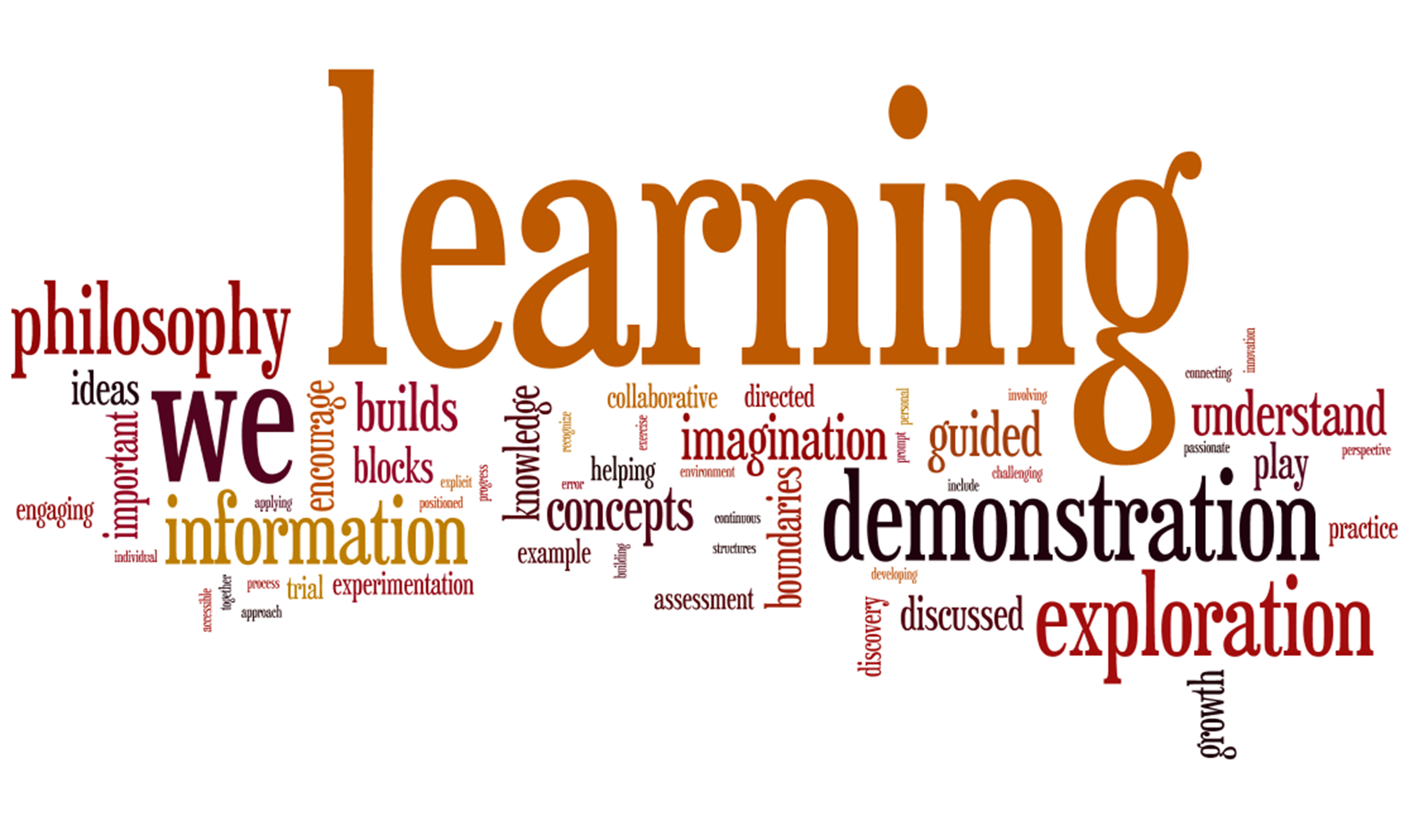
The organisational learning theme continued throughout the 20th Century with systemic management approaches of one form or another being adopted and implemented in most first world countries’ medium to large organisations. As organisations developed to become far more sophisticated, research of organisational learning developed into more discrete areas of organisations including how information flows, is processed and knowledge created. Nonaka et al proposed analysis of such organisations “in terms of its design and capability to process information …… constitutes an important approach to interpreting certain aspects of organisational activities” (1994, 338). Nonaka and Takeuchi continue the organisational learning theme examining how an organisation creates, maintains and exploits knowledge within that organisation”(2000, 5) .
In this era of organisational learning and development, the motivation is quite different. This time there was not the urgency to rebuild the nation’s economy post-war, but equally important from a corporate management point of view. To create organisational efficiencies, to continue to compete globally against market competitors within the constantly changing global economy (Hersey 2008).
Learning Organisation
As we entered the 21st Century, Senge (2006) offered a developed modern take on organisation learning in what he referred to as a learning organisations. That is, organisations that structurally and culturally developed, organically, beyond what the everyday management was directing the staff to do. Senge’s model was to create a dynamic cultural organism, that could develop, innovate and adapt as environmental circumstances changed. The environmental circumstances could include either global events, government policy, industry developments, or social or cultural trends (ie: the actual or potential clients). The key assets of a learning organisations were highlighted as: culture, physical, systems/processes, human capital, and leadership. Such a view contrasts to a more conservative corporate view.
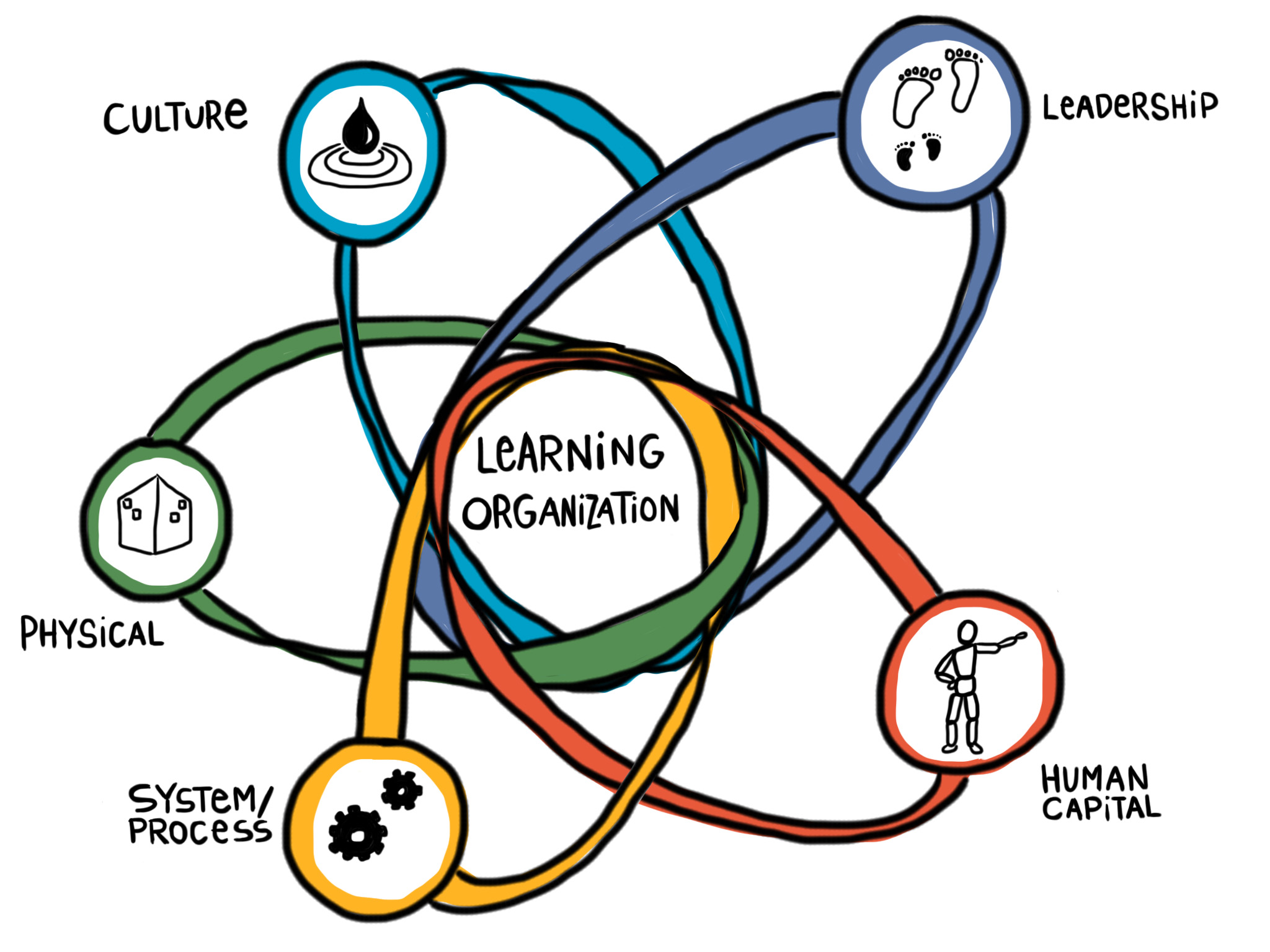
Senge’s Learning Organisation (2013)
Senge’s Learning Organisations carry forth the tradition of the Denning Management Method core of constant and never-ending improvement, something that has become synonymous with the developing economies in Asia, commencing with the Japanese rebuild post-war. Such an approach accepts that learning in never complete; that advantage is never won, and that humans should never cease to innovate. As a necessity, humans need to continue to develop themselves, in order to continue to challenge themselves, in order to continue in the space and attitude of innovation.
Senge outlines learning organisations are those that include a culture where: information is shared; learning is emphasised and valued; where mistakes or failures are encouraged for what they are (ie: a learning experience, and therefore they are not punished); where people are not only encouraged, but expected to constantly learn.

Learning Organisation infographic (2013)
The objective is similar to previous innovative organisational approaches, to maximise the sustainability of the organisation. However, this approach acknowledges the importance of maintaining highly engaged members of staff that can then maximise the innovation within the organisation of its products and services, and its engagement with society. Senge lists five disciplines that are vital dimensions in building organisations that can truly “learn, that can continually enhance their capacity to realise their highest aspirations” (2006, 6):
-
systems thinking – understanding that business and human endeavours are systems, intertwined by interrelated events
-
personal mastery – a special level of proficiency. “Personal mastery is the discipline of continually clarifying and deepening our personal vision, of focusing our energies, of developing patience, and of seeing reality objectively” (Senge 2006, 7)
-
mental models – ingrained assumptions, generalisations, images of the world. Our beliefs and cultural paradigms.
-
building shared vision; is there an owned joint vision of the organisation?
-
team learning – is the collective IQ of the organisation greater than the sum of the individuals?
Finally, another primary value of a learning organisation is benchmarking. Benchmarking is the practice of referencing one’s practice against another’s practice within a similar field or discipline in order to gain greater understanding or advantage for development and improvement of the practice over what they are currently achieving (Hersey 2008). Benchmarking is best practice and is an accepted management approach to attain success, whether as an organisation (eg: banking), or as an individual (eg: sportsperson or artist)

Learning Organisation benchmarking (2013)
My Practice as a Learning Organisation
My approach to my practice – irrespective of whether it is my practice as an educator, mentor, musician or engineer – share many of the same characteristics Senge outlines. As previously mentioned (see blog), I have practiced across a range of countries, industries and organisations.
I am very self-reliant practitioner, with my over riding philosophical stance embracing the 10,000 hours trades philosophy of skilled craftworkers (Ericsson et al 1993). In both myself and others, I value and believe in the merit of the the development of a skill, a trade, a craft, or art – for that practitioner developing specialist knowledge and tools over many thousand’s of hours of practice, to ultimately express one self through the development of a uniquely personalised quality end product. I accept at last that this is integral to how I conduct my self in my practice and life.
I consider my practices are dynamic cultural organisms, that develop, innovate and adapt as environmental circumstances change. The environmental circumstances have been known to include global events, government decisions, industry or company policy, industry developments, social or cultural trends, and the customers/clients I am engaging with. The site may change, but my approach within the organisation or to the client does not.
The key assets of my practice are: culture (I have developed an organisational culture ethos document), physical (my nominated physical sites of practice), systems/processes (my diverse range of processes across all of my practices), human capital (the sum total of my self – my experience, my education and training received, my life and skills development), and leadership (my self as a leader – along with my core traits and approach).
Senge’s Learning Organisation (2013)
My practice consciously carries forth the tradition of the Denning Management Method core of constant and never-ending improvement. Such an approach accepts that my learning in never complete; any advantage is never won, and that I as a human should never cease to innovate. As a necessity, I am of the belief that I want to continue to develop my self, in order to continue to challenge my self, in order to continue in the space and attitude of innovation.
My practice includes a culture where: information is shared amongst my practice colleagues; learning is emphasised and valued; learning experience is valued, and therefore mistakes or failures are not seen as negative events); where I encourage my self on a daily basis, but more so, accept that I am in this space as a human, to constantly learn.
My objective for my practice is to maximise the sustainability of the practice. I acknowledge the importance of maintaining my self as a highly engaged practitioner, in order to maximise the innovation within the practice of its products and services, and its engagement with my practitioner network.
Senge’s list of five disciplines (2006, 6) are all present within my practice:
-
systems thinking – I understand the systems of my practice, intertwined by interrelated events;
-
personal mastery – I constantly aim for an ever deepening level of proficiency;
-
mental models – I am clear as to what is, and understand my ingrained assumptions, generalisations, images of the world, my beliefs and cultural paradigms;
-
building shared vision – I possess a singular vision of my practice;
-
team learning – I believe that the collective IQ of the practice is greater than the sum of the individuals of my practice
The remaining primary value of my practice is benchmarking. Benchmarking is my practice of referencing my practice against another’s practice within the similar fields and disciplines of my practice to gain greater understanding or advantage for development and improvement of my practice over what I am currently achieving (Hersey 2008). I accept benchmarking is best practice for a practitioner.
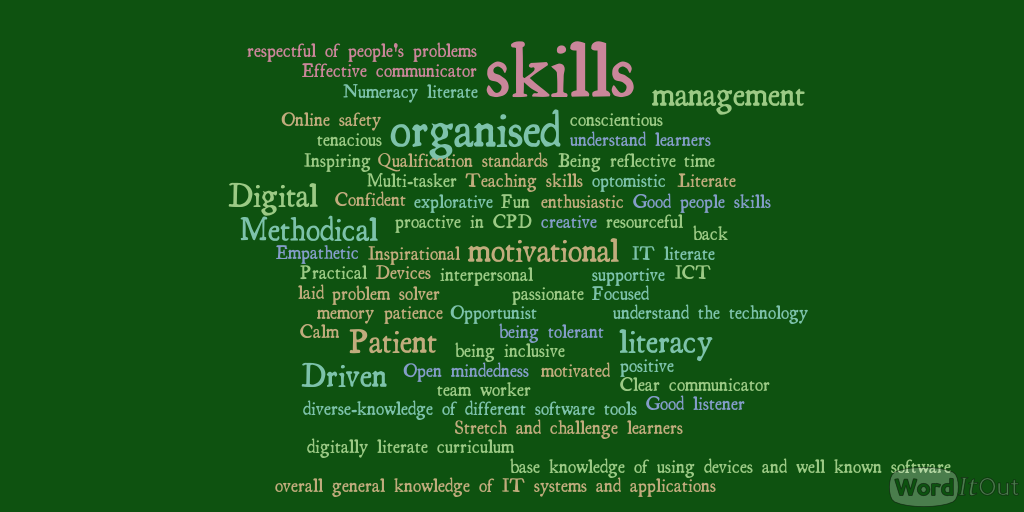
Conclusion
My life philosophy is one of constant and never-ending improvement. It has been consciously so for over the past decade. Irrespective of what field or discipline I am operating within, I focus every day at some time, reflecting upon some aspect of my diverse practice referenced against other practitioners, whether peers or those who I value their cultural production, attempting to gain clarity, greater understanding, increased insight, considering possible alternative workflows I could have pursued, and decide what form of practice I will pursue the next opportunity a similar circumstance arises.
My educational practice, how I engage within the site, and with my learners, and in fact how I approach all aspects of my life – my practice, and my self – is within a Learning Organisation paradigm. I have arrived here because of my diverse and broad experience. Similarly, I would encourage all practitioners to embrace new learning paradigms to develop their educational practice to broaden their knowledge and experience. Pursue different environments and situations, different desired outcomes, and to vastly different sets of learners. If you do, I believe you too will have the privilege to develop a diverse range of educational practice, across many different learning theories. As education and training is about achieving a specific intended end goal for a group of learners; and having the learners attain the learning outcomes of a particular discipline (Bowe et al 1992), the broader one’s experience as a practitioner, the more effective one will be at designing a curriculum, a program and a lesson plan for effective student learning experience; and the better your will be a both an educator and a facilitator.

This blog series is planned to continue with Educational Philosophy Part 2.
References:
Bowe, Richard, Stephen J Ball and Anne Gold. 1992. “Reforming education and changing schools.
Ericsson, K.A., Krampe, R.T. and Tesch-Römer, C., 1993. The role of deliberate practice in the acquisition of expert performance. Psychological review, 100(3), p.363.
Hersey, Paul, Kenneth H Blanchard and Dewey E Johnson. 2008. Management of organizational behavior. New Jersey: Pearson Prentice Hall.
Learning Organisation benchmarking image courtesy of: Learning Organisation Benchmarking Accessed 15th August 2013
Learning Organisation infographic image courtesy of: Learning Organisation infographic Accessed 13th August 2013
Learning Philosophy image courtesy of: Learning Accessed 17th August 2013
Learning Theories image courtesy of: Learning Theory v6_Millwood.D2.2.1.20130430 Accessed 15th August 2013
Millwood, Richard. 2013. Learning Theory v6_Millwood.D2.2.1.20130430 Accessed 15th August 2013
Nonaka, I., Konno, N. and Toyama, R., 2001. Emergence of “ba”. Knowledge emergence: Social, technical, and evolutionary dimensions of knowledge creation, 1, pp.13-29.
Nonaka, Ikujiro, Ryoko Toyama and Noboru Konno. 2000. “SECI, Ba and leadership: a unified model of dynamic knowledge creation.” Long range planning 33 (1): 5-34.
Nonaka, lkujiro, Hirotaka Takeuchi and Katsuhiro Umemoto. 1996. “A theory of organizational knowledge creation.” International Journal of Technology Management 11 (7-8): 833-845.
Nonaka, Ikujiro and Hirotaka Takeuchi. 1995. The knowledge-creating company: how Japanese companies create the dynamics of innovation. Oxford: Oxford University Press
Nonaka, I., Byosiere, P., Borucki, C.C. and Konno, N., 1994. Organizational knowledge creation theory: a first comprehensive test. International Business Review, 3(4), pp.337-351.
Onion image courtesy of: Onion Layers Accessed 18th August 2013
Page, David L. 1996. Leadership Part 1 Accessed 18th August 2013
Senge, Peter M. 2006. The fifth discipline: the art and practice of the learning organisation. 2nd ed, Business Books. London: Random House.
Senge, Peter M, A Kleiner, Charlotte Roberts, Richard Ross, George Roth and Bryan Smith. 1999. The dance of change: the challenges to sustaining momentum in a learning organization. London: Nicholas Brealey Publishing.
Senge, Peter M, Charlotte Roberts, Richard B Ross, Bryan J Smith and A Kleiner. 1994. The fifth discipline fieldbook: strategies and tools for building a learning organization. London: Nicholas Brealey Publishing.
Senge’s Learning Organisation image courtesy of: Learning Organisation Accessed 16th August 2013
Skills image courtesy of: Skills Accessed 18th August 2013
Walton, Mary. 1988. Deming management method London: Penguin.
– ©David L Page 19/09/2004
– updated ©David L Page 19/08/2013
– updated ©David L Page 12/04/2020
Copyright: No aspect of the content of this blog or blog site is to be reprinted or used within any practice without strict permission directly from David L Page.
E+L Session Plans Part 6


Education and Learning Session Plans (contd)
There are many forms of Education & Learning Session Plans which I have discussed in E+L Session Plans Part 5. This blog continues the series.
The synopsis plan is the most global of the Education & Learning Session Plans.
DLP’s Synopsis Education & Learning Session Plan
What: This is a precise paragraph of what you are planning to do…..
Possible Use: It is useful as the basis of marketing documents used in the promotion of the event
EG: see below
AUD111 16T1 Wk2 Ed + Learn Session Plan Synopsis:
Program: Bachelor of Audio Degree/AUD111 Introduction to Audio Engineering
Title of Education & Learning Session: Introduction to Signal Flow
Session Number: Wk2
Duration: 180 mins
Session Facilitator: DLP
Expected Numbers: 24
Site: Rm2.7
Assumed Prior Knowledge: Nil (0)
Resources Required: Typical small studio equipments such as console, transducer, dynamic microphone, xlr cables, monitors
Rationale:
The rationale of this education and learning session is to introduce new learners to introductory signal flow in concept and practically.
Aim:
The education and learning facilitator/instructor aims to gets learners in the audio discipline SAE Creative Media degree course Module – AUD111 to become practically familiar with key components of a contemporary small studio and introductory signal flow, prepared for the practical components commencing in Wk3.
Facilitator’s Objectives (by end of session):
The facilitator/instructor’s objectives are:
-
to reinforce all of the learners names, and assess them progressively of their particular traits or needs;
-
to introduce learners to key components of a contemporary small studio; and
-
to introduce learners to introductory signal flow
Learning Objectives (by end of session):
-
The education & learning session will provide the learners the following opportunities:
-
to provide learners with studio health & safety considerations (electrical, physical, auditory)
-
to provide learners an opportunity to have a hands on learning experience in preparation for Wk3 practical class
-
to have learners participate actively in their learning via note-pad and pen
-
to have learners participate collaboratively and respectfully of all their peers
-
to revisit Campus Online/AUD111 regarding specific Wk2 resources
-
to revisit AUD111 Module Guide to introduce AUD111.3 Signal Flow exam Assessment task
-
to introduce learners to myself and resources I make available
-
to remind learners re their SAE lynda.com accounts
-
to refer learners to specific resources such as my wordpress site – Signal Flow Part 1 – endorsing the cross-over from CIU110
-
to introduce learners to industry protocols via the SAE Studio Guide, remind students of the qualify and booking process for SAE Tri Studios
-
to reinforce Module Content requirement other than Module Guide
-
synergy with AUD110, AUD112 and CIU110
-
The next blog in this Project 1 series is E+L Session Plans Part 7.
References
Onion image courtesy of: Onion Layers Accessed 23rd November, 2015
Page, David L 2001. E+L Session Plans Part 5 Accessed 21st November, 2014
Page, David L. 2016. E+L Session Plan Part 6 Accessed 20th May, 2016
– David L Page 23/02/2002
-updated David L Page 24/11/2014
-updated David L Page 22/05/2016
Copyright: No aspect of the content of this blog or blog site is to be reprinted or used within any practice without strict permission directly from David L Page.