Media Identity & Curation Part 2

My Gravatar.20160220.P2.png
As revealed in my blog last month, Media Identity & Curation Part 1, I hold a very broad view of creative practice. My interests, activities and roles are diverse. I love life and the aesthetic of life. Whether it is a visual, auditory, kinaesthetic, gustatory or olfactory-based creations, I embrace them all. As my personal motto describes, my life is full: “Life is about the moment……. experiencing the moment…” (Page 2014). Whilst most days I prioritise my primary interest of music practice, I take every opportunity to immerse myself proactively in as many sensory-based practices as I can on a daily basis. I seek out people to engage and learn from – practitioners who know more of a discipline area than I do – to develop my knowledge, understanding and appreciation of that particular practice.

My Media Strategy

As described last month, I use social media to support my diverse interests and practice. The sites I choose and the practice I engage through each site such as blogging and curating of text, video and audio resources relate to my broad creative practice. My media strategy is very deliberate. The media sites must connect the diversity of my interests and practice. The media sites must facilitate the expression of my self, revealing more understanding of my self in the process, and making connections with others of similar interests or practice to share experience, knowledge, understanding and appreciation of a particular practice.
 In this aspect of my creative practice, new facets of myself and in turn, new distinctions regarding my practice are revealed – to my self, and to others. Through my media strategy the dynamic relationship between my self, my practice and my audience is demonstrated –  my self informing my practice, my practice informing my self and my audience, which in turn reinforces and consolidates my identity at any point in time.
Representative of my diverse interests and practice, the social media sites I use include: about.me, gravatar.com, wordpress.com, tumblr.com, twitter.com, linked-in.com, myspace.com, facebook.com, pinterest.com, you-tube.com, soundcloud.com, instagram.com, lastfm.com, slideshare.com, googlescholar.com, academia.com and google.com.
[Note: I also write, perform and produce under pseudonyms. I consider each pseudonym an alternative identity.  I am conscious these specific practice identities also inform my creative practice as defined in this blog, and will no doubt reveal themselves for interrogation, analysis and reflection during my  higher degree research study. But for the purpose of this blog, I will disregard the media I use to represent those identities. 
In this blog I choose one site that I proactively use to support my creative practice, and show how I have structured the curation of the content. The site is: Pinterest.com.

Pinterest [Pinterest.com/David L Page]
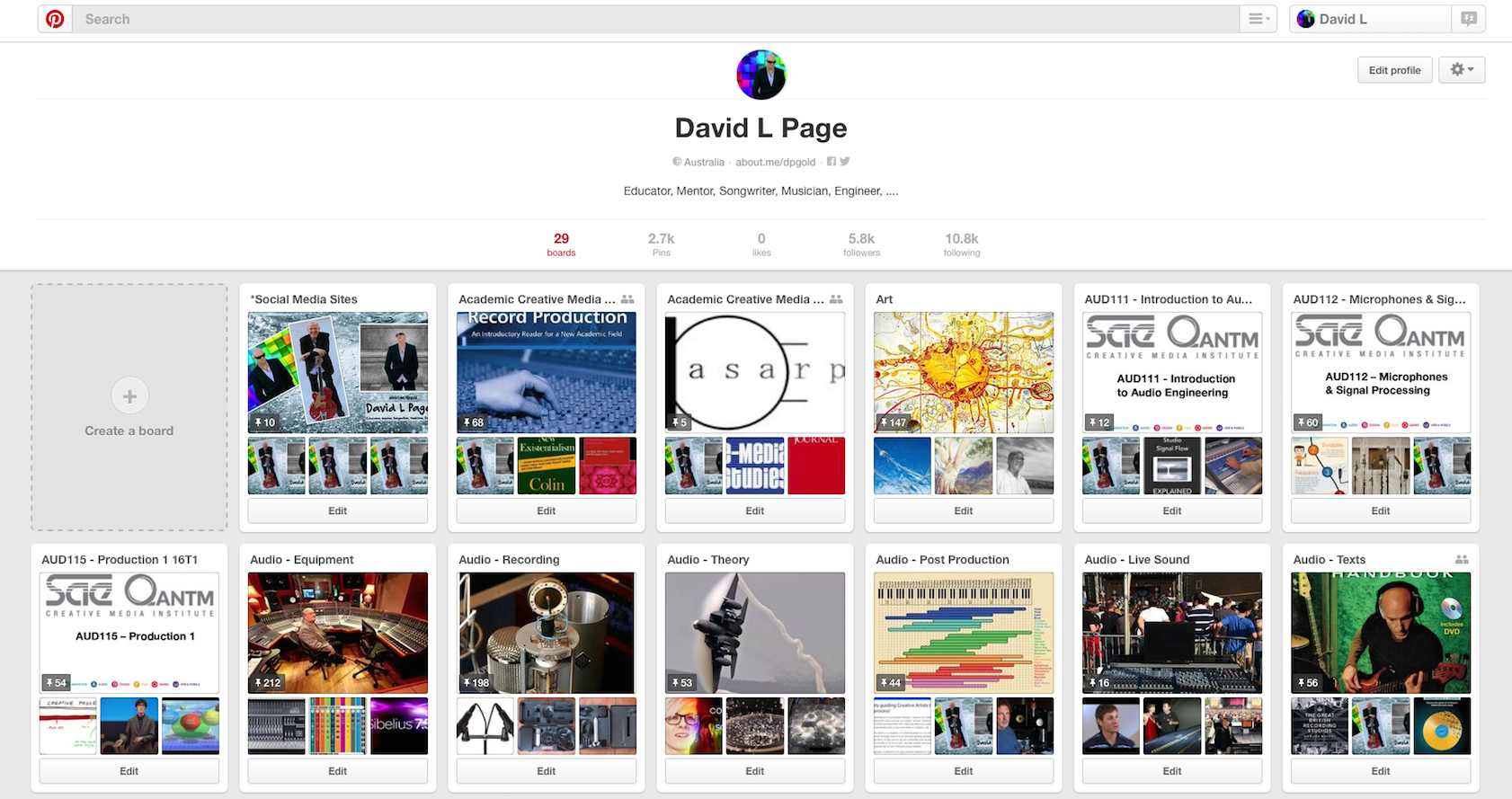
Pinterest Board Categories.20160306.P1b
Pinterest uses a board system for the user to categorise their interests. The boards I have created are intended to reflect the diversity of my interests, activities and roles. The following boards in some form represent my interests in visual, auditory, kinaesthetic, gustatory and olfactory-based phenomena or creations – natural or constructed. Please note that each the Boards within my Pinterest site, and each pin is linked to a relevant playlist within my You-Tube Channel [You-Tube/David L Page] .
  • *Social Media Sites: connections to David L Page’s Social Media Sites, all linked for ease of access.
  • Academic Creative Media – Texts: All ‘academic creative media texts’ related: Research Methodology, Creativity Theory, Music Theory, Genre Studies, Cultural Theory, Compositional Theory, Arrangement Theory, Songwriting Studies, Audio Theory – Digital versus Analogue, Production Theory – Recording, Mixing, Mastering, Post-Production, Anecdotal, etc. Intended audience are undergraduate and post-graduate Creative Media students
  • Academic Creative Media – JournalsAll ‘academic creative media journals’ related: Research Methodology, Creativity Theory, Music Theory, Genre Studies, Cultural Theory, Compositional Theory, Arrangement Theory, Songwriting Studies, Audio Theory – Digital versus Analogue, Production Theory – Recording, Mixing, Mastering, Post-Production, Anecdotal, etc. Intended audience are undergraduate and post-graduate Creative Media students
  • ArtAll things ‘visual art’ related: paintings, posters, drawings, lithographs, sculpture, pottery; and the people that do it……
  • Audio – EquipmentAll things ‘audio equipment’ related: any audio equipment including hardware, software, and peripheral equipment and devices……
  • Audio – RecordingAll things ‘audio recording’ related in a studio: microphones, microphone placement, microphone technique and any recording related technique or matter ……
  • Audio – TheoryAll things ‘Audio Theory’ related: sound waves, frequencies, amplitude, decibels, harmonics, acoustics, electronics……
  • Audio – Post ProductionAll things ‘Audio Post-Production’ related: ADR, Foley, Mixing, Mastering
  • Audio – Live SoundAll things ‘audio recording’ related in live sound: sound reinforcement, stage setup, front of house, monitoring side of stage, microphones, microphone placement, microphone technique and any live sound related technique or matter ……
  • Audio – TextsAll ‘audio texts’ related: Theory, Recording, Mixing, Mastering, Post-Production, Anecdotal or Process, etc. Intended audience are Audio Production practitioners & students
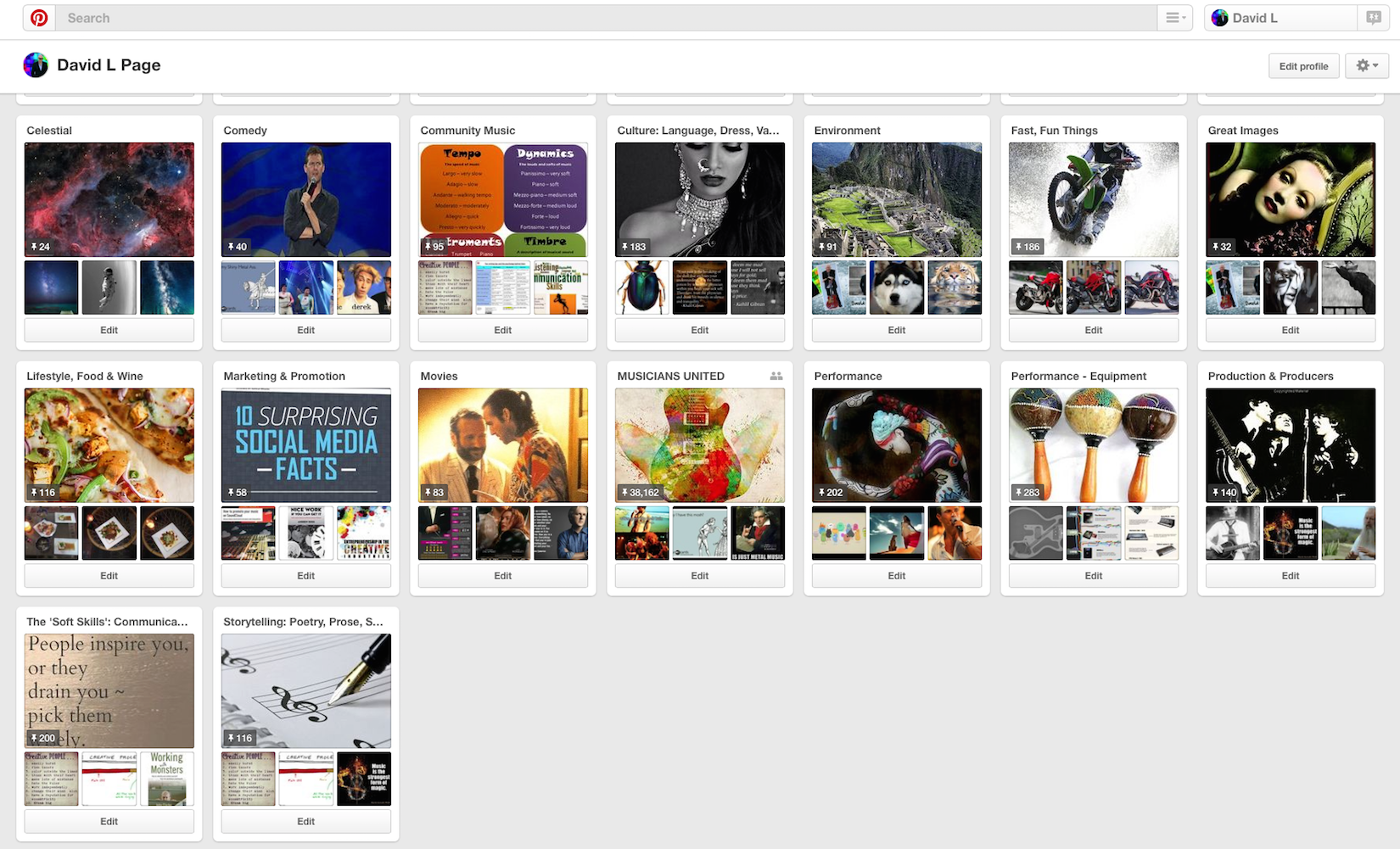
Pinterest Board Categories.20160306.P2b.png

  • CelestialAll things celestial – space and movement in places other than on Planet Earth………
  • ComedyAll things ‘comedy’ related: people or events…
  • Community MusicCommunity MusicAll things ‘community music’ related: making music accessible to all … for all to enjoy, to learn, to develop, to become, to overcome, ‘holistic therapy’ …..To guide, to mentor, to inspire, to educe……
  • Culture: Language, Dress, Values, Beliefs, Spirituality, Rituals, Traditions, Music, Food, LifestyleAll things ‘culture’ related: Language, Dress, Values, Beliefs, Spiritual Beliefs, Rituals, Traditions … (I have chosen to exclude Music and Food & Lifestyle here, making other ‘Pinterest boards’ dedicated to those..)…
  • EnvironmentAll things ‘environment’ related: continents, nature – flora, fauna, environmental or historical monuments….
  • Fast, Fun ThingsAll things related to going fast, being physically active, using exhilarating modes of transport……
  • Great ImagesAll things ‘photography and imagery’ related …….. [ In addition to my other Pinterest boards, for more great photos/images, see http://about.me/dpgold/collections/greatpic]
  • Lifestyle, Food & WineAll things ‘living’ related: enjoying, relaxing, breathing, exercising, eating and drinking…..
  • Marketing & PromotionAll things ‘marketing’ related: branding, strategic planning, product analysis, market analysis, proactive plan development, advertising via a range of mediums, print versus social media, promotion ………
  • MoviesAll things ‘film’ related: movies, documentaries, short film, sit-com, or animation; and the people that act or direct these …….
  • PerformanceAll things ‘performance’ related: any creative expression, irrespective of the art form…. performance or performer….
  • Performance – EquipmentAll things ‘performance equipment’ related: any performance-related equipment including hardware, software, and peripheral equipment and devices. ‘Instruments’, no mater their country or nationality origin, or whether their medium is ‘organic’, ‘electronic’ or ‘virtual’…
  • Production & ProducersAll things ‘Producers’ and the ‘Production’ of recorded mediums related: including the Recording and Mixing process and the Producers & Engineers dedicated to this….
  • The ‘Soft Skills’: Communication, Education, Learning, Development & ChangeAll things ‘communication’ related: all that is associated to the act of communicating, engaging, discussion, expressing, projecting, reflecting, learning, developing self image and ‘voice’, changing & developing views and perceptions, goal setting, time management, negotiation, conflict resolution, educing, teaching, training, guiding, or scaffolding: either of yourself or others, into something more than who you were, to become who you really are …….
  • Storytelling: Poetry, Prose, Songwriting & CompositionAll things ‘contemporary storytelling’ related: poetry, prose, & poets, songwriting & songwriters, raps & rappers, composition & composers, arrangements & arrangers….. examples, methods & people who practice the many and varied mediums of ‘contemporary storytelling’…
I have also created three Boards very specific to one particular audience, that of my Trimester One and Trimester Two students within the Bachelor of Audio degree I Lecture in at SAE Institute. I have used these specific Boards to engage in , and take a proactive interest in researching within the particular unit and subject content. These are:
I also joined one Pinterest Group Board which I thought was aligned to my media strategy:
  • MUSICIANS UNITED: ALL THINGS MUSIC:  Beautiful Instruments, Recording Studios, Concerts, Musical Heroes, Quotes, Tips and Tricks, and anything that makes musicians SMILE. :
I am proactive in curating resources (pinning)  and sharing these within my immediate music practice audience, predominantly my Higher Education undergraduate creative media students.I have yet to proactively engage in the wider global market place within Pinterest due to my other commitments and priorities.  I currently have  1,569 Pinterest followers, and I am following 2, 389 Pinterest users.
As a creative practitioner I use social media to support my diverse interests and practice, and Pinterest is an example of this strategy. Within Pinterest, I curate text, video and audio resources that relate to my broad creative practice. I have very deliberately used this media site to connect the diversity of my interests and practice, in concept and functionally via direct links to my other media sites. As a result, this media site facilitates an expression of my self, revealing more understanding of my self in the process, and making connections with others of similar interests or practice to share experience, knowledge, understanding and appreciation of a particular practice.
 In this aspect of my creative practice, new facets of myself and in turn, new distinctions regarding my practice are revealed – to my self, and to others. Through this particular media strategy the dynamic relationship between my self, my practice and my audience is demonstrated –  my self informing my practice, my practice informing my self and my audience, which in turn reinforces and consolidates my identity at any point in time.
References
Page, David L. 2014. Life is About the Moment 20/09/2014 Tumblr and WordPress.com blog. Accessed 13th November, 2014
Page, David L. 2014. Media  Identity & Curation Part 1  18/10/2014  WordPress.com blog. Accessed 13th November, 2014
Page, David L. 2014. David L Page’s Pinterest.com site  Accessed 13th November, 2014
Page, David L. 2014. David L Page’s You-Tube Channel  Accessed 13th November, 2014
– ©David L Page 14/11/2014
– updated ©David L Page 01/03/2015
– updated ©David L Page 15/15/2016
Copyright: No aspect of the content of this blog or blog site is to be reprinted or used within any practice without strict permission directly from David L Page.

SaveSave

SaveSave

Media Identity & Curation Part 1

My Gravatar.20160220.P2.png
This blog is a continuation of a series. See here for the previous blog.

A creative practitioner

As a creative practitioner I am conscious of the dynamic nature of creative endeavours. I am aware of the relationship between my self and my practice: my self informs my practice, and in turn, my practice informs my self and my identity.  This process enables the constant revealing of new facets of myself, and in turn, new distinctions regarding my practice.
In this blog I reflect on my use of social media in support of my practice:  the sites I choose, the images I select to represent my identity in those particular forums, and the practice I engage through each site such as blogging and curating of text, video and audio resources related to my broad practice. I embrace and proactively engage in the dynamic process of being a creative practitioner.

My Practice

As a contemporary music practitioner, my roles and activities are diverse. I practice music and creative writing on a daily basis for my creative projects, undertaking a higher degree research study, lecturing in a higher education undergraduate degree, mentoring a number of aspiring musicians, and actively engaging in a number of forms of research practice across multi-disciplines.
Note: I also write, perform and produce under pseudonyms. I consider each pseudonym an alternative identity.  I am conscious these specific practice identities also inform my music practice as defined in this blog, and will no doubt reveal themselves for interrogation, analysis and reflection during my  higher degree research study. But for the purpose of this blog, I will disregard the media I use to represent those identities. 

My Media Needs

What I require from my media is: to have multiple mediums that allow me to curate my interests and artefacts generated by my diverse practice, have a coherent image and brand that connects these multiple mediums, with means to engage and communicate with my potential audience.  Representative of my diverse practice, I use a wide range of social media sites including: about.me, gravatar.com, wordpress.com, tumblr.com, twitter.com, linked-in.com, myspace.com, facebook.com, pinterest.com, you-tube.com, soundcloud.com, lastfm.com, slideshare.com, googlescholar.com, academia.com and google.com to name a few. Each of these social media sites facilitate a specific aspect of my contemporary music practice.

David L Page logo.20141231.v2_resize4

My Media Identity

I use the above image as my contemporary music practice signature image, and as my profile image on my about.me site [about.me/David L Page]. As you may immediately notice in this image, I use the backdrop image of water. Water represents three things to me: firstly, the functional side of water-related activities such as swimming for health, fitness and feeling good; secondly, my life partner and I share a love for water-based activities, and since our initial meeting this love has always governed our lifestyle. [The original photo image was taken by  my life partner in our swimming pool] ; and thirdly, as expressed in my blog last month “Life is About the Moment”, water represents to me the fluidity of life:
“Life is about the moment ….. all things fluid……. experiencing the moment… listening, observing, interacting, laughing, loving, enJOYing, soaking the moment in, digesting it, considering it, reflecting …. expressing ones’ being, streaming ones’ consciousness. While in the moment, everything appears suspended – almost in slow motion – and yet is still very much part of life and moving somewhere…” (Page 2014).

~Pool_HP.v2.Web.jpg

I use this image as my banner image on my WordPress account [wordPress.com/David L Page] and my You-Tube Channel [You-tube.com/David L Page]. Blogging and curating resources such as text, video and audio resources related to my broad practice enables me to engage proactively and express the diversity of my music practice. As an educator and mentor I have the opportunity to model practice –  functional, conceptual and philosophical – across a diverse range of practice that collectively makes up my creative practice, and in particular, my music practice. I believe that such an opportunity encapsulates the idea of fluidity as I described above, and therefore it is fitting for me to have the image of water as the central theme of my branding, and present on my sites.  My likely audience is aspiring creative practitioners, novice reflective practitioners and researchers. Perhaps I trust that the extensive use of media will also allow the ocean of knowledge to flow to a far greater audience, far broader than to those who I currently interact with on a physical basis in my current world.
The other images within the above signature image include what I consider key different perspectives of my self. Whilst all taken at the same photo shoot, each one reveals a different dimension of my self as creative music practitioner.
The first image reveals me in a quiet reflective state. At the time of the photo, I was within my own thoughts, and not aware I was about to be photographed. To offset the melancholy of the moment, a state that is quite often interpreted by non-creative practitioners as my serious side, I chose to use a very colourful backdrop in my attempt to directly connect such melancholic moment to my creative practitioner self. I am hoping this image reinforces my acceptance of the necessity and value of such introspection and reflection as a music practitioner engaging in original and authentic creative practice. I use this image as my profile image on my Google Scholar account [Google scholar/David L Page] and my You-Tube Channel [You-tube.com/David L Page].

~DLP Pro Image Fun 5b small.20141020.jpg

The image in the centre reveals me in what I would hope is my everyday public face: happy, smiling, and approachable; relaxed, but professional. I chose this image as it places me with a guitar. Guitars in general are an integral part of how I see my self. Playing guitar represents a tool to express my self, a tool to lose my self in the moment, a tool that I learnt to reveal my creative being to my self, and then in and to the public. Guitar also represents a form of therapy to me, as I believe the action of my guitar-based music practice has allowed me to achieve and maintain a healthy balance in life – physically land spiritually. For this I am most grateful for the opportunity of my guitar-based music practice.
Guitar Room.20141004.P2.v3
More specifically, this particular guitar is one of my favourite guitars, my Gretsch 6120. This particular instrument represents several things in my life. I am left-handed, and given the scarcity of left-handed guitars relative to right-handed guitars, I have had to travel the world to find a selection of guitars that resonated with my self. I found this Gretsch 6120 in Houston Texas, at one of the few exclusive left-handed guitar shops, and after playing approximately sixty different left-handed guitar over three days, this guitar spoke to me.
I chose to include this particular guitar for two reasons: a) this particular Gretsch is a hollow body guitar, originally used by country-based artists such as Chet Atkins. In my mind, this image pays homage to those country artists who were respectful and gentlemanly, going about their business of music practice without unnecessary fanfare or the need for glamour. Chet Atkins and Les Paul directly influenced the art of session playing, recording and production techniques that remain to this day as significant. Their music practice and dedication to their craft and art of music practice directly influenced my love for music in general, and continues to influence my music practice;
and b) playing rock n’ soul style music live through guitar amplifiers is an experience that I have not yet found in any other form of practice or activity in life. Playing this type of guitar, a wide body hollow body guitar with large amounts of air inside the guitar, electrified through a guitar amplifier at loud volumes requires specific skill and control to avoid the guitar, amplifier, and the PA system from creating levels of extreme feedback that are unusable in terms of the the musical and sonic integrity of the music and the composition, or dangerous for the venues PA system or listener’s health (damage to their ears).  To realise the warmth of tone with high volume, achieving acceptable levels of signal distortion and degeneration, without going over the edge of total sonic destruction is a well practiced skill. It requires balanced amounts of reckless abandon and greatly intentioned control in order to achieve signal that is both musically and sonically complementary to the composition and the performance. Such practice represents to me: fun; creativity; rebellion; a heightened sense of energy, life and positivity; skill and expertise; and mostly joy when I am in that state of music practice. I use this image as my profile image on my Twitter account [Twitter/David L Page].
~DLP Gretsch Profile.20141006.v2.jpg
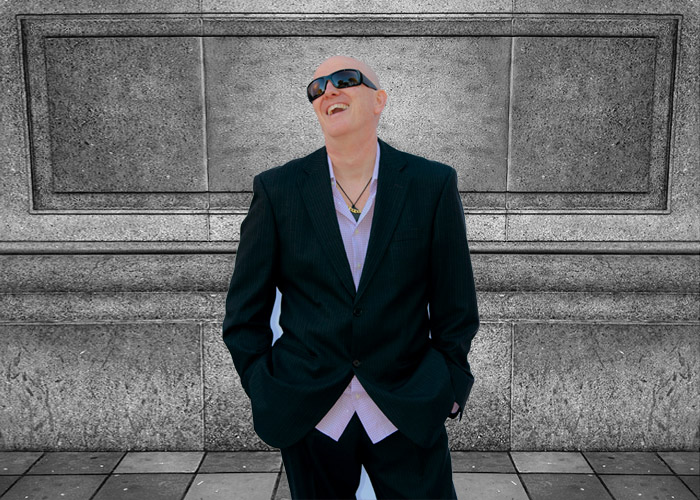
The third image is my professional image. This image represents to me my professional image. Having spent a large part of my career in business development, management and Corporate Governance , I chose the more formal backdrop that could be found on a building found in the financial district of a city. However to contrast this backdrop given my current field of practice is within  the Creative Industries, a profile shot that was professional but relaxed, and expressing gratitude and happiness was selected. At the time of this particular photo being taken I was actually thinking about how grateful I was for the abundance of opportunities and successes I have had in my life. I use this image as my profile image on my Linked-In account [Linked-In/David L Page]
~DLP Pro Image 1.20141020.jpg
As a creative practitioner I immerse myself proactively in all practice-related endeavours. I use social media in support of my practice.The sites I choose, the images I select to represent my identity in those particular forums, and the practice I engage through each site such as blogging and curating of text, video and audio resources related to my broad practice are all very deliberate actions, and must work together to reinforce the coherent image and brand that connects these multiple mediums. In this aspect of my music practice, new facets of myself and in turn, new distinctions regarding my practice are revealed. In this way the dynamic relationship between my self and my practice is demonstrated –  my self informing my practice, and in turn, my practice informing my self and my identity.
This blog series is planned to continue with Media Identity & Curation Part 2  (Page 2014b). It is intended for this blog series to continue on a regular basis as I progress through my doctoral research project.
References
Chet Atkins Official Website. 2014 http://www.misterguitar.us Accessed 16th October, 2014
Les Paul Biography. 2009. http://www.biography.com/people/les-paul-9435046  Accessed 16th October, 2014
Page, David L. 2014 David L Page’s About.me site Accessed 16th October, 2014
Page, David L. 2014. David L Page’s Google Scholar site  Accessed 16th October, 2014
Page, David L. 2014. Life is About the Moment 20/09/2014 Tumblr and WordPress.com blog. Accessed 16th October, 2014
David L Page’s Linked-In site: David L Page’s Linked-In site    Accessed 16th October, 2014
Page, David L. 2014. Media  Identity & Curation Part 2  18/10/2014  WordPress.com blog. Accessed 13th November, 2014
Page, David L. 2014. David L Page’s Pinterest.com site  Accessed 16th October, 2014
Page, David L. 2014. David L Page’s Twitter site  Accessed 16th October, 2014
Page, David L. 2014. Music Practitioner Part 2 Accessed 16th October, 2014
Page, David L. 2014 David L Page’s WordPress site  Accessed 16th October, 2014
Page, David L. 2014. David L Page’s You-Tube Channel  Accessed 16th October, 2014
– ©David L Page 18/10/2014
– updated ©David L Page 15/11/2014
– updated ©David L Page 15/05/2016
Copyright: No aspect of the content of this blog or blog site is to be reprinted or used within any practice without strict permission directly from David L Page.

Music Practitioner Part 2 – What Brought Me Here #5

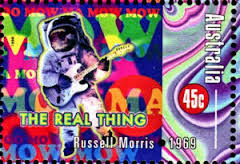
The Real Thing stamp - Image                                       (Australia Post stamp 1998)
This blog is a continuation of a series. See here for the previous blog.

A significant influence

A song that had a significant influence on my music practice in my formative years was “The Real Thing” written by Johnny Young, performed by Russell Morris, produced by Ian ‘Molly’ Meldrum (Max TV 2014).
The Real Thing
The song was originally released in 1969 – an era of exponential technological development, including space travel, exploration (the first man walking on the moon), global conflict (the Vietnam war), global uprising (protests against the US involvement in this war), the social and cultural movement of peace, love and the resultant drug taking (largely marijuana and LSD), and music including folk, jazz, R&B, pop, rock, progressive rock and psychedelic rock genres (to name a few).
Russell Morris was an acoustic pop performer with some popular music chart success, playing either 6 string or 12 string guitars. Whilst he did play as a solo performer, a band often supported Morris (Wikipedia 2014). This song uses the basis of acoustic music (acoustic guitars, bass, drums) with layers of keys, processing applied and sampled sounds (such as news recordings, laughter, choral bomb sirens and it concludes with a bomb blast) over the top. Despite this song had clear acoustic influence, performed by someone who was usually an acoustic artist I recall the main aspects that caught my attention with this song was:
  • This song was clearly of psychedelic character, with numerous technical processes applied
  • The most obvious technical characteristic are the full use of the stereo field, with liberal use of panning; and
  • the extreme use of time-domain processing, from the opening section of the song, applied to both the music and the vocal line……including large amounts of reverb, delay, and flanging to name a few. Additionally, because of the large amount of processing, the main sonic quality was quite distorted in places, particular in the later half of the song
  • The use of these, especially the extent and the amount of processing helped create and place the listener in an out of world or drug-induced type state.
  • The duration of the song is more than double the length of the usual pop song of the day at 6 mins 22 seconds in length. [However, there was also a 3 min 46 second version played on radio]
  • the simplistic nature of the lyric, being only a few lines repeated throughout the whole song. I recall how a song could take you on a journey, telling a story, with limited lyrics, and yet still had an emotional impact of me
  • whilst the song represented a vehicle that transported me to another world sonically & aurally, I recall the intrigue of how this song incorporated a political statement, with the music video referenced against a backdrop of Vietnam war film footage. This introduced to me the multiple intentions and messages a song could express, appealing to a range of listeners with different values and beliefs of what the cultural production actually meant to them.
It has been reported that the likes of US Producer Phil Spector, and his wall of sound style of productions influenced Ian Meldrum (Wall of Sound 2014). I am unsure if Meldrum specifically set out to reproduce recording and production techniques that Spector used to achieve the wall of sound style; or whether Meldrum had the intent to create a song with a similar type of sonic complexity and variety of recording, overdubbing and processing techniques that took the listener on a sonic experience and voyage. Irrespective of Meldrum’s intent, I was certainly taken on, and continue to be taken on a sonic experience and voyage each time I listen to this song. As I return to this song after several decades of not listening to it in depth, and analyzing it as an example for my undergraduate degree students, I am again entertained and impressed by the multiple textual layers that Meldrum’s production team achieved via the recording, overdubbing and processing techniques applied. I further realize the dynamics of the song vary throughout, with instrumentation, sampling, amplitude, frequency, stereo field and processing constantly changing, quite often within a particular section of a song. This variety and complexity for me, makes this song a sonic experience and voyage each time I visit it.
It is this compositional intent and production approach that I will incorporate into my pending original music practice project.
This blog series is planned to continue next month with Music Practitioner Part 3. It is intended for this blog series to continue on a regular basis as I progress through my doctoral research project.
References
Australia Post 1998 stamp image courtesy of Australia Post.com. Accessed 4th October, 2014.
Max TV. 2014. The story of the real thing  http://www.maxtv.com.au/news/the-story-of-the-real-thing.aspx  Accessed 4th October, 2014.
Page, David L. 2014a. Life is About the Moment  Accessed 4th October, 2014.
Page, David L. 2014b. Music Practitioner Part 3  Accessed 18th October, 2014.
Wikipedia. 2014. The real thing (Russell Morris)   https://en.wikipedia.org/wiki/The_Real_Thing_(Russell_Morris_song)  Accessed 4th October, 2014.
The Real Thing article courtesy of: The Real Thing Accessed 4th October, 2014.
The Real Thing video clip courtesy of: The Real Thing  Accessed 4th October, 2014.
The Wall of Sound article courtesy of:  The Wall of Sound  Accessed 4th October, 2014.
– ©David L Page 05/10/2014
– updated ©David L Page 18/10/2014
– updated ©David L Page 15/05/2016
Copyright: No aspect of the content of this blog or blog site is to be reprinted or used within any practice without strict permission directly from David L Page.

Life is about the moment…..


cropped-pool_hp-v2-web14.jpg
This blog is a continuation of a series. See here for the previous blog.

at any point in time…..

Life is about the moment ….. all things fluid……. experiencing the moment… listening, observing, interacting, laughing, loving, enJOYing, soaking the moment in, digesting it, considering it, reflecting …. expressing ones’ being, streaming ones’ consciousness. While in the moment, everything appears suspended – almost in slow motion – and yet is still very much part of life and moving somewhere… Education is about learning to learn, developing and expressing … often introspectively, learning about oneself, our boundaries, beliefs, values, languaging, thoughts, & feelings ….. discovering & then developing our voice ……. who we are and how we fit into the universe… Music and audio for me is the sum of both life and education. Songwriting, composing, recording, arranging, mixing, and performing is about being in the moment ….. being fluid ……. and yet also, learning, developing and expressing myself…… discovering & then developing MY voice ……(Page 2014b).
This blog series is planned to continue next month with Music Practitioner Part 2
References
Page, David L 2014a Music Practitioner Part 1 Accessed 20th September, 2014
Page, David L. 2014b. Life is About the Moment  20/09/2014 Tumblr and WordPress.com blog. Accessed 20th September, 2014
Page, David L 2014c Music Practitioner Part 2 Accessed 20th September, 2014
Water image courtesy of: David L Page’s About.me Accessed 20th September, 2014
– ©David L Page 20/09/2014
– updated ©David L Page 05/10/2014
– updated ©David L Page 15/05/2016
Copyright: No aspect of the content of this blog or blog site is to be reprinted or used within any practice without strict permission directly from David L Page.

Music Practitioner Part 1 – Beginnings

My earliest recollections of creative practice…..

Due to the ill health of my mother and her need for many medical operations over an extended period, I lived in a very dark house for the first seven (7) years on my life. With the curtains and blinds drawn shut the majority of the time, and bedrooms doors closed, I mostly only remember darkness during this time. Other memories include sitting in a very tense environment, fearful we would be reprimanded for talking out of turn, and disturbing my mother, and; being sat in front of a television screen for hours on end as a way of occupying my attention. To this day, the cartoon Mighty Mouse is at the forefront of my memories.
images                                 (Terry-Toons Comics 1945-1951)
I recall having the sense that my world was a remote place – perhaps on an island – and the main people I knew at that time were my brother, sister and father. I recall a number of big people – not sure who they were, but perhaps distant relatives, neighbours, or the wives of dad’s work colleagues – came and went during that time, assisting my father with daily duties such as preparing meals, I guess cleaning and our care. I certainly do not recall life in our house.
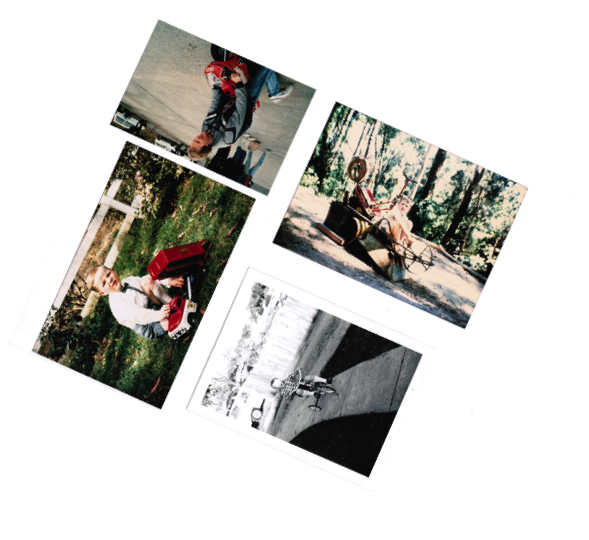
As I grew somewhat – perhaps around five (5) years of age –  I recall spending time exploring the local bushland with my brother and some of the local neighbourhood kids, or my mates from junior rugby. Whilst it was fun exploring, and having new adventures with others,  I do however recall that I was happiest in my own company, constructing things and becoming quite rowdy, exercising my unlimited bounds of energy and exploring my voice.

DLP Youth pictures

Then at the age of eight (8) years old, once my mother had somewhat recovered from her health issues, we moved into a new house in a new suburb on the North Shore of Sydney. The split-level house had its’ main living area on the top floor – bedroom, living room and kitchen – with the garages, laundry, rumpus room and bar kitchen on the ground floor. The blinds and curtains in our new house were literally pulled back. It was a large light and airy house with a large leafy garden, including a massive willow tree in the middle of it. It was a huge garden for an eight year old to exercise and explore, ride his scooter, yell and sing as he continued to explore his voice to his heart’s content, away from disturbing the family. The sea change included my mother playing what became her daily dose of European classical music – Baroque, Classical and Romantic (including Opera). In addition, my mother loved the pop artists of that era: those who performed on the television program of the day, “Bandstand”. In that era, it was one of the few opportunities to view the latest contemporary artists and hits on television. Whilst I still did not feel as though I belonged to anything – to my new school, my new rugby team, or the local neighbourhood kids – my world now had light and music in it.
Apparently, the music resonated with me and before long I was singing along.  I recall having melodies in my head, and I would hum them out, not aware of what I was doing, nor what was to come. I was always an early riser, and keen to get into the day.  I would wake well before my brother, my sister, and my parents; and wasn’t one for lying still. Of course – first things first – I would need to go to the toilet for a pee. [Note: the toilet rooms of that era had tiles on the floors and walls, and were great for reflecting sound].
It was very early in the morning, and I wasn’t in that much of a hurry.  So, rather than standing I would sit, and gaze at the walls.  I recall being fascinated with the light and reflections of the trees (from our back garden) being projected on the walls. I could see the trees bending up and down, some birds flying in and out, the leaves dancing, along with light, up and down the tiles on the walls. I would then start to play with sound, and start to make some noise. Sometimes I would hum one of my internalised melodies; and at times, I would make as many different short, sharp noises with my mouth. Anything to hear sound. I would listen to the sound, and note how the sound could bounce from wall to wall. I learnt to make some sounds stretch out, almost like it had a tail on it, and take even longer to bounce around. I recall thinking how good my voice sounded, in this toilet room. I realise now that I was I was experimenting making noise, listening to the sound bounce off the walls, to the sonic possibilities within our family toilet room, at possibly half past five (5) in the morn. I also reflect now, to realise that I was also possibly becoming comfortable with my voice. Listening to my self, experimenting with my voice, experimenting with what sounds I could make – what original sounds I could make, on my own.
With (apparently) my brothers and sister tired of my early morning vocalisations while on the toilet every morning – while they were still sleeping – my dad suggested I may like to relocate to a new room – into a converted rumpus room on the ground floor of our new house. While I was a little tentative at first, I quickly saw my new space as my own palace. I set up the room with low lighting – lots of lamps around the corners of the room, each with different coloured cellophane projecting up onto the walls. There were usually two or three candles burning, borrowed from my parents many dinner parties, adding to the subdued ambient lighting. Posters of pop culture icons of the day from the local music rag GoSet adorned my walls, beckoning me down a particular path.
Upright Pianola.P2
(My inherited grandfather’s pianola)
My grandfather’s pianola stood at the foot of my bed; alongside an old radio gramophone that blasted out my collection of 45rpms and am radio station hits for many hours of the day. I recall listening to all of the music and sounds that emanated from that gramophone, drawn into another world. I had friends, but with a very protective mother, I found my self spending a lot of time in my palace – my sanctuary – listening to a very wide range of music at every chance I had.
Whilst I loved the sound of the pianola (essentially a piano, but with some more high register tones present in each of the notes), I found the keyboard layout quite complex to understand. None of my family were players (that I knew of). However, I continued to tinker, I experimented but I admit that I never sat long enough, to learn how to play the piano. Over the next few years, my brother started playing guitar. He was cool, part of the politically savvy crowd. He listened to politically inspired music as part of the hippy movement, calling for change to the establishment. I was drawn in – not so much to the message – but to the instrument that seemed to be at the centre of this crowd – the guitar.
The guitar seemed to be far more simple to play than the piano, with its’ chord shapes. My brother was right-handed, and I was left-handed. So whilst I was drawn in, I did not find it easy to mimic what he was telling me to do, to play his guitar. I was frustrated, but my fascination was established. I would spend my time listening to music, sifting through the music magazines, looking at pictures of guitars. Several years later after much – quiet but persistent – badgering, my dad arrived back from overseas with an acoustic guitar in hand, for me.
I started guitar lessons the following week with a local guitar teacher who was teaching my brother. He taught me the notes on the strings, and then introduced a number of songs as a way of learning to play. One of the first songs I can recall learning was: Clearance Clearwater Revival’s (CCR) “Proud Mary” (Creedence Clearwater Revival 1969).

(Creedence Clearwater Revival 1969 music video)
 This song was followed shortly afterwards with CCR’s latest single, “Looking’ Out My Back Door” (Creedence Clearwater Revival 1970a).

(Creedence Clearwater Revival 1970 music video)
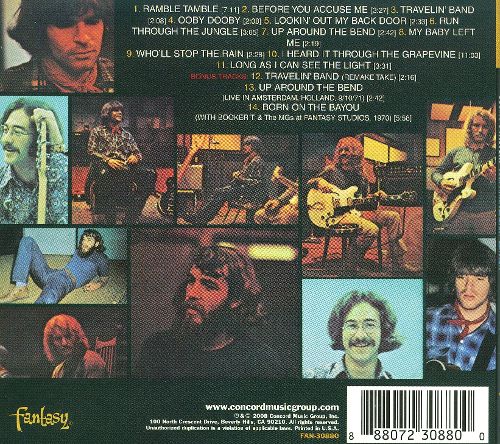
The album that these songs came off was Creedence Clearwater Revival 1970’s album, “Cosmo’s Factory” (Creedence Clearwater Revival 1970b).  My brother did eventually buy this album, and therefore I not only heard it many times, I ended up playing the album many times over myself.

Creedence_Clearwater_Revival_-_Cosmo's_Factory.P1

(Creedence Clearwater Revival 1970c).
This album produced so many singles that became popular hits on the radio; song’s that were country rock in flavour, that were predominantly based around the semi-acoustic electric guitar. I loved every song on the album, and therefore I used to played the album – when my brother wasn’t around – with the purpose of studying each and every song. I recall listening to each song over and over, learning to play them, and to try to emulate the guitar rhythm and vocal phrasing.  If I was practicing a particular section of the song – for a example a phrase – I would play it through, and then pick up the needle and play through again, over and over, until I could work out what the phrasing, harmony or melody was. I had also learnt a trick from my cousin in Victoria; putting a coin on the album while it was playing, would slow down the rotating record down, and therefore making it easier to hear the particular phrase I was trying to learn. I experimented for really difficult phrasing, adding the weight of a second coin.

Creedence_Clearwater_Revival_-_Cosmo's_Factory.P2

(Creedence Clearwater Revival 2008)
The following year Paul and Linda McCartney released their first studio album “Ram” after the Beatles had officially disbanded as a group (Paul and Linda McCartney. 1971). A single off the album “Uncle Albert/Admiral Halsey” was released and played on AM radio on a regular basis. I recall falling in love with this song instantaneously. The song was 4 minutes 50 seconds long – quite long for the day – and progressed from one style of music, to another style of music. It was as though Paul McCartney had gotten two songs, and joined them together. I recall being fascinated by this arrangement. But most particularly, the production. Listening to the song on the radio I could hear so many elements and textures that I had never heard before in any other song.  I was in awe!. I recall saving the money I earnt from doing my weekly chores, and going to the local music store to buy the 45rpm record of the single (Paul and Linda McCartney. 1971).
As it happened, on the B side was another song – more of a traditional pop rock song – but again with an interesting arrangement. This song “Too Many People” (Paul and Linda McCartney. 1971), became the first song I requested my guitar teacher to teach me how to play on the guitar.

Uncle Albert Admiral Halsey 45rpm

 (The Beatles Discography, 1971)

(Paul & Linda McCartney 1971 music video)
 In the same year that I had bought my first 45rpm, I heard another artist across the airwaves: the songs of Cat Stevens. I was mesmerised by his craft – sultry vocal tones, accompanied minimally, with an acoustic guitar, and sometime a bass line. The vocal had a lot of – mmm, how could I describe it – a lot of space around it – presence.  The guitar was very simple – a strummed guitar, and a fingerpicked guitar, recorded very precisely, and cleanly. There was often a bass riff present, and sometimes some percussive elements, in light support of the rhythm and harmony.  Often, there was a piano in accompaniment. Occasionally, the central instrument was a piano. Irrespective, what struck me of Cat Stevens’ songs were: the central element of his performances and the productions were – the song.
Cat Stevens was a UK troubadour with a social and spiritual conscience, carrying forth the tradition of the 1960’s confessional singer-songwriters such as Bob Dylan, Joan Baez, and Leonard Cohen. Cat Stevens was soon to be joined by other rising troubadours such as Carol King, James Taylor, Carly Simon, Jackson Browne and Don McLean (Greenwald 1992, 58). The songs of these troubadours took me to places that I hadn’t been before. To places that were quiet, considered and contemplative. I considered these songs poetic, in a similar vein as so many of the great poets before them. Their songs weaved words, turn of phrase – lyrics with melody and harmony in simple but cleverly crafted ways.
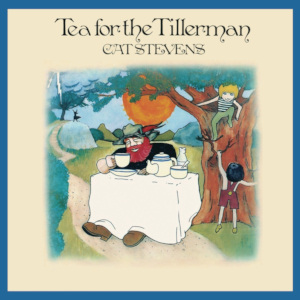
As a ten (10) year old, I remember thinking to myself – can I? could I? could I ever be able to learn to do what they do? could I dare to consider that I could learn to do what they do? Could I ever become a singer-songwriter-performer as they are? Could I ever learn how to transport a listener to a place that they hadn’t been to before? As they did to me? As they did for me? Could I possibly? Unfortunately though, irrespective of any logic, the seed was planted.  I recall Cat Steven’s influence on my desire to practice music was instantaneous: in terms of guitar playing, singing, songwriting and arranging – to a depth of personal experience that I had never heard before. I saved my pocket money, and a short time later I was holding my first album, Cat Steven’s “Tea for the Tillerman”.

Tea_for_the_Tillerman

(Cat Stevens 1970a)

https://www.youtube.com/watch?v=WkZJSFd0Ghw

(Cat Stevens 1970b)
The many songs that were on “Tea for the Tillerman” became the next group of songs I requested my guitar teacher to teach me how to play on the guitar. I spent much of the next year trying to emulate the guitar playing, singing, and feel of these Cat Steven’s songs.
A year later a follow up album came out “Teaser and the Firecat”.  I spent much of that year again trying to emulate the guitar playing, singing, and feel of these Cat Steven’s songs. Whilst I don’t feel I ever arrived at being able to play any of Cat Steven’s songs to my satisfaction, I do trust and believe this particular artist’s influence on my development as a music practitioner was significant. Cat Steven’s style had become engrained into my being; into my soul.

Teaser + The Firecat_Cat Stevens.P1

(Cat Stevens 1971)

https://www.youtube.com/watch?v=MRHN7nUg26M&list=RDMRHN7nUg26M#t=2

(Cat Stevens 1970c)
I continued to progress with the guitar, but found that I had been drawn somewhat back to the piano through the songs of performers such as Cat Stevens. A number of his songs on both “Tea for the Tillerman” and “Teaser and the Firecat” featured piano as the central instrument. I wasn’t so interested in learning to play the piano, but would spend hours listening – tinkering and experimenting – to the sounds that emanated from it.
I got a Labrador-cross pup for my eleventh birthday. We looked very similar – in that her coat colouring was similar to my skin complexion – fair with freckles. She and I became inseparable over the next five (5) years. As she grew, she would lay at the foot of my bed with one eye open, almost as if she was making sure I was ok. More often that not, I was occupied with any form of music practice.
  • I would play guitar – strumming the strings, forming chord shapes – and listen to the sounds that would emanate from the wooden body.
  • I was intrigued with how much change in tone could occur with subtle change in any aspect of my playing – such as my attack with the plectrum – velocity or speed, or the actual thickness or material of the plectrum;
  • I would focus on my right hand with the forming of chords, moving the angle of my wrist around the back of the neck. The clarity of the note would change as I did this to produce different qualities of sound;
  • I would try to sing the songs of my favourite artists, trying to emulate the phrasing of the vocal line, the rhythm and harmony of the music playing on old gramophone;
  • I would tinker on the piano’s ivories, listening to the notes as they rose out of the wooden cabinet:
  • I noted how these notes varied, depending on how hard I struck each of the keys;
  • I noted how these notes varied, depending on which foot pedal on the piano I was holding down;
  • I listened to the resonance of the notes as they sang out, bouncing off and out of the rosewood wooden cabinet, after the piano key hammer had come to rest on a particular string;
  • I immersed myself listening to a range of productions via the radio, albums, or 45rpm singles. I was in awe – full of wonder, joy and intrigue – listening to the cacophony of music and sonic textures that played out of the speakers;
  • With every song, I tried to strum out chords on my acoustic guitar along to it; or
  • I would mimic a live performance, guitar around my neck, standing behind my father’s camera tripod, mounted with a bicycle horn on top as my pretend microphone, strumming away to songs playing on the radio gramophone.
  • Yes, I could see my audience, I could hear the audience, I could feel the audience.
These are the earliest recollections I have of my creative activities.

The next step of my creative practice…..

However, at some point, I did work out that I was not born into music. My mother didn’t play an instrument, my father didn’t play an instrument – they were fans. Our house was not filled with our music – it was filled with the music of others. We listened to others perform.
A few short years later, a significant event occurred that led me to put down the guitar for about 9-10 years. This event had a profound impact on my confidence and belief in my worthiness to play music.
Some years later at University, after meeting some musical souls, I picked up the guitar again. But this time it was to be an electric guitar. Over the next few years I progressed into writing, singing, performing, arranging, recording, and playing bass. I also taught music, delved into project management and became an industry advisor.
I spent 3 years in Japan, where I fortunate enough to establish a platform across so many of these areas. I am so blessed for my Japan experience. Japan was so influential in my reconnecting and implanting a music practice flame within me that I still carry to this day.  It was one of the most productive periods I have had in terms of my performing and writing, including recording and experimenting in production. It was a wonderful period for me – one that I hoped would never end. But like everything in life, at some point there were enough taps on my shoulder that indicated it was time for me to return to Australia.
japan_grunge_flag
I arrived back into Australia and evaluated my options. I moved city, up to Brisbane, and made an effort to connect to players in that scene. I chose to refuse to play in the pub scene – blue jean, intoxicated punters, nicotine-filled live scene that contrasted significantly to the clubs and festivals I had played in Japan. Instead, as part of my tithing value to give back to society, I invested what spare time I had to assisting a range of community music programs. What resonated to me here was donating my breadth of experience as a player, teacher, coach & mentor, providing guidance and assistance to social groups that had mostly not had the opportunity of music practice due to lack of opportunity because of either economics, social situation or just the busyness of life.
Boxing Kangaroo
I have always found ways in my life to generate income streams from a variety of sources . My father always (somewhat condescendingly) referred to my creative industry activities as a hobby. Whilst I have been sponsored by the Australian Government at numerous times in my Creative Industries career, I have been fortunate enough to  maintain a professional career to develop my music practice, often overlapping into education, project management, and educational management here in Australia and overseas. After a study period at the Guitar Institute in California’s Musicians Institute in 2006, I returned home to accept an Executive Management role to manage an overseas multi-site educational organisation. Whilst it was going to disrupt my local live playing, it was an opportunity to lead what had previously been a multi-million dollar organisation (now facing closure due to non-compliance and financial adversity) in all aspects of governance and general management (including , stakeholder negotiation, change management, educational teaching practice, staff development and management). Whilst I played a few live gigs during that 3 year overseas posting, I focussed on alternative mediums to be creative musically. This opened the opportunity for the development of my music production skills within the virtual world of a DAW – both in Pro Tools and Logic Pro.
Somewhat ironic, this juncture in my music practice is at the core of my current doctoral studies: Contemporary DIY music practice and the practitioner self.
This blog series is planned to continue with Life is About the Moment. It is intended for this blog series to continue on a regular basis as I progress through my doctoral research project.
References
Australian Boxing Kangaroo Flag Image courtesy of: Boxing Kangaroo  Accessed 8th March, 2014.
Cat Stevens. 1971, Teaser and the Firecat, A&M Records. Album
Cat Stevens. 1970a, Tea for the Tillerman, A&M Records. Album
Cat Stevens 1970b music video link performing Wild World courtesy of: BBC©1970   Accessed 15th May, 2016.
Cat Stevens 1970c music video link performing How Can I Tell You courtesy of: BBC©1970   Accessed 15th May, 2016.
Creedence Clearwater Revival. 2008, Cosmo’s Factory, Fantasy Records. Compact Disc
Creedence Clearwater Revival. 2008. Cosmo’s Factory back image courtesy of All Music.com  Accessed 15th May, 2016.
Creedence Clearwater Revival. 1970a, Looking Out My Back Door, Concorde Music. 45rpm
Creedence Clearwater Revival. 1970b, Cosmo’s Factory, Fantasy Records. Album
Creedence Clearwater Revival. 1970c. Cosmo’s Factory image courtesy of All Music.com  Accessed 15th May, 2016.
Creedence Clearwater Revival 1970 music video link performing Lookin’ Out My Back Door courtesy of: Concord Music Group, Inc©2009   Accessed 15th May, 2016.
Creedence Clearwater Revival. 1969, Proud Mary, Fantasy Records. 45rpm
Creedence Clearwater Revival 1969 music video link performing Proud Mary courtesy of: Fantasy Records©1969   Accessed 15th May, 2016.
DLP images courtesy of David L Page  Accessed 15th May, 2016.
Greenwald, Ted. 1992. Rock and roll: the music, musicians, and the mania. New York: Friedman Group Book.
Japan Grunge Flag Image courtesy of:  Japan Flag  Accessed 8th March, 2014.
My inherited grandfather’s pianola image courtesy of: David L Page  Accessed 15th May, 2016.
Paul and Linda McCartney. 1971, RAM, Apple Records. Album
Paul and Linda McCartney. 1971 Uncle Albert/Admiral Halsey Apple Records. 45rpm
Paul and Linda McCartney 1971 music video link Uncle Albert/Admiral Halsey courtesy of: Apple Records©1971   Accessed 8th March, 2014.
Terry-Toons Comics. 1945-1951. Mighty Mouse in Mighty Mouse #38-85  Accessed 8th March, 2014.
The Beatles Discography. 1971. Uncle Albert/Admiral Halsey 45rpm image  Accessed 8th March, 2014.
– ©David L Page 09/04/2014
– updated ©David L Page 15/05/2016
Copyright: No aspect of the content of this blog or blog site is to be reprinted or used within any practice without strict permission directly from David L Page.
Cultural Production Project Part 3

“Music is in life. It occurs everywhere – at any moment in time, in every place” (Page 2010)

Continuing on from last month’s Cultural Production Project – Part 2 [February 2010], I will focus this month on the actual project of fusing together three musical styles to create a soundscape that expresses myself musically and sonically.

~DL with Gretsch + C414.20141006.P21

Aim and Objective for this Project

To recap, the aim of this project is to refocus on a creative production project that allows me to create a natural musical style and arrangement.

fuse-together

The objective of this project is two-fold: to fuse multiple musical styles into a finished product – a soundscape that expresses myself musically and sonically; and to develop a greater understanding of my workflow in a virtual environment using both a range of technologies (software and hardware).

logic-pro-8-session

The three musical styles I intend to fuse are: folk-rock, new-age/spiritual, and soul-rock musical styles, creating a new fusion musical style.

The Fusion of the 3 Musical Styles into 1 Cultural Production

The musical styles I have described and analysed in Cultural Production Project – Part 2 [February 2010] are three-fold:
  • Rock n’ Soul/Neo Soul;
  • World Fusion/New Age;
  • Country Folk/Indie Rock.
The fusion of these three musical styles I believe has yet to be developed and exploited in the mass market. I believe this fusion is of three quite disparate musical styles could be described as a: rock track, with soulful overtones, a strong ethnic-flavoured instrumental/synthetic base, with possibly a simplistic real-type story and/or music-bed (harmony/melody) underlying the track.
The historical development of these specific musical styles can be best shown within the following graphic.
Historical Development of Specific Musical Styles.P3
The graphic shows:
  • the development of the two genres of Rock n’Roll and Soul, developing into the genres of Rock n’ Soul and Neo Soul. These two genres then develops into the genre of Nu Soul;
  • the development of the two genres of World Fusion and New Age into the genre of Nu World;
  • the development of Country and Folk into the genres of Country Rock and Folk Rock. These two genres then develop into the genre of Country Folk Rock, which in turn develops into the genre of Indie Rock.
Therefore, from now I am referring to the historical development of musical styles of:
  • World Fusion/New Age as Nu World;
  • Rock n’ Soul/Neo Soul as Nu Soul; and
  • Country Folk/ Rock as Indie Rock.
  • Collectively I will refer to the new three-part fusion musical style as Nu World IndiSoul.

The Production & Compositional Elements of Nu World IndiSoul

analysis-with-magnifying-glass

As part of my analysis, I will now discuss the production and compositional elements of the three musical styles.

Musical Style Name

Nu Soul

Nu World

Indie Rock

Production & Compositional Elements

Rock n’ Soul/

Neo Soul

World Fusion/

New Age

Country Folk/

Indie Rock

Story Line

Love –
love found/love lost/heartache
Survival
Life
Meditative/
Spiritual Connection
Life
Day to Day Life
Politics
Lifestyle
Life Ideals
Ethnic/Cultural Connections

Compositional

Tempo

100-130 bpm
90-120bpm
80-100 bpm

Chord variety

6-8 chords
2-4 chords
3-4 Chords

Time signature

Typically 4/4
A variety
Typically 4/4 or 3/4

Instrumentation

Organic
Synthetic + Organic Combination
Organic

Drums/Percussive

Straight Up Full Rock Kit
Hollow Drum/Jembahs/
/Shakers/Triangles
Partial/Jazz Drum Kit

Bass

Rock Bass and/or Upright Double Bass
Synth/s
Bass or Upright Double Bass

Chordal

Guitar and/or Keyboards
Synth/s
Guitar and/or Keyboards

Lead

Vocals
Chanting/
Pan Flute/Strings (Cello)
Vocals/
Harmony Vocals

Secondary lead Lines

Strings (eg violin)
Brass (eg saxophone/ trumpet)
Backup Vocals
Synth/s
Percussion
Strings (eg violin)
Brass (eg saxophone/ trumpet)
Backup Vocals

Breaks

Vocals/Guitar/ Keyboards
Synth/s
Vocals/
Harmony Vocals

Production

Production techniques typical in this musical style

Depending upon the producer and the chosen sound for the band for this particular project; & their desire to stay as close to organic/pure ‘rock’ sound, or their intention to stray as far away from organic as possible;
A number of producers are known for ‘wall of sound’ – Daniel Lanois, Brian Eno – using synths/layers to build up sound (eg U2, Coldplay).
Steve Lillywhite is known for organic, keeping the guitar sound as organic as they are produced at source (eg Bruce Springsteen)
Depending upon the producer and the chosen sound for the particular project; but generally keeping the sound ‘crisp, clear & clean’.
Depending upon the producer and the chosen sound for the band for this particular project; & their desire to stay as close to organic/pure ‘country’ or ‘folk’ sound, or their intention to stray as far away from organic as possible;
Jeff Lynne, in contrast to his ‘synthetic’ session band ELO, produced a very organic sound for the Travelling Wilburies, keeping the guitars and vocals of Bob Dylan, George Harrison, Tom Petty and himself sound as organic as they are produced at source

Mixing

Applying the principles of David Gibson’s “The Art Of Mixing” to this project. Using Volume, Panning, EQ, Reverb and FX to give the feeling of space and placement
[see Mixing blogs for greater explanation here]
Applying the principles of David Gibson’s “The Art Of Mixing” to this project. Using Volume, Panning, EQ, Reverb and FX to give the feeling of space and placement
[see Mixing blogs for greater explanation here]
Applying the principles of David Gibson’s “The Art Of Mixing” to this project. Using Volume, Panning, EQ, Reverb and FX to give the feeling of space and placement
[see Mixing blogs for greater explanation here]

Dynamics & Effects Processing

Depending upon the artist and their desire to stay as close to organic/pure ‘rock’ sound, or their intention to stray as far away from organic as possible; generally, moderate amounts of reverb and/or echo. Possibly the individual musicians will add FX to their instrument at source, as they have become known for their sound = ‘colour’
A lot of echo & reverb on all of the tracks – drums, vocals, keys – making even the ‘organic’ instruments sound synthetic – but clear’
Depending upon the artist and their desire to stay as close to organic/pure ‘country’ or ‘folk’ sound, or their adventure to stray as far away from organic as possible; generally, very little reverb and/or echo as possible

Prominent Producers & Engineers

Brian Eno; Daniel Lanois; Steve Lilywhite
Alan Parsons; Brian Eno; Mike Oldfield;
Ennio Morricone; Eric Serra
Jaques Levy; Daniel Lanois; Brendan O’Brien; Jeff Lynne; Glen Ballard; Scott Litt

Common release formats (ie: Vinyl, CD, DVD, Digital or combination)

Combination -CD, DVD, Digital

Live performances of musical style/artists

Yes, traditional rock venues; pubs; festivals
Yes, but also music in DJ events, nightclubs, etc; certain festivals; Not in traditional pop-rock performance venues; possibly in cultural events such as WOMAD etc
Yes, traditional live music venues; festivals; folk festivals

The Cultural Production

Below is a link to the actual Nu World IndiSoul cultural production, Termination. It is the result of the fusion of three quite disparate musical styles possibly best described as a: rock track, with soulful overtones, a strong ethnic-flavoured instrumental/synthetic base, with possibly a simplistic real-type story and/or music-bed (harmony/melody) underlying the track.
Soundcloud link:  The Termination

How Has This Project Influenced My Own Understanding of Production and Composition

Essentially this project has forced me to stop and consider what my influences are, and then be able to concisely articulate this into a musical style. Whilst I have spent many hours in the past considering such a question, it would seem there are benefits to choosing to explore a specific cultural production project within a specified time-frame .

How Will This Project Influence My Future Development, Including the On-going Development of Nu World IndiSoul

I believe this project will influence my future development by allowing me to express myself more congruently within my music practice:
  • of divine spirit;
  • of rock drive;
  • of folk/culture/roots;
I believe this project will influence my future development by allowing me to express myself within my music practice through the technology of:
  • organic instruments – allowing me to create with more flexibility/more efficiency than I could on the Porta 4 Studio several decades ago;
  • Whilst utilizing the convenience of synthetics/electronic instruments
    • time;
    • cost;
    • organization of people;
    • hiring of space;
    • allowing myself to be more self-sufficient;
    • allowing myself to become more experimental;
    • trialling varying structures;
    • trialling varying instrumentation;
    • trailing varying combinations of the above;
    • trialling varying fusions of organic & synthetic;
Ultimately creating the famous wall of sound/anthemic/stadium rock sounds of the 1980’s that so many great Rock n’ Soul/Neo Soul bands possessed with the use of additional synthetic sounds, and a number have since continued on to create and develop to a new level.

Summary – The Fused Musical style of Nu World IndiSoul

Historical Development of Specific Musical Styles.P3

I imagine Nu World IndiSoul to be a fusion of production and compositional elements from the three quite disparate musical styles of:
  • Rock n’ Soul/Neo Soul;
  • World Fusion/New Age;
  • Country Folk/Indie Rock.
Into the future, my vision is to:
  • continue to experiment with a combination of both organic and synthetic instruments;
  • continue to experiment with a combination of both organic and synthetic processing, adding a variety of FX
  • continue to experiment fusing the main lyrical message of the three musical styles; and as well,
  • continue to experiment fusing the three musical styles in terms of musical elements such as tempo, chord variety, and time signature.
In essence, it is to be an ethnic-flavoured rock track, lying on an interesting but simple music-bed (harmony/melody), layered with a combination of both organics and synthetics, and a connected-type story sitting comfortably within. I have referred throughout my music analysis to relevant audio examples of each of three musical styles, and summarized these in the references below.
References – Print Examples – Books/Magazines/Internet Sites

Rock n’ Soul/Neo Soul

World Fusion/New Age

Country Folk/Indie Rock

“The Illustrated New Musical Express Encyclopedia of Rock”
By Nick Logan & Bob Woffinden (1977)
 
“The Illustrated New Musical Express Encyclopedia of Rock”
By Nick Logan & Bob Woffinden (1977)
“Rock Lives – Profiles & Interviews” By Timothy White (1990)
 
“Rock Lives – Profiles & Interviews” By Timothy White (1990)
“Rock & Roll – The Music, Musicians and the Mania”
By Ted Greenwald (1992)
 
“Rock & Roll – The Music, Musicians and the Mania”
By Ted Greenwald (1992)
“Writing Music for Hit Songs” By Jai Josefs (1996)
“The Art of Mixing” by David Gibson (1997)
“The Usborne Internet-Linked Introduction To Music” By Eileen O’Brien (2000)
 
“The Usborne Internet-Linked Introduction To Music” By Eileen O’Brien (2000)
“The Rolling Stone Encyclopedia of Rock & Roll”
By John Pareles 2001)
 
“The Rolling Stone Encyclopedia of Rock & Roll”
By John Pareles (2001)
“Future Sounds –
An insider’s Guide To Making & Selling Music in The Digital Age” By Tom Frederiske & Adrien Cook (2001)
“Future Sounds –
An insider’s Guide To Making & Selling Music in The Digital Age” By Tom Frederiske & Adrien Cook (2001)
“Future Sounds –
An insider’s Guide To Making & Selling Music in The Digital Age” By Tom Frederiske & Adrien Cook (2001)
“PC Music – The Easy Guide”
By Robin Vincent (2006)
“Behind The Glass – Volume 1 + 11” By Howard Massey (2006+2008)
“The Definitive Illustrated Encyclopedia of Rock”
By Michael Heatley (2008)
“The Definitive Illustrated Encyclopedia of Rock”
By Michael Heatley (2008)
“Mixing Audio” By Roey Izhaki (2008)
Wikipedia
(internet as at Sept 2009)
 
References – Audio Examples – CD/MP3

Rock n’ Soul/Neo SouSoul

World Fusion/New Age 

Country Folk/Indie Rock

Bruce Springsteen ‘The River’
Peter Gabriel ‘Biko’
Bob Dylan ‘I Shall Be Released’
Bryan Adams ‘Cuts Like A Knife’
Amr Diab ‘Tamally Maak’
Tom Petty ‘Learning To Fly’
U2 ‘Where The Streets Have No Name’
Enigma ‘The Cross Of Changes’
Travelling Wilburys ‘I Was So Much Older Then…’
Hothouse Flowers ‘I Can See Clearly Now’
Deep Forest ‘Sweet Lullaby’
Alanis Morrisette ‘Ironic’
INXS ‘By My Side’
Oliver Shanti + Friends ‘Donovan My Timeless’
Paul Kelly ‘Leaps & Bounds’
Michael Jackson ‘Stranger In Moscow’ + ‘Billie Jean’
Nakai & Khecog ‘Winds Of Devotion’
Linda Ronstadt ‘The Blue Train’
 
Sacred Earth ‘Dancing Shiva’
 
 
Sina Vodjani ‘Straight To The Heart’
 
 
Moby ‘Look Back In’
 
~DL with Gretsch + C414.20141006.P21
References
Analysis image courtesy of:  Analysis  Accessed 8th March 2010
DLP  image courtesy of: DLP Accessed 8th March 2010
Historical Development of Musical Styles  image courtesy of: DLP  Accessed 8th March 2010
Logic Pro 8 image courtesy of:  Logic Pro 8 Accessed 8th March 2010
Page, David L. 2010  DLP Quote  Accessed 10th January, 2010
Planetary fusion image courtesy of: Planet Fusion Accessed 8th March 2010
– ©David L Page 09/03/2010
Copyright: No aspect of the content of this blog or blog site is to be reprinted or used within any practice without strict permission directly from David L Page.
Cultural Production Project Part 2

“Music is in life. It occurs everywhere – at any moment in time, in every place” (Page 2010)

Continuing on from last month’s Cultural Production Project – Part 1 [January 2010], I will focus this month on a description and analysis of the three musical styles that I am choosing to fuse together in this creative production project – a soundscape that expresses myself musically and sonically.

logic-pro-8-session

Musical Style Analysis

fuse-together
To be an effective music producer, one needs to have a wide knowledge of musical styles and forms. The musical styles I have selected to draw on for my fusion-musical style are:
  • Rock n’ Soul/Neo Soul;
  • World Fusion/New Age;
  • Country Folk/Indie Rock.
I believe that these three (3 )musical styles are quite disparate musical styles. I will investigate these 3 musical styles of music using all available resources to me, such as the internet, magazines, books, dvd’s, documentaries, cd’s/albums/records. I will ensure I reference all resources used, and list these in the bibliography at the end of this document. As part of my analysis, I will firstly introduce the context of each of the three (3) musical styles in detail. I will then go through each of these against specific criteria.

analysis-with-magnifying-glass

Musical Style Analysis #1

Rock n’ Soul/Neo Soul context

Some contemporary examples of the Rock n’ Soul/Neo Soul musical style of music are:
  • Bruce Springsteen; Bryan Adams; U2; Hothouse Flowers; INXS; Michael Jackson.
-When did the Rock n’ Soul/Neo Soul musical style first appear (and if applicable the end date);
  • late 1960’s/early 1970’s Britain;
-Who were the founding artists of the Rock n’ Soul/Neo Soul musical style?
  • British Soul-Rock performers such as Joe Cocker; Procul Harum; Eric Burdon & The Animals; US Soul performers such as James Brown.
-What artists inspired the Rock n’ Soul/Neo Soul musical style?
  • US Rock n Roll such as Jerry Lee Lewis; Billy Hailey; Elvis Presley;
  • Afro-American Soul Rock such as James Brown; Freddie King; Booker T & The MG’s;
  • Motown/R+B/Soul Performers such a Curtis Mayfield; Eddie Floyd; Sam & Dave; Sam Cooke; Otis Redding; Wilson Picket; The 4 Tops; Bill Withers; Jackson Five; Michael Jackson; Alicia Keys.
-What records/albums/songs would be considered prime examples of the Rock n’ Soul/Neo Soul musical style?
  • Bruce Springsteen ‘The River’; Bryan Adams ‘Cuts Like A Knife’ ; U2 ‘Joshua Tree’; Hothouse Flowers ‘I Can See Clearly Now’; INXS ‘By My Side’; Michael Jackson ‘Stranger In Moscow’ + ‘Billie Jean’.
-What other musical styles inspired this Rock n’ Soul/Neo Soul musical style (What came before)?
  • Rock n’ Roll; Soul; R+B; Post-Dylan American Heroes; Pop-Rock.
– What Prominent Producers & Engineers work within this Rock n’ Soul/Neo Soul musical style?
  • Brian Eno; Daniel Lanois; Steve Lilywhite.
-How commercial successful and how popularly known is the Rock n’ Soul/Neo Soul musical style and why?
  • very successful in contemporary commercial/pop circles;
-What musical style and artists has this Rock n’ Soul/Neo Soul musical style inspired (What came after)?
–     Rock n’ Soul – U2; Simple Minds; Little Steven; INXS; Matchbox 20; Rob Thomas; Jeff Buckley; Government Mule; Hootie & The Blowfish; Coldplay.
–     Neo Soul; Amos Lee; Alicia Keys.

analysis-with-magnifying-glass

Musical Style Analysis #2

World Fusion/New Age context

 Some contemporary examples of the World Fusion/New Age musical style of music are:
  • Peter Gabriel; Amr Diab; Enigma; Deep Forest; Oliver Shanti; Nakai & Khecog; Sacred Earth; Moby; Sina Vodjani;
-When did the World Fusion/New Age musical style first appear (and if applicable the end date);
  • mid 1990’s Europe;
 -Who were the founding artists of the World Fusion/New Age musical style?
  • performers such as Deep Forest; Enigma;
-What artists inspired the World Fusion/New Age musical style?
  • Spiritual Performers such as Buddhist Monks; Gregorian Chants;
  • Traditional/Ethnic Performers; Ennio Morricone; Jai Uttal;
  • Disenchanted Successful ‘Rockstars looking for Spiritual/Life guidance such as The Beatles – John Lennon & George Harrison; Eric Clapton, Santana; Cat Stevens;
  • British Art Rock Performers such as Pink Floyd; Alan Parsons; Brian Eno; Roxy Music; Mike Oldfield;
  • British Progressive Rock Performers such as King Crimson; Genesis; YES;
  • Technopop Performers such as Kraftwerk; Jean-Michel Jarre;
  • New Age Performers such as Eric Serra; Oliver Shanti; Sacred Earth;
-What records/albums/songs would be considered prime examples of the World Fusion/New Age musical style?
  • Peter Gabriel ‘Biko’; Amr Diab ‘Tamally Maak’; Enigma ‘The Cross Of Changes’; Deep Forest ‘Sweet Lullaby’; Oliver Shanti + Friends ‘Donovan My Timeless’; Nakai & Khecog ‘Winds Of Devotion’; Sacred Earth ‘Dancing Shiva’; Sina Vodjani ‘Straight To The Heart’; Moby ‘Look Back In’;
-What other musical styles inspired this World Fusion/New Age musical style (What came before)?
  • Traditional Christian Religion/Music; Traditional Hindu Religion/Music; Traditional/Ethnic Performers; British Art Rock; British Progressive Rock; Technopop/Technodance (with synthesizer-based instrumentals); New Age;
– What Prominent Producers & Engineers work within this World Fusion/New Age musical style?
  • Alan Parsons; Brian Eno; Mike Oldfield; Ennio Morricone; Eric Serra;
-How commercial successful and how popularly known is the World Fusion/New Age musical style and why?
  • became popular within the new age/alternative therapy industry in the mid 1990’s, following a need for more instrumental’ based music that maintained a spiritual-base/spiritual connection, relevant to a peaceful, meditative environment for the therapy sessions and/or activities
-What musical style and artists has this World Fusion/New Age musical style inspired (What came after)?
–     World Fusion/New Age – The Buddha bar series; Enya;
–     Nature New age – Tony O’Connor;
–     Ambient Music – Brian Eno
–     Disco – Donna Summer; Bee Gees;
–     Dance – many forms, but including Moby as eg;
–     Nouveau Lounge Jazz – Billy Thunder;
–     Contemporary Visual performances such as Cirque de Solei;
–     EMP – the many and varied forms of electronic music and electronic dance music, such as chill, trance to name a few

analysis-with-magnifying-glass

Musical Style Analysis #3

Country Folk/Indie Rock context

Some contemporary examples of the Country Folk/Indie Rock musical style of music are:
  • Bob Dylan; Tom Petty; Travelling Wilburys; Alanis Morissette; Paul Kelly; Linda Ronstadt;
-When did the Country Folk/Indie Rock musical style first appear (and if applicable the end date);
  •  late 1960’s US;
 -Who were the founding artists of the Country Folk/Indie Rock musical style?
  • US Electric Country Folk Performers such as Buffalo Springfield; The Stone Ponies;
  • US Country Rock Performers such as The Flying Burrito Brothers; CCR;
  • US Electric Folk Performers such as The Byrds;
  • British Electric Folk/Folk Rock Performers such as Van Morrison; Pete Townsend
-What artists inspired the Country Folk/Indie Rock musical style?
  • US Folk Performers such as Woody Guthrie;
  • Country Performers such as Hank Williams; Patsy Cline;
  • Confessional Singer-Songwriters (drawing both on country and folk influences) such as Bob Dylan; Carole King; James Taylor; Joni Mitchell; Pete Townsend; Tim Buckley; Cat Stevens; Neil Young; Bruce Springsteen;
  • US Rock n Roll such as Jerry Lee Lewis; Billy Hailey;
  • US Country Rock Performers such as CCR;
  • US Folk Rock Performers such as The Byrds;
  • Rock Performers such as Rolling Stones; Jimi Hendrix; The Who;
-What records/albums/songs would be considered prime examples of the Country Folk/Indie Rock musical style?
  • Bob Dylan ‘I Shall Be Released’; Tom Petty ‘Learning To Fly’; Travelling Wilburys ‘I Was So Much Older Then…’; Alanis Morrisette ‘Ironic’; Paul Kelly ‘Leaps & Bounds’; Linda Ronstadt ‘The Blue Train’;
-What other musical styles inspired this Country Folk/Indie Rock musical style (What came before)?
  • Country; Folk; Country Rock; Folk Rock; Confessional singer-songwriter base; Rock n’ Roll; Rock; Pop-Rock
– What Prominent Producers & Engineers work within this Country Folk/Indie Rock musical style?
  • Jaques Levy; Daniel Lanois; Brendan O’Brien; Jeff Lynne; Glen Ballard; Scott Litt;
-How commercial successful and how popularly known is the Country Folk/Indie Rock musical style and why?
  • has perhaps had its main day in the 1980’s and 1990’s, but remains relevant, and ‘constant’, despite giving market share away to more current trends at the moment
-What musical style and artists has this Country Folk/Indie Rock musical style inspired (What came after)?
–     Country Folk/Indie Rock – Buckingham/Nicks; Suzanne Vega; Paul Kelly; Tracey Chapman; Alanis Morissette; Cracker;
–    Alternative Rock;
–    Indie Rock (Independent Rock) – REM, The Killers

analysis-with-magnifying-glass

Musical Style Analysis – Summary of the 3 Musical styles context

Context

Rock n’ Soul/Neo Soul

World Fusion/New Age

Country Folk/Indie Rock

Some contemporary examples of the musical style of music are:

Bruce Springsteen; Bryan Adams; U2; Hothouse Flowers; INXS; Michael Jackson
Peter Gabriel; Amr Diab; Enigma; Deep Forest; Oliver Shanti; Nakai & Khecog; Sacred Earth; Moby; Sina Vodjani;
Bob Dylan; Tom Petty; Travelling Wilburies;
Alanis Morissette; Paul Kelly; Linda Ronstadt;

When did the musical style first appear (and if applicable the end date):

Late 1960’s/early 1970’s Britain
mid 1990’s Europe
late 1960’s US

Who were the founding artists of the musical style:

British Soul-Rock performers such as Joe Cocker; Procul Harum; Eric Burdon & The Animals; US Soul performers such as James Brown.
New Age performers such as Peter Gabriel; Amr Diab; Enigma; Deep Forest;
US Electric Country Folk Performers such as Buffalo Springfield; The Stone Ponies;
US Country Rock Performers such as The Flying Burrito Brothers; CCR;
US Electric Folk Performers such as The Byrds;
British Electric Folk/Folk Rock Performers such as Van Morrison; Pete Townsend

What artists inspired the musical style:

US Rock n Roll such as Jerry Lee Lewis; Billy Hailey; Elvis Presley;   Afro-American Soul Rock such as James Brown; Freddie King; Booker T & The MG’s; Motown/R+B/Soul Performers such a Curtis Mayfield; Eddie Floyd; Sam & Dave; Sam Cooke; Otis Redding; Wilson Picket; The 4 Tops; Bill Withers; Jackson Five; Michael Jackson; Alicia Keys;
Spiritual Performers such as Buddhist Monks; Gregorian Chants; Traditional/ Ethnic Performers; Ennio Morricone; Jai Uttal; Disenchanted Successful ‘Rockstars looking for Spiritual/Life guidance such as The Beatles – John Lennon & George Harrison; Eric Clapton, Santana; Cat Stevens; British Art /Progressive Rock Performers such as Pink Floyd; Alan Parsons; Brian Eno; Roxy Music; Mike Oldfield; King Crimson; Genesis; YES; Technopop Performers such as Kraftwerk; Jean-Michel Jarre; World Fusion Performers such as Peter Gabriel; Amr Diab; New Age Performers such as Eric Serra; Oliver Shanti; Sacred Earth;
Folk Performers such as Woody Guthrie; Country Performers such as Hank Williams; Patsy Cline; Confessional Singer-Songwriters (drawing both on country and folk influences) such as Bob Dylan; Carole
King; James Taylor; Joni Mitchell; Pete Townsend; Tim Buckley; Cat Stevens; Neil Young; Bruce Springsteen;
US Rock n Roll such as Jerry Lee Lewis; Billy Hailey;
US Country Rock Performers such as CCR;
US Folk Rock Performers such as The Byrds;
Rock Performers such as Rolling Stones; Jimi Hendrix; The Who;

What records/ albums/songs would be considered prime examples of the musical style?

Bruce Springsteen ‘The River’; Bryan Adams ‘Cuts Like A Knife’; U2 ‘Where The Streets Have No Name’; Hothouse Flowers ‘I Can See Clearly Now’; INXS ‘By My Side’; Michael Jackson ‘Stranger In Moscow’ + ‘Billie Jean’;
Peter Gabriel ‘Biko’; Amr Diab ‘Tamally Maak’; Enigma ‘The Cross Of Changes’; Deep Forest ‘Sweet Lullaby’; Oliver Shanti + Friends ‘Donovan My Timeless’; Nakai & Khecog ‘Winds Of Devotion’; Sacred Earth ‘Dancing Shiva’;
Sina Vodjani ‘Straight To The Heart’; Moby ‘Look Back In’;
Bob Dylan ‘I Shall Be Released’; Tom Petty ‘Learning To Fly’; Travelling Wilburys ‘I Was So Much Older Then…’; Alanis Morrisette ‘Ironic’; Paul Kelly ‘Leaps & Bounds’; Linda Ronstadt ‘The Blue Train’;

What other musical styles inspired this musical style (What came before)?

Rock n’ Roll; Soul; R+B; Post-Dylan American Heroes; Pop-Rock;
Traditional Christian Religion/Music; Traditional Hindu Religion/Music; Traditional/Ethnic Performers; British Art /Progressive Rock; Technopop/Technodance (with synthesizer-based instrumentals); World Fusion; New Age;
Country; Folk; Country Rock; Folk Rock; Confessional singer-songwriter base; Rock n’ Roll; Rock; Pop-Rock

Prominent Producers & Engineers:

Brian Eno; Daniel Lanois; Steve Lilywhite
Alan Parsons; Brian Eno; Mike Oldfield;
Ennio Morricone; Eric Serra;
Jaques Levy; Daniel Lanois; Brendan O’Brien; Jeff Lynne; Glen Ballard; Scott Litt;

How commercial successful and how popularly known is the musical style and why?

very successful in contemporary commercial/pop circles
became popular within the new age/alternative therapy industry in the mid 1990’s, following a need for more instrumental’ based music that maintained a spiritual-base/spiritual connection, relevant to a peaceful, meditative environment for the therapy sessions and/or activities
has perhaps had its main hey day in the 1980’s and 1990’s, but remains relevant, and ‘constant’, despite giving market share away to more current trends at the moment

What musical style and artists has this musical style inspired (What came after)?

Rock n’ Soul – U2; Simple Minds; Little Steven; INXS; Matchbox 20; Rob Thomas; Jeff Buckley; Government Mule; Hootie & The Blowfish; Coldplay;
Neo Soul; Amos Lee; Alicia Keys;
World Fusion/New Age –The Buddha bar series; Enya;
Nature New age – Tony O’Connor;
–     Ambient Music – Brian Eno
–     Disco – Donna Summer; Bee Gees;
–     Dance – many forms, but including Moby as eg;
–     Nouveau Lounge Jazz – Billy Thunder;
–     Contemporary Visual performances such as Cirque de Solei;
–     EMP – the many and varied forms of electronic music and electronic dance music, such as chill, trance to name a few
Country Folk/Indie Rock – Buckingham/Nicks; Suzanne Vega; Paul Kelly; Tracey Chapman; Alanis Morissette; Cracker;
Alternative Rock;
Indie Rock (Independent Rock) – REM, The Killers
I will continue next month with Cultural Production Project Part 3 [March 2010], focussing on a description and analysis of the three musical styles that I am choosing to fuse together in this creative production project – a soundscape that expresses myself musically and sonically. I have referred throughout my music analysis to relevant audio examples of each of three musical styles, and summarized these in the references below.
References – Print Examples – Books/Magazines/Internet Sites

Rock n’ Soul/Neo Soul

World Fusion/New Age

Country Folk/Indie Rock

“The Illustrated New Musical Express Encyclopedia of Rock”
By Nick Logan & Bob Woffinden (1977)
 
“The Illustrated New Musical Express Encyclopedia of Rock”
By Nick Logan & Bob Woffinden (1977)
“Rock Lives – Profiles & Interviews” By Timothy White (1990)
 
“Rock Lives – Profiles & Interviews” By Timothy White (1990)
“Rock & Roll – The Music, Musicians and the Mania”
By Ted Greenwald (1992)
 
“Rock & Roll – The Music, Musicians and the Mania”
By Ted Greenwald (1992)
“Writing Music for Hit Songs” By Jai Josefs (1996)
“The Art of Mixing” by David Gibson (1997)
“The Usborne Internet-Linked Introduction To Music” By Eileen O’Brien (2000)
 
“The Usborne Internet-Linked Introduction To Music” By Eileen O’Brien (2000)
“The Rolling Stone Encyclopedia of Rock & Roll”
By John Pareles 2001)
 
“The Rolling Stone Encyclopedia of Rock & Roll”
By John Pareles (2001)
“Future Sounds –
An insider’s Guide To Making & Selling Music in The Digital Age” By Tom Frederiske & Adrien Cook (2001)
“Future Sounds –
An insider’s Guide To Making & Selling Music in The Digital Age” By Tom Frederiske & Adrien Cook (2001)
“Future Sounds –
An insider’s Guide To Making & Selling Music in The Digital Age” By Tom Frederiske & Adrien Cook (2001)
“PC Music – The Easy Guide”
By Robin Vincent (2006)
“Behind The Glass – Volume 1 + 11” By Howard Massey (2006+2008)
“The Definitive Illustrated Encyclopedia of Rock”
By Michael Heatley (2008)
“The Definitive Illustrated Encyclopedia of Rock”
By Michael Heatley (2008)
“Mixing Audio” By Roey Izhaki (2008)
Wikipedia
(internet as at Sept 2009)
 
References – Audio Examples – CD/MP3

Rock n’ Soul/Neo SouSoul

World Fusion/New Age

Country Folk/Indie Rock

Bruce Springsteen ‘The River’
Peter Gabriel ‘Biko’
Bob Dylan ‘I Shall Be Released’
Bryan Adams ‘Cuts Like A Knife’
Amr Diab ‘Tamally Maak’
Tom Petty ‘Learning To Fly’
U2 ‘Where The Streets Have No Name’
Enigma ‘The Cross Of Changes’
Travelling Wilburys ‘I Was So Much Older Then…’
Hothouse Flowers ‘I Can See Clearly Now’
Deep Forest ‘Sweet Lullaby’
Alanis Morrisette ‘Ironic’
INXS ‘By My Side’
Oliver Shanti + Friends ‘Donovan My Timeless’
Paul Kelly ‘Leaps & Bounds’
Michael Jackson ‘Stranger In Moscow’ + ‘Billie Jean’
Nakai & Khecog ‘Winds Of Devotion’
Linda Ronstadt ‘The Blue Train’
 
Sacred Earth ‘Dancing Shiva’
 
 
Sina Vodjani ‘Straight To The Heart’
 
 
Moby ‘Look Back In’
 
~DL with Gretsch + C414.20141006.P21
References
Analysis image courtesy of:  Analysis  Accessed 6th February 2010
DLP  image courtesy of: DLP Accessed 6th February 2010
Logic Pro 8 image courtesy of:  Logic Pro 8 Accessed 6th February 2010
Page, David L. 2010  DLP Quote  Accessed 10th January, 2010
Planetary fusion image courtesy of: Planet Fusion Accessed 6th February 2010
– ©David L Page 06/02/2010
Copyright: No aspect of the content of this blog or blog site is to be reprinted or used within any practice without strict permission directly from David L Page.

SaveSave

Cultural Production Project Part 1

“Music is in life. It occurs everywhere – at any moment in time, in every place” (Page 2010)

Aim and Objective for this Project

The aim of this project is to refocus on a creative production project that allows me to create a natural musical style and arrangement.
fuse-together
The objective of this project is two-fold: to fuse multiple musical styles into a finished product – a soundscape that expresses myself musically and sonically; and to develop a greater understanding of my workflow in a virtual environment using both a range of technologies (software and hardware).
The three musical styles I intend to fuse are: folk-rock, new-age/spiritual, and soul-rock musical styles, creating a new fusion musical style in which I am going to name: Nu World Indie Soul. The fused musical style I envisage could be described as a: rock track, with soulful overtones, a strong ethnic-flavoured instrumental/synthetic base, with possibly a simplistic real-type story and/or music-bed (harmony/melody) underlying the track.

Background Summary for this Project

I hope that a brief summary provides an insight of where I have come from, with a clear direction as to where I am heading to in terms of my creative practice.

~DL with Gretsch + C414.20141006.P21

My music practice experience over the past twenty-five years has been predominantly in live music performance (solo, duo, multiple piece bands) – mainly in rock-based musical styles. Several decades ago I self-recorded my original songs utilising a hybrid technology 4 track TASCAM Porta-studio. I achieved a logical practical work-flow that allowed me to produce many original songs in simple demo format that could then be forwarded to band members or record companies of the day. Side-tracked by life – performing, being recorded by others, recording other performers in studios and other opportunities – technology has changed and I have yet to develop my self-recording original song 4 track workflow within a virtual environment to an industry standard production level. I am conversant with three virtual production programs – Pro Tools, Logic Pro and Reason – which have become standard in production practice over the past few years. I have used these virtual production programs either as multi-track recorders in recording studios over the past decade, or as an electronic music production workstation over the past three to four years.

Constraints in Completing this Project

I have outlined my lack of developed workflow self-recording acoustic technologies into the virtual environment, to an industry standard of production. I will list the workflow I intend to use in this project.
Another constraint I see in completing this project is the lack of clarity I have in the diversity of musical styles I have chosen to fuse in this project. I lack a deep understanding of many electronic-based musical styles – such as new-age/spiritual. I will therefore describe and analyse all of the three styles included in this project in Part 2.

My Work-flow selected for this project

logic-pro-8-session

  • Analyse the three musical styles in order to help me focus my objectives
  • Exploring Logic Pro 8 in terms of ‘workflow’ of traditional songwriting
  • Applying Song Structure Templates into Logic Pro 8
  • Creating Song, using both manual and electronic programs
  • Importing base song into Logic Pro 8
  • Developing song in Logic Pro 8
  • Consider ‘Groove-based’ song development as an alternative option
  • I will experiment with Logic Pro 8 notation – importing basic digital recording, notating melody with MIDI instruments.
I intend to use the following technology:
  1. Mac tower computer (Power PC)
  2. MacBookPro (Intel)
  3. Logic Pro 8
  4. Logic Pro 8 Manual (Hard + Electronic)
  5. Digidesign 002 Rack
  6. BOSS DR 880 as a beat MIDI device
  7. Inboard/Software Drum – ‘idrum’
  8. Casio CTK 671 MIDI Controller
  9. Evolution MK-449C MIDI Controller
  10. Outboard hardware ‘Virus’
  11. Outboard hardware ‘MKS7’
  12. Outboard hardware ‘Proteous’
  13. Inboard/Software Synths ‘Reason’ (same as SAE front room)
  14. Inboard/Logic Software Synths such as ES1, ES2,
  15. Inboard/Logic Software Synths such as EFM1, ESM, ESP
  16. Inboard/Logic Software Samplers such as EXS24, Ultrabeat, etc
  17. Electric Guitar – passive pick ups + active pick ups
  18. Inboard amps/ Logic Software Amps such as ‘Amplitude’
  19. MIDI Guitar (GK3) + Processor (VG99)
  20. External amps such as Vox AC30, Fender Twin Reverb
  21. Shure SM57’s * 2 (for micing live amp cabinets)
  22. Effects Rack – TC Electronics G System
  23. Effects – Individual Pedals
  24. E-Bow Harmonic Pick
  25. Rode NT1A, Rode NT3 (for vocal micing)
  26. Microphone Pop Filter
  27. Import traditional guitar-based track (eg ZZ Top’s La Grange)
  28. DI/Live input Device
  29. Monster Cable DI Cable
  30. XLR Leads *2/3
  31. Guitar Leads * 1/2
Production Techniques to be incorporated:
  1. Create a drum beat from MIDI
  2. Create a drum beat from sample
  3. Quantising
  4. No audible distortions
  5. Create a drum beat from an audio sample (as per Assign #2)
  6. Applying FX to the sample
  7. Creating a sample from a Logic ‘loop’
  8. Creating a sample from an real ‘CD track’
  9. Remove unwanted noise/sounds from required ‘track’
  10. Create a sample from an external instrument
  11. External Instrument Direct input into Logic
  12. External Instrument Live Recording into Logic
  13. Simultaneous DI + Live Recording
  14. Create Synth-type sounds from MIDI
  15. Convert MIDI to audio sample
  16. Panning
  17. Rewire
  18. Side-chaining
  19. More understanding of ‘Musicology’
  20. More self awareness of my ‘workflow’/how I naturally like to work
I will continue next month with Cultural Production Project Part 2 [January 2010], focussing on a description and analysis of the three musical styles that I am choosing to fuse together in this creative production project – a soundscape that expresses myself musically and sonically.
References
DLP  image courtesy of: DLP Accessed 9th January 2010
Logic Pro 8 image courtesy of:  Logic Pro 8 Accessed 9th January 2010
Page, David L. 2010  DLP Quote  Accessed 10th January, 2010
Planetary fusion image courtesy of: Planet Fusion Accessed 9th January 2010
– ©David L Page 10/01/2010
Copyright: No aspect of the content of this blog or blog site is to be reprinted or used within any practice without strict permission directly from David L Page.

SaveSave

SaveSave

Educational Philosophy Part 1

Educational Philosophy

Education, training and learning is about achieving a specific intended end goal for a group of learners; and having the learners attain the learning outcomes of a particular discipline (Bowe et al 1992).

british-journal-of-edcuational-studies

 At the core of education, training and learning lays the education philosophy of the institution, which is then embedded within the curriculum – embedded within the design of the curriculum. Once the curriculum is designed, then the teaching program can be developed, and then the individual lesson plans can be drafted.
Designing the curriculum is the starting point of any effective student learning experience. The program should then effectively enable the educator to facilitate positive and effective learning experiences.  In contrast I would extend this to say, in my experience, that for every poor student learning experience, irrespective of the situation, there is an ineffective curriculum design. Further, in these situations I have experienced usually has a lack of developed or appropriate educational philosophy for the institution. This core reason for the organisation being lays within the executive leadership of the education institution. It would be of major concern to the organisation or institution and its future prosperity, if such an educational philosophy was either inappropriate, lacking or at worst, non-existent.

Educational Approaches and Learning Theories

To enter into the world of education and training, it is often challenging for an aspiring educator to become familiar with the scientific disciplines and the extensive list of learning theories.  Millwood (2013) in his project Holistic Approach to Technology Enhanced Learning  (HoTEL)  outlines twenty five (25) differing learning theories (red colour boxes) commonly referred to in the filed of education and educational practice. It is an exhaustive summary of contemporary educational practice –  an excellent summary for aspiring or developing educational practitioners. Listed are twenty-two (22) learning paradigms (blue colour boxes) across 9 scientific disciplines (bone colour boxes), and ten (10) key concepts (green colour boxes).
learning-theory-v6_millwood-d2-2-1-20130430
Figure I: Millwood’s Learning Theories ‘HoTEL’ (2013)
As the chart visually highlights, there are many different approaches, all potentially useful depending upon the context, the educator or facilitator and the desired outcomes, and the learners. It would be foolish, and I believe the voice of inexperience for anyone to suggest one discipline and learning paradigm as being superior to another. They are different, and have developed as a result of different needs in different situations with different practitioners for different learners. 
I have been fortunate in my educational practice career to have taught across different eras, in different environments and situations, for different desired outcomes, and to vastly different sets of learners. I have therefore had the privilege to develop a diverse range of educational practice, across many different learning theories. Whilst I have written about a number of these previously (see education and learning blogs), the particular learning paradigm I want to focus on in this blog is based on the learning paradigm of organisational learning (lower left area of Millwood’s chart).

Organisational Learning

Generic organisational learning has occurred throughout history, but perhaps most significantly since the industrial era with industrial-based companies trying to maximise their production economies of scale. A more recent significant contributor was US-born Edwards Denning’s systemic management approach, embraced by post-war Japan in the hope that such a process could assist them in their goal to rebuild their country and recover economically (Walton 1988). The underlying principle of Denning’s approach was one of constant improvement within an organisation. All staff were encouraged to provide their particular insight into the organisation’s operations; to make suggestions for change to any aspect of the organisation that they believed could be improved to make the organisation’s products and services more efficient and effective (Walton 1988,55). Each of the suggestions were then considered on their merits, with line management selecting those suggestions that could have most significant or immediate benefit to the product or service process. Many innovations occurred during this time in their production systems, providing Japan’s industry with efficiencies across all levels of organisations that had not yet been considered in US production facilities at that time (Walton 1988,18). [The irony of this is that a number of US corporations had originally rejected Denning’s systemic management approach prior to him turning to Japan as a potential adopter].
learning-philosophy
The organisational learning theme continued throughout the 20th Century with systemic management approaches of one form or another being adopted and implemented in most first world countries’ medium to large organisations. As organisations developed to become far more sophisticated, research of organisational learning developed into more discrete areas of organisations including how information flows, is processed and knowledge created. Nonaka et al proposed analysis of such organisations “in terms of its design and capability to process information …… constitutes an important approach to interpreting certain aspects of organisational activities” (1994, 338). Nonaka and Takeuchi continue the organisational learning theme  examining how an organisation creates, maintains and exploits knowledge within that organisation”(2000, 5) .
In this era of organisational learning and development, the motivation is quite different. This time there was not the urgency to rebuild the nation’s economy post-war, but equally important from a corporate management point of view. To create organisational efficiencies, to continue to compete globally against market competitors within the constantly changing global economy (Hersey 2008).

Learning Organisation

As we entered the 21st Century, Senge (2006) offered a developed modern take on organisation learning in what he referred to as a learning organisations. That is, organisations that structurally and culturally developed, organically, beyond what the everyday management was directing the staff to do. Senge’s model was to create a dynamic cultural organism, that could develop, innovate and adapt as environmental circumstances changed. The environmental circumstances could include either global events, government policy, industry developments, or social or cultural trends (ie: the actual or potential clients).  The key assets of a learning organisations were highlighted as: culture, physical, systems/processes, human capital, and leadership. Such a view contrasts to a more conservative corporate view.

learning-organization

Senge’s Learning Organisation (2013)
Senge’s Learning Organisations carry forth the tradition of the Denning Management Method core of constant and never-ending improvement, something that has become synonymous with the developing economies in Asia, commencing with the Japanese rebuild post-war.  Such an approach accepts that learning in never complete; that advantage is never won, and that humans should never cease to innovate. As a necessity, humans need to continue to develop themselves, in order to continue to challenge themselves, in order to continue in the space and attitude of innovation.
Senge outlines learning organisations  are those that include a culture where: information is shared; learning is emphasised and valued; where mistakes or failures are encouraged for what they are (ie: a learning experience, and therefore they are not punished); where people are not only encouraged, but expected to constantly learn.

learning-organisation

Learning Organisation infographic (2013)
The objective is similar to previous innovative organisational approaches, to maximise the sustainability of the organisation. However, this approach acknowledges the importance of maintaining highly engaged members of staff that can then maximise the innovation within the organisation of its products and services, and its engagement with society.  Senge lists five disciplines that are vital dimensions in building organisations that can truly “learn, that can continually enhance their capacity to realise their highest aspirations” (2006, 6):
  • systems thinking – understanding that business and human endeavours are systems, intertwined by interrelated events
  • personal mastery – a special level of proficiency. “Personal mastery is the discipline of continually clarifying and deepening our personal vision, of focusing our energies, of developing patience, and of seeing reality objectively” (Senge 2006, 7)
  • mental models – ingrained assumptions, generalisations, images of the world. Our beliefs and cultural paradigms.
  • building shared vision; is there an owned joint vision of the organisation?
  • team learning – is the collective IQ of the organisation greater than the sum of the individuals?
Finally, another primary value of a learning organisation is benchmarking.  Benchmarking is the practice of referencing one’s practice against another’s practice within a similar field or discipline in order to gain greater understanding or advantage for development and improvement of the practice over what they are currently achieving (Hersey 2008). Benchmarking is best practice and is an accepted management approach to attain success, whether as an organisation (eg: banking), or as an individual (eg: sportsperson or artist)

Learning Organisation benchmarking (2013)

My Practice as a Learning Organisation

My approach to my practice – irrespective of whether it is my practice as an educator, mentor, musician or engineer – share many of the same characteristics Senge outlines. As previously mentioned (see blog), I have practiced across a range of countries, industries and organisations.
I am very self-reliant practitioner, with my over riding philosophical stance embracing the 10,000 hours trades philosophy of skilled craftworkers (Ericsson et al 1993). In both myself and others, I value and believe in the merit of the the development of a skill, a trade, a craft, or art – for that practitioner developing specialist knowledge and tools over many thousand’s of hours of practice, to ultimately express one self through the development of a uniquely personalised quality end product. I accept at last that this is integral to how I conduct my self in my practice and life.
I consider my practices are dynamic cultural organisms, that develop, innovate and adapt as environmental circumstances change. The environmental circumstances have been known to include global events, government decisions, industry or company policy, industry developments, social or cultural trends, and the customers/clients I am engaging with.  The site may change, but my approach within the organisation or to the client does not.
The key assets of my practice are: culture (I have developed an organisational culture ethos document), physical (my nominated physical sites of practice), systems/processes (my diverse range of processes across all of my practices), human capital (the sum total of my self – my experience, my education and training received, my life and skills development), and leadership (my self as a leader – along with my core traits and approach).

learning-organization

Senge’s Learning Organisation (2013)
My practice consciously carries forth the tradition of the Denning Management Method core of constant and never-ending improvement.  Such an approach accepts that my learning in never complete; any advantage is never won, and that I as a human should never cease to innovate. As a necessity, I am of the belief that I want to continue to develop my self, in order to continue to challenge my self, in order to continue in the space and attitude of innovation.
My practice includes a culture where: information is shared amongst my practice colleagues; learning is emphasised and valued;  learning experience is valued, and therefore mistakes or failures are not seen as negative events); where I encourage my self on a daily basis, but more so, accept that I am in this space as a human, to constantly learn.
My objective for my practice is to maximise the sustainability of the practice. I acknowledge the importance of maintaining my self as a highly engaged practitioner, in order to maximise the innovation within the practice of its products and services, and its engagement with my practitioner network.
Senge’s list of five disciplines (2006, 6) are all present within my practice:
  • systems thinking – I understand the systems of my practice, intertwined by interrelated events;
  • personal mastery – I constantly aim for an ever deepening level of proficiency;
  • mental models – I am clear as to what is, and understand my ingrained assumptions, generalisations, images of the world, my beliefs and cultural paradigms;
  • building shared vision – I possess a singular vision of my practice;
  • team learning – I believe that the collective IQ of the practice is greater than the sum of the individuals of my practice
The remaining primary value of my practice is benchmarking.  Benchmarking is my practice of referencing my practice against another’s practice within the similar fields and disciplines of my practice to gain greater understanding or advantage for development and improvement of my practice over what I am currently achieving (Hersey 2008). I accept benchmarking is best practice for a practitioner.
effective-practictioner

Conclusion

My life philosophy is one of constant and never-ending improvement. It has been consciously so for over the past decade. Irrespective of what field or discipline I am operating within, I focus every day at some time, reflecting upon some aspect of my diverse practice referenced against other practitioners, whether peers or those who I value their cultural production, attempting to gain clarity, greater understanding, increased insight, considering possible alternative workflows I could have pursued, and decide what form of practice I will pursue the next opportunity a similar circumstance arises.
My educational practice, how I engage within the site, and with my learners, and in fact how I approach all aspects of my life – my practice, and my self – is within a Learning Organisation paradigm. I have arrived here because of my diverse and broad experience. Similarly, I would encourage all practitioners to embrace new learning paradigms to develop their educational practice to broaden their knowledge and experience. Pursue different environments and situations, different desired outcomes, and to vastly different sets of learners. If you do, I believe you too will have the privilege to develop a diverse range of educational practice, across many different learning theories. As education and training is about achieving a specific intended end goal for a group of learners; and having the learners attain the learning outcomes of a particular discipline (Bowe et al 1992), the broader one’s experience as a practitioner, the more effective one will be at designing a curriculum, a program and a lesson plan for effective student learning experience; and the better your will be a both an educator and a facilitator. 
This blog series is planned to continue with Educational Philosophy Part 2.
References:
Bowe, Richard, Stephen J Ball and Anne Gold. 1992. “Reforming education and changing schools.
Ericsson, K.A., Krampe, R.T. and Tesch-Römer, C., 1993. The role of deliberate practice in the acquisition of expert performance. Psychological review100(3), p.363.
Hersey, Paul, Kenneth H Blanchard and Dewey E Johnson. 2008. Management of organizational behavior. New Jersey: Pearson Prentice Hall.
Learning Organisation benchmarking image courtesy of:  Learning Organisation Benchmarking Accessed 15th August 2013
Learning Organisation infographic image courtesy of:  Learning Organisation infographic Accessed 13th August 2013
Learning Philosophy image courtesy of:  Learning  Accessed 17th August 2013
Learning Theories image courtesy of:  Learning Theory v6_Millwood.D2.2.1.20130430 Accessed 15th August 2013
Millwood, Richard. 2013. Learning Theory v6_Millwood.D2.2.1.20130430  Accessed 15th August 2013
Nonaka, I., Konno, N. and Toyama, R., 2001. Emergence of “ba”. Knowledge emergence: Social, technical, and evolutionary dimensions of knowledge creation1, pp.13-29.
Nonaka, Ikujiro, Ryoko Toyama and Noboru Konno. 2000. “SECI, Ba and leadership: a unified model of dynamic knowledge creation.” Long range planning 33 (1): 5-34.
Nonaka, lkujiro, Hirotaka Takeuchi and Katsuhiro Umemoto. 1996. “A theory of organizational knowledge creation.” International Journal of Technology Management 11 (7-8): 833-845.
Nonaka, Ikujiro and Hirotaka Takeuchi. 1995. The knowledge-creating company: how Japanese companies create the dynamics of innovation. Oxford: Oxford University Press
Nonaka, I., Byosiere, P., Borucki, C.C. and Konno, N., 1994. Organizational knowledge creation theory: a first comprehensive test. International Business Review3(4), pp.337-351.
Onion image courtesy of: Onion Layers Accessed 18th August 2013
Page, David L. 1996. Leadership Part 1 Accessed 18th August 2013
Senge, Peter M. 2006. The fifth discipline: the art and practice of the learning organisation. 2nd ed, Business Books. London: Random House.
Senge, Peter M, A Kleiner, Charlotte Roberts, Richard Ross, George Roth and Bryan Smith. 1999. The dance of change: the challenges to sustaining momentum in a learning organization. London: Nicholas Brealey Publishing.
Senge, Peter M, Charlotte Roberts, Richard B Ross, Bryan J Smith and A Kleiner. 1994. The fifth discipline fieldbook: strategies and tools for building a learning organization. London: Nicholas Brealey Publishing.
Senge’s Learning Organisation image courtesy of:  Learning Organisation Accessed 16th August 2013
Skills image courtesy of:  Skills  Accessed 18th August 2013
Walton, Mary. 1988. Deming management method London: Penguin.
– ©David L Page 19/09/2004
– updated ©David L Page 19/08/2013
– updated ©David L Page 12/04/2020
Copyright: No aspect of the content of this blog or blog site is to be reprinted or used within any practice without strict permission directly from David L Page.

Leadership Part 5

Doctorate of Philosophy (Education) proposal

qut-logo

Further to my previous 3 part blog series International Edcuation and Leadership, I decided to embark on a Doctorate of Philosophy in Education. The following represents my Doctoral Research Study proposal submitted in October 2000, and accepted by Queensland University of Technology in Brisbane Australia.
phd-cover-page-20001016                                               
Section 1.1 – Research Study Proposal Objective                        
Section 1.2 – Research Study Proposed Title                              
Section 1.3 – Research Study Proposed Question                 
Section 2.1 – Preliminary Literature Review                    
Section 3.1 – Methodology                                        
Section 4.1 – Suggested Time Line                              
Section 5.1 – Bibliography                                         

Section 1

Research Study Proposal Objective

  • Recently ELICOS ESOL teachers’ roles have been reported to have broadened beyond what was previously expected (Crichton 1994;Walker 2000). I propose that this development has been as a result of the industry’s and providers’ attempt to improve the service provision (TESOL-academic and non TESOL-academic in nature) for the customer’s (ESOL student’s) benefit, rather than as the result of developments in ESOL theory and methodology.
  • Such a customer-centred perspective emerges out of the contemporary management paradigm of service orientation. Central to this perspective is the ELICOS providers’ intent to remain market-responsive and profitable, securing their market share through providing a competitive TESOL service.
  • Within a ‘service organisation’, the attitudes of the employee towards their roles impacts directly upon how they will perform within the organisation. Specifically, what they are prepared to do and what they aren’t prepared to do: what they perceive as useful activities, and what they don’t. It is therefore important to the organisation to ascertain these employees’ opinions and perceptions. Given this then, it would be beneficial to identify ELICOS teachers’ attitudes and perceptions.
  • I feel that ELICOS ESOL teachers could have opinions about perceived trade-offs that may be considered to exist between the various aspects of the new broader ELICOS teaching roles. It is important to survey these service providers’ attitudes about their perceptions of their new broader roles. It is for this reason that such a research study has been decided to be undertaken: to gain distinctions of ELICOS ESOL teachers perception’s of their roles within an ELICOS service organisation.
The merit of highlighting the perceptions of ELICOS teachers of their roles is:
  • Such insights could provide valuable feedback for ELICOS Managers, Educational Managers and Program Coordinators about current professional development and teacher training practice for ELICOS ESOL teachers for the Australian service-orientated ELICOS context. This could be useful for both formal (University education training programs and ELICOS intensive teaching certificates) and informal teacher training program/event (in-house professional teacher development; conferences – EA, NEAS,ATESOL; association workshops – QTESOL; institution induction processes) purposes.

Research Study Proposed Topic

Given the contentious nature of the appropriateness of the inter-relationship between the two models, I have worded my topic as follows:
Have I Sold My Soul To The Devil?”
 However, due consideration of the inter-relationship of these two models I believe is deserved. Trying to derive possible benefits and synergies between two considered ‘incompatible’ disciplines could be a worthwhile exercise. As such, I have added the following advice:
“True Happiness Does Not Come From Obtaining What One Likes: It Comes From Cultivating A Liking For What One Dislikes” Gandhi-ji

Research Study Proposed Question 

  • What are ELICOS teachers’ perceptions of their new broader ESOL teacher employee role (in contrast to the more accepted expected ESOL teacher educational role) in the new market-based TESOL provision environment of College X?

Section 2

Preliminary Literature Review

THE NEW MARKET-BASED TESOL PROVISION ENVIRONMENT
The ELICOS (English Language Intensive Courses for Overseas Students) industry in Australia was established in the early 1980’s. In 1982 there were 9 ELICOS member associations, with two of those commercial entities. The ESOL (English as a Second Other Language) industry was “still in its infancy, and managed to maintain a good reputation”. “However”, they pondered, “if the current rise in (ESOL) student numbers continues, it is likely that more commercial enterprises will spring up to deal with the demand” (EA:1990:9). Over the past eighteen years there has been comprehensive growth in the Australian ELICOS industry. The EA’s 1982 prediction has proved correct, with now over 190 NEAS accredited commercial institutions competing to service the 65,671 ELICOS students (1999) that have come to study in Australia [average of 345.6 students per college per year] (EA:2000:4).
As part of the global English language learning phenomenon, the number of nations providing ESOL has also grown over the past 20 years. In 1982, Britain was the main provider country of ESOL instruction (EA:1990:9). By 2000, the continents of Europe (England, Ireland), North America (Canada, USA), and Oceania (Australia, NZ) all provide TESOL opportunities, giving students now wishing to study ESOL a range of English speaking countries to choose from. These nations compete to gain the business of the potential ESOL student (Singh:2000:12).
In this preliminary literature review, I will show how this competitive English language learning phenomenon has had an impact on ELICOS ESOL teacher roles, broadening what is expected of the teachers. I will show how these developments are a result of the industry’s and providers’ attempt to improve the service provision (TESOL-academic and non TESOL-academic in nature) for the customer’s (ESOL student’s) benefit, in order to remain competitive. The major development has come as a result of how ELICOS institutions are perceived conceptually from a management paradigm, more so than from developments in ESOL theory and methodology. This approach could be graphically represented as such below, showing the relationship between the two theoretical frameworks of service organization management and TESOL. 
service-organisational-paradigm-200010
As a result of these developments however, irrespective of whether one sees such development as necessary or even philosophically correct, a tension exists between the expected role of the ELICOS ESOL teacher educator, and this broader role now required of the ELICOS ESOL teacher as an employee of a service organization. Specifically therefore, in order to explore the extent of such tension, the preliminary literature review will examine:
  • Firstly, the service organization management paradigm and the role of the service organization employee, and;
  • Secondly, TESOL and the ESOL teacher role – both the expected ESOL teacher educator role, whereby generally only TESOL-academic activities were considered part of the ESOL teacher’s role, and the new broader ESOL teacher employee role which includes both TESOL-academic and non TESOL-academic responsibilities, inside (classroom activities) and outside (non-classroom activities) of the classroom. 
The contrast between the two considered roles could be described as: 
service-employee-role-200010
Firstly, the service industry. The service industry is defined as one that is made up of service organizations, where each organization is providing a service to a (range of) customer/s (Hicks & Gullett:1976:44). McColl et al defines a service as “an activity or benefit that one party can offer to another that is essentially intangible and does not result in the ownership of anything” (Kotler & Armstrong, 1991 in McColl et al:1998:45). The early definitions of services referred primarily to ‘essential’ (usually government-owned) services, such as hospital services, etc (Leebov,1988). A service organization was defined as one “that stands ready to assist persons without requiring full pay from each recipient of service” (Hicks & Gullett:1981:44). As such, “early economists paid little attention to services, considering them to be totally unproductive” in terms of contribution to the nation’s GDP (McColl et al:1998:45). However by the mid 1990’s, there was a shift in perceptions of what a service was, and what an organization that delivered service could be defined as. McColl et al contributed a broader definition of service: “the production of an essentially intangible benefit, either in its own right or as a significant element of a tangible product, which through some form of exchange satisfies an identified consumer need” (McColl:1998:47). This broadening of definition was due in part to a recognition by organisational managers of the importance of considering the needs of the consumer, as a result of increasing competitiveness in the global marketplace (Schneider & Bowen:1995:3). Classified in terms of characteristics held, a service organization is now said to be one that includes: ‘intangibility of service; inseparability of service; variability of service; perishability of service; and lack of ownership of service’ (McColl et al:1998:51). Schmenner claimed in 1995 that 70% of total employment in the US was now recognised as being attributed to the service sector. In fact, due to a broadening of the definition of ‘service’, Schemmer claimed that it would be now difficult to find any organization that couldn’t be classified as a service organization, given that all organizations could be defined as ‘attempting to satisfy a customers’ need’ (Schmenner:1995:2).
Walker (1999) suggests that the provision of TESOL should also be considered one of service, rather than in terms of provision of a product. Such a position accepts the ELICOS organization as a provider of language learning and associated services to international customers, rather than the provider of a ‘tangible product’. George in his study of ELICOS expectations found that the majority of ELICOS students surveyed, uncompromisingly expect a high level of service in all areas of living overseas, both academic and non-academic (George:1994:26). It is against this backdrop, that I would like to explore the implications of such a shift in organisational management paradigm upon one of the important roles of the ELICOS organization: that of the ELICOS ESOL teacher.
Discussion about the specific roles of ESOL teachers have continued over the past decade. Crandall’s (1999) “Preparing Teachers for Real Classrooms” highlight the fluidity of the TESOL area, with constantly changing roles and responsibilities of ESOL teachers, and therefore the need to continually reappraise the ESOL teacher role (Crandall:1999:1). Nunan confirmed this, finding that ESOL teachers were now expected to go beyond what they have previously been expected to do. When asked to summarise their perceptions of their newer ESOL teaching roles, “one group of teachers reflected that they saw themselves as having primary responsibilities for the following: firstly, identifying the learners’ needs; secondly, selecting and grading syllabus content; thirdly, selecting and creating materials and learning activities; fourthly, monitoring and assessing learner progress; and lastly, course evaluation” (Nunan:1998:8). Therefore, according to Nunan, it could be said that the two primary areas of a ESOL teachers responsibilities are considered to be that of TESOL-academic classroom activity and TESOL-academic non-classroom activity.
Last century marked the development of theory and teaching practice related to the provision of English as a Second Other Language (ESOL). Much research, debate and discussion over the last century was focussed upon the development of traditional perspectives of (first) language acquisition theory into a specific discipline of Second Language Acquisition (SLA) Theory and ESOL Teaching Methodology (Nunan:1991:228). As a result, by the later half of the century, new theoretical and practitioner perspectives continued to emerge. Nunan (1991), in summarising some of what he considered to be the main methodologies of the century, suggested that these methods should be considered complimentary and therefore used in an eclectic approach by TESOL practitioners. Such eclectic approaches became very topical in the 1990’s, with Williams (1995), Lashway (1995), Fotos (1993), Howes (1993), Crabbe (1993), Freeman & Richards (1993), Imel (1986) and Richards & Rogers (1986) contributing their views on possible combinations of ESOL teaching approaches. The eclectic method, whilst perhaps providing an answer to a number of highlighted ESOL teaching methodological issues, is not without its’ own shortcoming. Namely, the effectiveness of a teacher to select from the various methods to make a pedagogically sound decision. (Kumaravadivelu:1994:28).
Kumaravadivelu (1994) suggests that the Post Method Condition, through principled pragmatism overcomes the weakness of the eclectic method and empowers the practitioner to construct a classroom oriented, location generated theory and practice. It also promotes teacher autonomy and this autonomy empowers the teacher to theorise from their practice and practice what they theorise (Kumaravadivelu:1994:31). Kumravadivelu describes the key to the post method condition as the ‘strategic framework for L2 teaching’. This framework consists of macrostrategies and microstrategies which assist the teacher to make theoretical, empirical and pedagogically sound decisions. A macrostrategy is the broad guideline, while the microstrategy refers to the classroom techniques. Therefore the macrostrategies are made operational in the classroom through the microstrategies (Kumaravadivelu:1994:32).  
 The ten (10) macrostrategies consisted in the framework are as follows:
  1. Maximum learning opportunities;
  2. Facilitate negotiate interaction;
  3. Mimimise perceptual mismatch. Through the awareness of the 10 potential sources of mismatch, the teacher is able to effectively intervene whenever problems are noticed in the classroom. The 10 potential sources are a) cognitive, b)communicative, c) linguistic, d) pedagogic, e) strategic, f) cultural, g) evaluative, h) procedural, i) instructional, j) attitudinal;
  4. Activate intuitive heuristics;
  5. Foster language awareness;
  6. Contextual linguistic input;
  7. Integrate language skills;
  8. Promote learner autonomy;
  9. Raise cultural consciousness;
  10. Ensure social relevance (Kumaravadivelu:1994:33-42). 
Kumaravadivelu proposes that the strategic framework encourages the development of strategic teachers who:
  1. a) reflect on the specific wants of a situation;
  2. b) reflect on the process of learning;
  3. c) stretch their knowledge, skill and attitude;
  4. d) stay informed and involved;
  5. e) design appropriate macro and micro strategies to maximise learning;
  6. f) monitor their response and create meaning (Kumaravadivelu:1994:43).
Kumaravadivelu (1994) however warns that in current language teaching institutions, two key changes will have to occur before the true potential of the post method condition can be realised. The first is that the institutions will have to implement a teacher training and development program so that the teacher can be truly empowered to be autonomous; and the second challenge is for institutions to go through a cultural readjustment as far as the attitude towards syllabus-dominated teaching is concerned.
It would seem therefore that ESOL teaching role expectations are largely derived from the institutions and groups with which the teachers work: schools systems, tertiary institutions, programme administrators, professional colleagues, teachers and students (Turney and Wright:1990:31). In reporting her experience as an ESOL support teacher in a mainstream school in Melbourne Australia, Akoudis highlighted the unique (and often under prepared and under considered) set of circumstances that ESOL teachers had to cope with, as well as the attitudes and limited understanding of the programme administrators and professional colleagues (Akoudis:1994:51). Whilst Crandall’s issues essentially surrounded her academic role as ESOL teacher (‘expected’ ESOL teacher educator role), the issues that Akoudis highlighted clearly involved a range of factors that existed additionally outside of this world. It included issues of both TESOL academic and non TESOL-academic responsibilities, requiring activities both inside and out of the classroom. These could be said to be the basis of the new broader ESOL teacher employee role.
Crichton, Jameson and Walker supports the view of the new broader ESOL teacher employee role, with both TESOL academic and non TESOL-academic functions. Crichton in his article ‘Students as Clients: Consequences for the Construction of Teaching Roles’ puts forward what he sees as two most prominent classroom roles of contemporary ELICOS teachers: that of teacher and marketer. Rather than being critical of the ‘conflict’ in the role, Crichton “challenges the assumption, prevalent in the content of ELT (English Language Teaching) training courses, that the role of the teacher is exhausted by the competent application of a particular methodology. This view of the teacher’s role pays insufficient attention to the complex and potentially conflicting obligations inherent in the role of the teacher/marketer (Crichton:1994:14). Crichton finally offers the suggestion that perhaps more valid consideration needs to be given to the context of the ELICOS classroom that the trainee teachers will enter upon their graduation. “ELT teacher training courses, which typically focus on the teacher/student relationship, would do well to pay attention to the constraints and dilemmas which face teachers in the management of clients” (Crichton:1994:14). Such observation shows the acceptance of a broader ELICOS teaching role. Acceptance also implies the willingness of Crichton to accept an increase in terms of the teachers’ duty and responsibility, given the additional non TESOL-academic nature of the role (teacher as marketer). Jameson reports on a model of ESOL teachers’ roles for an aspect of the ESOL industry in which she is involved in, workplace TESOL programs. The “role of the ESOL teacher” (methodological issues in the classroom) “is only one of many different roles that the workplace instructor is expected to fill. Other roles range from curriculum developer to program evaluator, from market analyst to program salesperson”. Such description highlights a ‘broader’ range of duties, four in all: marketing,  planning and development, implementing, and evaluating (Jameson:1997:1). Extending upon this, Walker (2000) puts forward that teachers in the provision of ESOL should be considered as service industry providers. “In terms of some of the roles and skills required, as well as the nature of the work itself, ESOL teachers’ work already embodies classic service provider fundamentals” (Walker:2000:30). Walker continues by outlining some of the benefits of doing this. ”Commercial TESOL operations exist within a competitive environment where success is linked to creating service quality” (Walker:2000:30). This perspective clearly shows a ‘market-based TESOL provision’ perspective, in contrast to the more traditional expected role of ESOL teacher as SLA methodology practitioner. Rifkin (1996) and Dent (1995) put forward that such a view of a service provider is indicative of the demise of the state run institutions during the dawning of the post-market era. They propose that such ‘multiple roles’ should become the norm rather than the exception in the 21st century (Dent:1995:261). Jameson agrees that a teacher with expertise in the TESOL classroom has to learn to cope with such ‘multiple roles’ (Jameson:1997:1). Such discipline will allow the teacher to maintain mobility, flexibility and market-responsiveness and therefore remain competitive in the global market place.
To focus on the TESOL-academic aspects of a ESOL teachers’ role, whether classroom or non-classroom, limits the potential of the organization to act in a capacity of a service organization. As a service organisation, “the organisational culture, whereby customer satisfaction is the dominant value, is part of an approach founded on service excellence” (Fabien & desMarchais:1998:12). A service organization accepts and therefore expects its members to be involved and responsible to a level where product organizations do not. “The contribution of contact personnel is pivotal to customer satisfaction and centres on delivering service” (Fabien & desMarchais: 1998:12). Walker claims: 
“TESOL institutions…can capitalise…by assisting their teachers to become better acquainted with services management principles”,… “function as professional consultants and marketers ‘so that they see themselves as satisfying customers rather than just teaching students”.  
Walker suggests that it is the frontline ESOL teachers who are the personnel with direct contact with the organisations’ customers. As such, it is these teachers that “have most potential to influence the customer’s perception of the quality of the service” provided (Walker:2000:30). This view again supports the broader employee role of ‘new market-based TESOL provision’ perspective, in contrast to the more traditional expected role of ESOL teacher as SLA methodology practitioner. Service organisational employees are expected to possess affective behavioural traits such as “internalised values and attitudes that are coherent with the target culture”. Staff are recruited upon their perceived suitability to serve the customer, and to support the organisation in its aims of service excellence. In addition to ones’ ‘technical’ qualifications, experience and expertise therefore, it is imperative that service organization employees exhibit three ‘functional’ capacities. These are: the ability to listen to customer’s requests; the ability to interpret customer’s requests; and, the ability to communicate to the customer (Fabien & desMarchais:1998:12).
Like other service organizations, Walker argues that similar employee characteristics are desired by TESOL organizations. Singh supports this with his calls for greater involvement of all TESOL participants:
“….decisions have to be made by everyone from classroom teachers, through teacher education and public servants to politicians about the TESOL industry that will bring about innovations in particular English language businesses and their classrooms” (Singh:2000:12).
One way to holistically secure this innovation could be in the organization of the ELICOS institution. As part of a need to become more mobile, flexible, market-responsive and therefore competitive, consideration needs to be made as to how to involve all employees of the organization. Perhaps the key here is how ELICOS institutions are perceived conceptually from a management paradigm. Therefore a TESOL organization, Walker concludes, should be approached from a service organization management perspective, rather than from a standard product management perspective that has occurred during much of the nineties (Savage,1996;Pennington, 1991). This would allow customer-conscious providers of ELICOS to have a framework with which they could constantly be in the process of looking for more efficient ways of providing a better level of service.
As one can see from the chart below, the role of the new broader ESOL teacher employee includes both TESOL-academic and non TESOL-academic responsibilities, both inside (classroom activities) and outside (non-classroom activities) of the classroom.
 service-employee-role_non-tesol-200010
As already noted in the service organisation, the attitudes of the teachers towards their roles impact directly upon what how they will perform within the organization. Specifically, what they are prepared to do and what they aren’t prepared to do: what they perceive as useful activities, and what they don’t. It is of great importance to ascertain these opinions and perceptions. The discussion in this literature review thus far has not broached the possible trade-offs that may be considered to exist between the various aspects of the new broader ELICOS teaching roles. Whilst I do not feel that it was appropriate to discuss their possible existence here, it is this area that I presuppose that teachers’ will have opinions about, and for that reason it is important to survey their attitudes about the conflicts of such broader role expectations. Once their opinions and perceptions have been elicited, it would then be possible to consider appropriate professional developments sessions to address those points and issues of concern that are highlighted as potentially impeding the change process.
Over the course of this preliminary literature review, I have looked at the relationships between two theoretical models/orientations: 
  • Firstly, the service organization management paradigm and the role of the service organization employee, and;
  • Secondly, TESOL and the ESOL teacher role. 
As an integrated model, this could be graphically represented as:

service-organisation-management-paradigm-praxis-200010

Specifically, I have noted the competitive nature of ESOL provision; both in terms of the nation, and individual colleges. I have shown how this has had an impact on ESOL teaching roles, broadening what is expected of ESOL teachers. This breadth has been both in terms of their TESOL-academic and non TESOL-academic roles, both inside and out of the classroom. I have proposed that such development of the ESOL teaching roles has been as a direct result of the industry’s and providers’ attempt to improve the service provision (TESOL-academic and non TESOL-academic in nature) for the customer’s (ESOL student’s) benefit. The major development has come as a result of how ELICOS institutions are perceived conceptually from a management paradigm. Such a customer-centred orientation has its roots firmly entrenched within a more widely applied contemporary management paradigm; that of service orientation. Central to this perspective is the Australian ELICOS providers’ initiative to remain mobile, flexible and market-responsive, securing their global market share through a competitive TESOL service.
As a result of the developments, irrespective of whether one sees such development as necessary or even philosophically ‘correct’, a tension exists between the ‘expected’ role of the ELICOS ESOL teacher educator, and the broader role now required of the ELICOS ESOL teacher as an employee of a service organization. Given this, I have chosen to undertake a research study to gain greater distinctions of this tension. 

Section 3

Methodology

RESEARCH PROPOSAL QUESTION
What are ELICOS teachers’ perceptions of their new broader ESOL teacher employee role (in contrast to the more accepted expected ESOL teacher educational role) in the new market-based TESOL provision environment of College X?
METHODOLOGY
 Survey research is the methodology that has been deemed most appropriate to assist in the achievement of this research proposal objective. Survey research is one of the most important areas of measurement in applied social research. The broad area of survey research encompasses any measurement procedures that involve asking questions of respondents. A “survey” can be anything from a short paper-and-pencil feedback form to an intensive one-on-one in-depth interview. There are however some misconceptions about these methods. Perceptions seem to be that questionnaires always ask short closed-ended questions while interviews always ask broad open-ended ones. However, some questionnaires include open-ended questions (although they do tend to be shorter than in interviews) and there will often be a series of closed-ended questions asked in an interview. Irrespective of the detail of each of these, the survey researcher’s main job is “to ask questions in such a way as to obtain valid responses and to record the responses accurately and completely” (Burns:2000:582).
Given the research question is aiming to highlight the perceptions of the current teaching staff of a service orientated ELICOS institution (“College X”), a survey that focuses upon the beliefs and values of people is required. Hence, an attitude survey. The attitude survey is one that attempts to apply “standardised questionnaires to enable individuals to be placed on a dimension indicating degree of favourability towards the object in question” from the point of view of their beliefs (Burns:2000:555). The advantages of the attitude survey (utilising the Likert scale) are according to Burns (2000): “greater ease of preparation”; greater objectivity than the Thurstone approach; the “validity and reliability are reasonably high” due to the “more homogenous scales” (Burns:2000:560).
 A disadvantage of the attitude survey (utilising the Likert scale) is according to Burns: the Likert is “an ordinal scale”, rather than being capable of providing “interval data”, as many assume; “the total score of an individual has little clear meaning” (Burns:2000:560). Burns continues: “The chief criticism that might be levelled at all attitude scales is concerned with the indirectness of measurement”. Burns suggests that it is possible for attitude scales to be “easily faked”. Attitude scales are self-report measures and they suffer the from the same problems as all self-report techniques” (Burns:2000:564).
In addition to the attitude survey, a semi-structured interview will be used to elicit more rich data from each participant. The semi-structured interview will allow for more specific items to be addresses across the whole population. The researcher will have a pre-determined list of questions that should elicit open-ended responses. The results can then be quantified to a degree and evaluated to ascertain further distinctions as to the perceptions of teachers of the newer broader ELICOS organisation ‘teaching role’. The advantages of the structured interviews are: “observation of the respondent’s non-verbal communication and environment”; “the interviewer is able to control the sequence of the items”; and the ability to obtain responses from people who would otherwise “find a written response impossible”(Burns:2000:583).
The disadvantages of the semi-structured interviews (based on Burns 2000) that may impact this research are: expense and the time factor; the skill of the interviewer – an untrained interviewer may affect the interaction between the interviewer and respondent” and “respondents may feel that they are being ‘put on the spot’”; the downside of having flexibility in survey responses may mean that “difficulties may arise when attempts are made to categorise and evaluate responses”; attention must be given to the validity question – whether “the interview or questionnaire is really measuring what it is supposed to measure” (Burns:2000:583). There are certain ways to over come some for these disadvantages. These are: to ensure this validity is maintained by recruiting the services of a learned colleague to “examine the items to judge whether they are adequate for measuring what they are supposed to measure”; having two different interviewers interview the same individuals to check on the consistency of the results is one procedure for assessing reliability”. Additionally, “internal consistency may be checked by building in some redundancy”, such as including some items that are rephrased and repeated in the same interview (Burns:2000:585); in order to ensure the reliability and validity of the survey, sound sampling procedures should be used, following the guidelines for developing, administering, and analysing surveys.
SURVEY SAMPLING METHOD
There are two types of sampling methods: non-random sampling and random sampling. Non-random sampling is when statistical validity is not a concern. In these instances, researchers tend to pick someone like themselves or choose a convenient location for the surveys. Non-random sampling is widely used as a case selection method in qualitative research.  Random sampling is data collection in which every person in the population has a chance of being selected which is known in advance. Random samples are always strongly preferred as only random samples permit statistical inference.
 For the purpose of this research, a college that has attempted to deliberately embrace a service orientation will be the focus (‘College X’). The ELICOS institution will be chosen as a college that is deemed to be managed by a Principal in a service management manner. The service management framework introduced in the preliminary literature review will be used as the criteria to develop a series of questions to determine the eligibility of the ELICOS organization to be the subject of the Research Study. I would like to choose a service orientated ELICOS college in which to study; that is, a like-minded principal. I would like to determine a particular ELICOS college that is service orientated, and survey the teaching staff for their perceptions. In such an instance, it would be a non-random sample. However, in determining whether a college is one of a service orientation, it may be determined that no ELICOS college meets the criteria of a service organization management paradigm as defined in the preliminary literature review. As this evaluation process has not commenced yet, this is a possible outcome that has to be considered. In such an situation, where an ELICOS college can not be determined clearly as following specifically a service organisation management paradigm, an alternative sample method may need to be considered. Perhaps a random sample of all south-east Queensland ELICOS colleges could be an alternative.
ATTITUDE SURVEYS & INTERVIEW QUESTIONS CONSIDERATION
Once the survey research method and the subjects have been selected, the attitude survey and the semi-structured interview itself will be constructed. There are a number of issues that will need to be addressed, including: the different types of questions; decisions about question content; decisions about question wording; decisions about response format; and, question placement and sequence in the survey instrument.  It is planned to recruit the services of professional peers to assist in the complex question formulation process.
QUESTIONS
A range of possible questions to be used as a basis for development of more specific questions for the attitude surveys and interviews, to allow elicitation of the distinctions regarding the differing perceptions of teachers.  Who are you type questions:
  1. educational experience?
  2. educational training/background?
  3. ESOL experience? Onshore? Offshore? Adults? Children? Accredited college?
  4. perceptions of industry of TESOL; current forces at play within the industry; positives? frustrations?
  5. Current educational (teaching) role?
  6. Duties expected?
  7. Beliefs around relevance/importance of duties?
  8. Using a summary of academic literature re ‘teachers roles’ and ‘employee roles’ to gain teachers’ perceptions of how best to describe/categorise their roles in contemporary TESOL environments
  9. Extra supporting comments re above question to give greater understanding
  10. What assistance/professional training/induction process have you as teacher received from your place of occupation?
  11. How has this been of use to you in better equipping you as a professional given questions 3 – 6 (8)
  12. Reflective comments re progress of perception of role over the past say 5 years? 10 years? (ie questions 4 – 8),
  13. Reflective comments re progress of professional’s institution’s perception of role over the past say 5 years? 10 years? (ie questions 9 – 10),
  14. Comments re professional educational training being provided to the industry – formal and informal
It is intended to determine the profile of the interviewee for the purposes of having a broader portrait to better frame the perceptions elicited. It is not at this point intended to use such a profile as an evaluation criteria to determine the eligibility of the interviewee. It has been suggested that such an evaluation process may be valid. At present it is just that: a suggestion.
ETHICS AND SURVEY ADMINISTRATION
When carrying out the survey process, certain ethical guidelines will be followed. As a basic guideline in survey research, the surveyor is to make sure that: no individual suffers any adverse consequences as a result of the survey; the survey process involves voluntary cooperation from potential respondents; it’s OK to encourage participation, but individuals should never be forced to complete a survey; potential survey respondents should be informed that their participation is voluntary; respondents are to be assured of confidentiality; if there are limits on the confidentiality that is being offered, they should be clearly stated; respondents are to be informed of the interviewer’s name and the purpose of the survey, and how the data will be used.
METHOD OF DATA COLLECTION
As it is intended for the subject group to be contained within the one institution, I do not foresee as many logistical challenges as a traditional survey research may encounter. Nevertheless, in order to ensure a valid research process, due consideration to the method of data collection needs to be given. As part of my initial plan, I intend to: commence the study with the attitude survey. It will be arranged for the subjects to receive the survey at a common time, have time to respond, and return the completed surveys by a pre-specified date. Following this, the study will continue with the semi-structured interviews. It will be arranged for the subjects (and interview assistant) to be available at pre-determined times, allowing enough time for the subjects to respond concisely and thoroughly, and to have the whole subject group completed by a pre-specified date.
RECORDING DATA
An electronic device will be used to ensure that the information elicited during the semi-structured interviews is recorded accurately for analysis at a later time. Patton says that a tape recorder is “indispensable” (1990:348). However, to avoid the intrusion of a recording device that Lincoln and Guba warn of (“do not recommend recording except for unusual reasons” (1985:241)), it is recommended that the recording is done knowingly but discreetly. Lincoln and Guba base their recommendation on the intrusiveness of the recording devices and the possibility of technical failure. Recordings obviously have the advantage of capturing data more faithfully than hurriedly written notes might, and can make it easier for the researcher to focus on the interview. As the data that this research intends to collect is rich and descriptive, a tape recorder will be used to allow for a better accuracy and reference.
METHODS OF ANALYSIS
Bogdan and Biklen define qualitative data analysis as “working with data, organizing it, breaking it into manageable units, synthesizing it, searching for patterns, discovering what is important and what is to be learned, and deciding what you will tell others” (1982:145). It is the objective of this study to similarly work with a situation, to analyse the data elicited, to query, to reflect and then make some interpretations for the benefit of the TESOL industry.
NVIVO software (1999) will be used iteratively to look for patterns and further determine categories. Analysis may require some creativity. The challenge is to place the raw data into logical, meaningful categories; to examine them in a holistic fashion; and to find a way to communicate this interpretation to others. As the raw data is broken down into manageable chunks, the researcher must also devise an “audit trail”. That is, a scheme for identifying these data chunks according to their speaker and the context. The software package will allow for the above to take place.

Section 4

Suggested Time Line for Completion 

MONTH
PROCESS / PROCEDURE
One
Approach potential supervisors
Finalise the supervisor
Commence the study logistics (approvals),
Approach Experts to Assist with Survey/Interview Questions
Commence Drafting the Survey/Interview Questions
Refine Selection Criteria for an ‘Appropriate’ Service Org
Two
Draft the Survey/Interview questions
Finalise the study logistics (approvals)
Refine Criteria for an ‘Appropriate’ Service Org
Contact Range of Potential ELICOS Service Org
Pre-Test ELICOS Service Orgs for Suitability
Three
Review/Refine the Survey/Interview questions
Ensure ethics are considered – both in terms of surveys and research proposal; approach ‘designated institution’ for necessary approval to conduct study
Assess Service Orgs for Suitability
Approach subject group for ‘invitation’
Four
Finalise the Survey/Interview questions
Approach subject group for ‘invitation’
Arrange interviews; arrange attitude surveys
Five
Arrange interviews; arrange attitude surveys
Six
Conduct interviews; arrange attitude surveys
Collect responses
Seven
Conduct interviews; arrange attitude surveys
Collect responses
Eight
Conduct interviews; arrange attitude surveys
Collect responses
Nine
Collect responses
Appraise responses / Data analysis
Ten
Appraise responses / Data analysis
Eleven
Appraise responses / Data analysis
Twelve
Appraise responses / Data analysis
Commence to write up Findings
Thirteen
Write up Findings
*Propose Organisational Training Manual
Fourteen
Write up Findings
*Develop Organisational Training Manual
Fifteen
Write up Findings
*Develop Organisational Training Manual
Sixteen
Write up Findings
*Develop Organisational Training Manual
Seventeen
*Refine Organisational Training Manual
Eighteen
*Finalise Organisational Training Manual
Submit Draft Doctorate
* = Additional Project Element Required for EdDoc 

Section 5

Bibliography
Acker, J. (1990). Hierarchies, Jobs, Bodies: A Theory of Gendered Organisation. Gender and Society, 4 (2), June, pp 139-158. 
Aird, E., & Lippmann,.D. (1983). English is their Right – Strategies for Teachers in the Multilingual Classroom. Melbourne:AE Press.
Albercht, K. (1990). Service Within: Solving the middle Management Leadership Crisis. New York: Irwin Professional Publishing.
Albercht, K. (1992). The Only Thing That Matters. New York: Harper Collins Publishers.
Albercht, K. (1994). The Northbound Train: Finding the Purpose Setting the Direction Shaping the Destiny of Your Organization. New York: American management Association.
American Association of School Administrators. (1992). Creating Quality Schools. Arlington:AASA.
Arkoudis, S. (1994). Changing the Role Relationships between Classroom Teacher and ESL Teacher. Prospect, vol 9, no 3. 
Armatrading, J. (1991). Job Security, intensification of work damage British worker’s health. World Socialist Web Site. http://www.wsws.org/articles/1999/sep1999/uk-s07.shtml.
Aerbach, E.R. (1991). Politics, pedagogy, and professionalism: Challenging marginalisation in ESL. College ESL, vol 1, no 1.\ 
Bagnall, G. (1990) Preparing the Trainer in EA Journal vol 8 no 1
Bailey, K., & Leland,K. (1997). Customer Service for Dummies. Indianapolis. IDG Books.
Bauer,D. C. (1994). The Principal’s Guide to Grant Success. Sydney:Scholastic Inc 
Bowyer, L. (1995). Auditing Autonomy: An ELICOS Perspective. EA Journal, vol 13, no 1.
Bradley, L.H. (1993). Total Quality Management for Schools. Lancaster: Technomic Publishing. 
Britton, J. (1978). Language and Learning. England: Pelican
Brown, B.L (1997). New Learning Strategies for Generation X. Clearinghouse on Adult Career and Vocation Education. ERIC Digest, EN411414.http://ericacve/decgen.asp?tbl=digest&ID=37 
Burchell, D. (1994). Economic government and social sciences: the economic rationalism debate. Cultural Policy Paper, QLD: Griffith University.
Burns, R (2000). Introduction to Research Methods. Australia:Longman 
Burt, M. & Keenan, F. (1998). Trends in Staff Developments for Adult ESL Instructors, in NCLE, 6/98. http://www.cal.org/ncle/DIGESTS/TrendQA.htm 
Caldwell, B. (1996) Beyond the Self-Management School: Adding Value in Schools of the Third Millennium. IARTV Seminar Series, No 53, Jolimont, IARTV, pp 3-19.
Cane, A. (1993). Service Asia. Victoria: Australian Print Group.
Chamberlain, A. (1990). The origins of TEA news. EA Journal, Vol 8, no 1, pp7-11.
Chambers,F. (1999). Cyclical Innovations: Implications implementation. ELT Managements. Web Article. http://pers-www.wlv.ac.uk/~le1969/msig/fc.htm
Cervi, D. & Wajnryb, R. (1990). Task Design: A Teacher Development Workshop. EA Journal, vol 8, no 1.
Clark, R., & Ivanic, R. (1991) Consciousness-Raising about the Writing Process in James, C. (ed) Language Awareness. Longman:UK  
Clarkson, L.,& Lodge,P. (1999). Transforming the wheel: from teaching skills to management. Web article. http://pers-www.wlv.ac.uk/~le1969/msig/pl.htm
Collins, Cobuild Dictionary (1995) London: Harper Collins. 
Cole, M. & Heap, S. (1996). Empowering and Disempowering the DoS in the rapidly changing workplace. EA Journal, vol 14, no 2.
Cope, B.,& Kalantzis, M. (1997). Productive diversity: stories of organisation in the era of civic pluralism and total globalisation. Productive Diversity: A New Australian Model for Work and Management. Australia: Pluto Press, pp 128-129, 136-139, 189-198.
Crabbe, D. (1993). Fostering Autonomy from within the Classroom: The Teachers Responsibility. System, vol 21, no 4. 
Cradwell, B. (1998). Strategic Leadership, Recourses management and Effective School Reform. Paper Presented at the Annual Meeting of the American Education Research Association. http://www.edfac.unimalb.edu.au/EPM/papers/stratefic.html.
Crandall, J. (1999). Preparing Teachers for Real Classrooms: Aligning Teacher Education with Teaching. Web Article. http://www.tesol.org/assoc/articles/news990601.htm.
Crichton, J. (1994a). CLL and the Culture of Dependence. EA Journal,  vol 12, no 1. 
Crichton, J. (1994b). Students as clients: Conaequences for the construction of teaching roles. EA Journal, vol 12, no 2.
Crichton, J. (1995). From Staffroom to Staff Development. EA Journal,vol 13,no1.
Crichton, J. (1999). Rules, Maxims, Power & Knowledge: A Framework for Understanding Teacher Training and Education. EA Journal, vol 17, no 1. 
Crowther, F. (1996). Unsung Heroes: Leaders in our Classroom. The Sixth William Walker Oration. Australian Council for Educational Administration, Perth, Sept.
Crowther, F. & Olsen. P. (1997). Teacher as Leaders 0 an explanatory framework. International Journal of Education Management, Vol 11, no 1, pp 6-13 
Czepiel, J.A. et al. (1985).The Service Encounter. Massachusetts: Lexington Books
Dale, B.G. (1994). Managing Quality. New York: Prentice Hall
Davitz, J.R., & Davitz,L.L. ( 1996). Evaluating research Proposal. New Jersey: Prentice Hall.
Doff, A. (1988). Teach English: A Training Course for Teachers. London: CUP.
Drucker, P. et al. (1997) Looking Ahead: Implications of the Present. Harvard Business Review, Sept-Oct, pp18-20, 22, 24, 26, 28, 30,32
Duncan, J. (1995). English Teaching on the Portuguese side of the Fence. EA Journal, vol 13, no 1. 
Edwards, R. et al (eds) (1993). Adult Learners, Education and Training. London: The Open University Press.
Elliot, M. & McGregor, W. (1990). Review Article. ARALS Series, no 6 
Ellis, T.I (1984a). Motivating Teachers for Excellence. ERIC Clearinghouse on Educational Management: ERIC Digest, no 6. http://www.ed.gov/databases/ERIC_Digest/ed259449.html
Ellis, T.I (1984b). Teacher Competence: What Administrators Can Do ERIC Clearinghouse on Educational Management: ERIC Digest, no 9. http://www.ed.gov/databases/ERIC_Digests/ed259452.html
Ellis, R. (1997). The Study of Second Language Acquisition . Oxford:OUP
English In Australia. (2000). An Official Guide to English Language Colleges in Australia. EA Association Limited. 
Fabien, L.,& Des Marchais,V. (1998). Serivce Leadership: The Leader’s Role and Values in the Implementation is a Service Culture. Web Article. http://www.gonza.edu/rr/v4n2/fabiene.htm 
Fahmy, J. J. & Bilton, L. (1991). Planning A TEFL Education Program: Policies, Perspectives and Promise in Sadtono E (ed) (1991) Language Teacher Education in a Fast- Changing Worlds SEAMEO:1991
Foss,M. (1994). Gods and Heroes. London: Michael O’Mara Books Ltd. 
Fotos, S.S. (1993). Conscious Raising and Noticing through Focus on Form: Grammar Task Performance versus Formal Instruction. Applied Linguistics, vol 14, no 4. 
Fraenkel, J R., & Wallen, N E. (1993). How to Design and Evaluate Research In Education. New York: McGraw Hill 
Freeman, D., & Richards, J. C.(1993) Conceptions of Teaching and Education of Second Language Teachers. TESOL Quarterly, vol 27 no 2.  
Filson, B. (1994). The new leadership Hospitals & Health Networks. Leadership. Health care, Volume: 68 Issue: 17. 
Fromkin, V. & Rodman, R. (1993) An Introduction to Language.  New York: Holt, Rinehart and Wilson 
Fullan, M. G. (1991). The New Meaning of Educational Change. UK:Cassell.
Galbraith, J.R. (1977). Organisation Design. Reading:Addison-Wesley 
Gemmill, G., & Oakley, J. (1992). Leadership: An Alienating Social Myth? Human Relations, vol 45, no 2, p113-127.
George, M. (1994). ELICOS student expectations: What exactly do they expect. EA Journal, vol 12 no 2. 
Gerber, M. (1995).The E Myth Revisited. New York:Harper Business 
Glense, C., & Peshkin, A. (1992). Becoming Qualitative Researchers: An Introduction. London:Longman
Griffin, R. (1996). Management. Boston: Houghton Mifflin 
Guskey, T. R. (1986). Staff Development and the Process of Teacher Change. Educational Researcher, vol 15, no 5.
Handscombe, J. (1990). The Complementary Roles of Researchers and Practitioners in Second Language Education in Harley et al (eds) The Development of Second Language Proficiency CAL:USA
Haksever, C., et al. (1997). Service Quality for small firms: Can the Gap Model Help. Web Article. http://www.sbaer.uca.edu/docs/proceedingsII/97abi014.txt. 
Hamid, B.A. & Azman, H. (1991). Adapting the Six Category Intervention Analysis to Promote Facilitative Type Supervisory Feedback in Teaching.
Hargreaves, A. (1994) Changing teachers, Changing times: Teacher Work and Culture in the Postmodern Age. London: Cassell, pp 163-183 
Harcourt, T. & Kenna, S. (1997). Discussion paper on working time. ACTU wed article. http://www.actu.asn.au/national/media/articles/970401worktime.htm
Harley, B. et al. (eds) ( 1990). The Development of Second Language Proficiency. New York : CUP.
Hart, S. and Quinn, R. (1993). Roles Executives Play: CEO’s, Behavioural Complexity, and Firm Performance. Human Relations, 46, pp543-574. 
Hayes, B.E. (1997). Measuring Customer Satisfaction: Survey Design, Use and Statistical Analysis Method. Milwaukee:ASQ Quality Press. 
Hayes, D. (1991) Teachers as Trainers, in Sadtono E (ed) Language Teacher Education in a Fast- Changing Worlds SEAMEO:1991
Hennessy, M. (1990). Report on 4th National Teacher Education Conference Brisbane. EA Journal, vol 8. no 2. 
Hitt, W. (1995). The Learning Organisation: Some Reflections on Organisational Renewal. Leadership and Organization Development Journal, vol 16, no 8, pp 17 –25. 
Hicks. H.G., & Duncan,,J.W. (1972). The Management of Organisations. Sydney: McGraw-Hill Company.
Hicks. H.G., & Gullett,C.R. (1976) Management. Sydney: McGraw-Hill Company. 
Howes, D. (1993) The Importance of Coaching Apprentices: a Teacher Responds to the Teaching English Literacy Report, in English in Australia (no 105 Sept 1993)
Imel, S. (1996). The Adult Education Teacher’s Role in Career Planning, in ERIC Digest, no 55. http://www.ed.gov/databases/ERIC_Digests/ed272701.html 
Impey, G., & Underhill, N. (1994).The ELT Manger’s Handbook. Oxford: Heinemann. 
Jameson, J. (1997). The Many Roles of the Workplace ESL Instructor. The Connector, no8.
Johnson, D M (1992). Approaches to Research in Second Language Learning. New York:Longman
Kerka, S. (1995). The Learning Organization. Clearninghouse on the Adult Career and Vocation Education. ED388802. http://ericave.org/docgen.asp?tbl=mr&ID-59
Knight, J. and Ehrich,L.C. (1998). Leadership in Crisis. Flaxton: Post Pressed.
Kumaravadivelu, B. (1994) The Postmethod Condition (E)merging Strategies for Second/Foreign Language Teaching, in TESOL Quarterly, vol 28, no 1.
Kutner, M. Staff Developments for ABE and ESL Teachers and Volunteers in ERIC Digest 1992. http://wwwcal.org/ncle/DIGESTS/STAFF_DVLPT.HTML
Lashway, L. (1999) Facilitative Leadership. ERIC Digest, no 96. http://www.ed.gov/databases/ERIC_Digests/ed381851.html
Laskey, K.B. (1998). Are Students Our Customers in the Education Marketplace? Mason Gazette. November. http://gmu.edu/news/gazette/9811/studcus.html. 
Laurence, M. (1990) The Role of the Teacher Trainer: A Matter of Voodoo. EA Journal, vol 8, no 2.
Lewis, M. & Hill, J. (1985). Practical Techniques for Language Teaching UK:LTK.
Leebov,W. (1988). Service Excellence. USA: American Hospital Publishing. 
Limerick, D. Cunnington, B. and Crowther, F. (1998). Managing the New Organisation: Collaboration and Sustainability in the Post- Corporate World. Sydney: Business and Professional Publishing.
Limerick, B. and Cranston, N.   Forthcoming   Re/Engineering Leadership: Reconceptualing Our Understandings of Leadership, in Knight, J. and Elrich, L. (eds) Leadership in Crisis? Restructuring Principled Practice Essays on Contemporary. Educational Leadership, pp1-14 
Littlewood, W. (1981). Communicative language Teaching. UK:CUP.
Littlewood, W. (1984) Foreign and Second Language Learning: Language Acquisition Research and its Implications for the Classroom. UK:CUP.
Luke, A. (1998). Getting over method: Literacy Teaching as Work in the New Times. http://www.scholls.ash.org.au/litweb/page401.html
McColl,R. et al ( 1995). Service Marketing: A Managers Perspective. Sydney:McGraw-Hill Company.
McGrath, I. (1997a) Learning to Train: Perspectives on the Development of Language Teacher Trainers. Euorpe:Prentice Hall.
McGrath, I. (1997b) Learning to Train: Perspectives on the Development of Language Teacher Trainers. Europe: Prentice Hall.
McKereghan, D.L. (1997) “What is leadership?” Web Article. http://www.fortunecity.com/boozers/marquisgranby/34/whatis.html
Mafatlal, S.C. (1994). Mahatama Gandhi. Mumbai:Vakil&Sons. 
Meloy, J.M. (1994). Writing the Qualitative Dissertation: Understanding by Doing. UK:Lawerence Erlbaum Associated, Publishers.
Naibitt,J.,& Aburdene.P. (1990). Magatrends 2000. New York:Avon Books. 
Noble, A., Deemer, S.,& Davis, B. (1996). School-Based Management. Web Article. http://www.rdc.udel.edu/pb9601.html 
Nunan, D. (1991). Language Teaching Methodology. London:Prentice Hall.
Nunan, D. (1993). Teachers Interactive Decision-Making. Sydney: NCELTR.
Nunan, D. (1998). Syllabus Design. UK:OUP
O’Faicheallaigh,C., et al. (1991). Service Delivery and Public Sector Marketing. Melbourne:MacMilliam Press
Ogden, E.H. (1993). Completing Your Doctoral Dissertation of Master’s Thesis. Pennsylvania:Technimic Publishing.
Ozga, J. and Walker, L. (1995). Women in Education Management, in Limerick, B. and Lingard, B (eds) Changing Gender and Management. Rydalmere:Hodder, pp 34-43.
Parker, R. (1991). ‘Process vs Product’ in Language Teacher Education – Shifting the Focus of Course Design in Sadtono E (ed) (1991) Language Teacher Education in a Fast-Changing Worlds SEAMEO. 
Pennington, M. C. (1991). Human Resources Development in the Management of English Languages Programs: An Introduction for Teachers in Sadtono E (ed) (1991) Language Teacher Education in a Fast- Changing Worlds. SEAMEO.
Pennington, M. C. (1994). Advice from the front lines: What every ESL program director needs to know that they didn’t teach you in graduate school. Prospect, vol 9, no 1, pp 52-64. 
Pica, T.( 1994).Questions From the Language Classroom: Research Perspectives. TESOL Quarterly, vol 28, no 1 
Phelan, J. (1996). Narrative as Rhetoric: Techniques, Audiences, Ethics Ideology. Columbus:Ohio University Press.
Sadtono E (ed) (1991) Language Teacher Education in a Fast- Changing Worlds SEAMEO 
Quiggins, J. (1996) The intensification of work and the polarisation of labour. JCU web article http://ecocomm.anu.edu.au/quiggin/Conference/intensification.html 
Qualitative Solutions and Research (1999) Introducing Nvivo: a workbook (Handout in CLN 614) 
Richards, J.C. et al. (1993). Dictionary of Language Teaching and Applied Linguistics. London:Longman.
Richards, J. C. & Nunan, D. (eds) (1990) . Second Language Teacher Education . USA: CLTL.
Richards, J. C. & Rodgers, T. S. (1986) Approaches and Methods in Language Teaching: A Description and Analysis. USA: CLTL.
Rizvi, F. (1993) Contrasting Perceptions of Devolution. QUT Professional Magazine, vol 11, no 1, May, pp1-5. 
Rogers, J. (1988). New Paradigm Leadership: Integrating the Female Ethos. Initiatives, vol 51, Fall, pp1-8.
Sango, R., & Barnett, B.G (1994). The TQE Principal: A Transformed Leader. California: Corwin Press. 
Saraswathi, V. (1991) Coping With Teacher Resistance in Sadtono E (ed) (1991) Language Teacher Education in a Fast- Changing Worlds SEAMEO.
Schmenner, R.W. (1995). Service Operations Management. New Jersey: Prentice Hall. 
Schneider,B., & Bowen,D.E. (1999). Winning the Service Game. Boston:Harvard Business School Press.
Schulman, L. S.(1987). Knowledge and Teaching: Foundations of the New Reform. Harvard Educational Review, vol 57, no 1.
Schumacher,D. (1996). Get Funded. London:Sage Publications
Senge, P. et al, (1994). The Fifth Discipline Fieldbook. Great Britain: Nicholas Brealey Publishing Limited. 
Singh, M, (2000). Innovation in TESOL provision: Local responses and engagements with globalisation. EA Journal, vol 18, no 1,pp 30-39.
Smyth, J. (ed) (1993). A Socially Critical View of the Self-Managing School. London:The Falmer Press, pp1-9.
Swain, M.(1996). Discovering Successful Second Language Teaching Strategies and Practices. Journal of Multilingual and Multicultural Development, vol 17, nos 2-4. 
Turney, C., & Wright, R. (1990). Where the Buck Stops. Sydney:Sydmac.
Unknown, Beginning Teacher Education. ERIC Digest, no3, 1999.
Van Essen, A. & Burkart, E. I (eds) (1992) Essays in English as a Foreign or Second Language. New York:Foris Publications.
Walker, J. (1998).TESOL as a Service. EA Journal, vol 16, no 2. 
Walker, J. (1999). Blueprinting the EFL service Provision. ELT Management. Web Article.http://pers-www.wlv.ac.uk/~le1969/msig/jw.htm 
Walker, J. (2000.) ESOL Teachers as Service Providers. Prospect, vol 15, no 1.
Walsh, D. (1998). The Student as Customer: Other Points of View. Mason Gazette, November.http://www.gmn.edu/news/gazette/9811/studcus2.html
Watkins, P. (1989). Leadership, Power and Symbols in Educational Administration, in Smyth, J. (ed) Critical Perspectives in Educational Leadership. London:The Falmer Press, pp 9 –37
Waynryb, R. (1991). A Developmental Model of Teacher Development. EA Journal, vol 1,7 no 1.
Webster, F.E. (1994). Market Driven Management. New York: John Wiley &Sons, Inc. 
Wendon, A. L. (1995). Learner Training in Context: A knowledge- Based Approach. System, vol 23, no2.  
Whitson, G. & Bodycott, P. (1991). Using Feedback and Reflections as tools in Bridging the Theory- Practice link in Language Teacher Training at the Primary Level in Sadtono E (ed) (1991) Language Teacher Education in a Fast- Changing Worlds SEAMEO.
Williams, J. (1995). Focus on Form in Communicative Language Teaching: Research Findings and the Classroom Teacher, in TESOL Journal, vol ? , no ?  
Wilson, J. (1990). Classroom Space:An Actors Perspective. EA Journal , vol 8,no1. 
Zuelke, D C (1996). Educational Private Practice – Your Opportunities in the Changing Education Marketplace. Lancaster:Technomic Publishers.
– ©David L Page 16/10/2000

Concluding comment

Whilst I decided to embark on this Doctorate of Philosophy in Education, and had my Doctoral Research Study proposal submitted and accepted by Queensland University of Technology, after a number of months I got very busy with my educational management role in GEOS Corporation.

geos

I began to realise my management role actually provided me the perfect opportunity to apply what I had been theorising in  my Doctoral Research Study proposal into an actual industry situation. Quickly I gained further insight and understanding  that the life of a proactive industry management practitioner was similar to that of a doctoral student embarking upon a research study. They must research in order to appraise the environmental context of their organisation – both internal to, and external of; then they much critically analyse; they must along the way reflect, hypothesise, and develop a strategic option; seek feedback from key stake holders (executive management, governance members, industry, mentors and peers); refine the strategic option developing a strategic plan; consult, refine and test this plan; implement it; analyse the results; and again seek feedback regarding its’ degree of success; modify the strategic intuitive and strategise further implementation plans. I accepted that the opportunity before me as a practitioner was a unique one, and therefore focussed my energies in that area for the next ten years. It is intended for this blog series to continue on a regular basis as I progress through my role and apply my doctoral research project  proposal to an industry-based context: an educational institution.
All other images and charts courtesy of: DLP Accessed 15th October, 2000
GEOS image courtesy of:  GEOS Corporation   Accessed 18th November 2010
QUT image courtesy of:  Queensland University of Technology   Accessed 18th November 2010
– updated ©David L Page 19/11/2010
Copyright: No aspect of the content of this blog or blog site is to be reprinted or used within any practice without strict permission directly from David L Page.