All things research related to the development of a creative practitioner’s skills to enhance competence and enjoyment – to learn, to develop, to become a more masterful creative practitioner in one’s creative practice: investigating and interrogating a field or discipline practice, in accordance with accepted robust academic research practice
This blog is a continuation of a series. See here (Page 2015a) for the previous blog.
Year 2015: 2nd Observation Part b
Bordering my music-making practice
As mentioned in the previous blog, I came to understand within the first few months I needed to broadly explore the fields and disciplines of contemporary music-making, in order to border – and define – my music-making practice. Due to the breadth and rapid exponential growth of the music-making industry over the past century, I felt it was necessary to review the industry, fields and disciplines of music-making.
Historical development of the industry – an overview (continued)
Project Studio
Further technological developments gave rise to the increasing opportunity of having a music production setup in the home, based around a personal computer, a sound card, and some form of digital audio workstation to either record or arrange the music. Izhaki noted: “as computers became more affordable and competent, and the hiring of expensive {large format console, commercial} studios was no longer a requisite for multi-tracking and mixing”, a new era of home music creation and production studio iterations known as project studios began to emerge (2013, xiiii). As early as 2005, with a project studio based around an Apple computer with a range of analogue outboard hardware and synthesizers, Stuart Price admitted he “did much of the work for Madonna’s ‘Confessions On A Dancefloor’ album” in his home-based project studio (Doyle 2008). Madonna’s ‘Confessions On A Dancefloor’ album” was a commercial success. As Leyshon highlighted “the recording studio sector is not a particularly profitable or efficient part of the musical economy overall” (Leyshon 2009, 1315), and therefore from an industry perspective, it was positive that alternative options evolved.
Consoles – DAWsand Digital Virtual Instruments – Organs, Synthesisers, Samplers
The late 1990’s and 2000’s saw the development of the digital audio workstation (such as Cubase, Pro Tools, and then eMagic’s Logic). Virtual instruments (software instruments) and sample libraries (audio libraries for software instruments), available from 3rd party providers such as Spectrasonics, Native Instruments, Garritan, East West Quantm Leap, or Vienna Symphony came with extremely large and varied databases, at a cost range suitable for novice to serious producers, ready to include into their productions (Gilreath 2010). Miles Hubber and Runstein reinforced the view that the project studio, now with virtual technology “brought about monumental changes in the business of music and professional audio”, with the greatest benefit being a music creator able to “select from a wide range of tools and toys to generate specific sounds – or to get the particular sounds that he or she likes”, without necessarily having that instrument or musician capable of playing that instrument, on hand (Huber and Runstein 2013, 10-11). Webb confirms the potential of this practice, citing a commercially successful song (having reached the US Music charts) that included a sample from Apple’s household digital audio workstation Garageband: Rihanna’s “Umbrella used one of its drum loops (specifically, Vintage Funk Kit 03) to great effect” (Webb 2007).
As composer producer Goyte had made his first two albums using samples from prepared sample libraries exclusively, he decided for his third album he wanted to incorporate a range of unique acoustic instruments into the process. Recording these acoustic instruments – for example, an African thumb piano, music box, an autoharp – over time in his project studio (a barn on his family’s property), using a MacBookPro and a multi-track reel to reel recorder, Goyte then processed the recorded wave samples in a digital audio workstation via a digital sampling instrument. This effectively created a range of new virtual instruments that could be played in ways that the original acoustic instruments could not have – rhythmically, harmonically and even melodically. Goyte commented that “in virtualizing the instrument this way, it would become something unique” (Gotye 2011): effectively a unique instrument that no one else had access to, and had not necessarily heard previously, as a direct result of the digital environment processing. Goyte’s “Making Mirrors” CD was released to critical acclaim, and among many awards worldwide, won a Grammy Award for ‘Best Album’ in 2011.
“The rise of more affordable digital recording rigs and easier programming protocols represents a democratisation of technology, making available a process that was once accessible only through the facilities and skills provided by a recording studio” (Leyshon 2009,1309).
Portable Studio
With the development of laptops and handheld microphones such as the Zoom H4, the project studio got smaller and more mobile. Coined as portable studios, anyone with musical aspirations could compose and produce in a studio one moment, and then move outside to into nature, or even the extreme, “on the beach of a remote seaside island under battery power” and continue to compose and produce (Huber and Runstein 2013, 78). Such flexibility of recording environments enabled the composer producer the choice of using actual instruments (acoustic or digital), virtual instruments, purchased sample libraries, or creating their own sample libraries directly from the environment they habituate using these portable studios.
The laptop, particularly the Apple MacBookPro, was an integral part of this technological development enabling the portability of music production. Discussing the music production process of his 2011 Grammy Award winning “Making Mirrors” CD, Goyte reinforced choice with “some songs I sang into the mic of the MacBookPro – for whatever reason it sounded really good in that room and I left it in the final mix” (Holder 2011). Hewitt concludes that such choice and options of practice allows aspiring music producers “a significant degree of creative freedom”, to “produce highly accomplished soundtracks”, of a standard where “some of these tracks … can literally be sent straight to the record company for final mastering” (Hewitt 2008, xv). Certainly, the portable studio became a new environment for music production (Huber and Runstein 2013, 78).
Whilst specialising in the Post-Production stage of the Music Production process, Grammy award winning Mix Engineer Leslie Braithwaite mixed the Grammy Award winning song “Happy” entirely within a digital audio workstation. He explains his recent change of workflow to a “21st Century DAW-only approach” in order to:
“keep up with my productivity schedule. Doing recalls on large format consoles is a pain the butt, because it takes a lot of time and it is therefore just not efficient. With my workload increasing and me also trying to meet the demands for smaller budget projects, going into the box made total sense” (Tingen 2014).
As I gathered information, I documented it into a chart. This proved to be very beneficial enabling me to notice specific developments, and make connections across the various discipline streams of the industry that I have not previously recognised.
Contextual Development of Field (2015b)
As my investigation continued to focus, I was able to form connections that I hadn’t previously noticed between the development of music-making technology, and the development of certain musical styles. The industry of music production had exponentially developed, and was now so diverse.
This blog series is planned to continue next month with Doctoral Research Study – Part 2c(Page 2015b). It is intended for this blog series to continue on a regular basis as I progress through my doctoral research project.
Leyshon, Andrew. 2009. “The software slump?: digital music, the democratisation of technology, and the decline of the recording studio sector within the musical economy.” Environment and Planning 41 (6): 1309.
Copyright: No aspect of the content of this blog or blog site is to be reprinted or used within any practice without strict permission directly from David L Page.
This blog is a continuation of a series. See here (Page 2015a) for the previous blog.
Year 2015: 2nd Observation Part a
As part of the professional doctorate program I had entered, we were inducted into the world of academic research study. Whilst I was a relative open book in terms of my quest for new knowledge, I found the requirements of being fast-tracked from a position of practitioner into the world of academia at a doctoral level, overwhelming. The level of growth required was enormous.
As part of our program, we were being led to examine three (3) aspects of our practice:
the field and discipline of practice
the site of our practice
and me as a practitioner
Despite my practicing for many decades, I was starting to realise that I actually knew very little.
Bordering my music-making practice
I came to understand within the first few months I needed to broadly explore the fields and disciplines of contemporary music-making, in order to border – and define – my music-making practice.
Due to the breadth and rapid exponential growth of the music-making industry over the past century, I felt it was necessary to review the industry, fields and disciplines of music-making. I looked in depth at:
a. Historical development of the industry from the 1830’s to the current era. Recording industry – from the invention of the 1st recording, microphones, corporate studios, progressing to large format recording studios
Music Production
Digital Technology – Consoles
Digital Technology – Organs, Synthesisers, Samplers
Industry standards of practice – creative, aesthetic or affective
Industry standards of practice – soft skills
c. Defining DIY
d. Social, Cultural and Music-making practice Related
e. Changing Face of Music Production
f. The traditional definition of Music Producer
g. A new discipline of music-making emerges
h. The contemporary music-making practice
i. The contemporary music-making practitioner
Historical development of the industry – an overview
Music Production
Historically, music production lay within what is now referred to as the audio industry. During the 1940’s and 1950’s in both the US and the UK, the field of audio and the discipline of Music Production was centralised around commercial radio and television studios (Zagorski-Thomas 2005, 70), with the hiring of technical experts to experiment both in terms of recording techniques and equipment. By the early 1960’s the recording industry was flourishing with a lot of experimentation. Studios were now starting to be owned and operated by large recording corporations such as RCA, Colombia and EMI records[1], with technical departments to develop analogue technology to use within their studios. As a result, access to the technology, along with the knowledge and skill in using this technology was somewhat restricted to only those working within these environments (Burgess 1997, 30). Though it must be noted, a number of small-scale independent recording studios also operated in the 1960’s, though usually owned and operated by technical-based enthusiasts[2] who proved they were capable of commercial success[3]. However, by the early 1970’s and then into the 1980’s, with the advent of expensive and large format analogue consoles[4], commercial record label studios became more of the norm, and small independent studios became less prevalent (Zagorski-Thomas 2005, 70). Industrialization generated specialist roles and skills[5], as well a culture of capitalizing on one’s skillset, and reliance on others’ services for financial remuneration (Morawetz 1974, 3,4). Capitalism also introduced the notion of barriers to access in order to create or preserve the imbalance of power relations and ongoing dependence on goods and services. This culture was very prevalent in large format console commercial studios, and for those who were fortunate enough to gain employment within the scarce but highly sought after roles within these studios, were inclined to preserve the culture of limited access, scarcity of information and skills knowledge (Leyshon 2009, 1316). Burgess acknowledged a diversity of backgrounds of music producers from that era as being: artist/musician, audio engineer, songwriter, entrepreneur and multi path (1997, 29).
Digital Technology – Consoles
Throughout the 1970’s technology advanced, with “quality digital recording equipment more widely available” at progressively decreasing cost to the consumer (Wallis 2001, 11). With the development of digital technology alternative music production options to the large format console studio became available. The first digital portable console[6] was introduced in 1979 using tape technology, marking the beginning of a dramatic change in the music production playing field. “Evidence from the 1980’s showed that multi-track cassette based recording technologies spread at a high pace to virtually every nation” (Wallis 2001, 11). Three years after its initial release, Bruce Springsteen released the widely acclaimed and large volume selling solo album ‘Nebraska’[7], made on this same digital portable console in his bedroom {with the intention of it being a ‘demo’, but then choosing the quality and aesthetic as preferential to a studio produced product he had access to as a label signed artist} (TEAC 2015; Burke 2011, 119,188).
Digital Technology – Organs, Synthesisers, Samplers
Towards the end of the 1980’s, low cost digital keyboards and devices were released globally by a number of manufacturers[8]. Digital synthesisers and samplers, triggered by a MIDI[9] controlled keyboard could now play a range of tones, sounds, and emulate instruments. Because a single key could trigger multiple sounds or chords[10], the technique and skill required to play each of the instruments became virtually redundant. Whilst initially the range of instruments emulated were fairly limited, over time this has grown exponentially, from acoustic – European[11] or world[12] – instruments to synthetic instruments[13]. Such resources allowed music producers to have numerous instrumentation options available to them to integrate into any one of their music productions, as their creativity desired.
This has also had of course an affect on the industry in terms of labour, rendering musicians with specialist skills to a certain degree redundant. “Digital sampling and simulation techniques have decreased studio producers’ dependence on hiring the services of live musicians. These trends apply virtually everywhere in the world” (Wallis 2001, 11). However, the positive of this technological development enabled the creation and development of specific electronic music genres, and social and cultural events such as the 1990’s based rave parties. (Kuznetsov and Paulos 2010, 295)
Over the next two decades technology continued to develop at an exponential rate, in terms of general devices[14], global communication network options[15] and music-making equipment[16]. “Renewed interest and wider adoption of DIY cultures and practices through 1) easy access to and affordability of tools and 2) the emergence of new sharing mechanisms” such as the internet had a prolific effect on the widespread interest of music production (Kuznetsov and Paulos 2010, 295).
Wallis noted recently five (5) five main current trends in the music and audio industry, three (3) of which are related to the scope of my Research Study: one being the “deregulation of existing analogue channels and the growth of the Internet and digital channels as global means for conveying music to businesses and consumers”; another being the “removal of national boundaries in distribution, leading to globalization of media products” (‘distribution’ excluded in this essay); and ‘technology’: “Widespread diffusion of new digital technologies for recording and distribution, providing wider access to technology with satisfactory quality at an affordable price” (Wallis 2001,10).
The Behringer company (Music Group 2015) commenced while the founder was studying audio engineering at a German University with insufficient supply of working order audio processing equipment. With limited access to equipment, Behringer who had a DIY electronics background, started repairing the existing inoperable devices, and then progressed to building additional devices for his own use. Behringer recalls about the mid 1980’s “there was simply a tremendous need for good and affordable sound equipment”. Behringer’s mission became “to provide professional products at prices every musician could afford”, creating as they claim a new “prosumer or home-recording market that had not existed before”. Whilst quality was an issue in the early years, by the mid-2000’s Behringer was a very well established provider as they had aspired to.
Footnotes
[1] The biggest studios were owned and operated by large media companies like RCA, Columbia and EMI, who typically had their own electronics research and development divisions that designed and built custom-made analogue recording equipment and mixing consoles for their studios.
[3] Likewise, the smaller independent studios were often owned by skilled electronics engineers who designed and built their own analogue desks and other equipment. A good example of this is the famous Gold Star Studios in Los Angeles, the site of many famous American pop recordings of the 1960s. Co-owner David S. Gold built the studio’s main mixing desk and many additional pieces of equipment and he also designed the studio’s unique trapezoidal echo chambers.
[4] In the 1970s the first large analogue 32 channel mixing consoles appeared. Mixing consoles now featured EQs and FX sends on all channels, and it became also possible to route signals from one channel to another (such desks are also called “inline mixing consoles”). In the mid 1970s Neve developed NECAM, the first computer-controlled moving fader automation. Many popular mixing console manufacturers debuted in the 1970s. Famous mixing console companies in the 1970s included AMS Neve, Solid State Logic, API, Harrison and Raindirk.
[6] The Tascam Portastudio 144 was released in 1979, at a cost of approximately US$150. It was the world’s first four-track recorder based on a standard compact audio cassette tape (TEAC 2015) .
[7] In 1982, Bruce Springsteen released his solo album project “Nebraska”, recorded in his home, on a Tascam Portastudio 144 digital console. The album sold to platinum (Australia and the US) and gold (UK and Canada) levels, and was considered a success, making numerous top albums of the decade lists (Burke 2011; George-Warren et al. 2001) .
[8] Korg, Roland and Yamaha were the early manufacturers of digital synthesisers and samplers.
[9] Musical Instrument Device Input (MIDI) was created by a number of musical companies to allow the flow of digital signal between two or more digital devices (Gilreath 2010).
[15] A global communication network option – the internet – was termed in 1982, and grew within 5 years to 10,000 host sites. By the year 2000, the internet had 300,000 host sites, indicating the exponential growth that it was capable of into the future (Burgess 1997, 119).
[16] Such as those previously mentioned, namely digital samplers and digital interface.
This blog series is planned to continue next month with Doctoral Research Study – Part 2b (Page 2015b). It is intended for this blog series to continue on a regular basis as I progress through my doctoral research project.
References
Burgess, Richard James. 1997. The art of record production. London: Omnibus Press.
Burke, David. 2011. “Heart of Darkness : Bruce Springsteen’s Nebraska”. London: Cherry Red Books.
George-Warren, Holly and Patricia Romanowski. 2001. The Rolling Stone encyclopedia of rock & roll, edited by Jon Pareles: Touchstone.
Gilreath, Paul. 2010. The guide to midi orchestration. 4th ed. Oxford: Focal.
Kuznetsov, Stacey and Eric Paulos. 2010. “Rise of the expert amateur: DIY projects, communities, and cultures.” In Proceedings of the 6th Nordic Conference on Human-Computer Interaction: Extending Boundaries, Reykjavik, Iceland, October 16-20, 2010, edited, 295-304. http://dl.acm.org/citation.cfm?id=1868914&picked=prox:ACM.
Leyshon, Andrew. 2009. “The software slump?: digital music, the democratisation of technology, and the decline of the recording studio sector within the musical economy.” Environment and Planning 41 (6): 1309.
Morawetz, David. 1974. “Employment implications of industrialisation in developing countries: a survey.” The Economic Journal: 491-542.
Page, David L. 2014 image courtesy of David L Page Created 15th December, 2014
TEAC. 2015. “TEAC TASCAM history.” Accessed 15th April, 2015. www.tascam.com.
Wallis, R Dr. 2001. “Best practice cases in the music industry and their relevance for government policies in developing countries.” Paper presented at the United Conference on Trade and Development, Brussels, Belgium, May 14-20, 2001.
Zagorski-Thomas, Simon. 2005. “The US vs the UK sound: meaning in music production in the 1970s.” In The art of record production: an introductory reader for a new academic field, edited by Simon Frith and Simon Zagorski-Thomas, 57-90. Farnham, Surrey: Ashgate
– @David L Page 15/04/2015
– updated @David L Page 20/04/2015
– updated @David L Page 10/06/2017
Copyright: No aspect of the content of this blog or blog site is to be reprinted or used within any practice without strict permission directly from David L Page.
As I introduced in my blogs Critical listening part 2a & b [March 2015], aspiring audio engineers need to proactively and diligently develop their Critical Listening skills with regular and disciplined critical listening practice sessions. It will take time, practice and considerable dedication to learn to listen for the nuances of the cultural production – the genre, musical characteristics and the sonic qualities to a level of mastery.
Last month I introduced genre, musical characteristics and sonic qualities, followed by a first listening task example. In that reference track critical listening example, I introduced genre considerations, explored music characteristics in some detail, and then introduced the sonic qualities that supported the genre. Now that you have been practicing critical listening in dedicated sessions a couple of times per week over the past four weeks, I want to continue this month, outlining considerations and questions to stimulate your development of Critical Listening skills to a deeper level, focussing more closely on the third area, the sonic qualities of a production.
(DLP 2015)
In my blog Mixing Part 6 – effectively guiding creative artists through a task: process[May 2014] , I outlined Owsinski’s elements of mixing that he sees as common to all: session set up, gain structure, stereo balance, spectral, dynamics, time-domain and interest (Owsinski, 2013). In this blog I will focus on these elements, making suggestions as to how you can use resources that you have access to as an aspiring engineer to assist in a deeper level of discovery of a reference track. I will then provide a second listening task example in my next blog Critical listening part 3b [April 2015].
As mentioned in last month’s blog [March 2015], audio engineering is a craft and art that relies not only the auditory, but also on visual cues as well. Some of the tools I use include: my DAW, Pro Tools as the primary tool; and several plug-ins. But most importantly I rely on my ears and the enormous amount of experience as a hearing-able human I have.
(The Jury Expert 2015)
Critical Listening – Musical Characteristics
(AE 2015a)
Session set up
As outlined in last month’s blog, the first step is to open a DAW such as Pro Tools, import the reference track into the session, and create a click track. The session will be used initially for three main purposes: to play back the track, and while listening assist you in determining: 1) the bpm of the track, 2) the time signature of the track, and 3) assigning markers to determine the structure or form of the track, noting down what musical elements (instruments) exist, and feature in the various stages of the song. Having critically listened to the song many times over by this stage, we complete our critical listening analysis of the musical characteristics of the song, by deducing the harmonisation (chords) of the song.
Critical Listening – Sonic Qualities
(AE 2015b)
Gain Structure
My goal in this second stage of the reference track critical listening analysis task is to consider the balance of the musical elements in terms of their amplitude levels (ie their volume) – overall and relative to each other. Whist I have a DAW session in front of me, looking at this screen while listening to the track over multiple times, I also look to the visual cues available to me. This is the levels displayed on the metres, and also the audio wave file image. I listen to the track several more times, specifically from this perspective, and note down all and any of my observations. Focus questions could include:
Are the metered levels excessive?
Do the metered levels maintain a degree of consistency throughout the piece?
How are the individual musical elements (instruments) levels relative to each other
How much inherent noise is present (noise floor)?
If so, to what degree?
How much headroom is present?
Based on your gain level analysis of this track, is there anything you can you deduce about the original tracking session, equipment used or techniques applied?
Stereo Image/Stereo Field Balance
The next step is to consider the stereo image. Audio engineers consider stereo image in two ways: the stereo image of the whole track/mix, or the stereo image of the individual musical elements (instruments) [Izhaki 2013, 69]. My goal in this third stage of the reference track critical listening analysis task is to consider the balance of the musical elements in terms of the stereo field – the left and right side imagery.
Initially, I am interested in determining if there are obvious left and right channels of the audio mix. It is interesting to look at the history of production, as different approaches have been experimented with. For example, some of the early Motown records featured the vocals in the centre, with bass and drums primarily in one channel, and the snare primarily in the other channel (Moore 2012, 52). In some of the early Beatles tracks the vocals were featured primarily in one channel, and the instruments of the band primarily in the other channel. It was not until the 1970’s with the introduction of large format consoles that a normative approach to mixing had the drum kit sitting essentially in the middle of the stereo field (Moore 2012, 34).
As a critical listener, it would be foolish of me to to make any assumptions regarding the stereo field and the placement of the instruments. I want to understand how the engineers have spread out the various musical elements over the entire breadth of stereo field. I may do this by selecting the split into mono feature most DAWs in this era allow. This is a right-click feature when you have the audio wave form selected. It splits the stereo wave form into two distinct wave forms – one left, and one right. Once we have the stereo track split into two single mono tracks we are in a position to analyse them in greater detail (see my blog a second listening task example for how I apply this practically [April 2015]).
Sound stage/Sound stage environment
My next task here is to imagine and reproduce the sound stage on which this artist is imagined to be playing, with a rough estimate of the type of stage and dimensions, and where the instruments and musicians are located on that stage. A stereo phase vector scope display is useful here (I use IK Multimedia’s T-Racks CS as this is a simple well laid out metering tool that includes three amplitude metres – PPM and Perceived Loudness and RMS -, a stereo phase vector scope display, and a spectrometer), but I daresay that your ears and experience as a listening human will be your best resources. My advice, is to close your eyes, and imagine where the producer is attempting to transport you as the listener to. I listen to the track several more times, specifically from this perspective, and note down all and any of my observations. Focus questions could include:
What can I hear in terms of a stereo image?
Draw a picture of all musical elements (instruments) you can hear?
– What musicians and instruments are performing?
– Where on the sound stage are the musicians and instruments likely to be, relative to the other musical elements (instruments) are around them?
– Which of the musical elements (instruments) are the main or featured instruments, and which instruments make up the rhythm section?
– Do these musical elements change during the performance as the song progresses?
– And if so, do the positions these musical elements have on the sound stage change?
– Based on your analysis of the stereo field of this track, is there anything you can you deduce about the original tracking session, the instruments or equipment used, or techniques applied?
Sound stage environment
At this time, it is also useful for me to consider the type of environment this artist is imagined to be playing in, a rough estimate of the type of venue that the sound stage is located in, its likely dimensions, and the likely materials the walls – if any – are surrounding that sound stage. As we know from our studies of sound theory and acoustics, the space in which a performance occurs will influence the sonic qualities of all of the elements included in that performance. These are the instruments – including the vox – and any of the processing devices used by both the artists and the live engineers in and around the stage.
Where is this song likely to set (as you imagine the mix engineer has imagined it to be set in?)
indoors or outdoors?
if indoors – in a small venue, or a large venue?
if outdoors – in an urban environment or a rural environment?
if in a rural environment – in a valley or on a mountain? in a forest or by the sea?
out of space?
What type of venue?
what is the likely imagined room size?
how high is the ceiling likely to be?
what are the likely materials on the walls, floor and ceiling of this imagined venue?
what effect are these materials to have on the mix acoustically/sonically?
is the venue filled with an audience, or empty?
what effect is the presence or lack of audience likely to have on the mix acoustically/sonically?
Based on your stereo image analysis of this track, is there anything you can you deduce about the original tracking session, equipment used or techniques applied?
Spectral Processing
My goal in this fourth stage of the reference track critical listening analysis task is to consider the balance of the musical elements in terms of their frequency range. I listen to the track several more times, specifically from this perspective, and note down all and any of my observations. Useful tools here are an equaliser and a spectrometer. I use a dedicated EQ here (such as Pro Tools 7 band EQ or Sonnox’s EQ), and IK Multimedia’s T-Racks CS as this is a simple well laid out metering tool that includes a spectrometer. Whilst the tools can be very useful for confirming specific frequency information, your ears and experience as a human will be a very good starting resource. Again, close your eyes and listen the musical elements of the song, and their frequencies. Focus questions could include:
What can I hear in terms of spectral processing? List all spectral processing you can hear?
Referring back to the first stage of the this reference track critical listening analysis task, what are the musical elements (instruments) included in this song?
What are the frequency ranges of each musical element (instrument)?
Do they share any of their frequency range with any other musical element/s (instrument/s)?
if not, what is or are the other musical elements (instruments)?
is this other musical element or elements (instrument/s) one of the main or featured instruments, or is it a musical element (instrument) that makes up the rhythm section?
is there obvious masking present, with one instrument masking or covering up another instrument’s frequency range due to sharing or overlapping a similar frequency range?
if so, is this masking likely to exist deliberately for corrective or corrective purposes?
Does the amount of spectral processing applied to this track (or not) support the stereo image perspective as the producer has established?
Based on your frequency range analysis, is there anything you can you deduce about the original tracking session, equipment used or techniques applied?
Dynamic Processing
My goal in this fifth stage of the reference track critical listening analysis task is to consider the balance of the musical elements in terms of the dynamic range – overall and for each of the musical elements (instruments). I use a range of dedicated dynamics here (such as Pro Tools Dyn3 Compressor, Dyn3 Gate or Sonnox’s Dynamic), and IK Multimedia’s T-Racks CS as this is a simple well laid out metering tool. I listen to the track several more times, specifically from this perspective, and note down all and any of my observations. Focus questions could include:
What can I hear in terms of dynamic processing? List all dynamic processing you can hear?
Looking at the audio wave image reveals the amount of energy at various points in the song. Is the signal a dynamic audio signal with lots of movement between amplitude levels?
Or the signal quite static, with little movement between amplitude levels?
Further, has there been any heavy limiting applied to the track, essentially flattening out the top of the wave form?
If so, has this been applied naturally through an analogue signal path by driving the gain very high?
Or via an external compressor/limiter during tracking, or in post-production?
Has there been any other dynamic processing applied – eg gating – for either corrective or creative measures?
Does the amount of dynamic processing applied to this track (or not) support the stereo image perspective as the producer has established?
Based on your dynamic analysis of this track, is there anything you can you deduce about the original tracking session, equipment used or techniques applied?
Time-domain Processing
My goal in this sixth stage of the reference track critical listening analysis task is to consider the balance of the musical elements in terms of their time-domain placement within the song – overall and for each of the musical elements (instruments). I listen to the track several more times, specifically from this perspective, and note down all and any of my observations. Focus questions could include:
What can I hear in terms of time-domain processing? List all time-domain processing you can hear?
How much of a time-domain processing tail exists on any of the musical elements (instruments) when I stop the track?
How obvious is the time-domain processing (and the presence of a tail)?
Is the same degree of time-domain processing applied to the mix overall, or just on one or several of the musical elements (instruments)?
Is the degree of time-domain processing likely to have been applied for corrective or creative purposes?
Does the amount of time-domain processing applied support the stereo image perspective as the producer has established?
Irrespective of the determined purpose of the time-domain processing, does it work within this musical style (genre)?
Based on your time-domain processing analysis of this track, is there anything you can you deduce about the original tracking session, equipment used or techniques applied?
Based on your time-domain processing analysis of this track, is there anything you can you deduce about the post-production session, equipment used or techniques applied?
Interest
My goal in this seventh stage of the reference track critical listening analysis is to consider the balance of the musical elements in terms of interest – overall and for each of the musical elements (instruments). I listen to the track several more times, specifically from this perspective, and note down all and any of my observations. Focus questions could include:
What can I hear in terms of points of interest (hooks for the listener) in this production? List all you can hear?
Have any of the following points of interest (hooks for the listener) been used in this production?
Form Hooks
Rhythmic Hooks
Harmonic Hooks
Melodic Hooks
Improvisational Hooks
Instrumentation Hooks
Arrangement Hooks
If so, describe how they have been used, and comment as to their significance (points of interest hooks for the listener) in this production
Have any of the following contrasts been used in this production?
Shade (light/dark)
Mood (happy/sad)
Tempo (fast/slow)
Frequency (high/low)
Structure (complex/simple)
Instrumentation
Timbre (ie ‘colour’)
If so, describe how they have been used, and comment as to their significance (points of interest hooks for the listener) in this production
Based on your analysis of this track in terms of hooks, is there anything you can you deduce about the original tracking session, equipment used or techniques applied?
Based on your analysis of this track in terms of hooks, is there anything you can you deduce about the post-production session, equipment used or techniques applied?
Summary
As I introduced in my blogs Critical listening part 2a & b [March 2015], aspiring audio engineers need to proactively and diligently develop their Critical Listening skills with regular and disciplined critical listening practice sessions. It will take time, practice and considerable dedication to learn to listen for the nuances of the cultural production – the genre, musical characteristics and the sonic qualities to a level of mastery.
Last month I introduced genre, musical characteristics and sonic qualities, followed by a first listening task example. In that reference track critical listening example, I introduced genre considerations, explored music characteristics in some detail, and then introduced the sonic qualities that supported the genre. Now that you have been practicing critical listening in dedicated sessions a couple of times per week over the past four weeks, I want to continue this month, outlining considerations and questions to stimulate your development of Critical Listening skills to a deeper level, focussing more closely on the third area, the sonic qualities of a production.
Using Owsinski’s (2013) elements of mixing I have focussed on each element making suggestions as to how you as an aspiring engineer can use resources that you have access to, to assist in a deeper level of discovery of a reference track. I have listed a number of focus questions to assist you in focussing your critical listening sessions. I have encouraged you to rely not only on audio, but also on visual cues as well. Some of the tools I use include: my DAW, Pro Tools as the primary tool; and several plug-ins. But most importantly I rely on my ears and the enormous amount of experience as a hearing-able human I have. In order to demonstrate the application of the suggestions and focus questions provided within this blog, I have provided a second listening task example in my blog Critical listening part 3b [April 2015] .
(AE 2015b)
In the coming months, we will develop our Critical Listening process to the next level, Critical and Analytical Listening.
Copyright: No aspect of the content of this blog or blog site is to be reprinted or used within any practice without strict permission directly from David L Page.
Continuing on from my previous blogs in this series; I am a practitioner across multiple disciplines. My formal post-compulsory education qualifications include engineering, business, governance, teaching, education and sound production. I have held coal face type positions, project management and consultancy positions, numerous senior and executive management positions including leading a corporation in a managing director role, and have acted on several boards in governance roles. I have undertaken many more lessor accredited and non-accredited training programs across these disciplines and many industries. There are too many to list in name and content focus. I have been very fortunate to live in an era, a country and be of a gender and class where my access to knowledge is virtually boundless. What I have discovered over time, core to the range of roles I have engaged in professionally, irrespective of the discipline or industry, is knowing one self. Underlying what many are referring to as soft skills [see blog] , or as Light et al refers to as “Transferable skills – which include communication, teamwork, leadership, ethics, problem-solvingand information technology, etc – support the economic requirement of flexibility and adaptability which graduates expect to use in their future employment and careers, as well as in their life practices and activities”(Light at al 2009, 11). Skills which will enable people to manage themselves within society, and conduct themselves competently and professionally within industry.
As introduced in my blog Music Practitioner – Part 5 blog, “Ryan considers it essential for a creative arts practitioner to look deeper into self (Ryan 2014,77). Having been involved in multiple practice across disciplines, I would suggest that Ryan’s view equally applies to all practice. From the mid 1990’s there was a leadership movement present in most industrialised societies. Referred to by some as the new age management movement, industry or discipline leaders such as Tom Peters (Peters and Austin 1985), Michael Gerber (1988), Stephen Covey (1992), Anthony Robbins (1991), Deepak Chopra (1996) and Wayne Dyer (1992) presented seminars across the globe to concert halls of leaders, managers, entrepreneurs and practitioners across a broad range of industries. The seminal message was very simple: for success you need to develop yourself as a practitioner. In order to do this, irrespective of your role or function, you will need to continue to develop your self until you have a degree of mastery of your self. Recent observations show an increased number of higher education learning support resources – what once had the singular focus of ontological, epistemological and methodological content – now reference learners and their self, their social and cultural considerations, their emotions, their learning styles and intelligences (Marshall and Rowland 2013, 2-16).
Core to my beliefs, a practitioner must get to know one self on many levels. For one to be able to interact and engage with others at an effective level, one must first understand oneself. I believe we as humans have multiple layers or facets which makes each of us truly unique. I personally like the analogy of an onion, peeling back each layer one by one as we progress through life, revealing another layer of our complex selves. For me, to consider my self as a learner practitioner, I must also include into my consideration, my self. This should not perhaps be surprising given my higher degree research study is that of an auto-ethnographical study of my practice: an emergent research study that will no doubt have me revealing multiple layers of distinctions and understandings about my self, as I progress along my path – revealing my information of my practice, and my self.
Layer 1: My Background
I am a white male of european descent, born and raised in Australia by post-war baby boomers. I was raised and schooled christian, but have since spent time in both Japanese and Indian cultures for extended periods of time. I share a culture with my life partner of Indian cultural background. As a result, we consciously developed a fusion of values and beliefs that were minutely agreeable over several decades to form our own unique culture. We have now been married for twenty-five years.
I was Australian public school educated. I was an above average student – working hard to achieve this – but several events inside and outside of my schooling discouraged my continuing engagement. I had found music, and by mid-high school I had lost interest and I left to pursue an alternative option – a trade. I recall the school counsellor advised my parents that the trade I was leaving to pursue was unlikely to keep me engaged for long; but my parents left the decision to me. Within two years I found the trade role was straight forward – just not interesting. By the third year, I found I spent most time at work in the medium sized business office serving customers, managing their expectations and developing the centre’s poor systems. By the fourth year, I was researching returning to school in order to enable me to enrol in a business degree.
Due to my school grades, my aptitude test, and my work experience, I was accepted into tertiary education. None of my family (immediate or extended) had pursued tertiary studies previously (I recall at the time only 11% of Australians went on to higher education). Having departed high school prior to Year 12 and having missed many of the formative subjects that the tertiary course content developed on from. I struggled through engaging in the course content to varying levels. I however chose to spend much of my time socialising and exploring the limits of being young and free in Australia and overseas. My love for and interest in music developed exponentially at this time, and I returned to a single-minded focus of music practice.
I left for overseas immediately after completing my final year, to which would become a significant period in my life. I got a role consulting with Japanese industrial organisations regarding their training and development. I was trained in educational practice and also delivered training across many industries. I also formed an originals band with both locals and Internationals; played local venues, community events and festivals; writing, co-managing, and co-producing. I experimented with engineering on both analogue consoles and experimented within the developing digital technologies.
Upon returning back to Australia, I formalised my teaching experience, and gained diverse experience across a range of post-compulsory educational institutions – including tertiary – experimenting, designing curriculum and programs, and teaching across a broad range of educational approaches (Milwood 2013). Additionally, I continued to develop and practice music – from writing to performing.
After several overseas ventures consulting with International organisations, I formalised my education experience with a Masters degree. During this time, I was recruited by several educational institutions to assist them with leadership, curriculum design, developing systems, financial management, human resources management, strategic marketing, business development and governance. I continued with my music practice, outsourcing to many bands playing local venues and community events. I also engaged in community music programs as a mentor and coach.
During this time I took a leave of absence and studied at California’s Music Institute (MI) at the Guitar Institute of Technology (GIT). I also ventured into the virtual world of music production (Pro Tools and Logic Pro) and explored the world of virtual instruments in contrast to the acoustic or electric instruments I had experience with until then.
After a three year professional stint overseas, I returned to Australia and formalised my engineering and production experience in a course at SAE. One year later, I was invited to teach as a sessional Lecturer, which over time progressed into my current role as a Senior Lecturer. I am now formalising my broad Creative Practice in a professional doctoral program at Queensland University of Technology. What I am finding though, is that I am actually formalising all of my practice to date, across all disciplines and industries, with one of the two agreed outcomes being two original cultural productions (EPs) of my music and audio practice.
Layer 2: My generation
The types of information I ideally need to know prior to entering a education and training role, is to know myself.
I was born into Generation X (Gen X) – which has been referred to as the lost generation. As one of the smallest generational cohorts in terms of births, as a Gen Xer I found my parent’s baby-boomer generation to be quite overwhelming in terms of their large personalities and regular group get togethers. They were vocal, opinionated and highly engaged in living life to the fullest. As I was growing up, I recall I struggled to find my voice at various times, often feeling relatively invisible. My dad worked in a senior Corporate role which occupied his days, including often his evenings and the weekends. He was well intentioned by volunteering to manage our local rugby teams, but the reality was that he was often unavailable due to work commitments. I would say therefore, that my father was relatively disengaged from me and my brother and sister’s lives. When I was almost seventeen years of age, my parents accepted an international position and moved overseas. This situation forced me to become independent virtually overnight. My parents were a very loving and compatible couple towards each other, and travelled extensively as part of their Corporate lives, inviting me over the Australian summer season. I have definitely absorbed these influences as my life with my partner has demonstrated, along my global travels. I am also confident that my experiences of feeling invisible and voiceless at times allowed me to feel comfortable in engaging in other cultures of Japan and India.
Technology has played a major role in my life, having lives across many forms of developing media: from black and white television, to colour, to digital; computers from large room punch card devices, to personal computers, to portable laptop devices; landline to portable to mobile telecommunications devices; studios from large format studios to project studios to portable studios; analogue, digital and now digital virtual technologies in the music and audio field; This rapid change has aided me to being quite flexible and adaptable. One aspect that I have never felt a desire to embrace is gaming – digital or virtual. I was always too busy being physical or embracing physical instruments.
As a result, I believe I possess the typical Gen X characteristics of: self-reliance; seek a balanced life across work, family and interests; am relatively comfortable with technology; and comfortable working in non-traditional structures (environments,reporting lines, time of day, etc). The one train I do not share with fellow Gen Xers is my lack of adoption to DIY culture. I embraced punk is spirit, but not in activity.
“Whilst I am a very self-reliant practitioner, my over riding philosophical stance embraces the 10,000 hours trades philosophy of skilled craftworkers” (Ericsson et al 1993 in Page 2004)
I guess it is the phenomenologist within me, perhaps tied with my libran value of the aesthetic.
“In both myself and others, I value and believe in the merit of the the development of a skill, a trade, a craft, or art – for that practitioner developing specialist knowledge and tools over many thousand’s of hours of practice, to ultimately express one self through the development of a uniquely personalised quality end product. I accept at last that this is integral to how I conduct my self in my practice and life” (Page 2004).
Layer 3: My paradigm
As I outlined in my Research Practitioner – Part 2 blog, my ontology is one of phenomenology. Specifically, I view the world through an experiential phenomenological lens. Experiential Phenomenology professional practitioners tend to be less interested in the philosophy of phenomenological method than its practice and application:
“In existential phenomenology the focus is on individual’s experiences of being-in-the-world” (Grace and Ajjawi 2010, 198).
Layer 4: My epistemology
My epistemology is empirical, relying on my senses of observation and experimentation. It therefore should not be surprising that the methodology using a mixed-method qualitative methodology, including that of: practice-led research, evocative auto-ethnography, reflective practice, and reflexive practice, over the two projects. Reflecting on my life across numerous disciplines, I recognise I am the archetype who has to experience activities in life, rather than just theorising about it at arm’s length. Irrespective of my creative, sporting, or professional endeavours of education and management, I learnt early that I need to experience something to understand it.
Layer 5: My approach to all forms of practice
As introduced in my blog Educational Philosophy Part 1: “My life philosophy is one of constant and never-ending improvement. It has been consciously so for over the past decade. Irrespective of what field or discipline I am operating within, I practice every day, in some way towards. As mentioned in Layer 2 above, my over riding philosophical stance embraces the 10,000 hours trades philosophy of skilled craftworkers (Ericsson et al 1993). I value the development of a skill, a trade, a craft, or art, developing specialist knowledge and tools over many thousand’s of hours of practice, to ultimately express my self through a uniquely personalised and developed content, information knowledge base and skill level. I consider this approach integral to becoming a professional practitioner.
As part of this practice, I also make time to reflect every day at some time upon some aspect of my diverse practice, referenced against other practitioners, whether peers or those who I value their cultural production. My focus is to gain clarity, greater understanding, increased insight, considering possible alternative workflows I could have pursued, and decide what form of practice I will pursue the next opportunity a similar circumstance arises” (Page 2004).
I note that the life-long learning philosophy I have outlined aligns to what Billet and Newton refer to as a learning practice (Bradbury et al 2010, 52); and the daily practice I describe is both reflective practice (Schön 1983) and reflexive practice (West in Bradbury et al 2010, 66).
Layer 6: My learning styles
In terms of a personality type, I demonstrate characteristics of Littauer’s hippocratic approach as a sanguine (expressive), choleric (driving). I also have relative high levels of melancholic (analytic). Irrespective of the personality type I have taken over the years, I consistently test to these types. Having been immersed within Japanese culture for many decades, it not surprising that my blood type [Funukawa blood types]also matches constantly with the range of my personality type tests (Littauer 1986, 235).
As a left-handed person, I draw predominantly on the right-hemisphere of my brain. “The right-hemisphere appears to be responsible for certain spatial skills and musical abilities and to process information simultaneously and holistically”. That is not to say that I do not have access to the left-hemisphere of my brain, attributes which are usually noted as “analytic processes, especially the production and understanding of language, and it appears input in a sequential order” (Springer and Deutsch 1993, 5). I am a swimmer and previously a jogger, so both sides of my body, including the hemispheres within my brain have since a very young age got equal attention in their development. In terms of my music practice, I developed a degree of ambidextrousness playing a two handed instrument over about four decades. However in order to develop my music practice to another level, about a decade ago I decided to develop a fingerpicking style of playing (in contrast to straight single note or rhythm playing) using both a plectrum and my lower three (3) fingers. Whilst this style is now very natural, it took considerable time reprogramming my quite limited rhythmical left arm (strumming arm). As a result, I now find I have similar levels of dexterity, accuracy, strength, rhythm and feel from the fingers between both my right and left hands now.
In learning educational kinesiology (EK) such balance is not always the norm. It is not uncommon for people in their day to day activities, to develop one side of their body, and therefore one side of their brain in greater proportion to the other side. Through EK I learnt exercises to do when I feel that I have lost a degree of balance due to my everyday activities. These exercises allow me to “integrate both halves of the brain”again – and sometimes apply to my students as I feel it is appropriate and required – “to make learning both easier and more enjoyable” (Parker and Stuart 1986, 16). I consciously continue to exercise and develop my right side of my body, and therefore my left hemisphere of the brain, in order to maintain a more of a balanced life, and be flexible to switch my orientations when the situation requires it of me.
I am naturally a visual, kinaesthetic, auditory thinker. The core language characteristic is: “Speaks from personal experience a circling way” (Markova 1992, 65). This is perhaps not surprising to my peers and students who may have experienced this within the class room environment. It is also possibly goes a long way to explaining my affinity to circular curriculum (see below Layer 7 for more on this). But to suggest that I am only this would be incorrect. As per my natural hemisphere orientation, I have consciously developed myself in this regard to be comfortable across multiple thinking orientations such as. In any ways, my doctoral research study is an opportunity to demonstrate a range of thinking orientations.
According to Gardner’s multiple intelligences “each human being is capable of seven relatively independent forms of information processing with individuals differing from one another in the specific profile of intelligences that they exhibit”(Gardner and Hatch 1989, 4).
Figure I – Gardner’s Multiple Intelligences chart (2015)
The intelligences that I exhibit are in no particular order or priority, and I have found to depend upon the environment and context at a particular point in time. They are: visual/spacial, bodily/kinesthetic, interpersonal, interpersonal, naturalistic and musical/rhythmic intelligences. Depending upon the situation, I have also learnt to develop over time both my verbal/linguistic and my logical/mathematical intelligences.
In terms of learning types I demonstrate an affinity to Gawith’s multi-sense learning – physical and emotive learning (1991, 2-6); and that a baker in terms of learning type. That is, I “like to see the whole cake in the mind’s eye first. Bakers feel most comfortable when they can conceive of each part or ingredient in terms of what it contributes to the whole. Bakers tend to be visual, inventive, holistic, intuitive learners. They are driven as much by what feels right as what the book says is right” (1991, 9). But as previously mentioned, I have consciously developed myself learning types
As mentioned in Layer 5, I value and believe in a committed approach to becoming a professional practitioner. I am motivated to learn to constantly improve. It is now firmly integral within my core being. I have tried and have found to be unable to extinguish my desire to learning. I also attribute this desire to learn as an underlying reason why I have been able to overcome some of the learning challenges I experienced in my undergraduate degree, following being somewhat unprepared as an early school leaver.
Bradbury, Helen, Nick Frost, Sue Kilminster and Miriam Zukus. 2010. Beyond reflective practice: new approaches to professional lifelong learning. New York: Routledge.
Chopra, Deepak. 1996. The seven spiritual laws of success: a practical guide to the fulfilment of your dreams. New York: Random House.
Covey, Stephen R. 1991. Principle centered leadership. New York: Simon and Schuster.
Dyer, Wayne W. 1992. Real magic: creating miracles in everyday life. Sydney: Harper Collins.
Ericsson, K.A., Krampe, R.T. and Tesch-Römer, C., 1993. The role of deliberate practice in the acquisition of expert performance. Psychological review, 100(3), p.363.
Gardner, Howard and Thomas Hatch. 1989. “Multiple Intelligences go to school: educational implications of the theory of multiple intelligences.” Educational researcher 18 (8): 4-10.
Gardner’s Multiple Intelligences image courtesy of: Gardners’ MI Accessed 28th March 2015
Gawith, Gwen. 1991. Powerlearning: a student’s guide to success. Melbourne: Longman Chesire.
Gerber, Michael E. 1988. The E Myth. New York: HarperCollins Publishers.
Grace, S and R Ajjawi. 2010. Phenomenological research: Understanding human phenomena. Researcing practice: A discussion on qualitative methodologies. Rotterdam: Sense.
Light, Greg, Susanna Calkins and Roy Cox. 2009. Learning and teaching in higher education: the reflective professional. London: Sage.
Littauer, Florence. 1986. Your personality tree. Dallas: Word Publishing.
Markova, Dawna and Anne R Powell. 1996. How your child is smart: a life-changing approach to learning. Los Angeles: Conari Press.
Marshall, Lorraine and Frances Rowland. 2013. A guide to learning independently. 3 ed. New York: Open University Press.
Parker, A and J Cutler-Stuart. 1986. Switch on your brain: a guide to better reading, concentration and coordination. Sydney: Hale and Iremonger.
Peters, Thomas J and Nancy Austin. 1985. A passion for excellence. The leadership difference. London: Dorling Kindersley.
Robbins, Tony. 1991. Awaken the giant within: how to take immediate control of your mental, emotional, physical and financial. New York: Simon and Schuster.
Ryan, Mary Elizabeth. 2014. Reflective practice in the arts. In Literacy in the Arts, edited by G Barton, 77-90. London: Springer.
Schön, Donald A. 1983. The reflective practitioner: how professionals think in action. Aldershot, England: Arena.
Springer, Sally P and Georg Deutsch. 1993. Left brain, right brain. 4 ed. New York: WH Freeman & Company.
Armstrong, Thomas. 1999. 7 Kinds of Smart: Identifying and Developing Your Multiple Intelligences. New York: Plume Books.
Covey, Stephen R. 2013. The 8th habit: From effectiveness to greatness. New York: Simon and Schuster.
Covey, Stephen R. 1989. The 7 habits of highly effective people. Melbourne: The Business Library.
Gerber, Michael E. 2005. E Myth Mastery. New York: Harper Audio.
Gerber, Michael E. 1999. The e-myth manager: why management doesn’t work – and what to do about it. New York: Harper Business.
Lawrence-Wilkes, L. & Chapman, A. 2015. Reflective Practice. Accessed March 28th, 2015 http://www.businessballs.com/reflective-practice.htm
Peters, Thomas J. 2003. Re-imagine! London: Dorling Kindersley.
Peters, Thomas J, Robert H Waterman and Ian Jones. 1982. In search of excellence: Lessons from America’s best-run companies. London: Dorling Kindersley.
Pieper, Martha Heineman and William Joseph Pieper. 1999. Smart love: the compassionate alternative to discipline that will make you a better parent and your child a better person. Boston: Harvard Common Press
Sperry, Roger W. 1975. Left-brain, right-brain. Saturday Review 2 (23): 30-32.
Copyright: No aspect of the content of this blog or blog site is to be reprinted or used within any practice without strict permission directly from David L Page.
As I introduced in my Critical Listening Part 2a blog yesterday [March 2015], the reference track I am going to critically listen to today is:
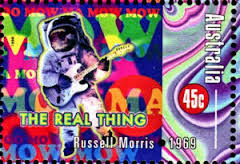
“The Real Thing” written by Johnny Young, performed by Russell Morris, produced by Ian ‘Molly’ Meldrum. Released in 1969 in Australia under the label of EMI/Columbia , it was tracked and produced during 1968 and 1969 at Armstrong Studios in Melbourne, Victoria.
(Australia Post stamp 1998)
Genre
The genre is Psychedelic Rock, and due to its heavy studio production basis, it follows the British version of Pyschodelic Rock. British Psychedelic Rock exponents in this era were: Pink Floyd, The Yardbirds, Procol Harum, and The Moody Blues (George-Warren and Romanowski. 2001). Additionally, there a number of non-Psychedelic Rock bands such as The Beatles and The Small Faces who produced albums or singles in the Psychedelic Rock genre (Max TV 2015). Psychedelic rock as a genre was established attempting to create a soundtrack to the emerging experimental and social drug culture of the day – relaxant and hallucinogenic drugs such as marijuana, mushrooms, and artificial produced LSD. As the psychedelic movement developed, people started identifying with alternate beliefs and spiritual philosophies from a number of global cultures such as Indian (Hindu), Eastern (Buddhist) and American Indian (Shamanic) cultures.
Therefore the musical characteristics and sonic qualities of psychedelic rock were to simulate and replicate the experiences of a user whilst under the influence of these mind-altering drugs. Included in the performances and productions were: electric instruments including the newly developed keyboards and synthesisers of the day; electronic sound effects including the newly developed samplers; musical form including extended improvisation and solos; and world music influences such as non-Western music form, scale, instruments including percussive, stringed, wind and vocal chants of numerous cultures from Indian, Eastern and American Indian cultures (Wikipedia 2015).
As introduced in my blog “Music Practitioner Part 2 – What brought me here” [October 2014], although “Russell Morris was an acoustic pop performer of the day, playing either 6 string or 12 -string guitars -…. this song uses the basis of acoustic music (acoustic guitars, bass, drums) with layers of keys, processing applied and sampled sounds (such as news recordings, laughter, choral bomb sirens and it concludes with a bomb blast) over the top” (Page 2014).
Musical Characteristics
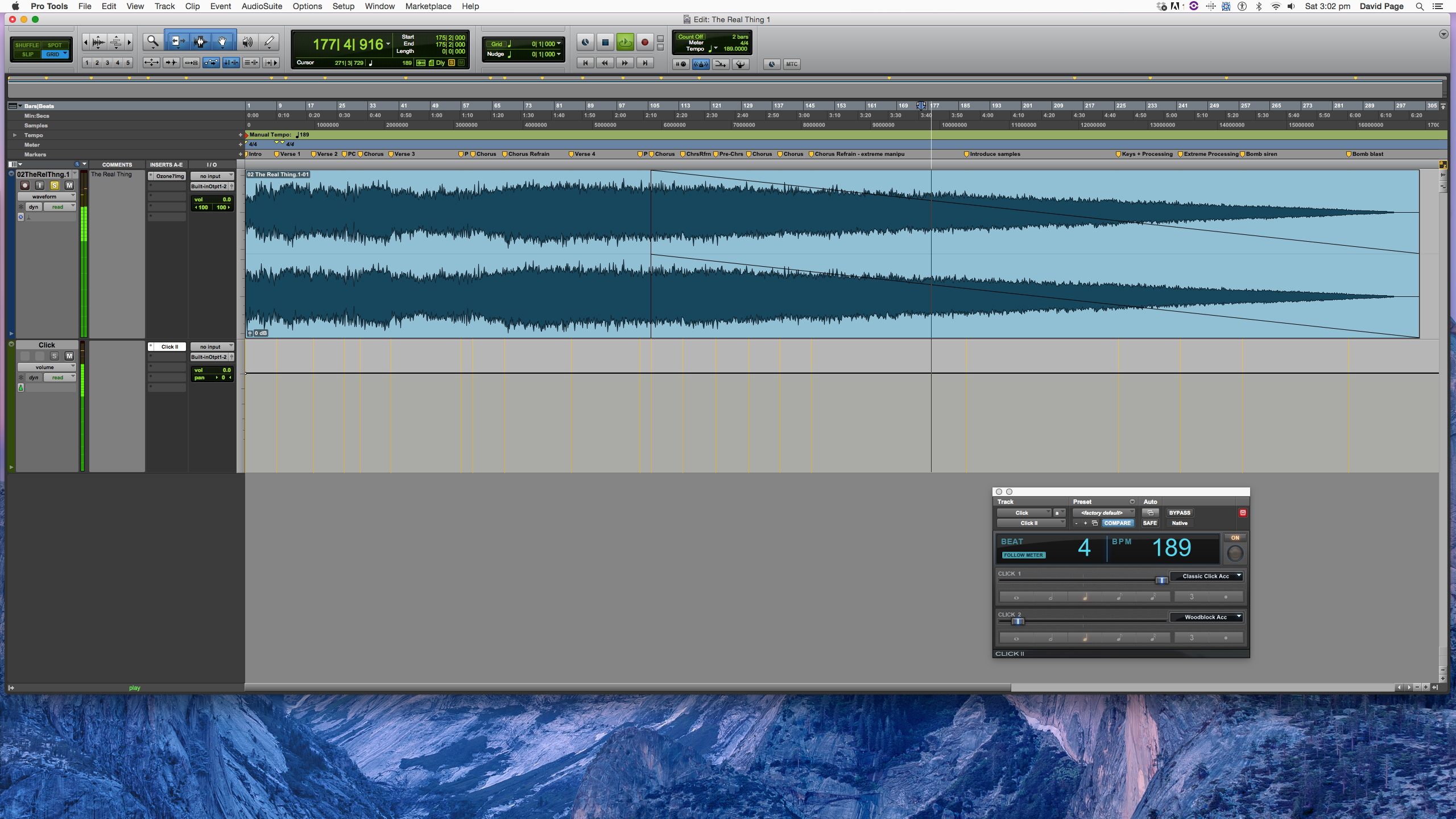
The tempo of this track is 189 bpm, in a 4/4 time signature. The song is 6 minutes 16 seconds in length (I trimmed the blank opening 6 seconds of the track within the DAW) – 298 bars – more than double the length of the usual pop song of the day in length. [Though there was however a 3 min 46 second version played on radio].
The structure of the song as it was written was a AABA form with A being the Verse, and B being the Pre-Chorus and Chorus. However, as it was produced in its psychedelic rock form, most of the second half of the B sections (chorus) were extended into what I am calling a Chorus Refrain (and labelling B+ or B++ or B+++ depending upon the length of it). Therefore, overall the song structure is: A A B A B B+A B B++ B B+++: I have listed below the structure, and noted the main musical elements (instrumentation) as they are added in each of the sections, and the harmonisation (chords) as well.
Intro [Bar 0] – acoustic guitar – D A E B
Verse 1 [Bar 9] – bass -D A E B
Verse 2 [Bar 19] – acoustic guitar – B E A E B, B D A E B
Pre-chorus – [Bar 27] -drums and tambourine – B
Chorus [Bar 31] – D F G Bb D
Verse 3 – extended [Bar 39] – organ and harmony vox – B E A E B, B D A E B
Pre-chorus – shortened [Bar 57] – B
Chorus [Bar 60] – D F G Bb D
Chorus Refrain {extended form of chorus}[Bar 68] – choral vox – D F G Bb D
Chorus Refrain {extended form of chorus} [Bar 114] – D F G Bb D
Pre-chorus [Bar 122]
Chorus [Bar 131]
Chorus [Bar 139]
Chorus Refrain – with extreme sonic manipulation {Bar 147] – D F G Bb D
Introduce Samples [Bar 187]
Keys and Processing [Bar 226] – hi-fi
More extreme Processing [Bar 242]
Bomb Siren [Bar 258] – lo-fi
Bomb blast [Bar 285+] – very lo-fi in places
end [Bar 298]
The harmonic progression as listed above is very simple. In fact, it is very repetitive when it is played in its originally written format on an acoustic guitar. In this highly produced format, this song in many ways depends upon the extreme contrasts of musical and sonic variations throughout; however most notably from Bar 114 there are a variety of points of interest included in order to hold the listener’s interest in the song* {*It is interesting to note that Bar 114 represents 2 minutes 22 seconds, which is around the usual length of a song in that era}.
This is done in four primary ways:
maintaining a very simple lyric to the song throughout;
repeating of the structure {A A B A B B+A B B++ B B+++:) so that it is repetitive, expected and therefore easy to follow;
changing the musical elements within the arrangement such as:
the changing of the instruments frequently throughout the later half of the song allowed my interest to be maintained, as I was not able to predict what was going to feature next.
adding other points of interest such as the samples from a wide range of social and cultural situations also helped me to maintain my interest as again I was not able to predict what was going to feature next.
with the changes to the musical elements came sonic differences of timbre, pitch and amplitude, adding another layer of interest and unpredictability for the listener.
Sonic Qualities
This song is clearly psychedelic rock in character, with numerous technical processes applied. There are multiple textual layers that Meldrum’s production team achieved via the recording, overdubbing and processing techniques applied.
Recording techniques applied
In 1969, the four track recording device had recently been expanded to included devices capable of recording eight tracks simultaneously. “‘The Real Thing’ was recorded on an eight-track machine” (Max TV 2015).
Overdubbing applied
Going through the above listing of musical elements contained in this song, it is a safe to assume that the track count would exceed eight tracks, necessitating a process of overdubbing the additional required tracks. As I listened to the song, it was clear to me from verse 3 that overdubbing was to be a central aspect of this production. The article The Story of the Real Thing, notes how elaborate this production was over a relatively long period of time. “The song just grew and grew. ‘The Real Thing’ became the living thing. It was like an alien monster in the basement” (Max TV 2015). In my 2014 blog Music Practitioner Part 2 – What Brought Me Here I noted it had been reported that Meldrum was heavily influenced in this production by the “likes of US Producer Phil Spector, and his wall of sound style” (Page 2014); a production style that not only relied on maximising tracks in the recording process, but also layering of overdubs to build up the sonic texture of the song.
Processing techniques applied
But the most obvious technical characteristic in this production, linking it beyond dispute to its’ psycholdeilc rock genre, is the extreme use of time-domain processing.
From the song’s introduction it is obvious a heavy dose of reverb is being used. Reverb provides an element of spaciousness into a recording suggests the song’s sound stage is in a different space to where the song was actually tracked. Large amounts of natural reverb indicate a very large space, and by applying large amounts of reverb processing the producer leads the listener to imagine the singer is in another location. The large amount of reverb processing used here aligns to the experimental and social drug culture of the day, helping transport the listener to an imagined ethereal, mystical or drug-induced state. From the first verse [Bar 9], the liberal use of reverb is noticeable exaggerating the sibilance in Morris’s vocal line. Adding time-domain processing to high frequencies will exaggerate the quality. In the production of another genre – eg jazz – such processing is likely seen to be indicative of poor tracking or mixing processes. However, in this context and genre, such sibilance is used deliberately to support the magined ethereal, mystical or drug-induced state.
From verse 3 excessive flanging is introduced, applied to both the music and the vocal line. As the song progresses, this becomes more of a feature of the song, with excessive amounts of reverb, delay, and flanging to name a few, further supporting the imagined ethereal, mystical or drug-induced state, and I for me, adding interest levels for the listener.
Because of the large amount of processing applied to the song progressively, the sonic quality became quite lo-fi from verse 3, and degenerated from that point into extended periods of poor quality signal. From the third Chorus Refrain at bar 145 the signal was noticeably distorted in places, a sonic quality not usually associated with a pop song of that era.
The dynamics of the song vary dramatically across the entire song, with instrumentation, sampling, amplitude, frequency and processing constantly changing, quite often drastically within a particular section of a song. For example, at bar 225 the signal returned to a typical hi-fi quality for about six bars with the return of some acoustic recorded keyboards. However, at bar 331 the distorted and heavily processed signal was reintroduced. At bar 242 the signal degenerated further into a very poor quality lo-fi signal and was immersed in the deliberate state of sonic and arrangement chaos until the end of the song.
The use of these technical features, the extent and the amount of processing, along with the full use of the stereo field with liberal use of panning., helped create and place the listener in a mystical or drug-induced type state as the producer had intended. Target achieved – bullseye!
Tools used to assist in the analysis of a reference track
Analysing a reference track is an exercise in Critical Listening. As mentioned in last month’s blog, it will take time, practice and considerable dedication to learn to listen for the nuances of the cultural production – the genre, musical and the sonic qualities to a level of mastery. As audio engineering is a craft and art that relies not only the auditory, but also on visual cues as well, you will note some of the tools I have used: my DAW, Pro Tools as the primary tool, along with several plug-ins. I used a Pro Tools session to confirm the tempo, the time signature, and analyse the structure of the song. In terms of the sonic analysis, visual cues I used as part of this Critical Listening task were: virtual meters, spectrometers and vector scopes to confirm what I was hearing with my ears. I suggest these tools can also assist aspiring engineer in the development of their critical listening skills.
(AE 2015)
Next month [April 2015] we will continue to develop our Critical Listening skills to a deeper level.
Copyright: No aspect of the content of this blog or blog site is to be reprinted or used within any practice without strict permission directly from David L Page.
Critical and analytical listening is a skill that separates the experienced audio engineer – particularly mix and mastering engineers – and aspiring engineers. Over the next six months I will cover theory and tasks for aspiring engineers to develop their critical & analytical listening skills. As part of that process, I introduce a task today that is a necessary step for the aspiring engineer to undertake in order to develop ones’ critical listening skills.
As I introduced in Critical Listening Part 1 last month [February 2015 blog] “Critical listening, the ability to hear musically and sonically – technically, is an essential attribute of a music producer” (Page 2015). Critical Listening (CL) is a learnt skill as a result of investing thousand’s of hours of listening critically to audio tracks. Aspiring audio engineers need to develop their ears, something that will require motivation and proactive discipline to commit to practicing on a regular basis. In order to separate ‘listening as a fan of music’ and ‘critical listening’, an aspiring practitioner needs to set aside time, scheduling a number of sessions per week to deliberately practice the discipline of critical listening. It is critical that this practice time is when your ears are fresh, when you will not be disturbed, and when you have access to some quality monitors and a DAW. Making such a commitment will be perhaps your most important decision in your development of one of the core audio engineering skills – your critical listening ability.
The first step is to choose a piece of music to analyse. My advice here is to choose a track you are already familiar with – that is, something that you like. This will assist you in the process of drilling down into the depths of the song, as you are already probably familiar with the features of the genre, and specifics of the song such as music characteristics and sonic qualities: even if you have not yet consciously set aside time to analyse the song in such a detailed manner.
In Critical Listening Part 1 I noted a song that was particularly influential on my development as a creative practitioner. Out of both respect, and I suppose a tribute to the significance of this song, I intend to use it as a reference track for one of my upcoming music productions.(Australia Post stamp 1998)
What is a reference track?
A reference track is a track you will use to ‘reference’ against throughout the process of the music production. In many ways, it could be considered a target for the production project; a target around which a building plan can be developed, an architectural plan for your song that has been designed, discussed, agreed and finally acted upon, and then evaluated at certain points in time along the process to confirm the target is likely to be achieved.
The reference track should therefore form an agreement as such between the artist and the producer of what the project objective is to be; what they are aiming at, and how the artist would like the final sound of their cultural production to be most similar to. And agreement between the artist and the production team.
The reference track is also most likely to play homage to the genre the artist is most aspiring to: who they are aspiring to sound like – stylistically, musically and sonically. What ‘reference’ track will your artist choose as their plan, their guide track for their production project? What sound do they desire for this specific production project?
Use of a reference track minimises the possibility of any issues later, avoiding a possible disagreement regarding the final product that was produced with difference of opinions between the artist and the producer of what the target was meant to be.
Why use a reference track?
The reference track specifies the genre, and outlines the specifics of the song such as the music characteristics and sonic qualities that will become the producer’s development plan for the particular production. If you do not have a reference track as starting point, a plan for your production as such, how does you producer know what the song should sound like overall? What mood should the song should evoke? What shape should the song should take? What musical qualities should be included? If you do not have such a plan, how does the producer know what instruments should be included? And if known, how does the producer know what the various instruments are required to sound? If you do not start with a reference track, how do you know what sonic qualities you as the producer will aim for in the production?
What are the elements of a reference track from a critical listening perspective?
A ‘reference’ track is essentially a building plan, an architectural plan for your song, outlining the genre, and what musical and sonic qualities are most desired.
The genre will generally indicate a number of characteristics such as mood (happy, sad, reflective, anger); message (everyday life, relationship, political, spiritual); perspective (1st person, 3rd person narrative, 2nd person conversation, no lyric); likely instrumentation; likely musical structure; likely sonic qualities (hi-fi, lo-fi); social and cultural characteristics (era, target market demographic, cultural significance, para-musical intentions, aesthetic in context).
The musical characteristics include such as musical form; rhythm (tempo, time signature,stress, contra rhythms); harmony (key, harmonic progression, contra harmonies); melody (melodic curve, contra melodies); improvisation; instrumentation; timbre (colour of instruments used); arrangement; elements of interest (form, rhythmic, harmonic, melodic, improvisational,instrumentation or arrangement hooks) .
The sonic qualities of amplitude, timbre, stereo image, spectral, dynamics and time-domain.
Resources to analyse a reference track?
Analysing a reference track is an exercise in Critical Listening. As mentioned, it will take time, practice and considerable dedication to learn to listen for the nuances of the cultural production – the genre, musical and the sonic qualities to a level of mastery.
Audio engineering is a craft and art that relies not only the auditory, but also on visual cues as well. Visual cues such as meters, spectrometers and vector scopes have traditionally all assisted the audio engineer to confirm what they are hearing with their ears. In today’s world of virtual digital technology, not only can we access a large range of meters and graphic scopes, but we can also rely on the additional visual cues of the tape (ie digital wave form in each track), and the virtual stave documents that can be generated from within the DAW. All of these tools can assist the aspiring engineer in the development of their critical listening skills.
(AE 2015b)
Self-learning task: schedule a critical listening period into your schedule over this coming weekend. Ensure you ears are going to be fresh, you will not be disturbed, and in a conducive listening environment with quality listening monitors. Choose a familiar song, and listen for clues regarding the genre, musical and the sonic qualities to a level that you have not practiced previously. Note down your findings. Repeat the exercise several days later, and not down your additional findings following the second critical listening session.
I have provided an example of such a critical listening task in my blog Critical listening Part 2b [March 2015].
Copyright: No aspect of the content of this blog or blog site is to be reprinted or used within any practice without strict permission directly from David L Page.
Critical listening, the ability to hear musically and sonically – technically, is an essential attribute of a music producer. “Listening skills need to be developed … to function in their job. …”. Producers need to be “actively engaged in seeking out information with each passing sound” (Moylan 2007, 89-91). Whilst a novice ear[1] listening to cultural production artifacts[2] could reveal elements, it takes training to reveal subtle production or post-production techniques, equipment or unorthodox use of equipment or instruments that may be used to create unique sonic qualities or textures to differentiate their music[3] (Davie 2015, 43). An aspiring music production practitioner requires guidance and training[4] to introduce them to the subtleties, gained previously by ‘employment’ in a studio[5] with skilled practitioners to observe, imitate and then the opportunity to apply as the situation provided: the importance of ‘training’ in the workplace, “learning and working are interdependent” (Billet 2001, 39; Burgess 2013, 38). The “apprenticeship approach – modelling, coaching, scaffolding and fading” was used as it was found to be central to effective workplace-training techniques (Billet 2001, 145). Whilst the contemporary DIY music production practitioner now has access to the technology, without access to experienced and skilled technicians within work-place-training environments, their ‘training and development’ is more than likely going to be deficient, with essential skills as critical listening[6] lacking (Hague 2010; Théberge 1997, 19; Holmes 2012, 6; Davie 2012, 44).
Self-learning: the ‘discipline’ required to be a contemporary music practitioner
Effective DIY learning requires the discipline of motivation and proactivity to seek out information and learning opportunities. With the unlikelihood of finding an existing studio to receive workplace-training, the contemporary DIY music production practitioner needs to be resourceful in their quest to learn the art and craft of production, and become “aware of the questions and problems that all producers face” (Burgess 2013, 35). There is an abundance of resources[7] today aimed at the aspiring music production practitioner, aligned to effective self-learning methods and tools (Billet 2001, 71). Professional level videos such as on Lynda.com (2015) and Pensado’s Place (2015) provide industry experienced and skilled technicians, with the benefit of this resource being it can be replayed infinite times. In addition to these reputable industry video resources, there are numerous text-based resources such as Sound on Sound (2015) and the Australian-based Audio Technology magazine (2015) that can be sourced online for professional industry relevant information as opportunities for aspiring music practitioners to learn. Burgess (2013, 35) encourages the practitioner to “learn as much as you can by imitation from the most experienced people who are available to you”. However, lacking in contemporary practice is having a more experienced and skilled technician in a position to observe one’s practice to provide appropriate feedback, further explanation and retraining as required. Networks and communities can provide such an opportunity, with experienced and skills technicians available to provide mentoring and training opportunities.
The other opportunity provided in the current era that was lacking in the 1960’s and early 1970’s were vocational and tertiary courses such as the likes of the Australian-based SAE {originally known as the School of Audio Engineering} (2015) and JMC Academy (2015) Institutes. SAE, regarded as the first commercial vocational course of its kind in the world, commenced in Sydney in 1976 (SAE 2015). In order to teach subject content, professional studio processes had to be analysed and industry-valid curriculum developed in order to provide to potential consumers and prosumers the justification of making the tuition fee investment. Burgess confirms their relevance in the discipline: “combined with a proactive DIY approach, a good school program can fill in knowledge gaps and instill a deeper understanding of the fundamentals while increasing awareness of best practices’ (Burgess, 2013, 35).
With the demise of the opportunities for on-the-job-training as with the large format studio model the audio industry used to be known for, many opportunities have resulted in the changing landscape of the contemporary audio industry. Effective DIY learning does require motivation and proactivity to seek out information and learning opportunities. However, the development of a skill such as Critical Listening is something that can be achieved without necessarily leaving one’s home by taking advantage of the internet and the many communication mediums and learning resources that are provided for in this era.
[1] A novice ear listening to cultural production artifacts[2] could reveal elements such as: the genre, aesthetic qualities, general instrumentation, musical structure, lyric or musical message, and spatial placement.
[2] Examples of cultural production artifacts in the field of music production are: albums, CDs and mp3s
[3] Many believe the unique range of sonic qualities or textures are the elements that influence and motivate music producers to create.
[4] Advice traditionally came from work-place training , via a trainer, adviser or ‘mentor’
[5] Employment could be a paid or unpaid role, usually very menial such as coffee boy or cleaner
[6] I developed my critical listening skill within industry, via workplace-training. Today, as part of my ongoing professional development process, I routinely reserve time for critical listening of a range of cultural production artifacts, across genres. Of particular interest to me are: innovative structures, techniques or equipment other practitioners may be employing in their production or post-production process, to realise unique musical or sonic qualities or textures.
[7] Examples of resources that exist in the market place to support contemporary DIY music producers with knowledge and influence are: 1) academic texts, academic journals, functional textbooks, industry associations, industry conferences, industry trade magazines, product and service providers, manufacturers and distributors, specialist professionals such technicians and engineers, forums, blogs and websites; courses, and; cultural production artifacts such as albums, CDs and mp3s.
Copyright: No aspect of the content of this blog or blog site is to be reprinted or used within any practice without strict permission directly from David L Page.
This blog is a continuation of a series. See here (Page 2014b) for the previous blog.
Year 2015: 1st Observation
Commencing the doctoral program, I had a relative clear idea of my proposed research study problem. I say relative as, as I have progressed through the many twists and turns of my doctoral program, I have gained clarity regarding just about every aspect of my planned research topic – my practice, my self understanding, the music styles I am attracted to, the reasons I use certain technologies, workflows, just to name a few. In few ways do I consider my self to be the same person – the same practitioner as when I considered embarking on this post-doctoral journey in 2014. This is my journey. Buckle up, as I take you for the ride of my life.
By the end of 2014, I had a clear idea of my research study problem. I made music in two ways:
using physical instruments; and,
using digital virtual technologies
I wanted to know why I felt connected to my music-making when using physical instruments, and why I largely did not feel connected to my music-making when using digital virtual technologies.
I made music via physical instruments. I strummed chords on a guitar or piano, hummed or played a melodic phrase, developed lyrics, and over time a song emerged. I felt connected to the music. I recall getting positive feedback when I shared my acoustic instrument-based songs with an audience. I followed this approach many hundreds of times over several decades.
As technologies developed, I transitioned into music-making using digital virtual technologies. I invested in virtual technologies, trialling a number of virtual music-making applications – digital audio workstations (DAWs). I experimented; I spoke to local pro audio retailers; I experimented some more; I bought instructional books and videos; I studied; I experimented a lot more. Over a number of years however, I found that irrespective of how much time and money I invested into my virtual music-making production practice, I never managed to achieve a similar flow or a similar feeling – a creative high – as I had music-making using physical instruments. There was one instance, a remix project where I felt a connection. That experience gave me hope that my attempts to use virtual technologies to make music I felt connected to, was not going to be in vain.
(2017)
End product orientated in my music-making
I acknowledged that I naturally took an end product focus with my music-making. Perhaps due to the relative ease I made music via physical instruments, I had never felt a need to consciously consider my music-making process. Similarly, I viewed my music-making in virtual technologies from an end product perspective. However, because I struggled with the results of my making music via virtual technologies, I had begun to realise that I perhaps needed to reconsider that approach. Perhaps I needed to consciously consider my music-making process?
A question that arose in my mind was:
how did I achieve this connection in one form of music-making – using physical instruments, and not another form of music-making – using digital virtual technologies?
This blog series is planned to continue next month with Doctoral Research Study Part 2a (Page 2015). It is intended for this blog series to continue on a regular basis as I progress through my doctoral research project.
Page, David L. 2014a image courtesy of David L Page Created 15th December, 2014
– @David L Page 29/01/2015
– David L Page 15/04/2015
– David L Page 10/06/2017
Copyright: No aspect of the content of this blog or blog site is to be reprinted or used within any practice without strict permission directly from David L Page
This blog is a continuation of a series. See here (Page 2014b) for the previous blog.
My life – music-making and education & learning
My journey in music-making commenced a number of decades ago. I made music via physical instruments. I strummed chords on a guitar or piano, hummed or played a melodic phrase, developed lyrics, and over time a song emerged. I felt connected to the music. I recall getting positive feedback when I shared my acoustic instrument-based songs with an audience. I followed this approach several hundred times over several decades, and because of the relative ease these songs came to me, I never had felt a need to consciously consider my music-making process.
(Page 2014c)
As technologies developed, I transitioned into music-making using digital virtual technologies. I invested in virtual technologies, trialling a number of virtual music-making applications – digital audio workstations (DAWs). I experimented; I spoke to local pro audio retailers; I experimented some more; I bought instructional books and videos; I studied; I experimented a lot more. Over a number of years however, I found that irrespective of how much time and money I invested into my virtual music-making production practice, I never managed to achieve a similar flow or a similar feeling – a creative high – as I had music-making using physical instruments. My frustration grew using virtual technologies to make music. I enrolled into a practical tertiary course. The course assisted me greatly to develop my theory and practical skills. However, using virtual technologies to make music that I felt connected to, (largely) continued to elude me. There was one instance, a remix project where I felt a connection. That experience gave me hope that my attempts to use virtual technologies to make music I felt connected to, was not going to be in vain. I continued to experiment; I continued to read; I continued to invest; I continue to immerse my self into my virtual music-making production practice. However, I still found I wasn’t achieving a similar flow or a similar feeling – a creative high – using virtual technologies to make music as I had music-making using physical instruments. My frustration was at an all-time high. I had arrived at a juncture in my life where I felt there was now no alternative: my virtual music-making production practice needed an intervention. I needed to put my creative practice using virtual technologies to make music, under scrutiny.
(Page 2014d)
In 2013 I applied to a formal academic research program – a professional doctorate program. I was accepted in readiness for commencing in 2014. However, as I neared the 2014 commencement date I accepted my very busy education and training role was not going to be conducive to embarking on such a demanding journey as a doctoral research study, at that time. I therefore immediately applied for a delayed commencement to 2015.
With my delayed commencement formalised, it allowed me to reconsider – to delve down into the many ideas I had for a higher degree research study topic. I developed mindmaps for each of the nineteen (19) potential topic ideas I had, drilling down to see where they took me. I was looking for a topic that allowed me to research as many aspects of interest.
In 2013/2014 I was practicing creatively, while also lecturing in creative media across the range of audio production modules – audio theory, signal flow, microphones, processing – , and a cross-disciplinary creative media studies module. SAE Institute has been going through exponential development – strategically and structurally. With a radical change to the focus of their academic programs, new academic staff were being recruited to lead the re-writing of the academic programs. SAE Institute revised focus was now to be project-based learning, promoting learners to engage to more in the learning process, developing assessment tasks that met their interests while realising the required learning outcomes. A major benefit of this approach was the possibility of cross-disciplinary collaborations. As part of the revised focus, all undergraduate programs were now to include studies in the broad discipline of creative media studies and critical thinking. As a Senior Lecturer with broad experience across a number of disciplines, I was assigned to assist on one of the new cross-disciplinary creative media studies module. Late last year the new versions of the undergraduate programs were rolled out.
However, despite many decades of post-compulsory education experience, I found in talking to the newly recruited academics a lot of their language that largely went over my head. These new peers were recruited from within the Australian higher education (HE) institutional system. Following completion of their doctorates, most had taught in the specialised HE environment, whilst continuing with their research projects and publishing schedule.
As part of the creative media studies stream at our Institute, learners were now to be immersed in specific creative media lexis and theory, via tasks that guided the aspiring practitioners in the development of them selves as unique and individual creative media identities. They were to learn to critically consider what creative media is for them as practitioners; researching and investigating concepts and areas of the creative media industry they may possibly choose to engage in via their practice. They were to then apply these concepts to develop their unique creative media practice. With a developed sense of themselves, having time to form their world views, they would be guided in their development as aspiring professional practitioners; and as undergraduate academic researchers.
(Page 2014e)
My background, and therefore my approach, was so different. I had developed my multiple forms of practice throughout my life, fundamentally as a craftsperson. I was practical. I liked to be hands-on. I had learnt to become a successful practitioner via the 10,000 hour rule – practice, consider, practice, reconsider, practice, etc. I had a Masters level of education, but I didn’t ever consider my self as a higher education critical thinker. I was a practical person that looked at outcomes. This is what I did for organisations over a number of decades – I improved outcomes. I was analytical for a functional outcome. My brief entrée in an education doctorate program in 1999 reinforced this. I accepted I was not naturally inclined as a scholar. I was a functional, practical practitioner.
When the newly recruited academics began arriving at SAE Institute late last year, speaking a language that largely went over my head, I felt very out of place. By the beginning of this year, I felt very challenged. Challenged on every front: as an educational practitioner, despite my years of experience, knowledge and developed skills; as a music practitioner – again, despite my years of diverse experience, knowledge and developed skills; as a guide and mentor to my learners. A question I asked my self was: how could I guide others when I was struggling with my own learning? I was struggling to both understand and engage in all forms of technology and networking opportunities currently on offer via the internet that were now part of the Institute’s degree program. I recall questioning my place within the higher education environment; I recall questioning my place within the Institute; in fact, I even recall questioning my place within an organisational workplace.
I have never considered my self smart, but had the experience of knowing what had served me well for most of my life: the principle of 10,000 hours (Page 2004). I decided to engage developing this new knowledge and approaches to contemporary creative media practice in the only way I knew how: hours of research, and hours of trial and error. My motive to engage in this were: I knew I needed to learn in order to model to my learners what their assessment tasks were asking of them; I needed to learn in order to be able to guide my learners as to how to do such tasks effectively and efficiently; I needed to learn in order to model the importance of these approaches in order for them to develop an industry ready practice by the end of their degrees; I needed to learn in order to engage with my new peers – the recently recruited academics; I knew I needed to learn in order to embrace new ways of seeing my practice – to see my creative practice through a different set of eyes. After all, my eyes had only gotten me so far in my creative media career. I was also reminded that my entire point of my engaging in my intended higher degree research was to discover what I had not been able to discover within my own means. Whilst this process was not yet part of my doctoral research study, I recall seeing the situation I found my self in as an opportunity to learn and develop under the tutorage of several published creative media academics. In addition to understanding the value of hard work, I also understood that I had always been an opportunist. I decided to embrace this opportunity of these new found peers, irrespective of whether I could immediately see the point or benefit of how such new knowledge or approach was going to apply to my creative practice. Frankly, I couldn’t. My head chatter throughout the year has been at a critical level. Internally, almost on a daily basis, I have been debating the pros and cons of such knowledge or approach, particularly in regards to the internet-based technology and networking opportunities.
Below is a small sample list of journal entries I have written in 2014. These journal entries record my newly acquired knowledge and approach to my music-making practice. These have been written for my eyes only, in order to record my learning, and to frame my position with regard to these topics as a practitioner; particularly for my role as an education and learning practitioner in a creative media higher education institution. You will note: some of the journal entries are more technical in nature – for example, the first four (4) Critical listening journals; some are about developing how, as a practitioner, I interact with society – for example the Media Identity and Curation journal; whilst others are about reflecting on my autobiography, and starting to consider who I was as a music practitioner – for example Beginnings, Life is About the Moment, What Brought Me Here and Genealogy. I concluded this year with the journal entry Reflecting Part 1 (as described in Doctoral Research Study Part 1 (Page 2014b), reflecting upon my life up until now. I was about to embark up a new journey in academia, and needed now to ground my self, and begin to focus on the journey in front of me.
(Page 2017a)
I believe going through this intensive one plus year long process was worthwhile in my development as an education and learning practitioner, in the specific discipline of creative practice. As I acquired this new knowledge, I found I now:
· felt more broadly informed when I taught related topics at this Institute; and
· more informed and better able to engage with learners in a range of discussions that I had been able to previously;
· more equipped to respond quickly to their many questions, irrespective of which discipline they were engaged in;
· whilst I was not of the belief that I had yet arrived at a clear sense of my identity following this twelve (12) to fifteen (15) months worth of development, I did accept that I now had a positive view of the direction I was heading in. I had a sense that I was on the right path. I was seeking new knowledge about alternative approaches to what I had previously considered. I had a sense that my nervous excitement, looking to the horizon in front of me, was infectious, and motivating for most of the learners that I engaged with at the Institute.
(Page 2014f)
I therefore consider this experience to have been very worthwhile in my development as an education and learning practitioner, in the specific discipline of creative practice. I inherently knew that it also prepared me better for my pending studies in 2015.
Preparing for 2015
Yes, I was excited about my pending studies; nervously excited about the journey into what was largely unknown territory for me – academic research. In some ways, I likened my nervous – apprehensive – excitement to that of the character Bilbo Baggins in the Hobbit (Bros 2014): nervous about embarking on a new adventure – perhaps even somewhat resistant; but trusting I was in need of going on this adventure, for a greater good. It was for me, in many ways, a self-imposed intervention process. I know I needed to look at my creative practice through a different set of eyes. As I have mentioned: the eyes I had previously been looking through had only gotten me so far in my creative media career. I knew I needed to walk down new paths in order to discover new knowledge and approaches that I had not been able to discover within my own means in all my prior decades of practice. I was ready to apply my self to the commitment that others had led me to understand was going to be required. Of the new academic peers I had met, one had taken ten (10) years to attain their doctorate; another seven (7) years; another six (6) years; another five (5) years. I knew undertaking a three (3) full-time doctoral program, whilst working in a very demanding full-time education and learning role, was going to need focus, and lots of hours: probably 10,000 hours.
2017 Update
I commenced the doctoral program in 2015. My formal research journey had begun. On the back of the new acquired knowledge and approach in 2014, I implemented a new blog strategy at the beginning of 2015. This saw me changing my blog site from tumblr.com to wordpress.com. I did this for a number of reasons, but primarily due to:
wordpress.com is what we were guiding our students to create as their primary creative practice blog site;
functionality of the wordpress.com site, including the use-friendly nature of the interface, the editing features, and the ability to publish multi-media within the one entry.
(Page 2017b)
These journal entries were published retrospectively in wordpress.com as blog posts as soon as I opened that site. The small sample of blogs I currently have listed on my wordpres.com site under the menu category DCI Phase 0 – Starting Point (Page 2017c) – are representative of some of this new knowledge and approach I acquired and developed during this period. These journals/blogs were completed prior to my official commencement of my doctoral studies, the research study I was choosing to embark on to hopefully find answers to my long-term queries regarding my music practice: 10,000 words book-ending the beginning of my research study.
(Terry-Toons Comics 1945-1951)
This blog series is planned to continue next month with A creative artists need (Page 2015). It is intended for this blog series to continue on a regular basis as I progress through my doctoral research project.
References
Ericsson, K.A., Krampe, R.T. and Tesch-Römer, C., 1993. The role of deliberate practice in the acquisition of expert performance. Psychological review, 100(3), p.363.
Terry-Toons Comics. 1945-1951. Mighty Mouse in Mighty Mouse #38-85 Accessed 8th March, 2014.
– @David L Page 17/12/2014
– updated @David L Page 30/04/2017
Copyright: No aspect of the content of this blog or blog site is to be reprinted or used within any practice without strict permission directly from David L Page.
I have never considered my self smart. My schooling test results were mainly above-average, but I worked consistently, and often for long hours in order to achieve these. I recall I often looked to those who got the top grades – those who appeared to do it effortlessly – and wondered what they had inside their heads that I didn’t. My mother was strict, and prohibited me from going out to play until I had done my chores, and homework. I therefore sat there, and continued to toil, in order to be able to get outside. It brought both resentment (for being denied play time) and conviction (to get my chores or home tasks completed, in order to get outside to enjoy playtime). Possibly this was imposed as a result of other behaviour I exhibited in the years prior, but I don’t recall what or when this, may have been.
I do however recall I always seemed to get into trouble with my parents, relatives and teachers, just for being me. Mmmmm……… Ok, I was probably mischievous. Thinking back, there was the time I talked my neighbour’s sister into going with me to the local gas station to buy a packet of cigarettes. I recall I was seven (7) years old, and she was possibly four (4) years old at best. What was the fuss? No one was harmed – just a simple afternoon walk. It was of no consequence to anybody really…… well, except the girl’s parents. When they eventually found out, they in turn told my parents. Mmmm…. banished to my room with limited dinner, no playing and no talking for what seemed like a month.
I perhaps had a limited filter between my thoughts and my mouth. I thought, I spoke, I acted.
(Terry-Toons Comics 1945-1951)
My mother was an active P+C member in my schools, and therefore she knew the teachers, and most likely, the principal. One of my school principals was a very social person. He would hang in the school grounds and talk to the students at break times. He was large – a big guy – with snow white hair, and a large jovial face. Much like I imagined Santa Claus would look like in an everyday suit. He was well over weight. I recall – when I was about six (6) years old – during a playground catch up sharing with him what my brother and sister called him at home – Fatty Arbuckle. Several days later, I recall coming home to be greeted by my mother…. mmmm….I was banished to my room with limited dinner, no playing and no talking for what seemed like a month. She had heard through the Principal at a P+C meeting what I had shared with him. I hadn’t told him to be malicious – I just thought it was funny, and wanted to share it with him. I was sure he would enjoy it. Mmmmm…. note to self.
Left-handed
I was left-handed. Up until I was about eight (8) years old, the teachers at my first primary school made me sit on my left-hand during class times, to (as they said) ‘get it (my left-handedness) out of my system’. I remember when I moved up to the next class level at another school, being told to sit on my left-hand was no longer a focus of the teacher. I recall wondering whether this ceasing to focus on my left-handedness being an issue at the new school was due to the teacher, the school’s approach, or in fact it was just the end of an era of left-handedness being considered wrong.
Always smiling
I recall I was naturally happy – smiling, and this too caused issues. Again with parents, relatives, and teachers – wondering with such a smile on my face, what I was up to. I recall a teacher talking sternly to our class one day (we had possibly been talking and acting up while waiting to be let into our home room after a lunch break). All students were standing, ready to be seated by our teacher prior to class, as she dressed us down for our noisy behaviour in the corridor. I was apparently standing there, during this dressing down, with a smile on my face. “What are you smiling at?” she barked. “I, I , I am happy?” I responded meekly. The class laughed, though I am unsure of whether they were laughing with me, or perhaps laughing at me?
(Page 2016)
I was average at individual sport, but recognised early on, the advantage of team sports. I learnt that within a team I could excel. I became a year house captain within my school; and played in team sports on Saturday mornings, with a team that was consistently in the top two teams in the district over an 8 year period.
Practical approach
I was always a practical person, wanting to do things with my hands, but also realised I wanted to know how it worked, and how I could use it for other applications. I pulled apart all kinds of gadgets, toys, billy carts, wheel-barrows; antique clocks, motor mowers, motorbikes, and cars. I admit I didn’t like the follow up process – the putting back together of these things. I had learnt in pulling them apart what I needed to know – how it worked, so that I could then consider other applications. I made (make believe) sports cars, space ships, and moon craft with the many parts I had before me – all in the backyard. Once I had created my make believe craft, I would then move onto the next thing. Yes, I got bored quickly.
Industry beckoning me
I quit school because I was bored, preferring to get out start working with adults. I started engineering at a trade level, but quickly realised, as soon as I had worked out the how, I was again ready to move on. I then applied to enter tertiary study, fumbling my way through a bachelor’s degree without having completed the final two years of high school. I used the time to explore all manner of things – philosophy, re-engage with my music-making, experiencing social events, bands, pubs, live gigs, and girls. I struggled to find my place in that institution studying a business degree, but looking through many photos of that era, I recall I had a lot of fun trying. Eventually, when I ended up graduating, I immediately headed overseas to explore the world. I arrived in Asia to an opportunity in corporate education and training. I played in a number of cross-cultural band, performing at many cultural festivals. As a foreign educator and trainer, I was also volunteered to make addresses at significant events in the local region, such as at the openings of bridges and at local government and community meetings. I gained invaluable experience and skills, that had I stayed in my native Australia, i would not have had similar opportunities. Several years passed and I returned home. I considered my options, and chose to formalise my experience gained in education and training with qualifications, in order to be able to continue my education and learning practice in Australia.
Corporate experience
After some ten (10) years of practice, the next level of formal qualifications beckoned. I re-entered university to complete my masters degree. At its conclusion, it was suggested I progress onto a doctorate in that discipline. However, after only a short time of study, I was tempted back into industry. The choice was easy for me to make – to apply in real life my proposed thesis topic, rather than remaining at university and developing the thesis statement theoretically.
I commenced managing a local site of a globally-run business, and within a few years had surpassed all projected targets. I progressed into a number of global leadership roles. These required much local and international travel attending conferences, and leading staff training and professional development sessions across a number of content areas: organisational and operational management (including finance, HR, business development, systems and processes), and my developing expertise -corporate culture. Within a global business with over 30 sites around the globe, there was always a need for re-aligning sites to the organisational needs. My demonstrated expertise in change management provided an opportunity to move overseas permanently, heading a region that was now in financial difficulty, and facing deregulation by the countries’ governing body. Over a three year period, I liaised closely with government, governing bodies, financial institutions and head office to return the regional multi-site entity to full accreditation and profitability. Unfortunately, just a few months after this GFC hit the global economy and over a twelve month period, the corporate entity – located in Japan – went into receivership. Fortunately, the region I had led in its development was one of the few secure entities to survive the GFC, and was able to be on-sold. My wife and I returned home to Australia, to enter our next phase.
Formal Studies
As my career had developed into governance roles, I formalised this experience with a qualification upon returning home. As a number of education, training and consulttancy opportunities arose, I arrived into the industry of my main passion, creative arts. Firstly, an education and training role in music and sound; followed by governance roles in film and arts business development. Having embarked on a doctorate previously, and not choosing to continue it, I had a feeling of incompleteness. In addition, having only formally studied my area of passion – music and sound – at an entry tertiary level, and still having so many unanswered questions, I decided to enquire what possible programs I could consider. In talking to several industry contacts, I was quickly referred to the Head of Department at one of Queensland’s leading universities, and over the course of a fifteen (15) minute conversation, a Doctorate of Creative Industries was suggested. I proposed a topic and after some months I received confirmation of my acceptance.
Symbol of my learning and development
Over the past number of years, I have used the image of the purple onion to represent my approach to life. I am committed to learning – something I have done over most of my life – looking under the many layers of my practice or self in order to gain more insight into life and practice. I still do not consider my self smart, but experienced. I believe in Ericsson’s 10,000 hours (Ericsson in Page 2004), and believe much of my life’s success is based on constant and continued work, rather than any presence of intelligence. I therefore embark on my doctoral pilot study journey with this in mind, and trust that this approach will be sufficient to have me realise the required milestones, at the level of rigour expected of Australian tertiary studies.
My journey begins….
This blog series is planned to continue next month with Pre-Doctoral Research Study – Part 2 (Page 2014b). It is intended for this blog series to continue on a regular basis as I progress through my doctoral research project.
References
Ericsson, K.A., Krampe, R.T. and Tesch-Römer, C., 1993. The role of deliberate practice in the acquisition of expert performance. Psychological review, 100(3), p.363.
Learning Philosophy image courtesy of: Learning Accessed 15th October 2013
Page, David L. 2016 image courtesy of: Slideshare Accessed 30th April, 2017
Terry-Toons Comics. 1945-1951. Mighty Mouse in Mighty Mouse #38-85 Accessed 15th December, 2014.
– @David L Page 16/12/2014
– updated @David L Page 30/04/2017
Copyright: No aspect of the content of this blog or blog site is to be reprinted or used within any practice without strict permission directly from David L Page.