Doctoral Research Study – Part 2g

My journey continues….

~DLP Pro Image Fun 5b small.20141020
(Page 2014)
This blog is a continuation of a series. See here (Page 2015a) for the previous blog.

Year 2015: 2nd Observation Part g

2nd Observation.P2a.renamed

Bordering my music-making practice

As mentioned in the previous blog, I came to understand within the first few months I needed to broadly explore the fields and disciplines of contemporary music-making, in order to border – and define – my music-making practice. Following exploring the breadth and rapid exponential growth of the music-making industry over the past century in the previous five (5) blogs, I continue to examine an aspect of my practice – me as a practitioner – outlining:
d. Changing motives of practice
and then outline my specific site/s:
e. My sites: my DIY Studio Production setup/s.
I will then conclude with:
f. Defining the Music Production process
g. Defining a holistic DIY Music Production process

Changing motives of practice

Given my current motives for practice are very much exploratory – research and investigation – not volume sales-based, I do not feel it is appropriate for me to categorise my music-making practice as per the industry definition of professional practice. In looking for an alternative classification to define my music-making practice, I considered the classifications for my practice of: professional, semi-professional, amateur or hobbyist (Rogers 2013). Could it be semi-professional, as I earn multiple small income streams from various forms of music-making practice? Or is it amateur, referring to my current status as a music producer where I am earning minimal income at present because of my current pursuits of creative industry education, and full-time doctoral studies? Referencing Kuznetson and Paulos’s article, I am reluctant to assume the title of expert for my music-making practice, as I consider myself a generalist across a breadth of skills and experiences. (Kuznetson and Paulos 2010, 295). However, I daresay my clients, the Institute that employs me as a Senior Lecturer, and my students may see that differently. What I do however accept is who I am: highly motivated, possessing an impassioned commitment to my practice, with a very high level of focus on developing my knowledge, skill level and technology. After four decades of music-making practice, I seek to learn on a daily basis: newly released creative technologies, applying them in a variety of creative locations; familiarising my self with new music styles; developing new practice workflows; better understanding my motives, and my self. I engaged in this doctoral research study to investigate my practice, in order to develop greater understanding and workflows. I therefore am of the opinion I exhibit qualities and attributes that reflect an attitude of professionalism. For these reasons, not with standing my experience, knowledge and skills accumulated and developed to date, both within the field and discipline of music and sound, and all other experiences in life, I also classify my self as an aspiring music practitioner.
As I continued my investigations, I began to recognise I approached my music-making with physical instruments in a different manner to my approach to music-making using virtual technologies (using my laptop to make music for example). In drilling down I determined that much of this was how I viewed both devices. I commenced my music-making practice with acoustic and analogue technology, developing a workflow that reinforced my musical literacy, instrumental skills and personal taste in music. However, as technology developed in the mid to late 1980’s, and alternative music-making devices became available, I moved from acoustic to digital technologies. In the early 2000’s my development of alternative devices included digital virtual technologies.
I viewed virtual technologies very differently. The actual device that housed the music-making application software (DAW) was a computer (a laptop for example). I saw a laptop as a device that houses many many application software that enabled me to record data and/or make transactions. I used computer technologies for administrative purposes (applications such as i-Note, word, excel, etc); organisation purposes (applications such as iCal, reminders, etc); and everyday personal and business management (services such as the internet-based social media sites, banking sites, utility sites to pay bills, etc). I viewed the music-making application software (DAW) as somewhat removed from me. It was housed in a aluminium and plastic case, that I could see, but not touch. The virtual keyboards were   engaged by pressing a computer keyboard letter; or perhaps a key on a plastic physical keyboard controller. Neither devices are derived directly from nature. They are manufactured. A computer and a keyboard controller are physical devices which also have natural resonant qualities. They only minimally expand and contract in extreme conditions, with such occurrences perhaps likely to render these devices inoperable. There is also a slight delay between the time you touch the key and having the sound emitted out of the computer monitors. They are not what I consider to be large resonant devices that can be embraced and/or feel the resonant qualities as they are played, such as I experience with a piano or guitar.
Moving from acoustic to digital and digital virtual technologies in recent decades, I observed the vastly different technologies and associated workflows that lend themselves to creative locations and music styles. This transition impacted my music-making practice, hindering the realisation of my creative productions: my EPs. I am compelled to learn more about my practice, and my practitioner self. I continue to practice a variety of music styles across multiple sites, motivated by multiple motives, developing my knowledge, skill level and technology. Whilst I have found my self at various times asking a number of questions in isolation, I now find myself seeing them as connected issues within a more global problem as I proposed for this doctoral research investigation.
Despite my four decades of practice, I have my eyes very much on the future. I still have a lifetime of music goals still to realise: songs to write and arrange; sonic textures to explore; creative productions to develop; and engage with both my peers and the public to a far greater degree than I have to date. I am hopeful of continuing my journey with music as an integral part of my life, core to my being, accompanying me wherever I am – wherever I choose to go.

My DIY Music Production setup

I have two music-making setups: a portable studio setup; and a project studio setup.
My portable setup includes:
An Apple MacBookPro 17” laptop[1] sits before me as a multi-dimensional tool for music production. It is portable, with me using it daily in a range of sites, from my project studio, the staffroom, a classroom, the waiting room of a professional service provider such as a doctor, on a train station while waiting for a commuter train, on a bus, on an airplane, in a park, or on the beach during my recreational time. The device includes a 2.5 Ghz intel processor, 16 gigabytes of random access memory (RAM) operating at 1,333 Megahertz, 1.75 terrabytes of storage, with an Intel high definition 512 megabytes graphics card. It has in excess of 170 applications installed on it {and to name but a few applications}, allowing me to use the device as a word processor, a multi-media player for both movies and music, a recording device, a multi-track recorder, or an instrument. And not just one instrument, but just about any instrument you can imagine, from an acoustic – European[2] or world[3] – instrument to a synthetic instrument[4]. In addition, I carry a two terabyte external hard drive with my laptop shoulder bag which stores my numerous and varied sample libraries[5] that allows me to have numerous instrumentation options wherever I am. Irrespective of the size, material, weight or value of that instrument, the need for electricity or batteries to operate it, or the technique and skill level required to play it, I have these instruments with me anytime I choose to travel to any location, and can choose to integrate any one of them into my music productions, as my creativity desires.
But such choices were not always available. I could not even begin to imagine in 1987 when I purchased my first digital recording console[6], with relative limited options, flexibility, speed, and quality that such a device with its enabled process and workflow would be possible. Several decades later, in 2004 when I purchased my first digital virtual audio recording workstation (DAW)[7], I did not imagine that I would be able to procure a device, the equivalent of a large note pad, and with it hanging lightly over my shoulder, be able to board a plane with such a powerful music production tool, with exponential more options, flexibility, speed, and quality in just another 8 years. My mind now ponders what I will be able to do in another 8 years time?
My project studio setup:
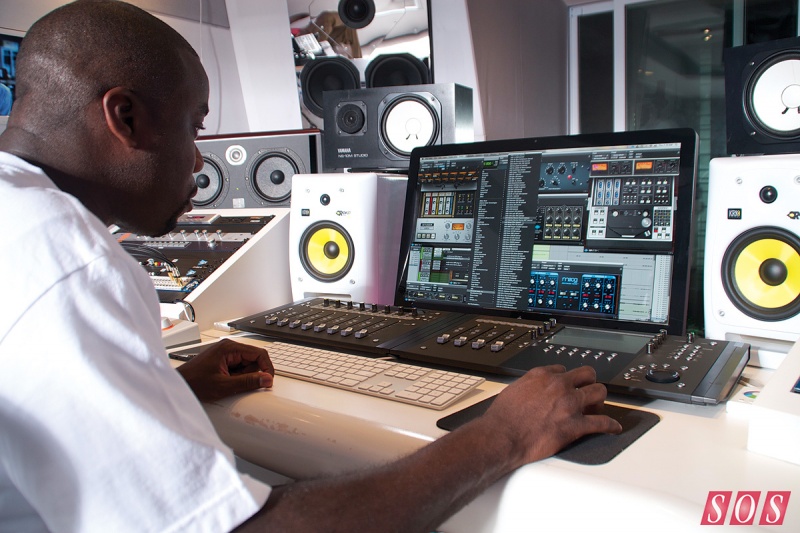
a 27” iMac has five (5) TB of internal hard drive with many TBs of samples. It runs a the industry standard DAW operation software (Pro Tools 11), and is supported by a 32 channel console with multiple monitors and a number of external analogue and digital audio processing devices. This setup allows extreme flexibility to be able to record and produce just about any style of acoustic or synthetic-based music possible.
I have practiced as a musician and a music producer in a number of locations globally for the greater part of my life. Irrespective of my geographical base, I approached these roles quite independently in my formative years. However, over the past decade I observe I am increasingly being drawn to attempt to fuse these two roles into what I would refer to as a singular, interdependent practice – musician as music producer. How I do this, and how I can do it more effectively is to be the basis on my Doctoral Research Study topic: “Holistic DIY Music Production: The effective integration of acoustic instruments with synthetic instruments during DIY Music Production in the digital environment[8].”

Defining the Music Production process

In order to explore these changes and new relationships, and what the implications have been on the process of music creation and production, we need to define the stages.
Raimond et al differentiates the music creation process (the musician composing) with that of the performance and recording process, whilst labeling them both under the ‘Music Production workflow’ (Raimond et al. 2007). Within the audio engineering industry, via anecdotal conversations with my audio engineering colleagues over many years, it is generally accepted that the Music Production process is divided into 3 main stages: Pre-Production, being prior to Production where the recording session is planned, and all logistics and all equipment confirmed; Production, being the actual recording process; and Post-Production, being the process following recording, up to having a ‘completed audio product’ in hand. This definition of the Music Production process is confirmed in such industry recognised texts as the “Art of Music Production”(Burgess 2013, 60-75), but I was unable to find such a suitable audio industry-based graphic, I am drawing on a similar practice described in a film industry document. Apple’s film digital workstation Final Cut Pro 7’s manual describes the process in terms of 5 stages {see graphic below}, with the two additional stages being ‘Scripting’ {what could be argued as the film equivalent of the music creation process with the film scriptwriter composing the film’s narrative – storyline and dialogue}, and Distribution {that which comes after the completed film product/artifact is in hand} (Apple 2010).

Production process.20150729.png

(Apple 2010)
It was common to have multiple roles for the various specialist technical skills along the music and audio industry production chain. Some of the specialist roles were: songwriters/composers, artists, arrangers, recording engineers, tape operators, console operators, mixing engineers, mastering engineers, and producers (Leach 2011).

Defining a Holistic DIY Music Production’ process

I will therefore refer to these five (5) stages both the Music Creation and Production stages, as the Holistic DIY Music Production process, including:
  1. the music creation stage (musician composing, lyrics and orchestrating the musical piece);
  • the three stages of the audio engineering process of,
  1. Pre-Production – pre-meetings to the actual performance and recording of that performance, planning the logistics of the production session, organising the ‘event’ including studio and equipment bookings, staffing, coaching people, setting up the session;
  2. Production – the actual performance and recording of that performance, control room and live room management, tracking, overdubbing, discussing the arrangement, creating an environment or space that will elicit the best out of the musicians
  3. Post-Production – following the completion of the actual performance and recording of that performance, an process that may include: arrangement, orchestration, decision to re-track, re-overdub, editing, mixing, embellishing all elements of the mix (including FX and interest), mastering, etc up to having a ‘completed audio product’ in hand;
    • and the final stage,
  4. Distribution – with the ‘completed audio product’ in hand, how this product will be released or distributed to the consumers or marketplace (irrespective of whether it is a commercially-motivated product, or not) 
onion-layers
Footnotes
[1] I purchased this in February 2012. The system came with a 250 gigabyte hard drive and cost my the equivalent of AUD$4,000 at the time. I currently have a 1.75 terrabyte hard drive capacity installed within it.
[2] Such as a double bass which I have seen many times in both European music orchestras and contemporary Jazz bands, but never played one
[3] Such as a Kenyan instrument – the Nyatiti – which I have only ever seen in Kenya during one of my trips in the early 1980s.
[4] Such as a Jupiter-8 synthesiser which I saw being played live in Japan in the late 1980s
[5] Sample libraries such a ‘symphonic orchestras’, ‘marching bands’, and ‘kitchen pot’ sets. I have compiled my sample libraries via purchases (about $10,000, including multiple instruments or play engines), creating samples from my recorded stock, and also trading via my peer network. I currently have approximately 2 Terrabyte of samples available for my use in music production at this time
[6] A TEAC Tascam Porta-4 Studio digital console. It cost me the equivalent of AUD$200 at the time.
[7] Referred to as a DAW, I purchased Pro Tools 6 and shortly after Logic Pro 7 multi-track software in August 2004, installed on a Mac Tower with a Digidesgn 002 interface. The system came with a 150 gigabyte hard drive, and cost me the equivalent of AUD$5,500 at the time
[8] As part of that KK59 Doctoral Research Study, I will necessarily need to define the ‘musician as music producer’ process, and intend to include both the Songwriting/Composition stage, and the Distribution stage in what I currently refer to as a Holistic DIY Music Production process. However, for the purposes of this KKP623 Essay “Assignment #2 Contextual Review of currents and trends that are shaping Effective Practice”, I will use the more common industry definition of Music Production as discussed by Burgess (1997, 64) in the “Art of Music Production”, excluding any extensive discussion of these two ‘additional’ stages of Songwriting/Composition and Distribution
onion-layers
This blog series is planned to continue next month with Doctoral Research Study – Part 2h (Page 2015b). It is intended for this blog series to continue on a regular basis as I progress through my doctoral research project.
References
Apple. 2010. “Final cut pro 7 manual. Accessed 10th May, 2015.
Burgess, Richard James. 2013. The art of music production: the theory and practice. New York: Oxford University Press.
Burgess, Richard James. 1997. The art of record production. London: Omnibus Press.
Kuznetsov, Stacey and Eric Paulos. 2010. “Rise of the Expert Amateur: DIY Projects, Communities, and Cultures.” In Proceedings of the 6th Nordic Conference on Human-Computer Interaction: Extending Boundaries, Reykjavik, Iceland, October 16-20, 2010, edited, 295-304. http://dl.acm.org/citation.cfm?id=1868914&picked=prox: ACM.
Leach, Joel. 2011. A concise guide to music industry terms. Missouri: Mel Bay Publications.
Onion image courtesy of: Onion Layers Accessed 15th December, 2014
Page, David L. 2017 2nd Observation image courtesy of David L Page  Created 10th June, 2017
Page, David L. 2015b. Doctoral Research Study – Part 2h  Accessed 5th September, 2015
Page, David L. 2015a. Doctoral Research Study – Part 2f  Accessed 20th May, 2015
Page, David L. 2014. image courtesy of David L Page.  Created 15th December, 2014
Raimond, Yves, Samer A Abdallah, Mark B Sandler and Frederick Giasson. 2007. “The music ontology.” In ISMIR, edited, 417-422: Citeseer.
Rogers, I. 2013. The hobbyist majority and the mainstream fringe: the pathways of independent music-making in Brisbane, Australia. In Redefining mainstream popular music, edited by Sarah Baker, Andy Bennett and Jodie Taylor, 162-173. New York: Routledge.
– @David L Page 29/07/2015
– updated @David L Page 05/09/2015
– updated @David L Page 10/06/2017
Copyright: No aspect of the content of this blog or blog site is to be reprinted or used within any practice without strict permission directly from David L Page.

SaveSave

SaveSave

SaveSave

SaveSave

SaveSave

SaveSave

Educational Philosophy Part 3c

On track to develop mastery of one self, what is your approach to education and learning? (contd)

Continuing on from my previous blogs in this series: it is my desired goal to develop a collaborative, collegial, safe learning environment. Trust and respect are core to this process.
As mentioned in the previous Layer, prior to the learning practice session I need to be in a position to pre-assess the learning group. In instances where I do not have the required background information – which I admit to being the majority of cases – I would need to structure my initial class room activities to include activities which enable me to educe the range of background information and understanding I consider relevant and useful. To facilitate the needed getting to know my learners phase, I find being open with my learners along similar levels of information and behaviour that I expect of them. I consciously invest time in the initial stages of the learning experience with a new group of learners to develop an appropriate learning session culture, which includes confirming the agreed learning outcomes. This step is necessary to ensure the learner’s expectation and the learner facilitator’s expectations are aligned; and if not, to take the opportunity to discuss and address any misaligned of expectations at the earliest opportunity. The ultimate goal of a learning experience is to optimise the effective student learning experience of the particular learners. In clarifying both the learner’s and my learning facilitation expectations, I am in my experience removing possible issues or objections that may arise later. Even if issues or objections regarding levels of expectations do arise later in the learning experience, at least there has been prior dialogue – a conscious reference point from the outset – to return to and continue discussion. This process is all part of developing trust and respect for a collaborative, collegial, safe learning environment.
Learner assessment – during session delivery
Throughout the learning experience I will be informally assessing the progress of the learner group, and as much as humanly possible, the progress – in real time assessment –  of each of the individual learners. My goal at any point in time thought the learning experience is to confirm all of the learners are engaged and are being presented with a learning experience that is compatible with their personality type, their thinking approach, their intelligences, and their learning styles (Light et al 2009, 77). I need to confirm the learner’s understanding independently throughout the learning experience by a range of means. Two such means are via questioning techniques; and observing students in action. Concept checking questioning techniques (CCQ) and instruction checking questions (ICQ) enable me to effectively and efficiently achieve this, ensuring that I systematically include all participants within the particular learning experience – as appropriate (Fisher and Frey 2007; Angelo and Cross 1993). Observing of students carrying out a task can also confirm to you as the learning environment facilitator that your instructions were clear. But such observation allows you to also confirm the student’s approach to a particular function; the degree of competence that may or may not have with that particular function; any gaps in knowledge they may or may not have; and the opportunity for you as their learning facilitator to further assist them in order to optimise their effective learning experience. This later observation in the environment of audio training used to be conducted in workplace training contexts (the apprenticeship model), but in the contemporary environment, much of this type of training is now conducted in formal education programs (Billett 2001): formal education programs such as SAE Institute’s Creative Media degree, Bachelor of Audio Production program (SAE Institute, 2015).
As a learning experience facilitator, my desired goal is to develop a collaborative, collegial, safe learning environment. Trust and respect are core to this process. As part of this process, my aim is to reveal my self as candidly as is appropriate – socially and culturally. In my experience, the more I know my self as a practitioner, the more congruent I can be with others – including my students; and the more potential I have to be able to optimise the effective student learning experience of those particular learners.

Layer 10: Evaluation of the learning practice

The evaluation of the learning practice session is what I consider to be one of the most important stages of the education & learning process. The purpose of this stage is to have the learners evaluate the learning session in terms of the content and/or processes.
I have observed many novice education and learning practitioners in many different scenarios overlook this stage, unaware of the importance of this stage. I have laid this evaluation section out in the following five (5) parts.

Layer 10a: Evaluation of the learning practice Pt1

This process commences at the conclusion of the central learning practice session. Often, I will have a break at the end of the central learning practice session, before I commence the evaluation stage.
In preparing for this stage prior to the commencement of the learning session, I need to consider how I am planning to have the learning session evaluated in terms of the content and/or processes. I consider how I will effectively and efficiently draw the education & learning practice session to a logical conclusion so that the learners can effectively and efficiently evaluate what they have learnt.
The evaluation process can be either a formal or informal process. However for best practice, I would advocate to include both a formal or informal process in the evaluation stage.
  • An example of an informal process could include a cohort-wide round table debrief of “what I learnt today?” I have be known in this stage to make notes down as they share; or if i feel this to be intrusive, then I may make mental notes that I will jot down immediately after the learning session has ended.
  • An example of a formal process could include a pre-arranged summative evaluation tool such as a feedback form that the learners respond to questions regarding the various aspects of the learning session.  The primary benefit of this confidential response of each individual if that one may elicit some responses that a informal round table debrief may not.
Once I have completed this evaluation process, I end the learning session officially – restating any expected action or practice required prior to a further learning session. I then dismiss the learners.

Layer 10b: Evaluation of the learning practice Pt2

Once the learning session has concluded, I then need to consider the evaluations.  For the formal process, this will include considering the quantifiable or qualitative responses in order to draw conclusions of the learner’s evaluation of the learning session.
For the informal process, this may include revisiting some jotted down points during the actually learning session round table debrief; or if considered an intrusive process, actually noting down learners’ comments that were made during that session.
This evaluation process could also include a third party observer who may have been sitting in on the learning session. Such a third party observer’s observations and input could be very beneficial in the event that there is a difference of opinion as to the usefulness of the learning sessions content and/or processes, between some of the learners; or some of the learns and you as the facilitator of the learning session.
Irrespective of what tool or party provided the evaluation of the learning session, my aim is to gather data regarding the following questions:
Did the learners realise the aims and objectives of the learning session?
How do I know they did?
How did I know they didn’t?
Anecdotally what was the feedback?
In terms of summative feedback, what was the evaluations?
Were there any observers in attendance in the learning session?
Intuitively, how did the learners realise the aims and objectives of the learning session?
Did some learners realise the aims and objectives of the learning session, but others not?
Why do I think this did/did not occur?
Did the learners realise the learning session objectives?
Why/why not?
How do I know this?
Did the learners feel they realised the learning session objectives?
Why/why not?
How do I know this?
Once I have completed the data gathering stage, I need to take time to reflect on the evaluation of the learning session.

Layer 10c: Reflective practice following the learning practice Pt3

There are benefits of reflecting on a learning practice session once it has concluded. The degree to which one can reflect is dependent upon one’s knowledge of the content or the different learning theories and approaches. You can only reflect on what you know. It is very difficult if not impossible to reflect on an aspect of your practice that you are not yet aware of. Whilst i feel this is obvious – common sense – I think the point is lost of some education administrators.
My practice covers the three disciplines of creative (music) practice, education and learning practice, and my most recent engagement, research practice. In Layer 5 I noted that my approach to all of these forms of practice, I “make time to reflect every day at some time upon some aspect of my diverse practice, referenced against other practitioners, whether peers or those who I value their cultural production. My focus is to gain clarity, greater understanding, increased insight, considering possible alternative workflows I could have pursued, and decide what form of practice I will pursue the next opportunity a similar circumstance arises” (Page 2004). I also noted my daily practice is to engage in both reflective practice and reflexive practice.
        Reflective Practice – introduction
Many novice practitioners may consider casual options of reflection; such as on the way home on the bus or in the car whilst listening to music, as being sufficient to develop their practice. Haseman differentiates casual reflections and conscious planned reflective practice as the difference between navel-gazing and what he terms forensic reflective practice (2015). The goal of reflective practice should be to turn experience into learning (Boud et al 2013). Therefore a deliberate activity to consider a past practice event, and then analyse it critically, appears to be the minimal criterion that defines robust reflective practice. A practitioner should consciously make time and space at a specific part of the day when where they can engage undisturbed in reflective practice; considering what they did, or didn’t do in that lesson; or what you did or didn’t do in terms of the agreed aims and objectives contained within your learning experience plan.
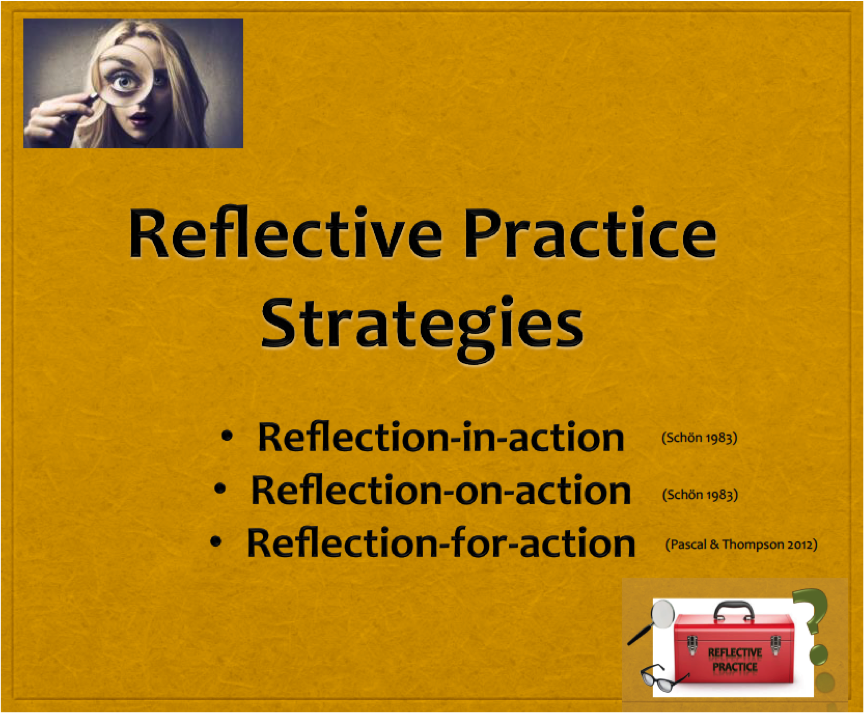
Specifically, education and learning practice needs to be considered in terms of the respective andragogies or pedagogies of the learning group.  In order to avoid the ill-disciplined habit of informal reflection, it should be the aim of the practitioner to have clear and transparent processes so that they can be examined closely as to their value, limitations and assumptions (McKee, 2003). The result could be a practitioner’s reflective practice toolbox, offering a range of strategies for: reflection-in-action (Schön 1983), reflection-on-action (Schön 1983) and reflection-for-action (Pascal & Thompson 2012): demonstrated by real world examples across any of the common aspects of teaching, such as: curriculum design; learning experience planning; delivery; and post-delivery evaluation.
Figure II – Reflective Practices Summary (Anderson et al 2015)
There are a number of possibilities of focus to reflect on following the learning practice. One can reflect on the experience of the learner; your experience as the practitioner; or your experience as a participant observer (Griffiths 2010). Brookfield’s theoretical framework for reflective practice is provided to examine these pedagogical practices through four different lenses – through our own eyes; through your student’s eyes; through our fellow professionals’ eyes; and through established theoretical views (Brookfield, 1995). This reflective practice process should at best inform and and enrich ones’ education and learning practice, allowing the discovery of innovative or creative practices, while also acknowledging contemporary literature on the subject.
Roth’s model could also be used for unpacking the reflective process, encouraging greater depth of analysis and further investigation as required (Roth, 1989). Together, these conceptual frameworks provide several perspectives and facilitate ways in which to think critically about teaching, and uncover effective practice. This framework could provide a platform for revealing a desired result of reflective andragogical or pedagogical practices in line with industry standards.
  • Questioning what, why, and how one does things and asking what, why, and how others do things 
  • Seeking alternatives 
  • Keeping an open mind 
  • Comparing and contrasting 
  • Seeking the framework, theoretical basis, and/or underlying rationale 
  • Viewing from various perspectives 
  • Asking “what if…?” 
  • Asking for others’ ideas and viewpoints 
  • Using prescriptive models only when adapted to the situation 
  • Considering consequences 
  • Hypothesising 
  • Synthesising and testing 
  • Seeking, identifying, and resolving problems
 Reflective Practice – specific to an education & learning practice session plan
The process I follow at the end of a education & learning practice session includes the following areas, with accompanying questions:
REFLECTION ON LEARNER’S LEARNING PT1
I do this process in two stages. The first stage is on-site, immediate post-practice. The benefit of this process is that the practice events are still fresh in my mind. I can scribe the physical, visual, auditory or emotional events of the day with a high degree of detailed recollection due to the currency of the events that have just been experienced or observed. In many ways, it is very much an stream of consciousness process – scribing without considering too much or judging my responses.  In terms of a detail of recollection I find this on-site, immediate post-practice reflective practice session is very beneficial as an initial data collection exercise. This process commits to my sub-conscious content for consideration, and until the point that I make time to return to the second stage of the deliberate reflective process, my mind will be turning over that data, and distilling the less significant events from the more prominent and significant events.
The range of questions I ask of myself to scribe my immediate first responses are:
  • Did the learner realise the aims and objectives of the learning session?
  • How do I know they did?
  • How did I know they didn’t?
  • Anecdotally what was the feedback?
  • Intuitively what was the feedback?
  • Did some learners realise the aims and objectives of the learning session, but others not?
  • Why do I think this did/did not occur?
  • Did the learners realise the learning session objectives?
  • Why/why not?
  • How do I know this?
  • Did the learners feel they realised the learning session objectives?
  • Why/why not?
  • How do I know this?
REFLECTION ON LEARNER’S LEARNING PT2
The second stage is away from site, and after some time has lapsed post-practice. I find it is crucial to conduct this second stage reflective practice in a different site to that of the practice session, as it allows a separation of any possible automated response that may be activated by the actual practice site that I am reflecting about. Additionally, the amount of time expired between the actual practice session and this reflective practice session may vary in each circumstance: I have found over doing this process over many decades that it has to be an appropriate amount of time to allow my mind to turn over that data, and distil out the less significant events from the more prominent and significant events. Sometimes this takes a few days, and at others times, it has taken several weeks. I am experienced enough in this process now to trust my inner time clock to know which particular practice session I will choose to reflect upon in any of the regular scheduled evening reflective practice sessions I hold.
As inferred, the benefit of this process is that the practice events become distilled in my mind, with the more prominent or significant events rising to prominence in my mind. This stage of reflective practice also allows for any emotion around that particular practice session to recede to a level where perhaps a greater degree of perspective can be applied to the event. With distance and time away from the practice, I find I scribe the prominent or significant physical, visual, auditory or emotional events of the last practice session with a greater degree of critical thinking due to the distance – time and place – from the events that had previously been experienced or observed. I generally do this process once I have concluded my responsibilities of the day – when the house is quiet, when my mind is free of other responsibilities. I may or may not have a hot beverage, and I sometimes conduct this exercise against a backdrop of soothing music which I find allows my mind to delve into depths of thought and analysis. In contrast to the stage of on-site, immediate post-practice stream of consciousness process gathering of recollection data, I scribe very consciously, analysing what and how I respond. I certainly consider why I have acted in practice – and also responded – in the ways I do, dissecting each and every prominent or significant event within my practice session. It is a rigorous process that I find is both mentally exhausting, but also satisfying due to the crystallisation of thoughts and ideas that I find usually occurs.
In this Part 2 stage, the range of questions I ask of myself to scribe my second round of very considered responses are very similar – if not the same – set of questions as outlined above. However, I definitely drill down within each question to a far greater level of depth, looking for insightful distinctions about my practice. The question words of what, how and why are instrumental in this process. In doing this second round of reflective practice, I find is that I am far more detailed in the scribing process, critically analysing to a depth that is absent from my on-site, immediate post-practice initial data collection reflection process. It is within this reflective practice session that I crystallise my thoughts and understandings, and gain fresh levels of clarity about my practice.
REFLECTION ON FACILITATOR’S PRACTICE DELIVERY
Given the above reflection on student learning, I ask myself the following questions:
  • Were the learning session outcomes realised?
  • How satisfied am I with the learning outcomes?
  • If not completely satisfied: why/why not?
  • Do I consider any changes need to be made in the next education & learning session of the similar aims and objectives? 
  • What were the strengths and weaknesses of the learning sessions?
  • How was the timing or the flow of the education & learning practice session? 
  • What worked?
  • What and why?
  • What didn’t work?
  • What and why?
  • Had I planned for this event/factor to happen?
  • Was it conceivable that it could occur?
  • What was the percentage of time between facilitator-talk (Ft) and learner-talk (Lt)?
  • Was this as planned and described in the education & learning practice session plan?
  • Why?
  • Why not?
  • How useful was the education & learning practice session plan?
  • What was?
  • What wasn’t?
  • How closely did I stick to the education & learning practice session plan?
  • What happened that forced the change?
  • Why hadn’t I planned for this change to happen?
  • Was it conceivable that it could occur/arise?
In terms of the education & learning approach:
  • How effective was the particular pedagogical/andragogical approach?
  • What worked?
  • What and why?
  • What didn’t work?
  • What and why?
  • In terms of the methods/tasks/processes:
  • How effective was the particular methods/tasks/processes implemented?
  • What worked?
  • What and why?
  • What didn’t work?
  • What and why?
  • What changes will I make for the next education & learning session of the similar aims and objectives? 
  • Are their any techniques or skills in terms of teaching practice I need to develop to better faclitate the education & learning session?
  • How could I further develop Ir learning session plan to accommodate unexpected events when they arise?
  • If I were working within a team, are there any issues related to the teaching team that I need to follow up on?
REFLECTION ON THE LEARNING SESSION’S ASSESSMENT STRATEGY
  • Did the learner meet the assessment requirements of the learning session?
  • How do I know they did?
  • How did I know they didn’t?
  • What assessment strategy did I use?
  • How effective was tthat approach in Ir opinion?
  • What worked?
  • How do I know it worked?
  • What didn’t work?
  • How do I know it didn’t work?
  • What changes will I make for the next education & learning session of the similar aims and objectives? 
  • Are their any techniques or skills in terms of assessment planning I need to develop to better faclitate the education & learning session requirement realisation?
REFLECTION ON THE LEARNING SESSION’S CONTENT
  • Did the learners absorb the required learning session content?
  • How do I know they did?
  • How did I know they didn’t?
  • Based on the pedadgogical/andragogical approach:
  • How effective was tthat approach in Ir opinion for this particular content?
  • What worked?
  • How do I know it worked?
  • What didn’t work?
  • How do I know it didn’t work?
  • What changes will I make for the next education & learning session of the similar aims and objectives? 
  • Are their any techniques or skills in terms of content I need to develop to better faclitate the education & learning session?
  • Are there any content questions I need to follow up with the learners? 
REFLECTION ON THE LEARNING SESSION’S LOGISTICS
  • Were there any factors outside of the educational and learning facilitator’s control that impacted the session in any way?
  • Negative? 
  • What?
  • Positive?
  • What?
REFLECTION ON TECHNOLOGY USED
  • What technology or tools will I need to have prepared prior to class (physical, IT)?
  • What digital tools and/or resources will I use in this education & learning practice session?
  • Will I need any technical support? If so state when, where and when.
  • Do I need to contact IT support prior to my education & learning practice session?
  • Do I need to schedule time to load computer programs or learning technologies prior to class? 
REFLECTION ON RESOURCES USED
  • What resources or materials will I need to have prepared prior to class (human, physical)?
  • What tools and/or resources will I use in this education & learning practice session? 
  • If so what, where and when. 
REFLECTION OF SELF
  • What did I learn or observe about Ir self during this education & learning practice session now that I have considered all aspects of the practice session in detail?
REFLECTION FOLLOWING ENGAGEMENT WITH CRITICAL FRIEND
  • Do I still hold the same opinions regarding the education & learning practice session now that I have discussed the practice session with my critical friend?
REFLECTION OF SELF
  • What did I learn or observe about my self during this education & learning practice session now that I have discussed the practice session with my critical friend?
REFLECTION FOLLOWING ENGAGEMENT WITH LITERATURE
  • Do I still hold the same opinions regarding the education & learning practice session now that I have engaged education & learning literature in terms of my specfiic education & learning practice session?
REFLECTION OF SELF
  • What did I learn or observe about my self during this education & learning practice session now that I have engaged education & learning literature in terms of my specific education & learning practice session?

Layer 10d: Reflexive practice following the learning practice Pt4

Returning to Brookfield’s approach as outlined above, once a practitioner has engaged in reflective practice, irrespective of whether that evaluative data has been internally generated, from the learner group within or post the central or evaluatiion session, observed and feedback from either a supervised observer, a peer observer, a critical friend, derived from reading literature, or from engaging in either informal or formal forms of professional development programs; unless something is decided upon to be trailed into one’s practice, in order to develop that practice, then I would question the usefulness or the validity of that reflective practice. As introduced in my Music Practitioner – Part 3 blog, Haseman outlines that for practice to be forensic reflective practice, the reflective practice must progress to and include the extra step of developing one’s practice to include aspects that have been reflected on, and decided that are in need of improvement. Aspects that are thought will enrich ones’ education and learning practice, and developing one’s experience in different learning theories and approaches.

forensic-reflective-practice_haseman

Figure III – Forensic reflective practice chart (Haseman 2015)
Therefore I would ask my self the following questions to complete this process of reflective practice, preparing for reflexive practice – actually applying development and change to my practice.
REFLECTION FOR PRACTICE/DEVELOPMENT FOR FUTURE EDUCATION & LEARNING PRACTICE SESSION DIRECTIONS
  • What are there areas of my education & learning practice that I need to develop prior to my next education & learning practice session? 
    List these areas in detail:
  • Of these, what will I select to focus on?
  • What do I need training and development in, in order to realise these developments in practice?
  • How will I know when I have successfully achieved this desired development?

Layer 11a: Reflective professional practice in contemporary higher education

Finally, I want to conclude with Light et al’s proposition of three (3) paradigms of academic development of educators and learning practitioners in a contemporary Higher Education environment (Light et al 2009, 12). Light et al describes a practitioner in terms of: their relative lack of engagement in their education and learning practice on a professional level; their relative lack of reflection and level of engagement with the context of the education and learning field and discipline; and finally, their engagement as a professional practitioner who also considers wider social and cultural issues and realities. As you read these, I request that you consider which one best describes your approach or situation to your learning experience practice:
  1. ad hoc paradigm: “is located primarily within the individual teacher, and essentially asserts that a good teacher is born, not made”. “Teaching is something one picks up and grasps informally and individually. It is non-reflective in the broader sense. The teacher is left to her own devices and draws upon past experience of being taught, trial and error, help from sympathetic colleagues when available, and her own natural affinities for teaching”(Light et al 2009, 12). Note: the self is at the centre of this paradigm;
  2. skills paradigm: “the development of teaching is an add-on process and rests in the accumulation and reproduction of performance and communication skills, competencies and tips. These skills are generic and provided by trainers and consultants who often have no formal experience of the discipline in which the trainers are working or even of higher education training”(Light et al 2009, 12). Note: both the self and the institution are at the centre of this paradigm;
  3. professional paradigm: “the location of the professional paradigm goes beyond the practitioner’s self and institution to embrace wider issues raised by society”: “professional status derives from the value that society places on higher education, the inclusion of specialised knowledge and the reliance on higher-order abilities critically to acquire, apply, reflect on and elaborate that knowledge. As such, it is essentially a reflective paradigm” (Light et al 2009, 13). Note: the self, the institution and society are at the centre of this paradigm.
    Which one best describes your approach or situation to your learning experience practice?
    Given this, in what ways can you develop as a professional practitioner?

Layer 11b: Reflective professional practice values statements

As developed across the 11 Layers of my approach to education and learning, I believe a contemporary practitioner needs to develop an understanding of their self – as a person, and as a practitioner. I believe the more self knowing a practitioner has of who they are in terms of their personality; their various thinking, learning orientations and intelligences; their values, beliefs and biases, the more congruent a practitioner can be with others. Ultimately, the more potential the practitioner is able to assist their learners in the learning experience – to develop their content, information knowledge base and skills level – the more opportunity the practitioner can guide the learner to maximise their development, their personal empowerment, in order for those learners to ultimately realise their full life potential. I consider this approach integral to becoming a professional practitioner.
The following statements are what I consider to be central to my reflective professional practice; values that I apply across all forms of my practice, whether it be education and learning, music practice, research practice, or life practice.

‘Know one self, develop mastery of one self

Take a proactive approach with your education and learning, investing in developing and advancing your content, information knowledge base and skill level 

A professional practitioner: 10,000 hours of practice, reflect, develop, practice, reflect, develop, practice, reflect, develop,practice, reflect, develop, practice..

As a reflective professional practitioner, embrace the wider social and cultural context rather than just the institution’s desired outcomes’ (© Page 2015)

References

Anderson, C, Carolyn Carattini, Heather Clarke, Gail Hewton, David Page 2015 QUT KKP623 Reflective Practice in Action Group Presentation submission Accessed October 24, 2015.
Angelo, Thomas A and K Patricia Cross. 1993. “Classroom assessment techniques: A handbookfor college teachers.” San Francisco: Jossey-Bass.
Billett, Stephen. 2001. Learning in the workplace: strategies for effective practice. Crows Nest, NSW: Allen & Unwin.
Boud, David, Rosemary Keogh and David Walker. 2013. Reflection: turning experience into learning. New York: Routledge.
Brookfield, Stephen D. 1995. Becoming a critically reflective teacher. San Francisco: Jossey Bass
Esposito, Emily 2015 The Essential Guide to Writing S.M.A.R.T Goals  Accessed 20th November 2015
Fisher, Douglas and Nancy Frey. 2007. Checking for understanding: formative assessment techniques for your classroom. New York: ASCD.
Griffiths, Morweena. 2010. “Research and the self.” In The Routledge companion to research in the arts, edited by M Biggs and H Karlsson, 167-185. London: Routledge.
Haseman, B 2015. “Forensic reflective practice: effecting personal and systemic change.” Accessed May 24, 2015. https://blackboard.qut.edu.au/webapps/blackboard/content/listContent.jsp?course_id=_118711_1&content_id=_5744651_1.
Light, Greg, Susanna Calkins and Roy Cox. 2009. Learning and teaching in higher education: the reflective professional. London: Sage.
McKee, Alan. 2003. Textual analysis: a beginner’s guide. London: Sage
Onion image courtesy of: Onion Layers Accessed 28th March 2015
Page, David L. 2015a. Music Practitioner Part 3 Accessed 28th March 2015
Pascal, J., & Thompson, N. 2012. Developing critically reflective practice. Reflective Practice, 13(2), 311. doi: 10.1080/14623943.2012.657795
Roth, Robert. 1989. “Preparing the reflective practitioner: transforming the apprentice through the dialectic“. Journal of Teacher Education 40 (2): 31-35
SAE Institute, 2015 SAE Institute Accessed 28th March 2015
Schön, Donald A. 1983. The reflective practitioner: how professionals think in action. Aldershot, England: Arena.
Springer, Sally P and Georg Deutsch. 1993. Left brain, right brain. 4 ed. New York: WH Freeman & Company.

Bibliography

Armstrong, Thomas. 1999. 7 Kinds of Smart: Identifying and Developing Your Multiple Intelligences. New York: Plume Books.
Ashwin, Paul. 2006. Changing higher education: the development of learning and teaching. New York: Routledge.
Bradbury, Helen, Nick Frost, Sue Kilminster and Miriam Zukus. 2010. Beyond reflective practice: new approaches to professional lifelong learning. New York: Routledge.
Brookfield, Stephen D. 2006. The skillful teacher: on technique, trust, and responsiveness in the classroom. 2 ed. San Francisco: The Jossey Bass.
Brookfield, Stephen D. 2002. “Using the lenses of critically reflective teaching in the community college classroom.” New Directions for Community Colleges 2002 (118): 31-38.
Brookfield, Stephen. 1986. Understanding and facilitating adult learning: A comprehensive analysis of principles and effective practices. Milton Keynes: Open University Press.
Chopra, Deepak. 1996. The seven spiritual laws of success: a practical guide to the fulfilment of your dreams. New York: Random House.
Covey, Stephen R. 2013. The 8th habit: From effectiveness to greatness. New York: Simon and Schuster.
Covey, Stephen R. 1991. Principle centered leadership. New York: Simon and Schuster.
Covey, Stephen R. 1989. The 7 habits of highly effective people. Melbourne: The Business Library.
Dyer, Wayne W. 1992. Real magic: creating miracles in everyday life. Sydney: Harper Collins.
Ericsson, K Anders. 2008. “Deliberate practice and acquisition of expert performance: a general overview.” Academic emergency medicine 15 (11): 988-994.
Entwistle, Noel and Paul Ramsden. 1983. Understanding Student Learning. New York: Routledge Revivals.
Gardner, Howard and Thomas Hatch. 1989. “Multiple Intelligences go to school: educational implications of the theory of multiple intelligences.” Educational researcher 18 (8): 4-10.
Gardner’s Multiple Intelligences image courtesy of:  Gardners’ MI   Accessed 28th March 2015
Gawith, Gwen. 1991. Power learning: a student’s guide to success. Melbourne: Longman Chesire.
Gerber, Michael E. 2005. E Myth Mastery. New York: Harper Audio.
Gerber, Michael E. 1999. The e-myth manager: why management doesn’t work – and what to do about it. New York: Harper Business.
Gerber, Michael E. 1988. The E Myth. New York: HarperCollins Publishers.
Grace, S and R Ajjawi. 2010. Phenomenological research: Understanding human phenomena. Researcing practice: A discussion on qualitative methodologies. Rotterdam: Sense.
Knowles, Malcolm S, Elwood F Holton III and Richard A Swanson. 2012. The adult learner: the definitive classic in adult education and human resource development. 7 ed. New York: Routledge.
Lawrence-Wilkes, L. & Chapman, A. 2015. Reflective Practice. Accessed March 28th, 2015 http://www.businessballs.com/reflective-practice.htm
Littauer, Florence. 1986. Your personality tree. Dallas: Word Publishing.
Markova, Dawna and Anne R Powell. 1996. How your child is smart: a life-changing approach to learning. Los Angeles: Conari Press.
Merriam, Sharan B. 2001. “Andragogy and self‐directed learning: Pillars of adult learning theory.” New directions for adult and continuing education 2001 (89): 3-14.
Millwood, Richard. 2013. Learning Theory v6_Millwood.D2.2.1.20130430  Accessed 20th July 2015
Page, David L. 2004. Educational Philosophy Part 1 Accessed 28th March 2015
Page, David L. 2015a. Educational Philosophy Part 2 Accessed 28th March 2015
Parker, A and J Cutler-Stuart. 1986. Switch on your brain: a guide to better reading, concentration and coordination. Sydney: Hale and Iremonger.
Pedagogy versus Andragogy chart courtesy of: Pedagogy vs Andragogy chart Accessed 28th March 2015
Peters, Thomas J. 2003. Re-imagine! London: Dorling Kindersley.
Peters, Thomas J and Nancy Austin. 1985. A passion for excellence. The leadership difference. London: Dorling Kindersley.
Peters, Thomas J, Robert H Waterman and Ian Jones. 1982. In search of excellence: Lessons from America’s best-run companies. London: Dorling Kindersley.
Pieper, Martha Heineman and William Joseph Pieper. 1999. Smart love: the compassionate alternative to discipline that will make you a better parent and your child a better person. Boston: Harvard Common Press
Robbins, Tony. 1991. Awaken the giant within: how to take immediate control of your mental, emotional, physical and financial. New York: Simon and Schuster.
Ryan, Mary Elizabeth. 2014. Reflective practice in the arts. In Literacy in the Arts, edited by G Barton, 77-90. London: Springer.
Schön, Donald A. 1987. Educating the Reflective Practitioner, San Francisco: Jossey-Bass. 355 + xvii pages.
Sperry, Roger W. 1975. Left-brain, right-brain. Saturday Review 2 (23): 30-32.
– ©David L Page 21/07/2015
– updated ©David L Page 20/11/2015
– updated ©David L Page 12/04/2020
Copyright: No aspect of the content of this blog or blog site is to be reprinted or used within any practice without strict permission directly from David L Page.

Educational Philosophy Part 3b

On track to develop mastery of one self, what is your approach to education and learning?

Layer 8: My approach in preparing for a learning practice session

Continuing on from my previous blogs in this series: as I have indicated in my first blog, I have laid this section out in the following nine (9) parts.

Layer 8a: My approach in preparing for a learning practice session Pt 1

In preparing for an education & learning practice session, I develop a plan. In doing so, I commence five (5) tasks.
My first task in developing an education & learning practice session plan is to develop a succinct phrase of the title of the session:
  • The title of the session: What is the discipline topic of this education and learning practice session?
My second task in developing an education & learning practice session plan is to develop a succinct sentence stating the rationale of the session:
  • The rationale of the session:  What is the purpose of this education & learning practice session? What do I hope to achieve by the end of the education & learning session?
     TIP: Use future tense active words – such as will increase, will gain, will encounter – in developing the rationale of the session. These are to guide your development of practice during the preparation development stage of the session plan.
Examples of Rationale statements: 
1. This education & learning practice session will increase understanding  …..
2. Learners will gain a perspective on……….
3. Learners will encounter these concepts………..
          My third task in developing an education & learning practice session plan is to develop the aims of the session:
  • The aims of the session need to be holistic: What is the end goal of your education & learning practice session? What do you plan to do and achieve with the learners by the end of the education & learning practice session? It is very important when developing your aims to remain focussed on the primary aim of the education & learning practice session: to ensure the learners realise the agreed learning outcomes of this session. In order to assist in this process, it is suggested to use a goal-orientated guide such as SMART in developing your session plan: be specific; include measurable statements; ensure the final aim/goal is achievable; and relevant to the learner and the agreed session learning outcomes; and bound in time (Esposito 2015).
    TIP: Use active verbs words –such as practice, trial, discuss, search , research, gather, analyse, articulate, propose, develop, design, record, mix, produce or present – in developing your objectives to guide the learners during the education & learning practice session. The primary objective  of the education & learning practice session is to ensure the learners are engaged in learning as per the agreed learning outcomes of this session.
Examples of Aim statements: 
1. To offer experiential insights into ………
2. To expose the learners to the ……….
3. To have the learners engage in a………..
My fourth task in developing an education & learning practice session plan is to develop the objectives of the session:
  •  The objectives of the session need to be more specific than the aims, but still succinct sentences of intent: What are your smaller steps that will help you achieve the main aim of the session? These smaller steps should lead the learners to realise the agreed learning outcomes of this education & learning practice session. Each objective may have a number of learning outcomes. In order to assist in this process, it is suggested to use a goal-orientated guide such as SMART in developing your session plan (Esposito 2015).
TIP: Use active verbs words –such as practice, trial, discuss, search , research, gather, analyse, articulate, propose, develop, design, record, mix, produce or present – in developing your objectives to guide the learners during the education & learning practice session. The primary objective  of the education & learning practice session is to ensure the learners are engaged in learning as per the agreed learning outcomes of this session.
Examples of Objective statements: 
1. The learners identify ……….
2. The learners analyse  …………
3. The learners develop………..
4. The learners produce………..
5. The learners present ……..
My fifth task in developing an education & learning practice session plan is to develop the learning outcomes of the session:
  •  The learning outcomes of the session need to be more specific than the aims and objectives, but still succinct sentences of outcome: What are the learning outcomes for each specified objective of the session? These statements state the agreed learning outcomes of this education & learning practice session for both the learning facilitator and the learners. Each objective may have a number of learning outcomes. The learning outcomes must differentiate from each other in terms of an outcome, but may also overlap. In order to assist in this process, it is suggested to use a goal-orientated guide such as SMART in developing your session plan (Esposito 2015).
TIP: Use active verbs words – such as apply, identify, evaluate, formulate, implement, construct, critically analyse, articulate, communicate, develop, work with, create, maintain, plan, employ, demonstrate, develop, design, record, mix, research, propose and publish – in developing your learning outcomes to inform the learners’ from commencement of the education & learning practice session. The primary objective of the education & learning practice session is to ensure the learners are engaged in learning as per these agreed learning outcomes of this session.
Examples of Learning Outcome statements: 
1. The learners apply knowledge of ………
2. The learners evaluate the impact of ……..
3. The learners formulate and implement …….
4. The learners evaluate and maintain………
5. The learners plan…….
6. The learners employ (specific) concepts ……..
7. The learners demonstrate………..
8. The learners employ (specific) skills ………

Layer 8b: My approach in preparing for a learning practice session Pt 2

My primary goal for the learning practice session is to align the learning objectives, the learning activities, and the learning assessment tasks (Light et al 2009, 82). The goal in developing a learning practice plan is to focus, with the goal of optimising the effective student learning experience of the particular learners during a learning practice session. For me to develop learning practice plans for a specific environment and learning group, I must understand the parameters of both of these variables as a starting point.
  •         What will the learning environment be?
  •         And perhaps most importantly, who are my learners?
Learning Space
How I conduct myself in the learning environment will in many ways be dictated by the actual space. Questions regarding the learning space to be considered prior to developing a learning practice plan include:
  • Is the learning space part of an organisation with other inhabitants?
  • Is there natural light?
  • Is it ventilated suitably, or air-conditioned or heated in certain climates?
  • Is it free from disturbance from other activities in the shared building?
  • How large or small is the space?
  • Is it an open space?
  • Is it a space with other resources such as tables, chairs, computers within it?
  • Is there a degree of portability or movability with those resourses, or are they fixed?
  • Is the space naturally conducive to active learning, or passive lecturing?
  • Is there an appropriate space for the learning facilitator to manage the learning experience?
Knowing the space allows me to consider what learning activities may be appropriate. Or may prompt me to source alternative learning space options. For example, I may be able to use alternative space within the same building, outside, or even at the local studio or park. Once I have confirmed the learning space options available to me, I am then free to consider the learners.

Layer 8c: My approach in preparing for a learning practice session Pt 3

The Learners/Learner pre-assessment/pre-delivery session
The word assessment is an interesting term in education and learning. Mention of the word quite often leads people to recall past experiences of being formally assessed in schools, quite often tarred with negative memories or emotions. In extreme cases I have observed people experience a complete shut down of their senses due to the extremity of their previous formal assessment experiences.
The other use of the term in education and learning is that of informal assessment of a learner: an assessment of the learner from your professional practice perspective – a needs analysis as such of who the learner is. An informal assessment of what the learner needs to ensure they are developing their content, information knowledge base and skills level, in order to maximise their development, their personal empowerment, in order for them to ultimately realise their full life potential.
Step 1: In the development of initial drafts of a generic learning practice plan, I specify the learning aims and objectives. These aims and objectives need succinctly describe the education and learning practitioner’s educational approach, the outcomes of the session, and holistically establish the expected interaction between the learner and the practitioner, predict the likely learning activities, and infer the likely learning assessment tasks. The learning aims and objectives should be the mission statement for the particular learning practice session. It is essential therefore, that the aims and objectives remain the highest priority, as these become the ground that the learning practitioner can bring the learners back to during moments of uncertainty. With so many variables which can potentially change during a learning practice session, it is imperative that the learning practitioner does not waiver from, or neglect the aims and objectives of the learning session.
Step 2: Prior to the learning practice session I want to be in a position to pre-assess the learning group. The extent of the information I ideally need to know prior to developing my learning practice plans is about the background of each of the learners. Having taught across many nations and cultures, the following represents a typical list of information I would be seeking prior to a learning experience session:
  • Nationality – what is there nationality, and can any introductory stereo types be gleaned from this about this learner?
  • Culture – what is their culture, their values and beliefs? Are there any learners from a particular culture that may require consideration in the planning of this particular education & learning session?
  • Native Language – what is the 1st language of this nationality, and can any introductory assumptions be made about this learner?
  • Age – what is their approximate age, their life experience, and their generation?
  • Life experience – based on their age, can we make any assumptions about this learner?
  • Gender – what is their gender and can any national, cultural or age assumptions be made about this learner?
  • Education – where are they educated? and to what level of reading, writing and mathematics?
  • Work Experience – are they currently skilled in terms of an industry role/occupation, and if so, what type of skill is it (white collar, blue collar, other)?
  • Previous experiences in learning – what have their previous learning experiences been? And are these predominantly positive or negative experiences?
  • Learner personality. To what degree will the learners be able to engage in any and all types of planned learning tasks, without concern for their lack of engagement due to fears or discomfort with risk-taking, being shy, or introverted?
  • Learner aptitude – what are the learner’s aptitude to learning? To what degree have the learners previously demonstrated that they are able to learn in a learning session situation similar to what they are about to engage in?
  • Learner strategies – are the learner’s likely to have developed strategies to apply in this learning session situation to successfully realise the learning outcomes?
  • Learning styles – what range of learning styles are they likely to have; both in terms of VAKD modalities, and also according to Gardner’s multiple intelligences? How differentiated will the learners’ styles be within this group?
  • Learners motivation for engaging in this learning experience. What is their motivation for learning in this instance of learning?
  • Content experience – What experience do they have in the planned education and learning context? What do they already know of the planned content? What have they studied or learnt before? How will the planned content of this education and learning session potentially build upon their existing knowledge? To what degree can this learner already demonstrate understanding of content knowledge, or competency of the applied content?
  • Declared learning, medical, mental health, intellectual or physical impairment conditions. Do any of the learners have any declared learning, medical, mental health, intellectual or physical impairment that need to be planned for? Do any of learner’s suffer from hearing or sight issues? Anxiety issues that could be prevent them from undertaking a particular type of task? Are there likely to be environmental concerns such as access? How will you plan to support learners with declared learning, medical, mental health, intellectual or physical impairment conditions?
  • Undeclared or unaware disabilities that could affect the learners’ ability to successfully realise the planned sessions’ learning outcomes? How will you plan to support learners whose undeclared learning, medical, mental health, intellectual or physical impairment conditions may arise during your education & learning session?
Some important clarifying questions for this final point could be: Is there a required prerequisite to this learning session content?; and if so, what level has the learner likely to have achieved in that content – theoretically and practically? Has the learner also likely to have since that pre-requisite learning event, been able to gain experience applying it in a real world context? In terms of the cohort of learners for this learning experience: can it be assumed that all of the learners will be on the same level of this assumed pre-requisite content? If not, I would need to plan for a mixed-levels education and learning session, being prepared for disparate levels across the cohort, and have pre-thought of a range of multi-level tasks with varying degrees of expectations of activities and tasks, to accommodate the potential range of learner levels, depending on the learners actual level – theoretical or practical – at this time.

Layer 8d: My approach in preparing for a learning practice session Pt 4

 If the information highlighted in any of these points is not accessible prior to developing my learning practice plans, then I need to develop what I classify as a generic education & learning practice session plan – an education & learning practice plan which allows me to ascertain such information from within the classroom environment when I first meet with the learners, and then as I grow to know over the ensuing sessions that follow.
Step 3: In the development of initial drafts of a generic education & learning practice plan, I take into consideration the learning session aims and objectives, and plan for a number of education & learning experience scenarios. In order to address the likely event of having a greatly differentiated learner group – a learner group with a wide range of learner types with various thinking orientations or intelligence – I am likely to be in a position where I need to make assumptions, and plan for a range of different scenarios.
Stages of Practice
In every education & learning practice session, there are specific stages of practice. The stages of practice aid the flow of the practice session overall, by dividing the education & learning practice session into logical divisions of introduction, development, conclusion, and closure.
However, these stages of the practice session are dependent upon the approach – theory and method – of the education & learning practice. Therefore I need to answer the following question:
  • What is the approach that I will adopt for the education & learning practice that will inform my practice?
I consider a range of learning theories and methods that could be appropriate for this particular education & learning session. As an integral part of this process, I consider the basis of the learning outcomes. Are the required learning outcomes – in nature – technical? functional? interactive? or situational? I make a decision as to what approach I will adopt for this particular education & learning practice, and am now in the position to plan the stages of practice in greater detail. The four (4) stages are:
  • Stage 1: the introduction stage to the learners and the learning session  – sets out how I am planning to situate this particular  learning session for this particular group of learners?; how I am planning to illuminate to this particular group of learners, the planned learning outcomes of this session?
  • Stage 2: the central stage of the learning session (also referred to as the core stage of learning session) – describes how the purpose of the learning session – content and/or process – will be delivered across a series of tasks and activities. Describes how the learning session is going to be developed so that the desired content and/or process will align with the pre-agreed learning practice aims and objectives;
  • Stage 3: the evaluation stage – describes how I am planning to have the learning session evaluated in terms of the content and/or processes. How will I draw the education & learning practice session to a logical conclusion so that the learners can effectively and efficiently evaluate what they have learnt?  What evaluation tools will I use – informal and/or formal?
  • Stage 4: the closure stage – describes how the session will be closed.
Sub-stages of Practice
Stage 2 the main stage then needs to be further detailed into a number of discrete education & learning sub-stages. Depending upon the chosen theory or approach, the sub-stages of the Stage 2 learning practice can include:
    • Stage 2a: establishing the context for the learning content and/or process in a situational example;
    • Stage 2b; presentation/instruction stage, teaching of new content and/or process;
    • Stage 2c: a heavily guided scaffolded learning practice stage;
    • Stage 2d: a moderately guided scaffolded learning practice stage
    • Stage 2e: a lightly guided scaffolded learning practice stage, and ;
    • Stage 2f: a performance practice stage.
    • Stage 2g: a debriefing stage, reflecting on, and evaluating the experience of the practice stage
    For greater description of these sub-stages, I refer you to my blog.

Layer 8e: My approach in preparing for a learning practice session Pt 5

Step 4: The next step in developing the draft education & learning practice plan is to consider what learning activities and tasks I intend to draw upon to support the learning objectives.These education & learning activities and tasks need to be congruent with the learners background and their expectations, as discussed above. These activities can be intellectual, physical or multi-modal activities. Each of these stages of education & learning practice should allow the education & learning facilitator to facilitate activities and tasks that engage and mobilise the learners, providing effective and efficient opportunities for the learner.
All activities need to be carefully planned and described in detail, predicted times for each activity to be allocated, and clear instructions for those activities and tasks written. These activities and tasks may encompass one or more of the communication modalities: speaking and listening; writing and reading. For example, an education & learning activity and task could be:
  • a lecture,
  • a workshop  – the workshop is likely to include (in no particular order):
    • an individual work component;
    • a pairwork component;
    • a group work component – perhaps small group, or perhaps whole group.
  • or an external task-based project.
The learning session facilitator needs to consider the core learner modalities engaged in during a learning task. Is it predominantly verbal, visual (image, graphic or data-based such as text), or kinaesthetic? Will the planned task fully engage a differentiated learner group? If not, how can the task to be modified?
The learning session facilitator needs to consider the planned interaction that may occur during these activities and tasks, between the facilitator and learner. Facilitator talk is not problematic, providing the time spent is actually realising a very specific objective of the education and learning session.
I consider the likely flow of communication will be at each and every stage of the education & learning practice session. Ultimately: how much time will the facilitator be talking (Ft); and how much time will the learner be engaged in either speaking and listening, or writing and reading (Lt). On every education and learning plan, I provide a narrow column down the right-hand side, where I note the focus of the learning task – either Ft or Lt – and how much time it involves. I am then in a position to add these figures up, informing me of how much facilitator talk (Ft) time there is planned; and how much learner talk (Lt) time there is planned. This is a very quick way to ascertain the probable balance of the proposed education and learning session, with the opportunity for change prior to the session if a likely imbalance is predicted.
Lastly, I need to consider what activity is planned to occur during this time.
  •  What will learner be doing? 
I need to detail how the learners are expected to work during each specified task.
Similarly, I also need to detail what I as the facilitator will be doing
  • What will I do during this time?
    • classroom management?
    • managing education & learning practice session flow?
    • learning checks?
    • how will my voice likely be? animated? calm?
    • my positioning to the learners?
    • my engagement with the learners?
    • to what degree or distance will I be facilitating the process?
FINAL NOTE: Session activities and tasks need to be aligned with the chosen education and learning theory or approach, and ultimately the aims and the objectives of the particular practice session.

Layer 8f: My approach in preparing for a learning practice session Pt 6

Step 5: The next step in developing the draft learning practice plan is to consider what learning assessment tasks are going to be introduced throughout the learning practice, in order to evaluate the learners’ learning. These can be either:
  • Informal ‘on the fly’ formative assessment tasks by the learning practitioner;
  • More structured formative assessment tasks, or possibly even;
  • Formal summative assessment tasks as required for a formal accredited course.
The challenge of formatively assessing the learners can be outlined by the following questions:
  • How will I monitor learner progress and needs across the education and learning practice session?
  • How will I record the data or evidence of learner’s realised learning?
  • At any point in time, how will I best assess the learners are learning?
  • What prompting questions could I use to assist the formative assessment process?
  • What clarifying questions could I use to assist the formative assessment process?
  • What probing questions could I use to assist the formative assessment process?
  • What concept checking questions could I use to assist the formative assessment process?
  • Essentially, how will I identify if the learners have actually learnt the objective of the task?
 Irrespective of the type of learning session, it is usual for the first type of learning assessment to make up the majority of in-class assessment. It is not unusual for a proactive education and learning practitioner to be assessing the learners – individually, in small groups, in larger groups, or as a whole group – constantly throughout the learning session. Such attention to the learners at any point in time is I believe a significant aspect of the role of a contemporary education and learning practitioner. With large classes, such attention can become quite consuming; and therefore a more structured assessment task may be considered timely to relieve the education and learning practitioner for a period of time, effectively affording them a break from their practice oversight. Such a more structured assessment task can also afford the learner an alternative modality of engagement to the activities they have been engaged in. These learning assessments can be intellectual, physical or multi-modal activities. Irrespective, all learning assessment activities need to be carefully planned, times to be allocated carefully considered, and clear instructions planned. Lastly, it needs to be noted that these learning assessment activities need to be congruent with the proceeding activities, as well as the learners background and their expectations, as discussed above.

Layer 8g: My approach in preparing for a learning practice session Pt 7

Step 6: As indicated earlier, with my primary goal for the education & learning practice session to align the learning objectives, learning activities and tasks, and the learning assessment tasks, as I develop the draft learning practice plan, I take the predicted learner experience into consideration. I need to consider how the members of this particular learning experience are likely to approach the pending learning session. Entwistle and Ramsden outline a deep and a surface level of approach “used by students in a wide variety of tasks in different disciplines and departments” (1983, 136).
Deep levels of approach are listed as:
  • Personal experience – “integrating the task with one self”
  • Relationships – “integrating the parts into a whole”, and
  • Meaning – “integrating the whole with its purpose”.
Surface levels of approach are listed as:
  • Unrelatedness – “defining the task as separate or its parts as discrete
  • Memorisation – “defining the task as a memory task”, and
  • Unreflectiveness – “defining the task in an external way” (Entwistle and Ramsden 1983, 137)
Depending on the agreed outcome of this particular education & learning experience, the learners need to be prepared for the style of learning experience they are about to engage in. If the content is required for a competency assessment at a vocational level, one may find a surface level expectation is inherent within the learner. This may be appropriate to the way you as the learning facilitator may intend to engage in, and deliver the content. However, if a surface level expectation is inherent within the learner, and the agreed outcome of this particular learning experience is that of an undergraduate degree module, perhaps the expectation of the education & learning facilitator and the learner will be misaligned – at odds with each other. This misalignment of learning expectations could be problematic within the learning experience, causing a range of possible outcomes such as: learner resistance; learner unwillingness to be involved, engage, or share in the learning experience; further learner attitudinal issues such as becoming introverted, or in contrast, being disruptive or aggressive; or either learner of learner facilitator frustration. It is therefore necessary to ensure that the learner expectation and the learner facilitator expectations are aligned; and if not, addressed at the earliest opportunity.

Layer 8h: My approach in preparing for a learning practice session Pt 8

Step 7: The last step in developing the draft education & learning practice session plan is to consider what resources, tools and technology I may need to organise in order to support the specified learning objectives, learning activities & tasks, and the assessment tasks of that practice session.
Some focus questions could include:
  • What needs to be considered and completed before the education & learning practice session commences?
  • What materials and resources will I need to have prepared prior to class (human, physical, IT)?
  • What digital tools and/or resources will I want to use in this practice session?
  • Will I need any technical support? If so state what, where and when.
  • Do I need to contact IT support prior to my education & learning practice session?
  • Do I need to schedule time to load computer programs or learning technologies prior to class? 

Layer 8i: My approach in preparing for a learning practice session Pt 9

The final stage in this process – once the education & learning practice session plan has been developed – is to consider the various forms such a plan may be required to be presented in. Whilst I have outlined each of these forms via a specific applied example of education & learning practice in another blog series series (Page 1990), an overview of these are:
  1. Synopsis Education & Learning Practice Session plan: this summary paragraph will be used by the marketing department to actually advertise the education & learning practice session – to attract learners of the potential fit of this program for their specific needs
  2. Summary Education & Learning Practice Session plan: this brief summary document may include only a section of either the aims, objectives or learning outcomes; and probably the task headings of what is to be on the agenda of the education & learning practice session. It could be used to present to the learners at the start of the session to outline the skeletal program of the education & learning session. Good practice would be also to use at the close of the session to recap what has been covered over the course of the learning session;
  3. The Interpretive Education & Learning Practice Session plan: this document would include the rationale, the aims, the objectives, and the learning outcomes, but may or may not include an education & learning approach to be taken. This level of documentation could be used by facilitators who are going to deliver the program that can be afforded some individual freedom of the approach and the tasks;
  4. Prescriptive Education & Learning Practice Session plan: this document would include the rationale, the aims, the objectives, the learning outcomes, and the intended education & learning approach indicating the pedagogy or andragogy. This document can be used for facilitators who are required to deliver a course in a specific way. A tertiary level course with multiple tutorial groups could require this level of documentation. In this scenario there are likely multiple instructors across multiple classes of learners who the administrators believe would benefit from sharing a similar experience;
  5. Prescriptive Plus Education & Learning Practice Session plan: similar to the above, this document would also include the rationale, the aims, the objectives, the learning outcomes, and the intended education & learning approach indicating the pedagogy or andragogy. Perhaps a formal industry accreditation course with ongoing multiple tutorial groups could require this level of documentation. The facilitators are delivering a course with important outcomes, demanding a duplicatable session so that irrespective of which session a learner attends, the learners will share a similar learning experience to that of another person in another session;
  6. Full/Detailed Education & Learning Session Plan. This is the master, fully-scoped document that I as the practice session developer developed as part of my preparatory practice, detailing every aspect of the education & learning practice session, including the learner group, and contingency strategies to address possible changes in circumstances during the actual practice sessions; or
  7. Instructional Education & Learning Session Plan. This is another version of the full/detailed Education & Learning Session Plan, that may include specific criteria terminology outside of what one may expect in a usual Education & Learning Session Plan. The Instructional Education & Learning Session Plan may be provided to a practitioner-in-training in an organisation which requires specifically worded criteria to be met in order for that practitioner-in-training to meet minimum performance standards. Whilst the criteria terminology may be different to usual education & learning practice session, it certainly should only differ to a usual Education & Learning Session Plan in the way the essential elements are divided or described. It should in short, contain all of the usual Education & Learning Session Plan elements (Page 1990).
            This blog series is planned to continue with Educational Philosophy Part 3c .

References

Entwistle, Noel and Paul Ramsden. 1983. Understanding Student Learning. New York: Routledge Revivals.
Esposito, Emily 2015 The Essential Guide to Writing S.M.A.R.T Goals  Accessed 20th November 2015
Light, Greg, Susanna Calkins and Roy Cox. 2009. Learning and teaching in higher education: the reflective professional. London: Sage.
Onion image courtesy of: Onion Layers Accessed 28th March 2015
Page, David L. 2015a. Educational Philosophy Part 2 Accessed 15th June 2015
Page, David L. 2015b. Educational Philosophy Part 3a Accessed 15th June 2015
Page, David L. 2015c. Educational Philosophy Part 3c Accessed 15th June 2015
Page, David L. 2004. Educational Philosophy Part 1 Accessed 15th June 2015
Page, David L. 1990. E+L Session Plans Part 1 Accessed 15th June 2015

Bibliography

Anderson, C, Carolyn Carattini, Heather Clarke, Gail Hewton, David Page 2015 QUT KKP623 Reflective Practice in Action Group Presentation submission Accessed October 24, 2015.
Angelo, Thomas A and K Patricia Cross. 1993. “Classroom assessment techniques: A handbookfor college teachers.” San Francisco: Jossey-Bass.
Armstrong, Thomas. 1999. 7 Kinds of Smart: Identifying and Developing Your Multiple Intelligences. New York: Plume Books.
Ashwin, Paul. 2006. Changing higher education: the development of learning and teaching. New York: Routledge.
Bradbury, Helen, Nick Frost, Sue Kilminster and Miriam Zukus. 2010. Beyond reflective practice: new approaches to professional lifelong learning. New York: Routledge.
Billett, Stephen. 2001. Learning in the workplace: strategies for effective practice. Crows Nest, NSW: Allen & Unwin.
Boud, David, Rosemary Keogh and David Walker. 2013. Reflection: turning experience into learning. New York: Routledge.
Brookfield, Stephen D. 2006. The skillful teacher: on technique, trust, and responsiveness in the classroom. 2 ed. San Francisco: The Jossey Bass.
Brookfield, Stephen D. 2002. “Using the lenses of critically reflective teaching in the community college classroom.” New Directions for Community Colleges 2002 (118): 31-38.
Brookfield, Stephen D. 1995. Becoming a critically reflective teacher. San Francisco: Jossey Bass
Brookfield, Stephen. 1986. Understanding and facilitating adult learning: A comprehensive analysis of principles and effective practices. Milton Keynes: Open University Press.
Chopra, Deepak. 1996. The seven spiritual laws of success: a practical guide to the fulfilment of your dreams. New York: Random House.
Covey, Stephen R. 2013. The 8th habit: From effectiveness to greatness. New York: Simon and Schuster.
Covey, Stephen R. 1991. Principle centered leadership. New York: Simon and Schuster.
Covey, Stephen R. 1989. The 7 habits of highly effective people. Melbourne: The Business Library.
Dyer, Wayne W. 1992. Real magic: creating miracles in everyday life. Sydney: Harper Collins.
Ericsson, K.A., Krampe, R.T. and Tesch-Römer, C., 1993. The role of deliberate practice in the acquisition of expert performance. Psychological review100(3), p.363.
Fisher, Douglas and Nancy Frey. 2007. Checking for understanding: formative assessment techniques for your classroom. New York: ASCD.
Gardner, Howard and Thomas Hatch. 1989. “Multiple Intelligences go to school: educational implications of the theory of multiple intelligences.” Educational researcher 18 (8): 4-10.
Gardner’s Multiple Intelligences image courtesy of:  Gardners’ MI   Accessed 28th March 2015
Gawith, Gwen. 1991. Power learning: a student’s guide to success. Melbourne: Longman Chesire.
Gerber, Michael E. 2005. E Myth Mastery. New York: Harper Audio.
Gerber, Michael E. 1999. The e-myth manager: why management doesn’t work – and what to do about it. New York: Harper Business.
Gerber, Michael E. 1988. The E Myth. New York: HarperCollins Publishers.
Grace, S and R Ajjawi. 2010. Phenomenological research: Understanding human phenomena. Researcing practice: A discussion on qualitative methodologies. Rotterdam: Sense.
Griffiths, Morweena. 2010. “Research and the self.” In The Routledge companion to research in the arts, edited by M Biggs and H Karlsson, 167-185. London: Routledge.
Haseman, B 2015. “Forensic reflective practice: effecting personal and systemic change.” Accessed May 24, 2015. https://blackboard.qut.edu.au/webapps/blackboard/content/listContent.jsp?course_id=_118711_1&content_id=_5744651_1.
Kemp, Anthony E. 1996. The musical temperament. New York: Oxford University Press.
Knowles, Malcolm S, Elwood F Holton III and Richard A Swanson. 2012. The adult learner: the definitive classic in adult education and human resource development. 7 ed. New York: Routledge.
Lawrence-Wilkes, L. & Chapman, A. 2015. Reflective Practice. Accessed March 28th, 2015 http://www.businessballs.com/reflective-practice.htm
Littauer, Florence. 1986. Your personality tree. Dallas: Word Publishing.
Markova, Dawna and Anne R Powell. 1996. How your child is smart: a life-changing approach to learning. Los Angeles: Conari Press.
McKee, Alan. 2003. Textual analysis: a beginner’s guide. London: Sage
Merriam, Sharan B. 2001. “Andragogy and self‐directed learning: Pillars of adult learning theory.” New directions for adult and continuing education 2001 (89): 3-14.
Millwood, Richard. 2013. Learning Theory v6_Millwood.D2.2.1.20130430  Accessed 28th March 2015
Page, David L. 2015d. Music Practitioner Part 3 Accessed 28th March 2015
Parker, A and J Cutler-Stuart. 1986. Switch on your brain: a guide to better reading, concentration and coordination. Sydney: Hale and Iremonger.
Pascal, J., & Thompson, N. 2012. Developing critically reflective practice. Reflective Practice, 13(2), 311. doi: 10.1080/14623943.2012.657795
Pedagogy versus Andragogy chart courtesy of: Pedagogy vs Andragogy chart Accessed 28th March 2015
Peters, Thomas J. 2003. Re-imagine! London: Dorling Kindersley.
Peters, Thomas J and Nancy Austin. 1985. A passion for excellence. The leadership difference. London: Dorling Kindersley.
Peters, Thomas J, Robert H Waterman and Ian Jones. 1982. In search of excellence: Lessons from America’s best-run companies. London: Dorling Kindersley.
Pieper, Martha Heineman and William Joseph Pieper. 1999. Smart love: the compassionate alternative to discipline that will make you a better parent and your child a better person. Boston: Harvard Common Press
Robbins, Tony. 1991. Awaken the giant within: how to take immediate control of your mental, emotional, physical and financial. New York: Simon and Schuster.
Roth, Robert. 1989. “Preparing the reflective practitioner: transforming the apprentice through the dialectic“. Journal of Teacher Education 40 (2): 31-35
Ryan, Mary Elizabeth. 2014. Reflective practice in the arts. In Literacy in the Arts, edited by G Barton, 77-90. London: Springer.
SAE Institute, 2015 SAE Institute Accessed 28th March 2015
Schön, Donald A. 1987. Educating the Reflective Practitioner, San Francisco: Jossey-Bass. 355 + xvii pages.
Schön, Donald A. 1983. The reflective practitioner: how professionals think in action. Aldershot, England: Arena.
Sperry, Roger W. 1975. Left-brain, right-brain. Saturday Review 2 (23): 30-32.
Springer, Sally P and Georg Deutsch. 1993. Left brain, right brain. 4 ed. New York: WH Freeman & Company.
– ©David L Page 17/06/2015
– updated ©David L Page 20/11/2015
– updated ©David L Page 12/04/2020
Copyright: No aspect of the content of this blog or blog site is to be reprinted or used within any practice without strict permission directly from David L Page.

Reflective Practice – Part 5

In addition to formal industry training, imitation and scaffolded experience, a third essential aspect of training and developing ones’ creative practice, is reflection (Burgess 2013, 35; Schön 1983, 3; McKee 2003; Roth 1989). Lawrence-Wilkes & Chapman (2015) encourage practitioners irrespective of their level within an industry or field: “Reflective practice provides an opportunity to enhance professional performance and self-development by enabling insight and assisting learning for new understanding, knowledge and action”.  Certain scholars believe reflective practice is so essential, one will experience a “crisis of confidence in professional knowledge” if it is lacking from ones’ practice routine (Schön 1983, 3). 

What is reflective practice?

The Art of self-reflection
Reflection allows for the consideration of your practice – “to understand, question, and investigate” – to appraise if one’s current processes are the most appropriate, or best practice (Brookfield 2002, 32). Reflective practice is learnt, a skill that develops with practice; and in my life experience, a skill you will draw on throughout your life, irrespective of your profession or role, or role in either family or society, to examine your practice – your strategic positioning or workflow. Schön believes reflective practitioner advocates are developing an “epistemology of practice implicit in the artistic, intuitive processes which some practitioners do bring to situations of uncertainty, instability, uniqueness and value conflict” (Ferry and Ross-Gordon 1998,99), for the benefit of all practitioners across all industries and fields.
Some academics have referred to reflective practice as ” ‘bending back’ upon oneself” (Archer in Ryan 2014, 80) in order to critically reflect on ones’ practice. Effectively looking over one’s shoulders back at their practice that they are either in the process of, have just completed, or completed some time previously in preparation for more practice. These steps are referred to as reflection-in-action, reflection-on-action and reflection-for-action (Schon 1983; Pascal and Thompson 2012). As Haseman (2015) acknowledges, such investigation is not referring to the casual capturing of aspects of ones’ practice, but the conscious deliberate disciplined act of probing ones’ practice. In contrast to Archer’s approach, Griffiths (2013) takes a more introspective approach with her focus on the self as a necessary part of effective reflective practice. It must be noted though, irrespective of their approaches, both Ryan and Griffiths agree that once critical reflective practice has taken place, then a practitioner needs to integrate the positive learnings into their practice from this point forth. Known as reflexive practice, this is a crucial step effectively completing the reflection process of: consideration of one’s practice, evaluating and analysing one’s options, choices, decisions, workflows, and results, concluding with the development of one’s practice with what one has learnt as a result of the reflection process.
Therefore in summary: Haseman’s (2015) model, referred to as Forensic Reflective Practice, requires the following criteria:
  • Reflexive practice rather than only reflective practice
  • Inclusion of the field, the site and autobiography of the practitioner, and
  • Tools for probing practice, rather than casual capturing of phenomena

forensic-reflective-practice_haseman

Figure I – Forensic reflective practice chart (Haseman 2015)

Strategies to practice reflection?

Tools for probing practice can take many forms, and again their is much opinion regarding what form and medium these tools take. Gibbs’ model relies on questions that the practitioner can ask of themselves within a conscious reflective practice cycle, such as:
  • Description: what happened?
  • Feelings: what were you thinking and feeling?
  • Evaluations: what was good and bad about the experience?
  • Analysis: what sense can you make of the situation?
  • Conclusion: what else could be done?
  • Generalizable rule: If it arose again, what would you do?
  • Description: etc, etc
Reflective Practice Cycle_Gibbs.1988
Figure II – Reflective Cycle (Gibbs in Knowles et al 2006)
Roth’s (1989) model for unpacking the reflective process is somewhat similar, though encouraging greater depth and further investigation as required. Together, these conceptual frameworks provide several perspectives and facilitate ways in which to think critically about practice, and uncover what is, exactly, effective practice. They provide a platform for revealing the efficacy of reflective pedagogical practices in light of industry guidelines.
  • Questioning what, why, and how one does things and asking what, why, and how others do things
  • Seeking alternatives
  • Keeping an open mind
  • Comparing and contrasting
  • Seeking the framework, theoretical basis, and/or underlying rationale
  • Viewing from various perspectives
  • Asking “what if…?”
  • Asking for others’ ideas and viewpoints
  • Using prescriptive models only when adapted to the situation
  • Considering consequences
  • Hypothesising
  • Synthesising and testing
  • Seeking, identifying, and resolving problems
As practitioners often use reflective practices informally {see above point re casual capturing of aspects of ones’ practice}, it is the aim of experienced reflective practitioners to ensure the reflective practice processes are clear and transparent so they can be examined closely for their value, limitations and assumptions of the practitioner (McKee, 2003).

Advice for novice reflective practitioners

Reflective practice is a raw and in-depth account of one’s practice. It is meant to be reflective and introspective. It is not meant to be a sales pitch to another person, irrespective of whether that person is in a position of authority (for example a HE Lecturer for an assessment task) or not.
For those practitioners who are engaging in reflective practice for the first time, I provide the following considerations. In my experience a range of potential challenges may be encountered in reflective practice, where one is both the researcher and the subject of the study [“research as subject” (Griffiths 2011,184)]. Given this practice, it is critical that one demonstrates academic virtue, rigour and transparency of researcher as subject to avoid bias. As a researcher, I subscribe to Griffith’s view that irrespective of what research methodologies one utilises – quantitative, qualitative ethnographic or auto-ethnographic – the researcher must illuminate their “relationships, circumstances, perspectives and reactions”, making these clear to the reader (Griffiths 2011, 184). One way of addressing the separation of the self, is to ensure there are a diverse range of reflective devices and mediums in order to capture the data, so that these multiple-methods can then be used to distill the true data about my self and processes, in order to crystalize the outcomes and conclusions. It is a goal of mine in my research studies to showcase the benefits and merits of such a qualitative study, particularly within a creative arts field, and therefore to have demonstrated academic virtue (Bridges 2003 in Griffiths, 2011, 183), be considered to have rigour, and guarded against bias, is a primary goal of mine for this KK59 Doctorate of Creative Industries research study.

Methods I employ in reflective practice

I regularly and deliberately take the time to reflect on what I am doing in my practice: reflection-in-action, reflection-on-action and reflection-for-action (Schon 1983; Pascal and Thompson 2012). This reflection could occur on-site of my practice, or off-site. Not only do I observe my practice, but by networking, collaborating, researching and pursuing the education of myself,  I get to observe my peers’ practices. This may be done by direct observation of peers or mentors, via resources such as texts and videos, or via attending courses.

reflection-in-on-for-action

Figure III – Reflective Practices Summary (Anderson et al 2015)
I am looking for innovative structures, techniques or equipment that other practitioners may be employing in their creative, pre-production, production, or post-production stage processes, in order to realise unique musical or sonic qualities or textures. I closely observe their practice, evaluating and analysing their options, choices, decisions, workflows and results. Reflexively, I then consider any disparities, innovations and possible developments that I may choose to integrate and develop my practice with what I have learnt as a result of the reflection process.
It is imperative that one has systematic methods and mediums decided upon prior to embracing reflective practice. The multiple-mediums and methods I use to record, describe or reflect on my experiences or observations during, immediately after, or some time after, are:
  • Pro Tools DAW software
  • Apple Macintosh iMac 27”, and Apple Macintosh MacBookPro 17”
  • iPhone for notes, impromptu recordings, messages
  • Zoom H6 recording device
  • Use a Microsoft Office programs such as excel and word to produce Content chart and Headings to enter structural notes – main topic headings, and sub-headings – and then develop as ideas and thoughts comes across ones mind whilst reading or typing;
  • Use of electronic folders on my computer HD with each folder representing a heading, and/or sub-heading etc. Folders can then also contain related word docs, pdfs, graphics, charts, etc;
  • Using pen and paper to create mindmaps while conceptualising, reading, summarising at certain times of the day;
  • Using iThought (mind map app) to create mindmaps while conceptualising, reading, summarising whilst using a computer;
  • Using iNotes (notepad on Mac) to jot down points as I am reading electronic journals or texts;
  • Directly copying a significant quote with full reference into word doc (with full reference imported into Endnote), so as to return to it later;
  • Highlighting significant passages or references, or writing into the sides of paper texts or journals, and then transferring these into word document to keep a more developed log or commence to develop a draft of an essay;
  • Use pieces of paper or iPhone to record ideas or thought comes across ones mind whilst reading, typing, driving, walking, having a coffee, chatting with peers, critical friend.
  • Creating charts to chart my progress – physical and electronic;
  • Prose and song lyrics;
  • Musical compositions;
  • Doodles, graphics or images;
  • Recording video and audio messages and notes;
  • Blogs, or web-based curation;
  • Network of critical friends, as external eyes and ears for both personal, creative, affective and effective development.
References
Anderson, C, Carolyn Carattini, Heather Clarke, Gail Hewton, David Page 2015 QUT KKP623 Reflective Practice in Action Group Presentation submission Accessed October 24, 2015.
Brookfield, Stephen. 1986. Understanding and facilitating adult learning: a comprehensive analysis of principles and effective practices. Milton Keynes: Open University Press.
Burgess, Richard James. 2013. The art of music production: the theory and practice. New York: Oxford University Press.
Ferry, Natalie M. and Jovita M. Ross-Gordon. 1998. An inquiry into Schön’s epistemology of practice: exploring links between experience and reflective practice. In Adult Education Quarterly 48 (2): 98-112. doi: 10.1177/074171369804800205.
Gibbs’ Reflective cycle image courtesy of: https://www.pinterest.com/pin/543739354987865666  Accessed 5th June, 2015
Griffiths, Morweena. 2010. Research and the self. In The Routledge companion to research in the arts, edited by M Biggs and H Karlsson, 167-185. London: Routledge.
Haseman, B 2015. Forensic reflective practice: effecting personal and systemic change. Accessed 7th July, 2015. https://blackboard.qut.edu.au/webapps/blackboard/content/listContent.jsp?course_id=_118711_1&content_id=_5744651_1.
Knowles, Zoë, Gareth Tyler, David Gilbourne and Martin Eubank. 2006. Reflecting on reflection: exploring the practice of sports coaching graduates. Reflective Practice 7 (2): 163-179.
Lawrence-Wilkes, L and A Chapman. 2015. Reflective practice. Accessed 2nd June, 2015. http://www.businessballs.com/reflective-practice.htm.
McKee, Alan. 2003. Textual analysis: a beginner’s guide. London: Sage.
Pascal, J and N Thompson. 2012. Developing critically reflective practice. In Reflective Practice: International and Multidisciplinary Perspectives 13(2) 311-325. Accessed June 12, 2015. doi: 10.1080/14623943.2012.657795.
Roth, Robert A. 1989. Preparing the reflective practitioner: transforming the apprentice through the dialectic. In Journal of Teacher Education 40 (2): 31-35.
Ryan, Mary Elizabeth. 2014. Reflective practice in the arts. In Literacy in the Arts, edited by G Barton, 77-90. London: Springer.
Schön, Donald A. 1983. The reflective practitioner: how professionals think in action. Aldershot, England: Arena.
All other images and charts courtesy of: DLP Accessed 7th June, 2015
Self reflection image courtesy of: Self Reflection for Personal Growth  Accessed 5th June, 2015
– ©David L Page 08/06/2015
Copyright: No aspect of the content of this blog or blog site is to be reprinted or used within any practice without strict permission directly from David L Page.

SaveSaveSaveSave

SaveSave

SaveSave

SaveSave

SaveSave

SaveSave

History Music Production Part 4d – Digital Project Studios become the platform for contemporary DIY music-making?

AE Project Studio
(MIDAS 2014)
This blog is a continuation of a series. See here (Page 2015a) for the previous blog.

The changing field of music production

Portable Studio

With the development of laptops and handheld microphones such as the Zoom H4, the project studio got smaller and more mobile. Coined as portable studios, anyone with musical aspirations could compose and produce in a studio one moment, and then move outside to into nature, or even the extreme, “on the beach of a remote seaside island under battery power” and continue to compose and produce (Huber and Runstein 2013, 78). Such flexibility of recording environments enabled the composer producer the choice of using actual instruments (acoustic or digital), virtual instruments, purchased sample libraries, or creating their own sample libraries directly from the environment they habituate using these portable studios. The laptop, particularly the Apple MacBookPro, was an integral part of this technological development enabling the portability of music production.

Making Mirros_Goyte

(Goyte, 2011)
Discussing the music production process of his 2011 Grammy Award winning “Making Mirrors” CD, Goyte reinforced choice with “some songs I sang into the mic of the MacBookPro – for whatever reason it sounded really good in that room and I left it in the final mix” (Holder 2011). Hewitt concludes that such choice and options of practice allows aspiring music producers “a significant degree of creative freedom”, to “produce highly accomplished soundtracks”, of a standard where “some of these tracks … can literally be sent straight to the record company for final mastering” (Hewitt 2008, xv). Certainly, the portable studio became a new environment for music production (Huber and Runstein 2013, 78). Specialising in the Post-Production stage of the Music Production process, Grammy award winning Mix Engineer Leslie Braithwaite mixed the Grammy Award winning song “Happy” entirely within a digital audio workstation (Tingen, 2014).
BraithwaiteSoS..201405(Tingen 2014)

Contemporary music-making practitioners challenging traditional industry standards?

Technology has continued to develop at an exponential rate, with increasing “interest and wider adoption of DIY cultures and practices through 1) easy access to and affordability of tools and 2) the emergence of new sharing mechanisms” such as the internet having a prolific effect on the widespread interest of music production (Kuznetsov and Paulos 2010, 295; Wallis 2001,10). Numerous companies commenced manufacturing to fill “a tremendous need for good and affordable sound equipment”, entrenching the “prosumer or home-recording market” (Music Group 2015). Continuing technological developments influenced the increase of music production setups in the home, based around a personal computer, a sound card, and some form of digital audio workstation to either record or arrange the music. The technological developments have afforded multiple benefits, such as decreased production costs and increased convenience. With project studios, “the hiring of expensive studios was no longer a requisite” (Izhaki 2013, xiiii). More major artists were being recorded in these evironments [1]. Other professionals[2] such as Braithwaite moved their workflow entirely within a digital audio workstation.
Live rig_20160131
(AE 2015)
As Leyshon highlighted, “the recording studio sector is not a particularly profitable or efficient part of the musical economy overall” (2009, 1315), and therefore from an industry perspective, it was positive that alternative options evolved. The development of the digital audio workstation, along with virtual instruments and sample libraries, provided resources ready to include into productions (Gilreath 2010). The project studio now had virtual technology accessible by both novice and professional producers alike. This “brought about monumental changes in the business of music and professional audio”, with music producers able to “select from a wide range of tools and toys to generate specific sounds – or to get the particular sounds that he or she likes”, without needing to have that instrument or musician capable of playing that instrument, on hand (Huber and Runstein 2013,76). In an article on best practice within the music industry, Wallis (2001, 13) observed that access to user-friendly technology has “resulted in many creative artistic talents achieving a high degree of IT literacy, leading to the emergence of the combined studio producer/ writer role. Max Martin from Sweden…is such an example”. Today, continuing technological developments have further opened the field and discipline to an even broader market. Music production technology is now accessible to anyone who has a degree of interest in the creation and production of music, irrespective of their background {social status or professional role}, their musical or professional audio training and/or experience, or the genre of music they may be interested in attempting to produce, making for a truly diverse and eclectic music production society (Burgess 1997, 34; Rogers 2013).
Historically, the music and audio industry’s standards have addressed economic and technical criteria. Both of these criteria are included in annual industry award events, well known and usually televised events the public engages in with interest, as they make up the consumer market for such music and audio artifacts (ie songs, mp3s, CDs, albums). The Grammy Awards (The US), the British Music Awards (the UK), and the ARIA Awards (Australia) acknowledge publically released artists and their music, in terms of specific criteria such as: commercial success (song sales via record companies and formal distribution channels such as i-tunes); popularity (via radio play which may or may not transfer into song sales[3]); with a few categories acknowledging the technical and creative expertise of the engineers and producers behind the artists[4]. “A successful record producer is, by definition, someone who has had multiple hits” (Burgess 1997, 162).  Artists such as Lorde are taking greater control of their creative careers by proactively tasking aspects of the music production process themselves. Lorde writes her own compositions, and has achieved  global success in part by engaging in informal distribution channels such as ‘Soundcloud’[5], However, Lorde remains produced by an external professional[6], and therefore does not fit entirely within the definition of contemporary DIY music production practitioner (Bockstedt et al 2005).
Different Motivation?
The limitation of such an industry standard such as the awards listed above is two-fold.  Firstly, these awards acknowledge only publically-released music through formal distribution channels. Secondly, the awards are predominantly for non-DIY artist producers, where the artists contract the professional services of an external producer.
Perhaps motivated by the power imbalance and limited access to studios in the 1970’s and 1980’s, aligned with the broader social and cultural developments of DIY culture from the 1970s, with music-makers in the new era of project and mobile studios, emerging as a new generation of prosumers – both producers and consumers (Theberge 1997, P3; Hracs, 2012). The ever increasing access to technology appears to be attracting a diverse range of aspiring practitioners to he process of music creation and production. Burgess has observed the diversity of DIY music production practitioners has expanded from the previous music producer list several decades earlier of artist/musician, audio engineer, songwriter, entrepreneur and multipath, to now include: DJ, self-taught/school-trained and discoverer (2013, 29). In addition, as Rogers in his 2010 study on local musicians in the Brisbane scene found, there are now varying levels of professionalism found amongst the participants: professional, semi-professional, emerging and several non-commercial aspirational levels – including amateur or hobbyist practices (Rogers 2013, 168). By far, the largest group is the amateur category. I adopt the term amateur “not as a reflection on a hobbyists’ skills, which are often quite advanced, but rather, to emphasise that most of DIY culture is not motivated by commercial purposes” (Kuznetson and Paulos 2010, 295) . The “status and position of the amateur have been redeemed and a new, less aristocratic, breed of amateur has emerged .. (who) .. are technologically literate, seriously engaged, and committed practitioners” (Prior 2010, 401). A contemporary DIY music production practitioner is not likely to be motivated by economic motivations, and less likely to release their music through formal distribution channels. In fact, they are likely to deliberately choose to release their music through alternative informal independent DIY music channels in line with DIY ideals (Purdue et al 1997).
DIY Image
DIY perspectives are particularly influential in music production, in many ways redefining the field today (Kealy 1982; Hemphill and Leskowitz 2012; Frith 1992; Watson and Shove 2008; Watson 2014; Kuznetsov and Paulos 2010; Ritzer and Jurgenson 2010; Purdue et al. 1997), traditional standards of effective practice, which have played a central role in the music production industry, are now being challenged. Music and audio industry’s standards of commercial sales and technical criteria (Burgess 1997, 162; Grammy Awards 2015; Gibson 2006, 42; Recording Producers and Engineers Wing 2008) appear to be less valued by contemporary DIY music production practitioners. Breaking with previously accepted industry practices (Hracs,2012), the notion of ‘effective practice’ appears to be actively disregarded due to the prioritizing of other motivations such as creativity, emotional connection, networking, and free-spiritedness. That is, creative practice, affective practice and social practice, with a preparedness to reject accepted effective practice (eg: technical or genre standards) as the contemporary DIY music production practitioner sees fit (Montana and Charnov 2000,12; Robbins et al 2009, 313; Griffin 1996; Rogers 2013, 168; McWilliam 2008, 38; Davie 2012, 41).

In summary

Prior to my own research study and planned interviews, what I have discovered about the likely profile of a contemporary DIY music production practitioner is: They appear to be proactive, resourceful, tenacious and rebellious practitioners with eclectic backgrounds, musical tastes and skill levels. They most certainly possess a just do it spirit as the Nike slogan has encouraged since 1971. They are likely motivated by creative, affective or social practice, rather than effective practice, making aesthetic choices over technical standards, and working in what could be once considered, ineffective or inefficient workflows. They are more likely to be passionate hobbyists, who want to create, express and be heard, using project or portable technology as either a studio or an instrument, probably in a way that was not originally intended by the manufacturer, and yet creating unique sonic qualities or textures, influencing new genres to emerge (Wallis 2001,13; Burgess 2013, 29; Huber and Runstein 2013,76; Izhaki 2013, xiiii; Gilreath 2010; Watson 2014; Burke 2011; Doyle 2008; Wallis 2001,11; Kuznetsov and Paulos 2010, 296; Spencer 2005, 226-273; Moran 2011, 1; Rogers 2013, 168; Kuznetsov and Paulos 2010, 295; Watson 2013, 334; Prior 2010, 401; Watson 2013, 331; Braithwaite alluded in Tingen 2014; Theberge 2012, 6; Hracs et al 2013, 1144).
Footnotes
[1] In 2005, Stuart Price used his home-based project studio, based around an Apple computer with a range of analogue outboard hardware and synthesizers to produce Madonna’s commercially successful ‘Confessions On A Dancefloor’ album, achieving commercial success reaching the US Music charts (Doyle 2008).
[2] Grammy award winning Mix Engineer Leslie Braithwaite mixed the Grammy Award winning song “Happy” entirely within a digital audio workstation. He explains his recent change of workflow to a DAW-only workflow: “With my workload increasing and me also trying to meet the demands for smaller budget projects, going into the box made total sense” (Tingen 2014).
[3] Radio play which may or may not translate into album sales such as Australia’s Triple ZZZ ‘Unearthed series’, acknowledging emerging artists, and by default, their productions (ABC 2015)
[4] Within these music and sound awards, there are numerous categories, in which the artist, the producers and the recording engineers are acknowledged. These categories cover predominantly the economic criteria (album or song sales), but there are some categories that acknowledge the technical and creative of music production. For example: ‘68. Best Engineered Album, Non-Classical’, ’69 Producer of the year, Non-Classical’, ’70 Best Remixed Recording, Non-Classical’, ‘72 Best Engineered Album, Classical’ (Grammy Awards 2015).
[5] Soundcloud.com is an informal hosting site for musicians, producers and artists. Soundcloud is not a sales based distribution site, and therefore I am classifying it an informal distribution site, as it is possible to generate interest to a potential consumer market (Souncloud 2015)
[6] Lorde’s producer of her first album was local Auckland NZ producer, Joel Little (Davie 2015)
onion-layers
This blog will continue next month History of Music Production Part 5a – The DIY Music-making practitioner (Page 2015b).
References
ABC. 2015. “Triple J Unearthed.” Accessed 6th June, 2015.
AE Project Studio, 2015 external live devices image courtesy of AE Project Studio. Accessed 7th June 2015
Bockstedt, Jesse, Robert J Kauffman and Frederick J Riggins. 2005. “The move to artist-led online music distribution: Explaining structural changes in the digital music market.” In System Sciences, 2005. HICSS’05. Proceedings of the 38th Annual Hawaii International Conference on, Hawaii, USA, edited, 1-10: IEEE.
Burgess, Richard James. 2013. The art of music production: the theory and practice. New York: Oxford University Press.
Burgess, Richard James. 1997. The art of record production. London: Omnibus Press.
Davie, Mark. 2015. “DIY: don’t be a tool.” Audio Technology 2015 (106): 98.
DIY image courtesy of: DIY Accessed 24th July, 2015
Doyle, Tom. 2008. “Stuart Price: producing Seal & Madonna.” Accessed 7th June, 2015. https://www.soundonsound.com/sos/feb08/articles/stuart_price.htm.
Frith, Simon. 1992. “The industrialization of popular music.” Popular Music and Communication 2: 49-74.
Gibson, Bill. 2006. The s.m.a.r.t. guide to becoming a successful producer/engineer Boston: Thompson Course Technology.
Gilreath, Paul. 2010. The guide to midi orchestration. 4th ed. Oxford: Focal.
Goyte. 2011. Making Mirrors. Eleven May 5, 2015. Compact Disc.
Grammy Awards. 2015. “The 2015 Grammy Awards.” Accessed 6th June, 2015. https://www.grammy.com/nominees.
Griffin, RW. 1996. Management. 5th ed. Boston: Houghton Mifflin Company.
Hemphill, David and Shari Leskowitz. 2012. “DIY activists: communities of practice, cultural dialogism, and radical knowledge sharing.” Adult Education Quarterly 63 (1): 57-77. doi: 10.11.77/0741113612442803.
Hewitt, Michael. 2008. Music theory for computer musicians. Boston: Cengage Learning Course Technology.
Holder, Christopher. 2011. “Goyte.” Audio Technology (84): 98.
Hracs, Brian J. 2012. “A creative industry in transition: the rise of digitally driven independent music production.” Growth and Change 43 (3): 442-461.
Hracs, Brian J, Doreen Jakob and Atle Hauge. 2013. “Standing out in the crowd: the rise of exclusivity-based strategies to compete in the contemporary marketplace for music and fashion.” Environment and Planning A 45 (5): 1144-1161.
Huber, David Miles and Robert E Runstein. 2013. Modern recording techniques. 8th ed. Burlington: Focal Press.
Huber, David Miles and Robert E Runstein. 2010. Modern recording techniques. 7th ed. Boston: Focal Press.
Izhaki, Roey. 2013. Mixing audio: concepts, practices and tools. 3rd ed. Oxford: Focal.
Kealy, Edward R. 1982. “Conventions and the production of the popular music aesthetic.” The Journal of Popular Culture 16 (2): 100-115.
Kuznetsov, Stacey and Eric Paulos. 2010. “Rise of the expert amateur: DIY projects, communities, and cultures.” In Proceedings of the 6th Nordic Conference on Human-Computer Interaction: Extending Boundaries, Reykjavik, Iceland, October 16-20, 2010, edited, 295-304. http://dl.acm.org/citation.cfm?id=1868914&picked=prox: ACM.
Leyshon, Andrew. 2009. “The software slump?: digital music, the democratisation of technology, and the decline of the recording studio sector within the musical economy.” Environment and Planning 41 (6): 1309.
McWilliam, Erica. 2008. The creative workforce: how to launch young people into high-flying futures. Sydney: UNSW press.
MIDAS 2014 console image courtesy of AE Project Studio. Accessed 29th June, 2014
Montana, Patrick J and Bruce H Charnov. 2000. Management. 3rd ed. Vol. 333, Business Review Books. New York: Barron’s Educational Series.
Moran, Ian P. 2011. “Punk: the do-it-yourself subculture.” Social Sciences Journal 10 (1): 13. http://www.behringer.com/EN/Our-Story/index.aspx
Music Group. 2015. “Behringer : our story.” Accessed 4th June, 2015. http://www.behringer.com/EN/Our-Story/index.aspx
Onion image courtesy of: Onion Layers Accessed 15th December, 2014
Page, David L. 2015b. History of Music Production Part 5a – The DIY music-making practitioner Accessed 24th July, 2015.
Page, David L. 2015a. History of Music Production Part 4c – Large Format Console Studios to Digital Project Studios Accessed 5th March, 2016.
Prior, Nick. 2010. “The rise of the new amateurs: Popular music, digital technology and the fate of cultural production.” Handbook of cultural sociology. London: Routledge: 398-407.
Purdue, Derrick, Jörg Dürrschmidt, Peter Jowers and Richard O’Doherty. 1997. “DIY culture and extended milieux: LETS, veggie boxes and festivals.” The Sociological Review 45 (4).
Recording Producers and Engineers Wing, The. 2008. “Digital Audio Workstation Guidelines for Music Production.” Accessed May 27, 2015. https://www.grammy.org/files/pages/DAWGuidelineLong.
Ritzer, George and Nathan Jurgenson. 2010. “Production, consumption, prosumption: the nature of capitalism in the age of the digital ‘prosumer’.” Journal of Consumer Culture 10 (1).
Robbins, Stephen, Rolf Bergman, ID Stagg and Mary Coulter. 2009. Management 5. Sydney: Pearson Education Australia.
Rogers, I. 2013. “The hobbyist majority and the mainstream fringe: the pathways of independent music-making in Brisbane, Australia.” In Redefining mainstream popular music, edited by Sarah Baker, Andy Bennett and Jodie Taylor, 162-173. New York: Routledge.
SoundCloud. 2015. “SoundCloud.com.” Accessed 7th June, 2015. https://soundcloud.com.
Spencer, Amy. 2005. DIY: The rise of lo-fi culture: Marion Boyars London.
Théberge, Paul. 1997. Any sound you can make: making music/consuming technology. Hanover: University Press of New England.
Tingen, Paul. 2014. “Inside track: Happy – secrets of the mix engineers: Leslie Braithwaite.” Accessed 5th May, 2015. http://www.soundonsound.com/sos/may14/articles/inside-track- 0514.htm.
Wallis, R Dr. 2001. “Best practice cases in the music industry and their relevance for government policies in developing countries.” Paper presented at the United Conference on Trade and Development, Brussels, Belgium, May 14-20, 2001.
Watson, Allan. 2014. Cultural Production in and Beyond the Recording Studio. New York, NY: Routledge.
Watson, Allan. 2013. “‘Running a studio’s a silly business’: work and employment in the contemporary recording studio sector.” Area 45 (3): 330-336.
Watson, Matthew and Elizabeth Shove. 2008. “Product, Competence, Project and Practice DIY and the dynamics of craft consumption.” Journal of Consumer Culture 8 (1): 69,74.
Watson, Allan. 2012. “The world according to iTunes: mapping urban networks of music production.” Global Networks 12 (4): 446-466.
Webb, A. 2007. “Is GarageBand top of the pops?” The Guardian Available at: http://www.guardian.co.uk/technology/2007/oct/18/news.apple.
Zagorski-Thomas, Simon. 2005. “The US vs the UK sound: meaning in music production in the 1970s.” In The art of record production: an introductory reader for a new academic field, edited by Simon Frith and Simon Zagorski-Thomas, 57-90. Farnham, Surrey: Ashgate
– ©David L Page 07/06/2015
– updated ©David L Page 24/07/2015
Copyright: No aspect of the content of this blog or blog site is to be reprinted or used within any practice without strict permission directly from David L Page.

Doctoral Research Study – Part 2f

My journey continues….

~DLP Pro Image Fun 5b small.20141020
(Page 2014a)
This blog is a continuation of a series. See here (Page 2015a) for the previous blog.

Year 2015: 2nd Observation Part f

2nd Observation.P2a.renamed

Bordering my music-making practice

As mentioned in the previous blog, I came to understand within the first few months I needed to broadly explore the fields and disciplines of contemporary music-making, in order to border – and define – my music-making practice. Following exploring the breadth and rapid exponential growth of the music-making industry over the past century in the previous five (5) blogs, I will now examine the remaining two (2) aspects of my practice:
  • the site of practice
  • and me as a practitioner
I will commence with me as a practitioner, outlining:
a. My autobiography as a music-maker
b. What form my practice currently takes
c. Broadening definition of music-making practice
d. Changing motives of practice
and then outline my specific site/s:
e. My sites: my DIY Studio Production setup/s.
I will then conclude with:
f. Defining the Music Production process
g. Defining a holistic DIY Music Production process


My autobiography as a music-maker
In the field of contemporary music production my eyes were starting to open to who I, David L Page was in terms of my music-making. In terms of my musical identity, I felt a compulsion to explore the diversity of my musical influences.
 I have listened to music across many mediums in my life, such as: TV, radio, gramophones, pianolas, movie theatres, record players, tape players, HIFI systems, car radios, car playback systems such a tape, CD and more recently via ipod and iphones; aeroplane inflight systems; ipods; desktops, iphones, and live performance.
I played physical instruments derived directly from nature. The pianos and guitars I played in my formative years were manufactured from woods from the forest. They were physical instruments with natural resonant qualities. The woods expand and contract, depending upon temperature and humidity. They are large instruments that I can touch, embrace and/or feel the resonant qualities as they are played. When I listen to music I generally experience a physical or emotional response. Often I felt the hairs stand up on my arms, or down the back of my neck. Often I would feel a calmness come over me, dissipating my worries or concerns. Sometimes, I would feel a swell of emotion, to the point of tears.
I had started to consider who I was as a music-maker – my autobiography – and what had influenced me to arrive to be at this point, prior to commencing my doctorate. As evidenced in my 2014 blogs Music Practitioner Part 1 (Page 2014b) and Part 2 (Page 2014c) I was brought up within a household of illness and not a lot of engagement during the first seven (7) years of my life. I therefore learnt to spend time within my self.
Music has been the one constant in my life, central to my being, accompanying me wherever I am, irrespective of whether I am physically playing, listening or internally listening via memory. Irrespective of the location, circumstance or event, music was within me. I had for many years accepted I had diverse musical influences. My mother filled our house with European classical music and opera on a daily basis from the age of eight (8) years old. I was also being influenced by the likes of my brother in blues rock, country rock, psychedelic rock, and political-driven folk music. I my self was naturally gravitating towards the experimental pop music of the day, along with more confessional singer –songwriter folk music. On the back of the historical investigation I had undertaken as described above, I considered the next step: to develop my music genealogy chart. I had led my HE creative media students through such an exercise within their chosen disciplines. I therefore was intrigued to delve into such an exercise for my self; developing a chart that contained the vastness of my musical influences. I understood music had always been, and continues to be an integral part of my life. However, it was not until I had completed this exercise, and in looking over the detail of this chart, did I acknowledge how diverse and influential music had been. For perhaps the first time in my life, I had a chart that visually depicted the breath of my musical influences, and in doing so, inferred many significant periods of my life.

    (Page 2015b)
Music had always been an integral part of my life. However, such a statement I believe still understates the importance of it for me.
What form does my practice currently take?
“Music-making practice is not a choice for me; it is a necessity” (Page 2015c).
I have practiced music for over four decades in multiple social and cultural contexts, and in significantly contrasting creative locations, such as a church choir singer, musician, songwriter, band member, teacher, project manager, engineer, solo artist, musician for hire, producer, and most recently an electronic music producer and educator. Over this time, I have engaged a (vast) range of technologies, using countless variations of workflow. Having commenced my music-making practice with acoustic and analogue technology, I then progressed to digital technologies, finally to digital virtual technologies. I found moving to digital and digital virtual technologies in recent decades, difficult. The vastly different technologies and associated workflows that lend themselves to creative locations and music styles impacted my music-making practice, hindering the realisation of my creative productions, my EPs. I observed this phenomenon had an effect on the concept of my self, which then in turn had an effect on my motive to practice music (DeNora 1999; MacDonald et al 2002; DeNora 2005; Peraino 2006; Taylor 2012). Despite lapses in motive, I continued to practice music on a daily basis, engaging physical instruments and also digital virtual technologies.
Broadening definition of music-making practice
However, over the course of my first year on my doctoral studies, I became familiar with, and subsequently embraced a broader definition of music-making practice – musicking (Small 1998; DeNora 2000; Wallis 2001; DeNora 2005; Hesmondhalgh 2013). In spending so much time away from what I had always known as music-making practice, I realised I was still in some way researching, analysing music, or in some way considering my music-making practice. I noticed that my music-making practice was not only occurring within the sites I had always associated with my music-making practice – a stage or a studio. The term musicking acknowledged the many other times and locations that I engaged in music-making practice, outside of what a professional music practitioner would potentially consider to be music-making practice, or music-making practice sites. These are the times when one is listening to music, considering music, or possibly recalling music in their memory. As my investigation progressed, I realised I engaged in this other form of music-making practice – musicking – often. I observed my practice music occurred across a range of sites, including my home music studio, my home performance space, at colleague’s houses, in rehearsal sheds, commercial practice rooms, and tertiary institution studios. [Note: I am not currently practicing music-making in pubs, clubs and public festival stages]. However, I now recognize that my music-making practice also included the sites of: my lounge room, the bathroom, the toilet, in my car, in my bed, on my bed, at my office desk, and even, outdoors. Yes, any location I can hear, listen or recall music.
onion-layers
This blog series is planned to continue next month with Doctoral Research Study – Part 2g (Page 2015d). It is intended for this blog series to continue on a regular basis as I progress through my doctoral research project.
References
DeNora, Tia. 2005. “The pebble in the pond: Musicing, therapy, community.” Nordic Journal of Music Therapy 14 (1): 57-66.
DeNora, Tia. 2000. Music in everyday life. Cambridge: Cambridge University Press.
DeNora, Tia. 1999. “Music as a technology of the self.” Poetics 27 (1): 31-56.
Hesmondhalgh, David. 2013. Why music matters. Vol. 1. West Sussex, UK: Wiley Blackwell.
MacDonald, Raymond A. R., David J. Hargreaves and Dorothy Miell. 2002. Musical identities. Oxford: Oxford University Press.
Onion image courtesy of: Onion Layers Accessed 15th December, 2014
Page, David L. 2017 2nd Observation image courtesy of David L Page  Created 10th June, 2017
Page, David L. 2015d. Doctoral Research Study – Part 2g  Accessed 29th July, 2015
Page, David L. 2015c. Quote courtesy of David L Page.  Created 30th May, 2015
Page, David L. 2015b. Music Practitioner – Part 4. Accessed 30th May, 2015
Page, David L. 2015a. Doctoral Research Study – Part 2e  Accessed 20th May, 2015
Page, David L. 2014c. Music Practitioner – Part 2  Accessed 20th May, 2015
Page, David L. 2014b. Music Practitioner – Part 1  Accessed 20th May, 2015
Page, David L. 2014a image courtesy of David L Page.  Created 15th December, 2014
Peraino, Judith Ann. 2006. Listening to the sirens: musical technologies of queer identity from Homer to Hedwig. Berkeley: University of California Press.
Small, Christopher. 1998. Musicking: the meanings of performing and listening. Hanover: University Press of New England.
Taylor, Jodie. 2012. Playing it queer: popular music, identity and queer world-making. Bern: Peter Lang.
Wallis, R Dr. 2001. “Best practice cases in the music industry and their relevance for government policies in developing countries.” Paper presented at the United Conference on Trade and Development, Brussels, Belgium, May 14-20, 2001.
– @David L Page 30/05/2015
– updated @David L Page 29/07/2015
– updated @David L Page 10/06/2017
Copyright: No aspect of the content of this blog or blog site is to be reprinted or used within any practice without strict permission directly from David L Page.

SaveSave

SaveSave

SaveSave

Educational Philosophy Part 3a

On track to develop mastery of one self, what is your approach to education and learning?

Layer 7: My approach to educational practice

Continuing on from my previous blogs in this series: as I have indicated in prior blogs “I have been fortunate in my educational practice career to have taught across different eras, across a diverse number of fields and disciplines, across different environments and situations, for different desired outcomes, and to vastly different sets of learners. I therefore, have had the privilege to develop a diverse range of educational practice, across many different learning theories” (Page 2004). Millwood’s (2013) project Holistic Approach to Technology Enhanced Learning  (HoTEL) visually highlights the many different approaches an educator or facilitator may approach a specific learning environment and group of learners. All are potentially useful depending upon the context, the desired outcomes, and the learners. As I stated previously, it “would be foolish, and I believe the voice of inexperience for anyone to suggest one discipline and learning paradigm as being superior to another. They are different, and have developed as a result of different needs in different situations with different practitioners for different learners” (Page 2004). Though with time and conscious development, I have developed my personal philosophical approach to not only life, but also to my educational practice.  Fundamentally,
“my educational practice, how I engage within the site, and with my learners, and in fact how I approach all aspects of my life – my practice, and my self – is within a Learning Organisation paradigm” (Page 2004).
Pedagogy vs Andragogy
A Learning Organisation paradigm fits appropriately along side of the andragogical movement of adult educational practice (Knowles et al 2012). The andragogical movement differentiates itself from a pedagogical perspective of practice primarily around the age and dependence of the learner. Pedagogy, based on the greek word for child assumes the learner is a dependent, reliant upon the educator in the learning environment. In contrast, the andragogical movement defined as “the art and science of helping adults learn”, assumes the learner is self-directed, and responsible for their own learning (Knowles in Merriam 2001, 5).
Figure I – Pedagogy vs Andragogy Chart (2015)
There is some debate as to the validity of the andragogical approach being used in the same breath as a pedagogical method. However, my view is both approaches have their place in contemporary adult and education and learning practice. Whilst fundamentally I am predisposed to a andragogical approach to my education and learning practice, it does not exclude instances where I consider a pedagogical approach may be more appropriate in order to optimise the effective student learning experience of a particular learner or learners at that time (Boud in Ashwin 2006,19). I rely on sound sustainable and replicatable methodological approaches within my education and learning practice. As mentioned, I am in a position to draw on developed content, information knowledge and skill gained across a wide range of experience in different learning theories and approaches. I have yet to experience one theory or approach that is optimal in every contemporary adult education and learning practice context.
Multiple-facetted approach
I also rely on my life experience to assist in the learning process as I see appropriate.  I regularly draw on a broad range of roles and faces to assist me in my educational practice. Assuming that within a learning practice session of say twenty-four (24) learners, there is expected to be a wide range of backgrounds, personalities, thinking and learning orientations. I as the learning facilitator approach the learning experience knowing I need to be flexible and adaptable to cater to, or relate to, the individual learner. Some of the roles or faces I see my self as having include that of: an educator, a teacher, a facilitator, an authority, a coach, a motivator, a guide, a mentor, a consultant, a manager, a delegator, a performer, an adviser, a supervisor, a curator, a learner, a peer, a team member, an empathiser, a friend, a parent, a disciplinarian, a court jester, a cajoler, a philosophiser, an administrator, a carer, or a (small c) counsellor, to name a few (Light et all, 2009, 122). I find having such a multiple facetted role and face approach in the practice of education and learning is particularly necessary when approaching students who have varying degrees of learner experience and development. For instance, as Knowles et al summary of four (4) stages in Adult Learner Learning Autonomy highlights, for each stage of a student’s development, the learner facilitator will require a different role or face.
  • Stage 1 learner development: student dependence, in which the teacher may need to be one of an authoritative figure or a coach;
  • Stage 2 learner development: student interested, in which the teacher may need to be one of a motivator or guide;
  • Stage 3 learner development: student involved, in which the teacher may need to be one of a facilitator;
  • Stage 4 learner development: student self-directed, in which the teacher may need to be one of a consultant or delegator (Knowles et al 2012, 185).
Further to this, I have regularly found that even within the one learner, they may be at different stages of their learner development depending upon what the task at hand is. For example, if a learner is expected to engage in four (4) tasks during a 180 minutes learning session – for example researching, analysing, discussing and writing – a learner may have differing levels of aptitude, competence and development across these four (4) functions. Therefore, as a professional learning practitioner, I am likely to draw on a range of my multiple facetted practice roles and faces within the learning environment context in order to optimise my interaction with the learners.
My sole purpose of engaging in these multiple practice faces is to assist the learner in gaining an understanding or insight of their learning challenge at that particular point in time. My goal is always first and foremost to assist the learner, and optimise the effective student learning experience at that moment in time. I would also like to state: I would be incongruent if I was to claim that I always get the correct balance when approaching a particular learner or group of learners. I don’t. However, as a practitioner and social being I need to take ownership of what choices and decisions I have made at any point in time, and at a later time, make the time to reflect on my decisions, actions and  outcomes that presented themselves within the learning environment I was responsible for.
Replication and Duplication of Practitioner Practice
Some observers could consider such a multi facetted practice approach as being problematic in terms of institutional management, given that such an individual practitioner approach may not be a replicatable or duplicatable methodological approach across faculty.  As most are aware, the landscape of higher education has rapidly changed over the past decade, and is continuing to evolve. Business measures of success have increasing become measures of higher education institutions – economic effectiveness and efficiency.  Accepted business processes are being developed in order to attempt to control the three (3) pillars of higher education activity: teaching, research, administration & service (Light et al 2009, 3-8).  I believe the parameters surrounding these three pillars can be and should be defined to benchmarked best practice in order to maintain levels of service delivery to all learners irrespective of the institution they attend. But I do not agree that learning practitioners could ever, or should ever have their unique practitioner approaches restricted – as long as these practices are aligned with optimising the effective student learning experience of those particular learners. I rely on sound sustainable and replicatable methodological approaches within my educational practice. However, as developed across the preceding Layers, my view is that each practitioner is a unique self, with potentially differing culture, education, age (generational experience), work experience, previous experiences in learning, learning styles, motivation to learn, and prior experience in the pending agreed learning experience discipline or subject area. Each practitioner should also have a uniquely personalised and developed content, information knowledge base and skill level. Each practitioner will therefore bring to a learning experience a unique approach to practice, in order to optimise the effective student learning experience of those particular learners. I consider the uniqueness of the professional practitioner to being a valid and exciting aspect of the contemporary education and learning field.
Practitioner Congruence
It is important to note: in order for me to practice to a level of personal integrity – being professionally congruent with my practice – irrespective of who my learners are. I must ensure that my educational philosophy is aligned to the executive leadership of the education institution where I am conducting my practice. As a professional education and learning practitioner, I accept one of my core values is to assist people with their learning. Having experienced issues with learning at certain stages of my development, I consider my self to have an empathy and a holistic care for people, wanting to assist them in any way that they need, to ensure they are developing their content, information knowledge base and skills level, maximising their development, their personal empowerment, in order for them to ultimately realise their full life potential.
It would be problematic for me to engage in educational practice within an organisation or institution where their educational philosophy was not aligned to my philosophy and approach. In approaching an educational or learning program, I either commence by creating a curriculum from this philosophical stance. However, if I am in a learning institution where I have not been part of the curriculum development process, I need to ascertain and absorb the specifics of the content; determine how best this content can be delivered to address the learning outcomes in way that is aligned to my philosophy; develop a teaching program across the full duration of the course; and then at that point I can begin to draft the individual learning experience plans.
       Professional Practice
As mentioned in Layer 2 of my previous blog, my over riding philosophical stance embraces the 10,000 hours trades philosophy of skilled craftworkers (Ericsson et al 1993). I value and believe in the merit of developing of a skill, a trade, a craft, or art – for that practitioner developing specialist knowledge and tools over many thousand’s of hours of practice, to ultimately express one self through uniquely personalised and developed content, information knowledge base and skill level. I consider this approach integral to becoming a professional practitioner.
            This blog series is planned to continue with Educational Philosophy Part 3b.

References

Ashwin, Paul. 2006. Changing higher education: the development of learning and teaching. New York: Routledge.
Ericsson, K.A., Krampe, R.T. and Tesch-Römer, C., 1993. The role of deliberate practice in the acquisition of expert performance. Psychological review100(3), p.363.
Knowles, Malcolm S, Elwood F Holton III and Richard A Swanson. 2012. The adult learner: the definitive classic in adult education and human resource development. 7 ed. New York: Routledge.
Light, Greg, Susanna Calkins and Roy Cox. 2009. Learning and teaching in higher education: the reflective professional. London: Sage.
Merriam, Sharan B. 2001. “Andragogy and self‐directed learning: Pillars of adult learning theory.” New directions for adult and continuing education 2001 (89): 3-14.
Millwood, Richard. 2013. Learning Theory v6_Millwood.D2.2.1.20130430  Accessed 28th March 2015
Onion image courtesy of: Onion Layers Accessed 28th March 2015
Page, David L. 2015a. Educational Philosophy Part 2 Accessed 28th March 2015
Page, David L. 2015b. Educational Philosophy Part 3b Accessed 28th March 2015
Page, David L. 2004. Educational Philosophy Part 1 Accessed 28th March 2015
Pedagogy versus Andragogy chart courtesy of: Pedagogy vs Andragogy chart Accessed 28th March 2015

Bibliography

Anderson, C, Carolyn Carattini, Heather Clarke, Gail Hewton, David Page 2015 QUT KKP623 Reflective Practice in Action Group Presentation submission Accessed October 24, 2015.
Angelo, Thomas A and K Patricia Cross. 1993. “Classroom assessment techniques: A handbookfor college teachers.” San Francisco: Jossey-Bass.
Armstrong, Thomas. 1999. 7 Kinds of Smart: Identifying and Developing Your Multiple Intelligences. New York: Plume Books.
Bradbury, Helen, Nick Frost, Sue Kilminster and Miriam Zukus. 2010. Beyond reflective practice: new approaches to professional lifelong learning. New York: Routledge.
Billett, Stephen. 2001. Learning in the workplace: strategies for effective practice. Crows Nest, NSW: Allen & Unwin.
Boud, David, Rosemary Keogh and David Walker. 2013. Reflection: turning experience into learning. New York: Routledge.
Brookfield, Stephen D. 2006. The skillful teacher: on technique, trust, and responsiveness in the classroom. 2 ed. San Francisco: The Jossey Bass.
Brookfield, Stephen D. 2002. “Using the lenses of critically reflective teaching in the community college classroom.” New Directions for Community Colleges 2002 (118): 31-38.
Brookfield, Stephen D. 1995. Becoming a critically reflective teacher. San Francisco: Jossey Bass
Brookfield, Stephen. 1986. Understanding and facilitating adult learning: A comprehensive analysis of principles and effective practices. Milton Keynes: Open University Press.
Chopra, Deepak. 1996. The seven spiritual laws of success: a practical guide to the fulfilment of your dreams. New York: Random House.
Covey, Stephen R. 2013. The 8th habit: From effectiveness to greatness. New York: Simon and Schuster.
Covey, Stephen R. 1991. Principle centered leadership. New York: Simon and Schuster.
Covey, Stephen R. 1989. The 7 habits of highly effective people. Melbourne: The Business Library.
Dyer, Wayne W. 1992. Real magic: creating miracles in everyday life. Sydney: Harper Collins.
Entwistle, Noel and Paul Ramsden. 1983. Understanding Student Learning. New York: Routledge Revivals.
Esposito, Emily 2015 The Essential Guide to Writing S.M.A.R.T Goals  Accessed 20th November 2015
Fisher, Douglas and Nancy Frey. 2007. Checking for understanding: formative assessment techniques for your classroom. New York: ASCD.
Gardner, Howard and Thomas Hatch. 1989. “Multiple Intelligences go to school: educational implications of the theory of multiple intelligences.” Educational researcher 18 (8): 4-10.
Gardner’s Multiple Intelligences image courtesy of:  Gardners’ MI   Accessed 28th March 2015
Gawith, Gwen. 1991. Power learning: a student’s guide to success. Melbourne: Longman Chesire.
Gerber, Michael E. 2005. E Myth Mastery. New York: Harper Audio.
Gerber, Michael E. 1999. The e-myth manager: why management doesn’t work – and what to do about it. New York: Harper Business.
Gerber, Michael E. 1988. The E Myth. New York: HarperCollins Publishers.
Grace, S and R Ajjawi. 2010. Phenomenological research: Understanding human phenomena. Researcing practice: A discussion on qualitative methodologies. Rotterdam: Sense.
Griffiths, Morweena. 2010. “Research and the self.” In The Routledge companion to research in the arts, edited by M Biggs and H Karlsson, 167-185. London: Routledge.
Haseman, B 2015. “Forensic reflective practice: effecting personal and systemic change.” Accessed May 24, 2015. https://blackboard.qut.edu.au/webapps/blackboard/content/listContent.jsp?course_id=_118711_1&content_id=_5744651_1.
 Lawrence-Wilkes, L. & Chapman, A. 2015. Reflective Practice. Accessed March 28th, 2015 http://www.businessballs.com/reflective-practice.htm
Littauer, Florence. 1986. Your personality tree. Dallas: Word Publishing.
Markova, Dawna and Anne R Powell. 1996. How your child is smart: a life-changing approach to learning. Los Angeles: Conari Press.
McKee, Alan. 2003. Textual analysis: a beginner’s guide. London: Sage
Page, David L. 2015c. Music Practitioner Part 3 Accessed 28th March 2015
Parker, A and J Cutler-Stuart. 1986. Switch on your brain: a guide to better reading, concentration and coordination. Sydney: Hale and Iremonger.
Pascal, J., & Thompson, N. 2012. Developing critically reflective practice. Reflective Practice, 13(2), 311. doi: 10.1080/14623943.2012.657795
Peters, Thomas J. 2003. Re-imagine! London: Dorling Kindersley.
Peters, Thomas J and Nancy Austin. 1985. A passion for excellence. The leadership difference. London: Dorling Kindersley.
Peters, Thomas J, Robert H Waterman and Ian Jones. 1982. In search of excellence: Lessons from America’s best-run companies. London: Dorling Kindersley.
Pieper, Martha Heineman and William Joseph Pieper. 1999. Smart love: the compassionate alternative to discipline that will make you a better parent and your child a better person. Boston: Harvard Common Press
Robbins, Tony. 1991. Awaken the giant within: how to take immediate control of your mental, emotional, physical and financial. New York: Simon and Schuster.
Roth, Robert. 1989. “Preparing the reflective practitioner: transforming the apprentice through the dialectic“. Journal of Teacher Education 40 (2): 31-35
Ryan, Mary Elizabeth. 2014. Reflective practice in the arts. In Literacy in the Arts, edited by G Barton, 77-90. London: Springer.
SAE Institute, 2015 SAE Institute Accessed 28th March 2015
Schön, Donald A. 1987. Educating the Reflective Practitioner, San Francisco: Jossey-Bass. 355 + xvii pages.
Schön, Donald A. 1983. The reflective practitioner: how professionals think in action. Aldershot, England: Arena.
Sperry, Roger W. 1975. Left-brain, right-brain. Saturday Review 2 (23): 30-32.
Springer, Sally P and Georg Deutsch. 1993. Left brain, right brain. 4 ed. New York: WH Freeman & Company.
– ©David L Page 25/05/2015
– updated ©David L Page 20/11/2015
Copyright: No aspect of the content of this blog or blog site is to be reprinted or used within any practice without strict permission directly from David L Page.

History Music Production Part 4c – Large Format Console Studios to Digital Project Studios

David Gilmour.Large Format Console(Meter 2014)
This blog is a continuation of a series. See here (Page 2016) for the previous blog.

The changing field of music production

Twenty-first century music production exists as a fragmented field of practice, in part as a result of increasing decentralisation in the audio and music industry since the 1980’s. A range of factors influenced this decentralization, including the development and adoption of digital recording technologies (Zagorski-Thomas 2005; Leyshon 2009; Huber and Runstein 2013; Izhaki 2013; Théberge 1997; Burgess 2013) and the exponential influence of global communication networks on music production and consumption practices (Spencer 2005; Moran 2011; Kuznetsov and Paulos 2010; Watson 2012).

(TEAC/TASCAM 2015a)

Ever increasing levels of access

Throughout the 1970’s technology continued to advanced with “quality digital recording equipment more widely available” at progressively decreasing cost to the consumer (Wallis 2001, 11). Offering an alternative music production option to the large format console studio continued, all levels of the field actively engaged with the technology. Springsteen released his solo album ‘Nebraska’, made in his bedroom (Springsteen 1984a).
(Springsteen 1982b)
Intended to be a ‘demo’, it was decided the aesthetic of the DIY recording was preferred to the studio-produced album (TEAC/TASCAM 2015b; Burke 2011, 119,188). “Evidence from the 1980’s showed that multi-track cassette based recording technologies spread at a high pace to virtually every nation” (Wallis 2001, 11).
(TEAC/TASCAM 2015c)
Digital Technology – Organs, Synthesisers, Samplers
Towards the end of the 1980’s, low cost digital keyboards and devices were released globally by a number of manufacturers. Digital synthesisers and samplers, triggered by a MIDI controlled keyboard could now play a range of tones, sounds, and emulate instruments. Because a single key could trigger multiple sounds or chords, the technique and skill required to play each of the instruments became virtually redundant. Whilst initially the range of instruments emulated were fairly limited, over time this has grown exponentially, from acoustic – European or world – instruments to synthetic instruments. Such resources allowed music producers to have numerous instrumentation options available to them to integrate into any one of their music productions, as their creativity desired. This has also had of course an affect on the industry in terms of labour, rendering musicians with specialist skills to a certain degree redundant. “Digital sampling and simulation techniques have decreased studio producers’ dependence on hiring the services of live musicians. These trends apply virtually everywhere in the world” (Wallis 2001, 11).
Over the next two decades technology continued to develop at an exponential rate, in terms of general devices, global communication network options and music-making equipment. By the late 1990’s and early 2000’s development in music-making technology had moved into the digital virtual realm.  Several digital audio workstations (such as Cubase, Pro Tools, and then eMagic’s Logic) became available for domestic consumption. A few years following this – as more refined versions became available, virtual instruments (software instruments) and sample libraries (audio libraries for software instruments) from 3rd party providers started to become available. Commercial providers such as Spectrasonics, Native Instruments, Garritan, East West Quantm Leap, or Vienna Symphony came with extremely large and varied databases, at a cost range suitable for novice to serious producers, ready to include into their productions (Gilreath 2010). Miles Hubber and Runstein reinforced the view that the project studio, now with virtual technology “brought about monumental changes in the business of music and professional audio”, with the greatest benefit being a music creator able to “select from a wide range of tools and toys to generate specific sounds – or to get the particular sounds that he or she likes”, without necessarily having that instrument or musician capable of playing that instrument, on hand (Huber and Runstein 2013). Webb confirms the potential of this practice, citing a commercially successful song (having reached the US Music charts) that included a sample from Apple’s household digital audio workstation Garageband: Rihanna’s “Umbrella used one of its drum loops (specifically, Vintage Funk Kit 03) to great effect” (Webb 2007).

(Rhianna 2007)
As composer producer Goyte had made his first two albums using samples from prepared sample libraries exclusively, he decided for his third album he wanted to incorporate a range of unique acoustic instruments into the process. Recording these acoustic instruments – for example, an African thumb piano, music box, an autoharp – over time in his project studio (a barn on his family’s property), using a MacBookPro and a multi-track reel to reel recorder, Goyte then processed the recorded wave samples in a digital audio workstation via a digital sampling instrument. This effectively created a range of new virtual instruments that could be played in ways that the original acoustic instruments could not have – rhythmically, harmonically and even melodically. Goyte commented that “in virtualizing the instrument this way, it would become something unique” (Gotye 2011): effectively a unique instrument that no one else had access to, and had not necessarily heard previously, as a direct result of the digital environment processing. Goyte’s “Making Mirrors” CD was released to critical acclaim, and among many awards worldwide, won a Grammy Award for ‘Best Album’ in 2011.

Making Mirros_Goyte

(Goyte, 2011)
Wallis notes five (5) primary trends in the music and audio industry, three (3) of which are related to the discussion here: one being the “deregulation of existing analogue channels and the growth of the Internet and digital channels as global means for conveying music to businesses and consumers”; another being the “removal of national boundaries in distribution, leading to globalization of media products” (‘distribution’ excluded in this essay); and ‘technology’: “(w)idespread diffusion of new digital technologies for recording and distribution, providing wider access to technology with satisfactory quality at an affordable price” (Wallis 2001,10).
“The rise of more affordable digital recording rigs and easier programming protocols represents a democratisation of technology, making available a process that was once accessible only through the facilities and skills provided by a recording studio” (Leyshon 2009,1309).

Project Studio

Further technological developments gave rise to the increasing opportunity of having a music production setup in the home, based around a personal computer, a sound card, and some form of digital audio workstation to either record or arrange the music. Izhaki noted: “as computers became more affordable and competent, and the hiring of expensive {large format console, commercial} studios was no longer a requisite for multi-tracking and mixing”, a new era of home music creation and production studio iterations known as project studios began to emerge (Izhaki 2013, xiiii). As early as 2005, with a project studio based around an Apple computer with a range of analogue outboard hardware and synthesizers, Stuart Price admitted he “did much of the work for Madonna’s ‘Confessions On A Dancefloor’ album” in his home-based project studio (Doyle 2008). Madonna’s ‘Confessions On A Dancefloor’ album” was a commercial success [1]. As Leyshon highlighted “the recording studio sector is not a particularly profitable or efficient part of the musical economy overall” (Leyshon 2009, 1315), and therefore from an industry perspective, it was positive that alternative options evolved.
Footnotes
[1] In 2005, Stuart Price used his home-based project studio, based around an Apple computer with a range of analogue outboard hardware and synthesizers to produce Madonna’s commercially successful ‘Confessions On A Dancefloor’ album, achieving commercial success reaching the US Music charts (Doyle 2008).
onion-layers
This blog will continue next month History of Music Production Part 4d – Digital Project Studios become for contemporary DIY music-making (Page 2015).
References
Burgess, Richard James. 1997. The art of record production. London: Omnibus Press.
Burke, David. 2011. “Heart of Darkness : Bruce Springsteen’s Nebraska”. London: Cherry Red Books.
Doyle, Tom. 2008. “Stuart Price: producing Seal & Madonna.” Accessed May 2, 2015. https://www.soundonsound.com/sos/feb08/articles/stuart_price.htm.
Gilreath, Paul. 2010. The guide to midi orchestration. 4th ed. Oxford: Focal.
Goyte. 2011. Making Mirrors. Eleven May 5, 2015. Compact Disc.
Holder, Christopher. 2011. “Goyte.” Audio Technology (84): 98.
Huber, David Miles and Robert E Runstein. 2013. Modern recording techniques. 8th ed. Burlington: Focal Press.
Izhaki, Roey. 2013. Mixing audio: concepts, practices and tools. 3rd ed. Oxford: Focal.
Kuznetsov, Stacey and Eric Paulos. 2010. “Rise of the expert amateur: DIY projects, communities, and cultures.” In Proceedings of the 6th Nordic Conference on Human-Computer Interaction: Extending Boundaries, Reykjavik, Iceland, October 16-20, 2010, edited, 295-304. http://dl.acm.org/citation.cfm?id=1868914&picked=prox: ACM.
Leyshon, Andrew. 2009. “The software slump?: digital music, the democratisation of technology, and the decline of the recording studio sector within the musical economy.” Environment and Planning 41 (6): 1309.
Meter, M . 2014. “For their last-ever album the endless river, Pink Floyd recorded on a boat” Accessed May 20, 2015  http://www.digitaltrends.com/music/pink-floyds-nick-mason-on-the-endless-river
Moran, Ian P. 2011. “Punk: the do-it-yourself subculture.” Social Sciences Journal 10 (1): 13.
Music Group. 2015. “Behringer : our story.” Accessed May 2, 2015. http://www.behringer.com/EN/Our-Story/index.aspx
Onion image courtesy of: Onion Layers Accessed 15th December, 2014
Page, David L. 2015.  History of Music Production Part 4d – Digital Project Studios become for contemporary DIY music-making Accessed 7th June, 2015.
Page, David L. 2016. History of Music Production Part 4b – Experimental practice changes the approach to mainstream music production Accessed 5th March, 2016.
Rhianna and feat Jay-Z. 2007. Umbrella. Def Jam. Compact Disc. Video courtesy of You-Tube. Accessed 21st May, 2015
Spencer, Amy. 2005. DIY: The rise of lo-fi culture: Marion Boyars London.
Springsteen, Bruce. 1982b. Nebraska. image courtesy of Discogs Accessed 21st May, 2015.
Springsteen, Bruce. 1982a. Nebraska. Columbia Records. Vinyl LP.
TEAC/TASCAM. 2015c. TEAC Tascam History. www.teac.com: TEAC Inc. Accessed 24th July, 2015
TEAC/TASCAM. 2015b. TEAC Tascam series: 1979 model 144 Portastudio Manual, edited by TEAC Inc.  www.teac.com: TEAC Inc. Accessed 24th July, 2015
TEAC/TASCAM. 2015a. TEAC/TASCAM 144 Portastudio advertising image courtesy of Museum of Magnetic Sound Recording Accessed 24th July, 2015
Théberge, Paul. 2012. “The end of the world as we know It: the changing role of the studio in the age of the internet.” In The art of record production: an introductory reader for a new academic field, edited by Simon Frith and Simon Zagorski-Thomas, 77-90. Farnham, Surrey: Ashgate.
Théberge, Paul. 1997. Any sound you can make: making music/consuming technology. Hanover: University Press of New England.
Wallis, R Dr. 2001. “Best practice cases in the music industry and their relevance for government policies in developing countries.” Paper presented at the United Conference on Trade and Development, Brussels, Belgium, May 14-20, 2001.
Watson, Allan. 2012. “The world according to iTunes: mapping urban networks of music production.” Global Networks 12 (4): 446-466.
Webb, A. 2007. “Is GarageBand top of the pops?” The Guardian Available at: http://www.guardian.co.uk/technology/2007/oct/18/news.apple.
Zagorski-Thomas, Simon. 2005. “The US vs the UK sound: meaning in music production in the 1970s.” In The art of record production: an introductory reader for a new academic field, edited by Simon Frith and Simon Zagorski-Thomas, 57-90. Farnham, Surrey: Ashgate
– ©David L Page 21/05/2015
– updated ©David L Page 24/07/2015
Copyright: No aspect of the content of this blog or blog site is to be reprinted or used within any practice without strict permission directly from David L Page.

SaveSaveSaveSaveSaveSave

SaveSave

SaveSave

SaveSave

SaveSave

SaveSave

SaveSaveSaveSave

SaveSaveSaveSave

SaveSave

SaveSave

SaveSave

Doctoral Research Study – Part 2e

My journey continues….

~DLP Pro Image Fun 5b small.20141020
(Page 2014a)
This blog is a continuation of a series. See here (Page 2015a) for the previous blog.

Year 2015: 2nd Observation Part e

2nd Observation.P2a.renamed

Bordering my music-making practice

As mentioned in the previous blog, I came to understand within the first few months I needed to broadly explore the fields and disciplines of contemporary music-making, in order to border – and define – my music-making practice. Due to the breadth and rapid exponential growth of the music-making industry over the past century, I felt it was necessary to review the industry, fields and disciplines of music-making.
Changing face of music-production
Perhaps motivated by the power imbalance and limited access to studios in the 1970’s and 1980’s, aligned with the broader social and cultural developments of DIY culture from the 1970s, the ever increasing available range of technology has enabled the process of music creation and production to exponentially develop, with musicians in the new era of project and mobile studios, emerging as a new generation of prosumers – both producers and consumers (Théberge 1997, P3). The acknowledged diversity of backgrounds of the contemporary DIY music production practitioner expanded to include: DJ, self-taught/school-trained and discoverer (Burgess 2013, 29).
Technological development provides multiple outcomes, including choices within music production practice: devices to use, work environment location, processes and procedures to use, skills to draw on and workflows, to name a few. In an article on best practice within the music industry, Wallis (2001, 13) observed that access to user-friendly technology has “resulted in many creative artistic talents achieving a high degree of IT literacy, leading to the emergence of the combined studio producer/ writer role. Max Martin from Sweden, writer and producer of the majority of songs recorded by artists such as Britney Spears, is such an example”. Just 5 years later, the ongoing technological developments that influence the project and portable studios further open the discipline to a broader prosumer market (Cole 2011, 448).
This in turn has attracted a range of people and what motivates them to produce music. Music production technology is now accessible to just about anyone who has any degree of interest in the creation and production of music, irrespective of their background {social status or professional role}, their musical or professional audio training and/or experience, or the genre of music they may be interested in attempting to produce, making for a truly eclectic music production society (Burgess 2014, 34; Rogers 2013). Rogers in his 2010 study on local musicians in the Brisbane scene to be of varying levels of professionalism: professional, semi-professional, emerging and several ‘non-commercial’ aspirational levels – including amateur or hobbyist practices – in the discipline (Rogers 2013, 168). I will apply the term “amateur not as a reflection on a hobbyists’ skills, which are often quite advanced, but rather, to emphasise that most of DIY culture is not motivated by commercial purposes” (Kuznetson and Paulos 2010, 295) . The “status and position of the amateur have been redeemed and a new, less aristocratic, breed of amateur has emerged .. (who) .. are technologically literate, seriously engaged, and committed practitioners”. (Prior 2010, 401).
The traditional definition of Music Producer
Traditionally, Music Producers were defined as being responsible for the: “control, guidance, and communication of the musical vision of the project”, seeing the completed product prior to the project even commencing (Gibson 2006, 1). A music producer was recognised as likely to originate from a diversity of backgrounds that would provide them with a different perspective and approaches in the studio. These background types were most commonly: artist/musician, audio engineer, songwriter, entrepreneur and multipath (Burgess 2013, 29).
A good producer was also seen to have a diversity of skills, beyond the specialist technical skills as outlined in the previous section. These skills, commonly referred to as soft skills (Page 2014b), would be:
  • understanding and proficiency of music;
  • high degree of communication skills;
  • motivational and inspirational skills to encourage greater performance and execution of roles;
  • inspirational skills to encourage a change of approach if or as required;
  • an experienced reflective practitioner;
  • project management and administrative skills to ensure the project remains viable and on target;
  • an understanding of business and have the associated skills or communication, negotiation, conflict resolution;
  • functional knowledge of the genre;
  • passion for music and all elements of the holistic music production process (Gibson 2006, 2-3; Griffin 1996, 15-19).
A new discipline of music-making emerges
Following substantial technological development from the late 1960s to today, music-making practice has diversified exponentially in a variety of social and cultural contexts (Wallis 2001; Watson and Shove 2008). Limited access to major corporate record label and broadcasting studios in the 1970’s and 1980’s aligned with the broader social and cultural developments of DIY culture from the 1970s, and with the ever-increasing available range of technology. This enabled the process of music creation and production to exponentially develop, with musicians in the new era of project and portable studios, emerging as a new generation of music practitioners (Théberge 1997, P3; Hracs 2012). A new music discipline has emerged – contemporary DIY music-making practice (Moran 2011; Watson 2014; Spencer 2005; Rogers 2013). Increased access to digital recording and production technology has enabled aspiring music practitioners from diverse backgrounds and interests to participate in a do-it-yourself (DIY) capacity, resulting in a significantly more fragmented industry (Kuznetsov and Paulos 2010; Spencer 2005; Moran 2011; Watson 2014). Wallis (2001, 13) observed that practitioners’ access to user-friendly technology has “resulted in many creative artistic talents achieving a high degree of IT literacy, leading to an even broader market”. Music production technology is now accessible to most people who have any degree of interest in music-making practice, irrespective of their social status or professional role, their musical or sonic training or experience, or the social and cultural context. This enables a truly diverse and eclectic music-making practice society (Burgess 1997, 34; Rogers 2013).
Practitioners now access and use broad range of music production and instrument technology, have vastly different workflows, for a broader range of music styles, and use a range of creative locations to create their EP’s. This diversity of practice now exemplifies contemporary industry (Ritzer and Jurgenson 2010; Purdue et al. 1997). As a result, recorded music is now created in ways that contrast with previous models, where cultural products resulted from established industrial hierarchies and imperatives (Burgess 1997).
Multiple options to play and produce music have implications on what elements of music production are used at any point in time: the creative technologies that can be used, the music style that emerges naturally out or certain technology, the creative location that practice occurs within, and the practice workflow. Further, as practitioners tend to assume all of these creative labour roles in their home-style project studios, contemporary music practitioners continue to extend their knowledge, skill level and technology, in obvious contrast with previous models (Izhaki 2013; Théberge 1997).
With the fragmentation of the industry, and the attracting diverse peoples in music-making practice, the contemporary practitioner’s motivations to practice music have also diversified. Rogers’ study highlighted varying orientations of motive amongst participants: professional, semi-professional, emerging and several non-commercial aspirational levels – including amateur or hobbyist practices. By far, the largest group was the amateur category (2013, 168). The term amateur is adopted “not as a reflection on a hobbyists’ skills, which are often quite advanced, but rather, to emphasise that most of DIY culture is not motivated by commercial purposes” (Kuznetson and Paulos 2010, 295). Not interested in the traditional music industry criteria of volume sales of commercially released tracks, these contemporary practitioners pursue music-making practice for their own motives – “their sense of identity is firmly attached to the pursuit of ‘serious leisure’” (Stebbins in Prior 2010, 401; Kuznetson and Paulos 2010, 295). The “status and position of the amateur have been redeemed and a new, less aristocratic, breed of amateur has emerged .. (who) .. are technologically literate, seriously engaged, and committed practitioners” (Prior 2010, 401).
With DIY perspectives on cultural production being particularly influential in music-making practice, in many ways redefining the field today (Frith 1992; Watson and Shove 2008; Watson 2014; Ritzer and Jurgenson 2010; Purdue et al. 1997), traditional standards of practice are now being challenged. Music industry standards (Burgess 1997, 162; Grammy Awards 2015; Gibson 2006, 42; Recording Producers and Engineers Wing 2008) appear to be less valued by DIY music practitioners. Notions of effective practice appears to be actively disregarded due to the DIY practitioners prioritizing of motivations such as creativity, emotional connection, networking, and free-spiritedness (Hracs, 2012; Kuznetsov and Paulos 2010). Burgess found contemporary music practitioners are likely to be: self-taught, and of a ‘discoverer’ learning style (2013, 29); with a preparedness to reject accepted industry practice (eg: technical or music style standards); and a willingness to borrow at will any music or sonic characteristics from other cultural approaches to fuse into their practice, leading to “unprecedented diversity” (Rogers 2013, 168; McWilliam 2008, 38; Davie 2012, 41).
With this diversity comes the portability of both production and performance technology. For example; producing a full EP on a beach, only needing to retreat to a location to get some electricity when my laptop battery runs empty; dance festivals in a forest where the artists arrive with as little gear as a laptop, or perhaps a USB stick and perform in front of 1,000 people for up to several hours; or, as a result of the technological developments, a new music style emerges because practitioners use the digital virtual technology as an instrument and performance tool, rather than for what it was originally designed for by the manufacturer {data management} (Hewitt 2008, xv). One of the best examples of this would be the creation of electronic music and its sub-genres of electronic dance music, trance music and chill music.
It could also be stated that in Electronic Music Production (EMP), musicians and producers generally use portable technology, accessing synthetic or digital instruments, and compose typically in a structured process (Gunderson 2004; Johnsen et al 2007; Davie 2014, 38; Duckworth 2005, 148; Goyte 2011a; Goyte 2011b; Davie 2015, 34; Holder 2011; Huber and Runstein 2014, 78). In contrast, Indie Rock musicians and producers generally use project studios, access acoustic or electric instruments, and quite often compose in an organic process (Emerick and Massey 2006, 306; Burgess 2014, 93; Dandy Warhols 2010; Leyshon 2009, 1309; Davie 2012, 44-45; Tame Impala. 2012).
The contemporary music-making practice
I propose contemporary DIY music-making practice is now positioned in large part due to factors including, the DIY cultural focus of the past 4 decades, spurred significantly from the punk music era of the 1970’s, where independence and expression was held in greater regard than either aesthetics, musical training or performance technique [DIY cultural pursuit as continued agency of change], and; the simultaneous technological development of the equipment and tools contemporary musicians as music producers use, facilitating unrivalled levels of access to professional equipment, significantly influencing the manner in which musicians as music producers engage in their practice (Wallis 2001). [technology as agent of change]. Additionally, effective contemporary DIY music production practice potentially has the following characteristics:
  • The practitioner is a prosumer, using professionals tools, but also be a consumer of the new technologies [technology as agency of economic change];
  • The practitioner interacts with the technology as a medium for creative expression, as if it were an instrument [technology as agency for creativity and differentiation];
  • The practitioner works in varied environments, use different processes, skills and workflows in order to achieve the outcomes that the musicians and music producers would have a decade ago {and probably including a portable environment} [technology as agency of change].
  • The practitioner works across varied genres, requiring different workflows and instruments
  • The practitioner works with a variety of technologies, likely to be a combination of digital, digital virtual and analogue equipment
  • The practitioner works with a combination of acoustic, digitalised and synthetic instruments
In framing my research study, I have broadly and deeply researched the technological advancements historically in the following audio and audio-related areas of: the telephone; the telegraph; the phonograph; microphones; gramophones; the recording process; the development of radio stations and broadcasting; the development of recording and recording studios; the development of alternative electronic instruments such as synthesisers, organs and samplers; recording consoles, multi-track recording devices, popular music production, large format console studios and analogue audio processing equipment; general computers and Apple Macintosh computers; the internet; digital instruments such as digital sequencers and samplers; digital consoles and audio processing equipment; virtual soft samplers and instruments; virtual Digital Audio Workstations {‘DAWs’}, and a range of exemplar artists (commercially successful, full-time practitioners) that were innovative in some way, influenced by the technological developments, and incorporated the new technologies into their creative works for either new or unique sounds, and/or improved workflow.
The contemporary music-making practitioner
Having explored how the technological development of general devices (namely personal computers and sound cards) and music-making equipment (namely samplers and digital interfaces), has had on, and continues to have on, the music production process, lets look at a profile of the contemporary DIY music production practitioner and the technology they use, we have unearthed to date.
The contemporary DIY music production practitioner may be of any age, of any social status or professional role, but are likely to be IT conversant. They are likely to come from a range of backgrounds such as: artist/musician, audio engineer, songwriter, DJ, self-taught/school-trained, discoverer, entrepreneur or multipath (Burgess 2013, 29). The contemporary DIY music production practitioner is likely to have at the very least a portable studio, or perhaps a project studio with a range of both outboard and in-the-box instruments and audio processing devices, or quality ranging from entry level, through to professional level. I believe that the term prosumer accurately describes the contemporary DIY music production practitioner, one who is both a purchaser and an operator of technology aimed at the level of domestic, semi-professional or professional use. This technology could be analogue, digital or virtual, procured as a DIY kit, as an assembled device via retail channels, or procured through a range of file share, shareware, or freeware, either legally or not. anti-consumerism, rebelliousness, and creativity. They most certainly possess a ‘just do it’ spirit as the Nike slogan has encouraged since 1971.
They may or may not be currently a professional or a semi-professional DIY music production practitioner, they may or may not be motivated by commercial aspirations to become a professional or a semi-professional DIY music production practitioner. They may be motivated by purely creative or social aspirations, operating on a non-commercial basis, at an amateur or hobbyist level. Kuznetsov and Paulos found the majority of DIY communities engaged “to express themselves and be inspired by new ideas”, “not to gain employment, money, or online fame” with an example being “amateur radio hobbyists in the 1920’s” (2010, 295). Operating at this amateur level does not however reflect their level of passion or commitment compared to the professional practitioners, just the reliance on alternative forms of income to fund their contemporary DIY music production practice.
If the contemporary DIY music production practitioner does have professional aspirations, they are more than likely an ‘entrepreneurial’ producer, “who must increasingly not only perform creative tasks, but also a range of business including searching for work, self-marketing and managing the finances of small studio facilities. This mirrors the increased entrepreneurialism found among independent musicians” (Watson 2013). I would argue, that in these times of tasking multiple roles in economically tight times (as Braithwaite alluded), the choice of music production environment and music production process comes down to what resources are available, how much time one has, and access to funds to support their passion (Théberge 2012). However, as the contemporary DIY music production practitioner is a resourceful species, in the new economy restraints of budget no longer guarantee there will be limitations of access as previous generations of aspiring music producers experienced. A slogan of  DIY practitioners in the new economy may be ‘where there is a will, there is way’. With access, comes choice: choice of technology, location, musical style and workflow. These elements of practice provide each practitioner many combinations of  options to apply to their practice, enabling uniqueness in process, sonics and musical style. Yes, the discipline of contemporary DIY music production is now “characterized by infinite choice” and as a result of the burgeoning numbers of practitioners, “intense competition” to have their music heard, irrespective of commercial or non-commercial motives. As a result, practitioners need to expand their focus from production to also include promotion, developing “strategies to ‘stand out in the crowd’” (Hracs et al 2010, 1,144). 
onion-layers
This blog series is planned to continue next month with Doctoral Research Study – Part 2f (Page 2015b). It is intended for this blog series to continue on a regular basis as I progress through my doctoral research project.
References
Burgess, Richard James. 2014. The history of music production. New York: Oxford University Press.
Burgess, Richard James. 2013. The art of music production: the theory and practice. New York: Oxford University Press.
Burgess, Richard James. 1997. The art of record production. London: Omnibus Press.
Cole, S. J. 2011. “The Prosumer and the Project Studio: The Battle for Distinction in the Field of Music Recording.” Sociology 45 (3): 447–463.
Dandy Warhols, The. 2010. The Dandy Warhols: best of the capitol years 1995-2007. Capitol Records. Compact Disc.DIY image courtesy of: DIY Accessed 5th May, 2015
Davie, Mark. 2015. “DIY: don’t be a tool.” Audio Technology2015 (106): 98.
Davie, Mark. 2014. “Danger Mouse: producer of the decade.” Audio Technology (100): 98.
Davie, Mark. 2012. “The diy revolution.” Audio Technology (91): 98.
DIY image courtesy of: DIY Accessed 5th May, 2015
Duckworth, William. 2005. Virtual music: How the web got wired for sound. New York, NY: Routledge.
Emerick, Geoff and Howard Massey. 2007. Here, there and everywhere: my life recording the music of the beatles. New York, NY: Gotham Books.
Frith, Simon. 1992. “The industrialization of popular music.” Popular Music and Communication 2: 49-74.
Grammy Awards. 2015. “The 2015 Grammy Awards.” Accessed 20th April, 2015. https://www.grammy.com/nominees.
Griffin, RW. 1996. Management. 5th ed. Boston: Houghton Mifflin Company.
Hewitt, Michael. 2008. Music theory for computer musicians. Boston: Cengage Learning Course Technology.
Huber, David Miles and Robert E Runstein. 2014. Modern recording techniques. 8th ed. Burlington: Focal Press.
Gibson, Bill. 2006. The s.m.a.r.t. guide to becoming a successful producer/engineer Boston: Thompson Course Technology.
Goyte. 2011b. Making Mirrors. Eleven May 5, 2015. Compact Disc.
Gotye. 2011a. “Making, making mirrors – a short documentary.” Accessed May 5, 2015. https://www.youtube.com/watch?v=2ZXLyeatI0s&list=PL2qcTIIqLo7WEHIeJ0s2Y21jgIKoQahkD&index=64.
Gunderson, Philip A. 2004. “Danger Mouse’s “grey album”, mash-ups, and the age of composition.” Postmodern Culture 15 (1): 7. doi: 10.1353/pmc.2004.0040.
Holder, Christopher. 2011. “Goyte.” Audio Technology (84): 98.
Hracs, Brian J. 2012. “A creative industry in transition: the rise of digitally driven independent music production.” Growth and Change 43 (3): 442-461.
Izhaki, Roey. 2013. Mixing audio: concepts, practices and tools. 3rd ed. Oxford: Focal.
Johnsen, Andreas , Ralf Christensen and Henrik Moltke. 2007. “Good Copy, Bad Copy.” Copyright and Culture Documentary. Accessed June 7, 2015. https://www.youtube.com/watch?v=WEKl5I_Q044&list=PL2qcTIIqLo7WEHIeJ0s2Y21jgIKoQahkD&index=72.
Kuznetsov, Stacey and Eric Paulos. 2010. “Rise of the Expert Amateur: DIY Projects, Communities, and Cultures.” In Proceedings of the 6th Nordic Conference on Human-Computer Interaction: Extending Boundaries, Reykjavik, Iceland, October 16-20, 2010, edited, 295-304. http://dl.acm.org/citation.cfm?id=1868914&picked=prox: ACM.
Leyshon, Andrew. 2009. “The Software slump?: digital music, the democratisation of technology, and the decline of the recording studio sector within the musical economy.” Environment and Planning 41 (6): 1309.
McWilliam, Erica. 2008. The creative workforce: how to launch young people into high-flying futures. Sydney: UNSW press.
Moran, Ian P. 2011. “Punk: the do-it-yourself subculture.” Social Sciences Journal 10 (1): 13.
Onion image courtesy of: Onion Layers Accessed 15th December, 2014
Page, David L. 2017 2nd Observation image courtesy of David L Page  Created 10th June, 2017
Page, David L. 2015b. Doctoral Research Study – Part 2f  Accessed 30th May, 2015
Page, David L. 2015a. Doctoral Research Study Part 2d  Accessed 20th May, 2015
Page, David L. 2014b Knowledge base & skill set required for Creative Artists today  Accessed 20th May, 2015
Page, David L. 2014a image courtesy of David L Page  Created 15th December, 2014
Prior, Nick. 2010. “The rise of the new amateurs: Popular music, digital technology and the fate of cultural production.” Handbook of cultural sociology. London: Routledge: 398-407.
Purdue, Derrick, Jörg Dürrschmidt, Peter Jowers and Richard O’Doherty. 1997. “DIY culture and extended milieux: LETS, veggie boxes and festivals.” The Sociological Review 45 (4).
Recording Producers and Engineers Wing, The. 2008. “Digital Audio Workstation Guidelines for Music Production.” Accessed May 27, 2015. https://www.grammy.org/files/pages/DAWGuidelineLong.
Ritzer, George and Nathan Jurgenson. 2010. “Production, consumption, prosumption: the nature of capitalism in the age of the digital ‘prosumer’.” Journal of Consumer Culture 10 (1).
Rogers, I. 2013. “The hobbyist majority and the mainstream fringe: the pathways of independent music-making in Brisbane, Australia.” In Redefining mainstream popular music, edited by Sarah Baker, Andy Bennett and Jodie Taylor, 162-173. New York: Routledge.
Spencer, Amy. 2005. DIY: The rise of lo-fi culture: Marion Boyars London.
Tame Impala. 2012b. Lonerism. Modular. Compact Disc.
Théberge, Paul. 2012. “The end of the world as we know It: the changing role of the studio in the age of the internet.” In The art of record production: an introductory reader for a new academic field, edited by Simon Frith and Simon Zagorski-Thomas, 77-90. Farnham, Surrey: Ashgate.
Théberge, Paul. 1997. Any sound you can make: making music/consuming technology. Hanover: University Press of New England.
Wallis, R Dr. 2001. “Best practice cases in the music industry and their relevance for government policies in developing countries.” Paper presented at the United Conference on Trade and Development, Brussels, Belgium, May 14-20, 2001.
Watson, Allan. 2014. Cultural Production in and Beyond the Recording Studio. New York, NY: Routledge.
Watson, Matthew and Elizabeth Shove. 2008. “Product, Competence, Project and Practice DIY and the dynamics of craft consumption.” Journal of Consumer Culture 8 (1): 69,74.
– @David L Page 20/05/2015
– updated @David L Page 30/05/2015
– updated @David L Page 10/06/2017
Copyright: No aspect of the content of this blog or blog site is to be reprinted or used within any practice without strict permission directly from David L Page.

SaveSaveSaveSaveSaveSaveSaveSaveSaveSaveSaveSave

SaveSaveSaveSave

SaveSaveSaveSave

Doctoral Research Study – Part 2d

My journey continues….

~DLP Pro Image Fun 5b small.20141020
(2014)
This blog is a continuation of a series. See here (Page 2015a) for the previous blog.

Year 2015: 2nd Observation Part d

2nd Observation.P2a.renamed

Bordering my music-making practice

As mentioned in the previous blog, I came to understand within the first few months I needed to broadly explore the fields and disciplines of contemporary music-making, in order to border – and define – my music-making practice. Due to the breadth and rapid exponential growth of the music-making industry over the past century, I felt it was necessary to review the industry, fields and disciplines of music-making.

Defining DIY

‘Do-it-yourself’ {D-I-Y, DIY} is now a broadly used term. I found numerous academic articles, publications and commercial organisations to use the term in varied ways and meanings. DIY has been linked from the core of human survival to the early settlers who needed to be resourceful due to either economic or geographical reasons, relying on themselves, or their network of family or friends to provide any required services and repairs outside of their skillset. For hundreds of years people have been doing tasks themselves, irrespective of their skillset, “without the aid of paid professionals” (Washburn 2013; Ryan et al. 1996; Skordas and Trader 1968; Kuznetsov and Paulos 2010, 1)[1]. The Oxford Dictionary defines DIY specifically to home improvement as an activity engaged for economic motive (Hornby 2005). Watson and Shove agree, but expand the definition to include a social aspect of such practice “personal networks of family, friends and neighbours are crucial for individual experiences of DIY” (2008, 69,74). Ritzer and Jurgenson similarly suggest there is an economic motive in the phenomenon of DIY, with examples from the 1970’s of corporations “putting consumers to work”[2] in order to reduce both the expense to the organisation, and the cost to the consumer. The American fast-food restaurant[3], the self-serve petrol station and banking ATMs are examples of the customer ‘volunteering’ to be a more active player in the consumption transaction process with the understanding that this should provide a level of agreeable service, whilst reducing the cost of the good being purchased (2010, 18).
Kuznetsov and Paulos offers an alternative perspective that the rise of DIY culture is motivated by creativity. They found the majority of DIY communities engaged “to express themselves and be inspired by new ideas”, “not to gain employment, money, or online fame” with an example being “amateur radio hobbyists in the 1920’s” (2010, 295), making their analogue radio devices, and then engaging in social groups to use them. Such a trait aligns to Purdue et al’s definition of DIY culture as: “self-organising networks, with overlapping memberships and values”, “challenging the symbolic codes of mainstream” (Purdue et al 1997, 647). This theme was developed in the 1960’s with the retailing of electronic parts and kits for DIY construction. The products were very popular (Saee 2010, 1081) with high school students having get-togethers to discuss projects, and meeting once they had individually completed the projects to compare what they had done. It is interesting that the oxforddictionairies.com definition of prosumer, unlike Ritzer and Jurgenson’s above, is very specific to electronic goods consumers:
Prosumers are those defined as: “who buys electronic goods … of a standard between those aimed at consumers and professionals”, and “who becomes involved with designing or customizing products for their own needs” (Oxford 2015).
A generation of prosumers were being developed, and similar to the amateur radio hobbyist, the assembler could then become the technical operator of the analogue equipment. With scarcity of relatively priced professional pieces of analogue audio equipment, these operators used their customized DIY built analogue equipment in varied audio situations, from hobbyist, semi-professional or professional applications. Still today, DIY electronic kits of specialist analogue audio processing equipment are available and used in today’s project studios (Cole 2011). The motivations to engage in this activity seem to be creative, social, economic and anti-main stream consumerism. As technology advanced, “quality digital recording equipment more widely available” at progressively decreasing cost to the consumer (Wallis 2001, 11). With the development of digital technology alternative music production options to the large format console studio continued. The first digital portable console[4] was introduced in 1979 using tape technology. Three years later, Springsteen released his widely acclaimed and large selling solo album ‘Nebraska’[5] made on this digital portable console, in his bedroom. Originally intended to be a ‘demo’, Springsteen decided the quality and aesthetic of the DIY recording was preferred to the studio-produced album developed (TEAC/TASCAM 2015a; Burke 2011, 119,188). “Evidence from the 1980’s showed that multi-track cassette based recording technologies spread at a high pace to virtually every nation” (Wallis 2001, 11).
Defining DIY Social, Cultural & Music-making practice-related
Examples of DIY in the practice of music have been present for centuries, with the combining of genres together to create a unique style of music, often using specific instrumentation. ‘Skiffle’ music[6], including ‘spasm bands’, ‘jug bands’ and ‘rent party bands’ with the common elements of “simple yet rhythmic style of music using home-made or improvised instruments”[7]. The motivation was for impromptu entertainment (unrehearsed at least), with the choice of instruments more than likely economic, given the prevalence of these bands in communities and an era experiencing harsh economic times (Spencer 2005, 219-226).
By the early 1970’s and 1980’s, expensive and large format analogue consoles[8], commercial record label studios became the norm, and small independent studios became less prevalent (Zagorski-Thomas 2005, 70; Watson 2014, 150). A diversity of music production backgrounds were common, being: artist/musician, audio engineer, songwriter, entrepreneur and multipath (Burgess 2013, 29). However, a culture of preserving limited access, scarcity of information and skills knowledge was very prevalent in large format console commercial studios by those who were fortunate enough to gain employment within the scarce but highly sought after roles within these studios (Morawetz 1974, 3,4; Leyshon 2009, 1316).
By the 1980’s, economic hardship and British government policy helped to mobilise a culture of rebellion, protest and anti-establishment[9]. The punk movement, with limited capital, resources and access, drew on the DIY social and cultural ethos, creating music, fanzines, record labels, press, and venues. At the core of the cultural movement was independence and expression, with the anti-establishment aesthetic held in greater regard than the formal arts institutions’ interpretation of aesthetic and value of disciplined training and technique. Many believe the DIY aspect is what “kept the punk subculture alive since the late 1970s”, allowing “individuals who seek an alternative lifestyle to thrive. The DIY record labels and independent pressing system created social networks that allowed punk music and ideologies to be distributed” (Moran 2011, 1).
With the birth of the internet[10], people under the age of 33 years old today have not experienced life without the global communication network phenomena. What is unique about the internet is that it is there are virtually no rules and no governing body to regulate it. Therefore this generation, and all generations after them, have experienced life without rules and regulations on for most people is atleast a daily interaction (if not exponentially more). So it is no wonder that Kuznetsov and Paulos (2010, 296) [11] believe DIY cultures reflect the anti-consumerism, rebelliousness, and creativity of earlier DIY initiatives, supporting the ideology that people can create rather than buy the things they want”.  I would add to this list for DIY music production culture, procure at any cost.
onion-layers
 Footnotes
[1] Of course such a geographical necessity may also include a motive of economic necessity, where the consumer cannot afford the extra service charge that may be due given the extra distance required for the professional to travel.
[2] Referred to as ‘prosumers’ (Ritzer & Jurgenson, 2010; Cole, 2011).
[3] McDonald’s restaurant as a systemized approach to a fast-food restaurant, where service is reliant on the customer ‘helping themselves’ to the table, to get utensils, condiments, etc.
[4] The Tascam Portastudio 144 was released in 1979, at a cost of approximately US$150. It was the world’s first four-track recorder based on a standard compact audio cassette tape (TEAC/TASCAM 2015b) .
[5] In 1982, Bruce Springsteen released his solo album project “Nebraska”, recorded in his home, on a Tascam Portastudio 144 digital console. The album sold to platinum (Australia and the US) and gold (UK and Canada) levels, and was considered a success, making numerous top albums of the decade lists (Burke 2011; George-Warren et al. 2001) .
[6] “‘Skiffle’ refers to the form of grass roots music produced in the first half of the 20th century” (Spencer 2005, 220)
[7] Instruments range from tea-chests, washboards, and kitchen utensils – any resource imaginable that could be used to participate and improvise within the music at that moment (Spencer 2005, 219-226).
[8] In the 1970s the first large format analogue mixing consoles were released including API, Neve, Solid State Logic. 32 channel consoles were the first large format incarnation.
[9] British Parliament Margaret Thatcher is often cited as being a primary motive of the British punk rebellion movement
[10] A global communication network option – the ‘internet’ – was termed in 1982, and grew within 5 years to 10,000 host sites. By the year 2000, the ‘internet’ had 300,000 host sites, indicating the exponential growth that it was capable of into the future (Burgess 2014, 119).
[11] The success of file sharing, shareware, freeware internet sites such as piratebay.se, utorrent.com etc are testament of the proactiveness, motivation, resourcefulness and tenaciousness of the youth of today to get what they desire outside of the traditional and legal retain channels
onion-layers
This blog series is planned to continue next month with Doctoral Research Study – Part 2e (Page 2015b). It is intended for this blog series to continue on a regular basis as I progress through my doctoral research project.
References
Burgess, Richard James. 2014. The history of music production. New York: Oxford University Press.
Burgess, Richard James. 2013. The art of music production: the theory and practice. New York: Oxford University Press.
Burke, David. 2011. “Heart of Darkness : Bruce Springsteen’s Nebraska”. London: Cherry Red Books.
Cole, S. J. 2011. “The Prosumer and the Project Studio: The Battle for Distinction in the Field of Music Recording.” Sociology 45 (3): 447–463.
DIY image courtesy of: DIY Accessed 5th May, 2015
George-Warren, Holly and Patricia Romanowski. 2001. The Rolling Stone encyclopedia of rock & roll, edited by Jon Pareles: Touchstone.
Hornby, Albert Sydney. 2005. Oxford advanced learner’s dictionary. 7 ed. New York: Oxford University Press.
Kuznetsov, Stacey and Eric Paulos. 2010. “Rise of the Expert Amateur: DIY Projects, Communities, and Cultures.” In Proceedings of the 6th Nordic Conference on Human-Computer Interaction: Extending Boundaries, Reykjavik, Iceland, October 16-20, 2010, edited, 295-304. http://dl.acm.org/citation.cfm?id=1868914&picked=prox: ACM.
Leyshon, Andrew. 2009. “The Software slump?: digital music, the democratisation of technology, and the decline of the recording studio sector within the musical economy.” Environment and Planning 41 (6): 1309.
Moran, Ian P. 2011. “Punk: the do-it-yourself subculture.” Social Sciences Journal 10 (1): 13.
Morawetz, David. 1974. “Employment implications of industrialisation in developing countries: a survey.” The Economic Journal: 491-542.
Onion image courtesy of: Onion Layers Accessed 15th December, 2014
Oxford. 2015. “Oxford dictionary.com.” Accessed 20th April, 2015
Page, David L. 2017 2nd Observation image courtesy of David L Page  Created 10th June, 2017
Page, David L. 2015b. Doctoral Research Study – Part 2e  Accessed 20th May, 2015
Page, David L. 2015a. Doctoral Research Study – Part 2c  Accessed 10th May, 2015
Page, David L. 2014 image courtesy of David L Page  Created 15th December, 2014
Purdue, Derrick, Jörg Dürrschmidt, Peter Jowers and Richard O’Doherty. 1997. “DIY culture and extended milieux: LETS, veggie boxes and festivals.” The Sociological Review 45 (4).
Ritzer, George and Nathan Jurgenson. 2010. “Production, consumption, prosumption: the nature of capitalism in the age of the digital ‘prosumer’.” Journal of Consumer Culture 10 (1).
Ryan, DG, JE Ryan, BJ Starr and Murrumbidgee Catchment Management Committee. 1996. “The Australian landscape: observations of explorers and early settlers.
SAE. 2015. “SAE Institute.” https://sae.edu.au/ Accessed 20th April, 2015
Saee, John. 2010. “Foreign Direct Investment as a Catalyst for Economic Development.” In The 6th International Scientific Conference “Business and Management’2010, edited, 1080-1085.
Skordas, Gust and Arthur Trader. 1968. The early settlers of Maryland: an index to names of immigrants compiled from records of land patents, 1633-1680, in the Hall of Records, Annapolis, Maryland: Genealogical Publishing Com.
Spencer, Amy. 2005. DIY: The rise of lo-fi culture: Marion Boyars London.
TEAC/TASCAM. 2015b. TEAC Tascam History. www.teac.com: TEAC Inc. Accessed 10th May, 2015
TEAC/TASCAM. 2015a. TEAC Tascam series: 1979 model 144 Portastudio Manual, edited by TEAC Inc.  www.teac.com: TEAC Inc. Accessed 24th July, 2015
Wallis, R Dr. 2001. “Best practice cases in the music industry and their relevance for government policies in developing countries.” Paper presented at the United Conference on Trade and Development, Brussels, Belgium, May 14-20, 2001.
Washburn, Sherwood Larned. 2013. Social life of early man. New York: Routledge.
Watson, Allan. 2014. Cultural Production in and Beyond the Recording Studio. New York, NY: Routledge.
Watson, Matthew and Elizabeth Shove. 2008. “Product, Competence, Project and Practice DIY and the dynamics of craft consumption.” Journal of Consumer Culture 8 (1): 69,74.
Zagorski-Thomas, Simon. 2005. “The US vs the UK sound: meaning in music production in the 1970s.” In The art of record production: an introductory reader for a new academic field, edited by Simon Frith and Simon Zagorski-Thomas, 57-90. Farnham, Surrey: Ashgate.
– @David L Page 10/05/2015
– updated @David L Page 20/05/2015
– updated @David L Page 10/06/2017
Copyright: No aspect of the content of this blog or blog site is to be reprinted or used within any practice without strict permission directly from David L Page.

SaveSaveSaveSaveSaveSave

SaveSaveSaveSave

SaveSaveSaveSave

SaveSave

SaveSave

SaveSave