
In Search of Embodied Practice

Self Reflection (2016)
Research Practice
Continuing on from previous blogs in this series; I have actively engaged in research practice investigating various research methodologies, I started to define my view of what my practice was. Whilst I have not formally studied Reflective Practice at a tertiary level, I have been presented a number of formal tertiary milestone opportunities where I was required to reflect on my practice. As a post-graduate research student, I am reading broadly about this particular methodological practice in order to improve my understanding. Whilst reading, I have found my self reflecting on each of my various forms of practice, and speculating how the particular methodological practice may apply to any of these forms.
Questions arising in my mind over the past several months have included:
-
What is the range of opinions about the process of reflecting within academic literature?
-
What of these opinions have been related to the context of creative practice?
-
What benefits might I expect as result of my reflecting on my own creative practice?
-
Should I expect these benefits to be of a tangible or non-tangible form?
-
If of a non-tangible form, how will I know that I have received the benefit?
-
-
Does the current literature differentiate between the process of reflecting, and what is referred to as reflective practice?
-
What are there different models of reflective practice, and how could they be applied?
-
Could different models of reflective practice be more appropriate to different forms of practice?
-
Is the act of reflective process in itself expected to bring benefit to my practice?
As I have progressed my Project 1’s creative process over the past several months – particularly in terms of the collection of data and accompanying documentation process – I have found myself considering:
-
if I reflect in my music practice?; and if so,
-
how do I reflect in my music practice?
Further questions have arisen:
-
assuming I reflect, at what point in my practice – ie when – did I engage in reflective practice?
Further:
-
were there any observations in regard to the timing of my reflective practice? (ie: positive, neutral or negative implications);
-
had I observed that my reflective practice occured as a planned or unplanned process?
-
what did my reflective practice process look like? (ie: site, time relative to my practice, did I collect evidence of these reflections? and if so, how did I collect this data/by what mediums did I collect this reflection data)?
-
had I observed any benefits from engaging in reflective practice?
-
to what degree would I classify these benefits as being tangible or non-tangible?
-
how did I engage in the act of reflection or reflective practice?
Given that I nominated a number of authors in my project brief who I had thought I would align myself to their approaches to reflective practice, have I found any of these models useful in the process of investigating my practice?
-
If so, which particular model or models have I found to be useful at which stage of my practice?
-
If not, are there other reflective practice models defined in academic literature that may better apply to my practice?
-
If so, which model or models may these be?
Reflective versus Reflexive Practice
The other side of the discussion practitioners may have with fellow reflective practitioner models is: when does creative practice move from one of reflection, to that of reflexive practice? Reflexive practice is referred to when practice is reflected upon, and choices of improvements are determined to trial and integrate into one’s practice moving forward. There is a sequence to the two forms of practice merely by definition, but as to how I can use or integrate these into my practice is still unclear to myself.
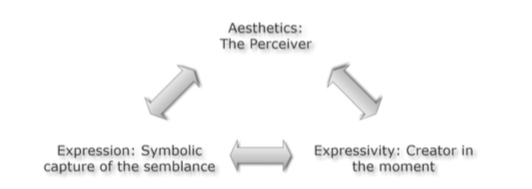
For me as a songwriter, I have for many years acknowledged that I intuitively use a writing technique called stream of consciousness – writing commenced from a specific stimuli (visual or other), writing continuously, pursuing a thought process without stopping for contemplation, narrowing ones’ focus in on a central theme, until the point of a specific topic and line of thought is illuminated and committed to the document (paper of electronic). I find as part of the process I actually move into a semi-conscious state. It is as Ryan describes Archer’s model in “Reflective Practice in the Arts”. Whilst not music practice specific, Ryan talks about performative practice which applies very well to this experience of this creative stage of my music practice. Archer’s model terms this type of reflective practice as [bottom right point] “Expressivity – reflecting as performer to improve/change in the moment” (Ryan 2014, 80).